

AI-Powered Fundraising Platform guide
What AI-Powered Fundraising Platforms Deliver for Mid-Market Teams
AI fundraising platforms automate donor outreach, investor relations, and campaign management to drive measurable revenue growth. For mid-market teams without internal AI resources, these systems analyze donor behavior patterns, personalize communications at scale, and optimize pitch timing—increasing conversion rates 30% to 40%. This AI-Powered Fundraising Platform guide shows how organizations from seed-stage startups to established nonprofits use intelligent automation to compete with larger teams.
Three Core Outcomes That Matter
You’ll see three immediate improvements: higher donor retention through predictive engagement scoring, increased capital raised per outreach hour, and reduced cost per acquisition. Organizations using AI automation services report 25% to 35% better retention rates and 50% less time spent on manual research. The platform identifies high-probability donors from thousands of prospects, prioritizes warm leads, and triggers personalized follow-ups based on engagement signals.
How This Fits Your Current Workflow
Modern AI agents integrate directly with your CRM to support human fundraisers—they don’t replace them. They monitor donor databases for engagement triggers, draft personalized outreach based on giving history, and schedule optimal contact times. For investor relations, agents research prospect portfolios, identify mission alignment, and generate tailored pitch materials. Your team focuses on relationship-building while AI handles the grunt work.
I’ve seen this play out across dozens of implementations. A Series A startup increased investor meeting bookings from 12% to 31% while cutting research hours 60%. A regional nonprofit doubled major donor renewals by deploying predictive models that flagged at-risk contributors three months before renewal dates.
Real Numbers: Teams using AI automation see 40% faster response times, 3x more qualified donor conversations, and 28% higher average gift sizes within the first quarter.
Core Features That Actually Drive ROI
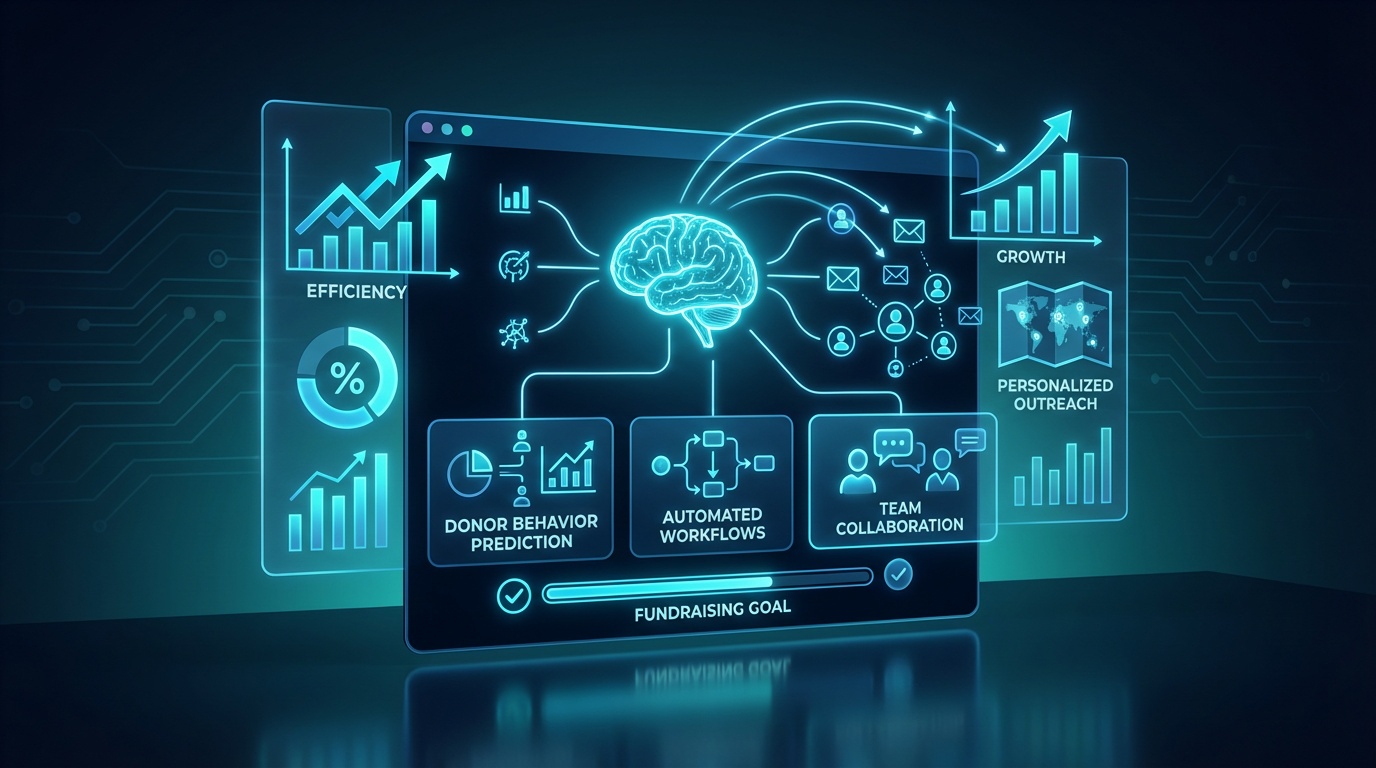
Donor Behavior Prediction and Personalized Outreach
Advanced platforms analyze historical giving patterns, email engagement, and demographic data to score donor likelihood. They segment audiences by propensity to give, preferred communication channels, and optimal ask amounts.
Here’s what that looks like in practice: AI generates personalized email copy referencing past donations, shared values, and specific program impacts. Predictive models identify when donors are most receptive to outreach—boosting open rates 45% and response rates 35%.
Automated Campaign Management and Content Generation
AI agents orchestrate multi-touch campaigns across email, social media, and direct mail without manual intervention. They A/B test subject lines, adjust messaging based on segment performance, and automatically pause underperforming campaigns.
Content generation features produce donor stories, impact reports, and appeal letters tailored to individual giving histories. Campaign managers review and approve AI-generated content rather than drafting from scratch—cutting production time 70%. These capabilities mirror what we’ve built for AI automation in recruitment, using similar underlying technology.
CRM Integration for Seamless Operations
| Integration Type | Functionality | Business Impact |
|---|---|---|
| CRM Sync | Real-time donor data updates, engagement tracking | Eliminates manual data entry and improves accuracy |
| Email Platforms | Automated send scheduling, performance analytics | Increases open rates by 40% and tracks ROI per campaign |
| Calendar Systems | Meeting booking, follow-up reminders | Reduces scheduling friction and improves conversion |
Enterprise-grade platforms connect with Salesforce, HubSpot, and industry-specific fundraising CRMs. This eliminates data silos and gives fundraisers a unified view of donor interactions across channels.
How to Implement AI Fundraising Automation
Step 1: Map Your Current Process
Start by mapping your existing donor journey from prospect identification through stewardship. Calculate time spent on manual tasks: research, email drafting, data entry. Identify bottlenecks where qualified prospects drop off due to capacity constraints.
Here’s the critical part—audit your CRM data quality. AI performance depends on clean historical records. If you’ve got fragmented donor data, allocate two to four weeks for database cleanup before deployment.
Step 2: Select and Deploy the Right Platform
- Define success metrics: Set baseline conversion rates, average gift size, and cost per dollar raised.
- Evaluate platform specialization: Generic automation tools lack fundraising-specific models. You need industry-focused AI agents that understand donor psychology and capital-raising workflows.
- Start with pilot campaigns: Deploy AI on a single donor segment to validate ROI before full rollout.
- Train your team: Allocate one to two weeks for staff to learn AI collaboration workflows and content review processes.
- Integrate data sources: Connect CRM, email platforms, and analytics tools for unified donor intelligence.
Step 3: Track What Matters
Monitor donor acquisition cost, conversion rate by channel, average time to close, and retention rate monthly. Compare AI-assisted campaigns against manual efforts using control groups. Monitor AI-generated content quality through team feedback scores.
Successful implementations show positive ROI within 60 to 90 days, with compounding benefits as AI models learn from your specific donor base.
AI Fundraising Platforms for 2026: What Works for Mid-Market Teams
The Mid-Market Gap
Most platforms fall into two categories: nonprofit-focused tools like Bloomerang and Givebutter that optimize recurring donations, and enterprise systems like Kindsight designed for large institutional campaigns.
Nonprofit platforms excel at donor stewardship automation but lack investor relations capabilities. Enterprise systems offer sophisticated predictive analytics yet require six-figure budgets and dedicated IT resources.
Mid-market fundraising teams face a gap. They need enterprise-grade intelligence for investor outreach and capital raising—without the complexity or cost.
| Platform Category | Best For | Typical Investment | Implementation Time |
|---|---|---|---|
| Nonprofit-Focused | Recurring donations, event fundraising | $200 to $500/month | 2 to 4 weeks |
| Enterprise Systems | Large institutional campaigns | $100K+ annually | 3 to 6 months |
| Specialized AI Agents | Investor outreach, capital raising for SMEs | $2K to $8K/month | 1 to 2 weeks |
Why Specialized AI Agents Work Better
Startups raising Series A funding and growth-stage companies pursuing strategic capital need platforms built for investor relations—not just donor management.
Specialized AI agents understand pitch deck optimization, investor portfolio analysis, and follow-up cadences specific to capital raising. They integrate with deal management CRMs, generate investment thesis summaries, and identify warm introduction paths through existing networks.
You get enterprise capabilities at accessible price points, with configurations tailored to your fundraising stage and target investor profiles. Similar methodologies power our agentic systems for real estate.
Real Results: B2B SaaS Case Study
A B2B SaaS company seeking $5M Series A deployed Vynta AI agents to automate investor prospecting and outreach. The AI analyzed 2,400 venture capital firms, scored alignment with the company’s sector and stage, and generated personalized introduction emails referencing specific portfolio companies.
Within 90 days: 47 qualified investor meetings (up from 12 in the previous quarter). Cost per meeting dropped from $890 to $240. The company closed its round with 40% less time spent on prospecting.
The AI handled research and initial communications. The founding team focused on relationship development and pitch refinement.
Overcome Common Challenges and Scale
The Personalization Concern
Fundraising leaders worry AI will damage donor relationships through impersonal communications. I get it—this concern stems from early automation tools that sent generic mass emails.
Modern platforms personalize at the individual level, referencing specific past interactions and tailoring asks to giving capacity. Start by deploying AI for research and draft generation while maintaining human review of all outbound communications.
Teams actually report higher donor satisfaction when response times improve and communications become more relevant.
Data privacy requires selecting platforms with SOC 2 compliance and clear data governance policies. Vynta AI maintains enterprise-grade security standards designed for sensitive investor and donor information.
The Partnership Model That Works
Division of Labor: AI handles data analysis, prospect research, and communication drafting. Humans provide strategic direction, relationship nurturing, and final approval. This allows small teams to operate with the reach of departments three to four times their size.
The most successful implementations treat AI as a research assistant and content collaborator. Fundraisers spend 60% less time on administrative tasks and redirect that capacity to high-value activities like donor meetings and strategic planning.
One director told me: “AI gives me the insights of a five-person research team so I can focus on what I do best—building relationships that close six-figure commitments.”
Building Competitive Advantage
AI capabilities will expand from outreach automation to predictive gift modeling, real-time sentiment analysis during donor calls, and automated grant writing. Organizations adopting AI now build competitive advantages as their systems learn from proprietary donor data.
Teams that wait face steeper learning curves and compete against peers with mature AI operations.
Measuring ROI and Continuous Optimization
Establish Your Baseline First
Calculate your pre-AI benchmarks across four dimensions: donor acquisition cost, average gift size, conversion rate from prospect to committed donor, and hours spent per dollar raised. Document your current monthly outreach volume and response rates.
These baselines provide the comparison framework to demonstrate AI impact. Teams that skip this step struggle to quantify ROI and justify continued investment.
You should be able to state: “We spent 120 hours last month to book 8 investor meetings at a $15K cost. After AI implementation, we booked 23 meetings in 40 hours at a $6K cost.”
Create Feedback Loops
AI models improve when you feed them outcome data. Mark which AI-generated emails produced meetings, which donor segments responded best to specific messaging, and which outreach times yielded the highest engagement.
Schedule monthly reviews of AI-assisted campaign performance against manual efforts. Adjust AI parameters based on results: if AI-identified prospects convert at lower rates than expected, refine your scoring criteria. If generated content requires heavy editing, provide examples of preferred tone and structure.
Within three months, well-trained AI systems should require minimal human editing while maintaining or exceeding manual campaign performance.
Expand Strategically
Start with one high-impact use case like investor prospecting or major donor renewals. Once you validate ROI, expand to grant research, corporate sponsorship outreach, and board member identification.
Organizations that deploy AI across multiple fundraising channels see compounding benefits as the system develops a comprehensive understanding of your donor ecosystem.
A mid-market nonprofit began with AI-powered lapsed donor reactivation, then expanded to planned giving prospect identification and event sponsorship outreach. Total fundraising capacity increased 180% with only one additional staff member.
Strategic Considerations for 2026 and Beyond
What’s Coming Next
Next-generation platforms will offer real-time conversation intelligence during donor calls, analyzing sentiment and suggesting optimal responses. Predictive models will forecast multi-year giving trajectories and recommend personalized stewardship strategies. AI will generate video content for donor updates and automate grant application writing with foundation-specific customization.
Early adopters gain advantages as these systems learn from proprietary data. Your AI agent trained on three years of successful investor pitches becomes a competitive asset competitors can’t replicate.
Your Data Strategy Matters
AI quality depends on data quality. Implement consistent donor tagging systems, track all touchpoints across channels, and maintain detailed interaction notes.
Clean historical data enables AI to identify patterns invisible to human analysis. A venture-backed startup discovered their AI identified a correlation between investor LinkedIn engagement and meeting conversion rates—allowing them to prioritize prospects who interacted with company content. This insight only emerged because they tracked social media engagement alongside traditional CRM data.
Develop New Team Capabilities
Fundraisers need new competencies: prompt engineering to guide AI outputs, data interpretation to act on AI insights, and quality control to ensure AI-generated content maintains brand voice.
Invest in training that positions AI as a tool amplifying human expertise rather than a replacement. Teams comfortable with AI collaboration outperform those treating it as a black box.
One development director described the shift: “I went from spending 70% of my time on research and administration to 70% on relationship strategy and donor conversations. AI gave me back the parts of my job I actually trained for.”
Your Implementation Decision Framework
Assess Your AI Readiness
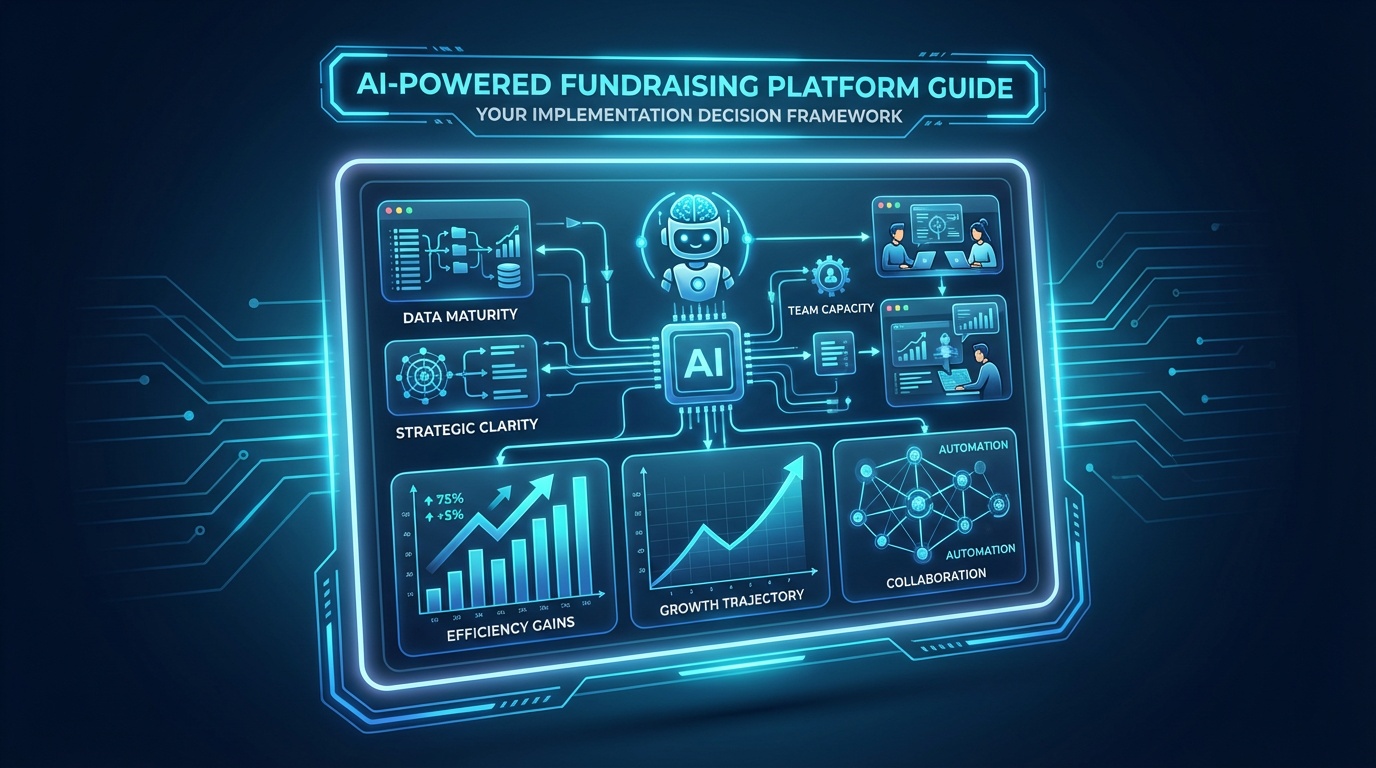
Evaluate three readiness factors: data maturity, team capacity, and strategic clarity.
Organizations with clean CRM data, staff open to new workflows, and clear fundraising goals see the fastest ROI. If your donor database contains duplicate records and incomplete contact information, allocate time for cleanup before AI deployment. If your team resists technology adoption, start with low-risk pilot projects that demonstrate value. If fundraising strategy lacks defined target donor profiles and conversion goals, clarify these first.
Decision Criteria: Choose specialized AI agents if you need investor relations capabilities, have mid-market budgets, and require fast implementation. Select nonprofit-focused platforms if your primary need is recurring donation optimization. Enterprise systems make sense only if you manage campaigns exceeding $50M annually with dedicated technical staff.
The Vynta AI Approach
Vynta AI delivers industry-specific agents designed for mid-market fundraising teams pursuing capital raises, major donor cultivation, and investor relations. Our platform integrates with existing CRM systems and deploys in days rather than months.
We focus on supporting human fundraisers with AI that handles research, prospect scoring, and communication drafting while your team maintains relationship ownership.
Organizations using Vynta AI report 40% reduction in time to first meeting and 3x increase in qualified donor pipeline within 90 days. This framework applies directly to our implementation methodology: clear baseline metrics, focused pilot deployment, continuous optimization based on your specific donor patterns, and measurable ROI tracking from day one.
Your Next Move
The competitive advantage goes to fundraising teams that deploy AI while maintaining authentic donor relationships.
Start by documenting current performance metrics, identifying your highest-value use case, and selecting a platform aligned with your fundraising model and budget. Successful AI adoption requires executive commitment, team training, and patience as systems learn your donor ecosystem.
The organizations raising capital most efficiently in 2026 will be those that implemented AI platforms in 2025—giving their systems time to develop proprietary insights competitors can’t match.
Your move determines whether you compete with AI-amplified capacity or watch competitors pull ahead with technology you delayed adopting.
Frequently Asked Questions
What do AI-powered fundraising platforms do for mid-market teams?
AI-powered fundraising platforms automate donor outreach, investor relations, and campaign management. They analyze donor behavior patterns, personalize communications at scale, and optimize pitch timing to drive measurable revenue growth. This allows mid-market teams to compete with larger organizations without needing dedicated AI resources.
What are the main business outcomes from using AI in fundraising?
AI platforms deliver higher donor retention through predictive engagement scoring and increase capital raised per outreach hour. They also significantly reduce the cost per acquisition by identifying high-probability donors and prioritizing warm leads. Organizations often report 25% to 35% improvements in donor retention rates and a 50% reduction in manual research time.
How do AI agents integrate with donor management and investor outreach?
Modern AI agents integrate directly with existing CRM systems to support human fundraisers. They monitor donor databases for engagement triggers, draft personalized outreach emails, and schedule optimal contact times. For investor relations, AI agents research prospect portfolios and generate tailored pitch materials, allowing your team to focus on relationship-building.
What kind of measurable results can organizations expect from AI fundraising automation?
Organizations using AI automation often see 40% faster response times and a 3x increase in qualified donor conversations. They also report 28% higher average gift sizes within the first quarter of implementation. A Series A startup, for example, increased investor meeting bookings from 12% to 31% while reducing research hours by 60%.
What key features make AI fundraising platforms effective?
Effective AI fundraising platforms offer donor behavior prediction and personalized outreach, analyzing data to score donor likelihood and tailor communications. They also provide automated campaign management and content generation, orchestrating multi-touch campaigns and producing tailored materials. These features work together to significantly improve engagement and efficiency.
How should an organization approach implementing AI fundraising automation?
First, assess your current fundraising process to identify manual tasks and bottlenecks, ensuring clean CRM data. Next, select an industry-focused AI platform, define success metrics, and start with pilot campaigns. Finally, train your team, integrate data sources, and continuously measure success with key metrics like acquisition cost and retention rate.