
ai investor matching fundraising
Beyond the Rolodex: How AI Transforms Investor Matching for Fundraising
The Traditional Fundraising Environment: A Network-Dependent Game
Fundraising has long been a relationship game. Founders rely on personal networks, warm introductions, and industry connections. This approach creates significant barriers for entrepreneurs without established contacts, particularly those from underrepresented backgrounds or emerging markets. The result? Mismatched investor-startup pairings, wasted time on unsuitable prospects, and extended fundraising cycles that drain resources.
Enter AI Investor Matching: A Data-Driven Revolution
AI investor matching fundraising flips this script entirely. Instead of relying on chance encounters at networking events, intelligent systems analyze vast data sets to identify optimal matches. The technology considers sector focus, investment stage, geographic preferences, and historical funding behavior. This approach democratizes access to capital by connecting promising ventures with relevant investors. No existing network required.
Key Insight: Companies using AI investor matching see 3x faster connection rates and 40% higher response rates compared to traditional cold outreach methods.
What This Really Means for Your Business
Modern platforms go beyond simple database searches. They analyze investment thesis alignment, portfolio diversification needs, and timing factors to estimate investor interest probability. The AI-Powered Fundraising Platform processes behavioral signals, market trends, and competitive intelligence to identify not just potential investors, but the right investors at the optimal moment.
This addresses core fundraising challenges: reducing rejection rates, shortening deal cycles, and improving valuation outcomes. Smart matching considers investor communication preferences, decision-making timelines, and co-investment patterns to maximize success probability while minimizing founder effort.
How AI Investor Matching Actually Works: Data, Algorithms, and Results
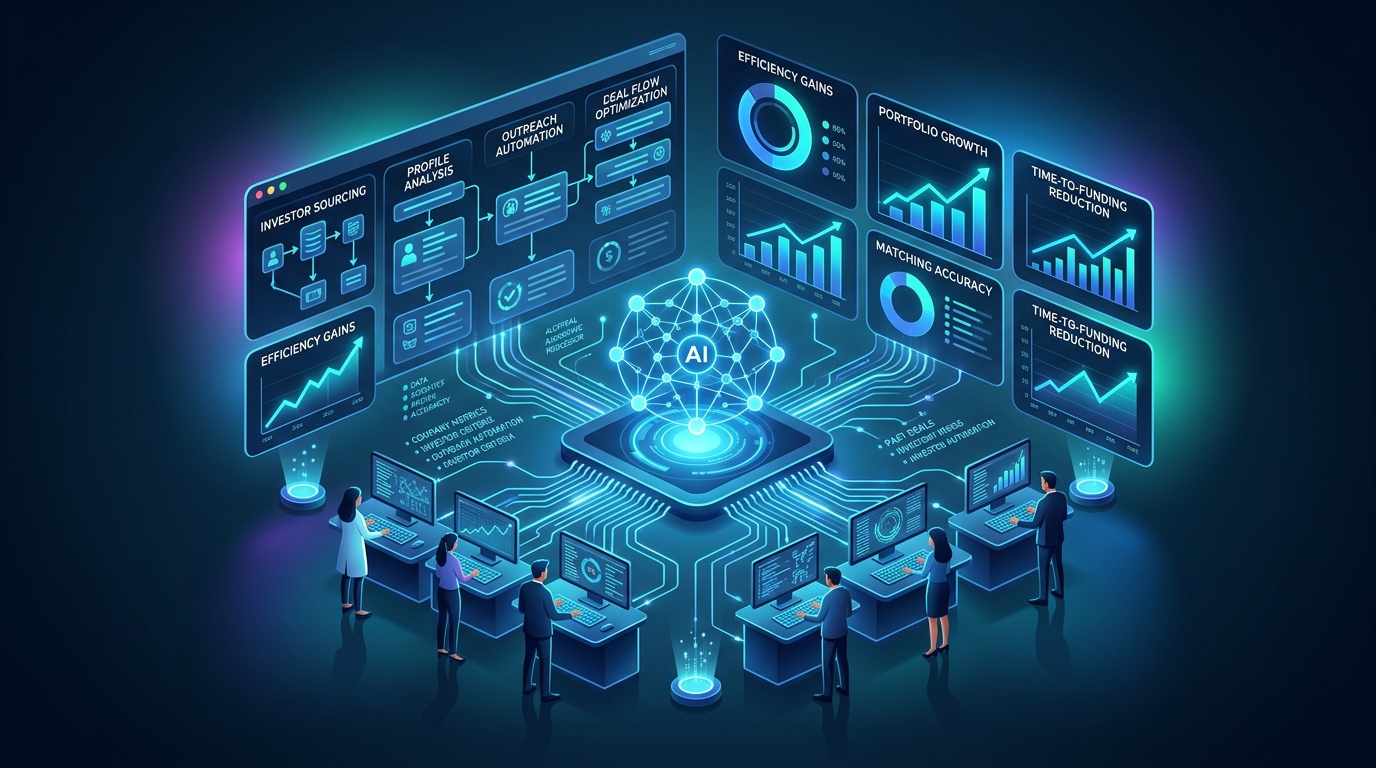
The Foundation: What Data Powers These Systems?
Effective matching relies on data aggregation from multiple sources. Investment databases, SEC filings, portfolio company announcements, and social media activity create detailed investor profiles. The system tracks check sizes, sector preferences, geographic focus, co-investment patterns, and decision-making timelines. Startup data includes financial metrics, team backgrounds, market positioning, and competitive analysis.
Advanced platforms incorporate real-time market signals: funding announcements, industry trends, and economic indicators. This dynamic layer enables predictive modeling that anticipates investor appetite shifts and emerging opportunities. Quality validation processes ensure accuracy while privacy protocols protect sensitive information.
The Matching Process: How It Actually Connects You
Machine learning processes multidimensional compatibility matrices to score potential matches. Natural language processing analyzes investment thesis documents, portfolio descriptions, and startup pitch materials to identify alignment. Collaborative filtering techniques identify investors who funded comparable companies at similar stages.
The system weighs various factors: sector expertise, investment stage preferences, ticket size compatibility, and geographic proximity. Pattern recognition identifies successful funding relationships to replicate winning combinations. Continuous learning improves matching accuracy as outcomes get processed and models refined.
Timing Is Everything: Predictive Analytics for Investor Fit
Top platforms predict optimal outreach timing by analyzing investor activity cycles, portfolio diversification needs, and fund deployment schedules. Behavioral analytics track response patterns, meeting acceptance rates, and investment decision timelines to optimize engagement strategies. Sentiment analysis of public statements and social media reveals current investor focus areas.
Key Insight: Predictive timing can increase investor response rates by up to 60% by identifying optimal contact windows based on fund cycles and portfolio activity.
Building Trust in AI-Driven Connections
Transparency in decision-making builds confidence among both founders and investors. The best fundraising comparison platforms provide match reasoning, highlighting specific compatibility factors and success probability scores. Human oversight validates high-probability matches while machine learning handles initial screening.
Outcome tracking demonstrates platform effectiveness through measurable metrics: response rates, meeting conversions, and successful funding completions. Regular audits reduce bias and support fair representation across diverse founder demographics and investment sectors.
The Vynta AI Advantage: From Investor Prospecting to Campaign Automation
Why Generic Tools Miss the Mark
Generic CRM systems and basic investor databases lack the nuanced understanding required for effective fundraising automation. These platforms treat all prospects equally, missing critical context about fund deployment cycles, portfolio construction strategies, and sector-specific investment criteria. Without deep fundraising domain expertise, automated outreach becomes spam. Damaging founder reputation and burning valuable connections.
Specialized platforms understand the unique dynamics of capital markets, including LP pressure cycles, fund vintage considerations, and competitive deal flow patterns. This specialization enables intelligent campaign sequencing that respects investor preferences while maximizing engagement probability.
Vynta’s Fundraising AI: Beyond Simple Matching
The AI Automation Services orchestrate complete investor engagement workflows. Automated research compiles investor profiles, including recent portfolio additions, public statements, and co-investment patterns. Dynamic pitch customization adapts messaging based on individual investor preferences and current market positioning.
Campaign automation handles follow-up sequences, meeting scheduling, and document sharing while maintaining human oversight for critical decisions. Integration with existing CRM systems ensures seamless data flow while advanced analytics track engagement metrics across multiple touchpoints.
Key Insight: Complete fundraising automation can reduce founder time spent on investor outreach by 70% while increasing qualified meeting rates by 45%.
Measuring Success: ROI of AI-Powered Fundraising
Effective platforms provide detailed performance analytics across key metrics: response rates, meeting conversion rates, and funding completion percentages. Cost per qualified lead calculations demonstrate clear ROI compared to traditional networking approaches or hiring business development staff.
Advanced attribution modeling tracks investor journey progression from initial contact through term sheet negotiation. This granular visibility enables campaign optimization and strategic adjustments based on real performance data rather than gut feeling.
Seamless Integration: How Vynta AI Fits Your Operations
Modern fundraising automation integrates with popular startup tools including Notion, Airtable, and existing CRM platforms. API connections enable bidirectional data synchronization while maintaining data security and compliance requirements. Team collaboration features allow multiple stakeholders to participate in investor relationship management without duplicating effort.
The platform adapts to existing fundraising processes rather than forcing workflow changes, ensuring smooth adoption across diverse organizational structures and team sizes.
Navigating AI Fundraising: Pitfalls to Avoid and Success Strategies
The Human Element: Why ‘Set It and Forget It’ Doesn’t Work
Successful AI investor matching requires strategic human guidance rather than complete automation. Founders must review match recommendations, approve outreach campaigns, and personally handle high-value investor relationships. Technology amplifies human judgment but can’t replace authentic relationship building and strategic decision-making.
Regular campaign monitoring ensures messaging remains relevant and responsive to market conditions. Human oversight prevents algorithmic bias and maintains the personal touch that investors expect from founding teams.
Prep Work: Preparing Your Startup for AI-Powered Outreach
AI-powered platforms require clean, organized data to function effectively. Startups must organize financial models, market research, and competitive analysis in standardized formats. Clear value propositions and differentiation statements enable accurate matching while reducing manual customization requirements.
Team preparation includes defining investor criteria, establishing response protocols, and creating content libraries for automated personalization. This foundation work maximizes platform effectiveness while ensuring consistent messaging across all investor communications.
Pros
- Dramatically expands investor reach beyond personal networks
- Reduces time spent on unqualified prospects
- Provides data-driven insights for strategic decision making
- Scales personalized outreach without proportional effort increases
Cons
- Requires significant upfront data organization and platform setup
- May reduce personal relationship development opportunities
- Platform dependency creates a potential single point of failure
- Learning curve for teams unfamiliar with automation tools
Building for Scale: Using AI Responsibly
Forward-thinking founders see AI investor matching as competitive infrastructure rather than an optional nice-to-have. Early adoption creates data advantages and relationship-building opportunities that compound over multiple funding rounds. Platform sophistication continues advancing, making delayed adoption increasingly costly.
Strategic implementation focuses on building repeatable processes that scale across Series A, B, and later rounds while maintaining relationship quality and founder authenticity.
Getting Started: Implementation Steps
Begin by auditing existing investor data and defining target investor profiles. Establish clear success metrics including response rates, meeting conversion goals, and timeline expectations. Start with limited campaigns to test platform effectiveness before scaling to broader automation.
Successful adoption requires team training, process documentation, and regular performance review cycles. Focus on integration quality over speed to build sustainable long-term results and positive investor relationships.
Frequently Asked Questions
What challenges does AI investor matching address in fundraising?
AI investor matching tackles the inefficiencies of traditional fundraising, which often relies on personal networks. It helps founders overcome barriers like limited contacts and reduces wasted time spent on unsuitable prospects. This systematic approach democratizes access to capital, connecting promising ventures with relevant investors.
How does AI investor matching find the right investors for a startup?
AI investor matching uses sophisticated algorithms to analyze vast datasets of investor preferences, portfolio patterns, and startup characteristics. It identifies optimal matches based on sector focus, investment stage, geographic preferences, and historical funding behavior. This goes beyond simple database searches, considering investment thesis alignment and timing.
What types of data are used to fuel AI investor matching systems?
Effective AI investor matching relies on comprehensive data aggregation from multiple sources. This includes investment databases, SEC filings, portfolio company announcements, and social media activity. The system analyzes check sizes, sector preferences, and real-time market signals to create detailed investor and startup profiles.
Can AI investor matching truly accelerate the fundraising process?
Yes, AI investor matching significantly accelerates fundraising by optimizing connections. Companies using this technology often see 3x faster connection rates and 40% higher response rates compared to traditional methods. Predictive timing algorithms can also increase investor response rates by up to 60% by identifying optimal contact windows.
How do AI algorithms ensure compatibility between investors and startups?
Machine learning algorithms process multidimensional compatibility matrices to score potential matches. Natural language processing analyzes investment thesis documents and pitch materials for semantic alignment. Collaborative filtering and pattern recognition identify successful funding relationships to replicate winning combinations, continuously improving accuracy.
Is human involvement still important with AI investor matching platforms?
Absolutely, human oversight remains a key component in AI investor matching. While AI handles initial screening and prioritization, human validation of high-probability matches builds confidence. Transparency in algorithmic decision-making and regular audits also help reduce bias and support fair representation.