

ai automation roi
Beyond the Hype: Understanding “AI Automation ROI” for Real Business Impact
AI automation ROI measures the financial return from implementing intelligent systems that handle repetitive business processes. Unlike simple productivity gains, true ai automation roi appears in measurable cost reductions, revenue increases, and operational efficiency improvements that directly impact your bottom line.
The AI Automation ROI Promise: More Than Just Faster Tasks
Real ai automation roi transforms entire business operations, not just individual tasks. When properly implemented, AI agents handle complex workflows with defined controls, from lead qualification in agentic systems for real estate to candidate screening in recruitment. The financial impact comes from eliminating manual bottlenecks, reducing the costs of human error, and enabling your team to focus on high-value strategic activities.
Smart automation delivers compound returns. A single AI agent processing customer inquiries doesn’t just save time. It captures leads around the clock, maintains consistent response quality, and scales without additional headcount. This multiplier effect separates genuine ROI from superficial productivity theater.
Why “Productivity Theater” Falls Short: The Real P&L Difference
Many businesses mistake activity for achievement. Faster email responses or quicker data entry might feel productive, but they don’t necessarily improve profit margins. Authentic ai automation roi appears in concrete financial metrics: reduced operational costs, increased conversion rates, and eliminated manual processing expenses.
From Pilot Projects to Tangible Gains
Most organizations struggle with pilot paralysis. Endless small experiments that never scale to meaningful business impact. Successful ai automation roi requires strategic implementation that targets high-impact processes. AI Automation Services should focus on enterprise-grade solutions that deliver measurable outcomes from day one, not months of testing.
The transition from pilot to profit demands clear success metrics, realistic timelines, and systems designed for scalability. When AI agents integrate smoothly with existing workflows, businesses see early efficiency gains while building a foundation for long-term transformation.
The “Boring” AI That Drives Serious Returns: Practical ROI Metrics That Matter
Quantifying Efficiency: From Time Saved to FTE Reduction
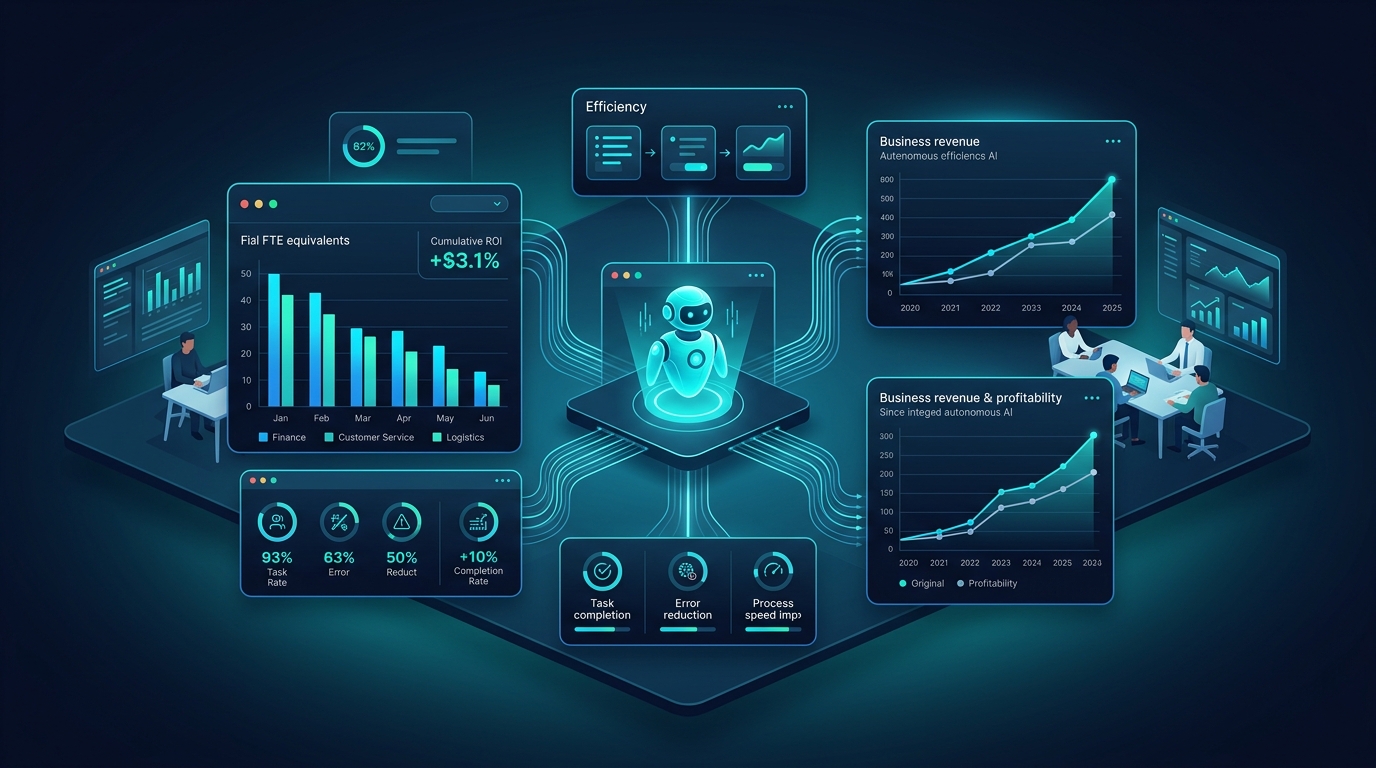
Measuring time savings misses the bigger picture. Smart businesses track full-time equivalent (FTE) reduction: the real headcount impact of automation. When AI agents handle lead qualification, customer service, or data processing, organizations can avoid hiring additional staff or redeploy existing team members to revenue-generating activities. This shift from operational overhead to growth-focused roles creates compounding financial benefits.
Process automation also eliminates error-related costs. Manual data entry mistakes, missed follow-ups, and inconsistent customer communications carry hidden expenses. AI systems maintain accuracy rates above 99% in well-defined tasks, reducing costly corrections, customer churn, and compliance issues that drain resources.
Revenue Amplification: How AI Directly Boosts Your Top Line
Revenue impact appears through improved conversion rates and expanded capacity. AI-powered lead scoring identifies high-value prospects earlier, while automated nurturing sequences maintain engagement without manual intervention. Businesses often see 15-30% increases in qualified leads and 20-40% improvements in response times, which translate to more closed deals.
Cost Containment: The Hidden Savings of Smart Automation
Operational cost reduction extends far past salary savings. Automated workflows reduce software licensing needs, remove redundant tools, and minimize training requirements. Vynta AI Agents for Hospitality integrate existing systems, creating unified data flows that reduce IT maintenance overhead.
Communication automation delivers savings through reduced manual outreach costs, improved response consistency, and fewer missed opportunities. Organizations reduce customer acquisition costs by 25-50% while improving service quality and response reliability.
Industry-Specific KPIs: Real Estate, Recruitment, Fundraising, and Hospitality Metrics That Count
| Industry | Primary ROI Metrics | Typical Improvement Range |
|---|---|---|
| Real Estate | Lead response time, qualification accuracy, showing conversion rate | 40-60% faster response, 25% more qualified leads |
| Recruitment | Candidate screening efficiency, placement rate, time-to-fill | 50% reduction in screening time, 30% better matches |
| Fundraising | Donor engagement rate, campaign reach, follow-up consistency | 35% increase in donor retention, 45% more touchpoints |
| Hospitality | Guest satisfaction scores, booking conversion, service response time | 20% higher satisfaction, extended availability |
Finding Your 20%: Identifying the AI Automation That Delivers True ROI
The “Chaos” Problem: Why Unsupervised AI Agents Can Fail
Poorly designed automation creates more problems than it solves. Unsupervised AI agents make incorrect decisions, provide inconsistent responses, and require constant manual correction. This chaos stems from inadequate training data, unclear decision parameters, and a lack of oversight mechanisms.
Successful ai automation roi depends on structured implementation with clear boundaries, exception handling, and human oversight protocols. Without these safeguards, automation becomes a liability rather than an asset, increasing operational complexity and customer dissatisfaction.
Vynta AI’s Approach: Enterprise AI Agents for Predictable Outcomes
Enterprise-grade AI agents deliver consistent performance through rigorous testing, industry-specific training, and continuous optimization. These systems include built-in quality controls, escalation protocols, and performance monitoring that support reliable operation without constant human intervention.
The Power of Specialization: AI Automation Tailored to Your Industry
Generic automation tools produce mediocre results across industries. Specialized solutions support industry-specific workflows, compliance requirements, and customer expectations. Real estate teams need different automation than agentic systems for recruitment or hospitality businesses.
Industry-tailored AI agents use your business language, align with regulatory constraints, and integrate with sector-specific tools. This specialization drives stronger performance metrics and faster implementation timelines compared with one-size-fits-all solutions.
Frequently Asked Questions
What defines true AI automation ROI for businesses?
True AI automation ROI goes beyond simple task speed-ups. It measures the financial return from intelligent systems that streamline repetitive business processes. This impact appears in concrete cost reductions, revenue growth, and significant operational efficiency gains that directly improve your profit margins.
How is AI automation ROI different from just being productive?
Many businesses confuse activity with actual achievement. While faster tasks might feel productive, genuine AI automation ROI is about improving profit margins and business growth. It shifts focus from mere speed metrics to tracking concrete revenue impact and significant cost reductions.
What financial metrics should businesses track for AI automation ROI?
To quantify AI automation ROI, businesses should track metrics like full-time equivalent (FTE) reduction, which shows real headcount impact. We also look at reduced costs from human error, improved conversion rates, and lower customer acquisition costs. These metrics provide a clear picture of financial gains.
How can AI automation directly boost a company's top line?
AI automation directly boosts revenue through improved conversion rates and expanded operational capacity. AI-powered lead scoring identifies high-value prospects, and automated nurturing sequences maintain engagement around the clock. This continuous availability captures opportunities that might otherwise be missed, leading to more closed deals.
What are the hidden savings of smart AI automation?
Beyond salary savings, smart AI automation reduces operational costs by minimizing software licensing needs and redundant tools. For example, Vynta AI Agents can integrate existing systems, creating unified data flows that reduce IT maintenance overhead. Communication automation also delivers savings through improved response consistency and fewer missed opportunities, reducing customer acquisition costs.
How does Vynta AI ensure successful AI automation implementation?
Successful AI automation requires structured implementation with clear boundaries and human oversight protocols. At Vynta AI, our bespoke agents are fully customizable to brand tone and business rules, operating within client-defined hours. We also ensure VIP guests always receive human care via strict escalation rules, preventing the ‘chaos’ of unsupervised systems.
How does AI automation help specific industries like hospitality?
In hospitality, AI automation significantly improves guest satisfaction scores, booking conversion, and service response times. Vynta AI Agents, designed for luxury venues, respond instantly to inquiries within client-defined hours, mimicking human-like timing. This can increase booking conversion by 50% and reduce customer inquiry abandonment by 60%, while also increasing average guest spend through brand-safe upselling.