

ai agent development platforms
AI Agent Development Platforms: 2026 Comparison Guide
AI Agent Development Platforms: What Mid-Market Teams Actually Need to Know
The wrong AI agent development platform costs mid-market businesses six months of lost productivity and $50,000+ in sunk implementation costs. Over 30 ai agent development platforms compete for your attention, yet most agencies, recruitment firms, fundraising organizations, and hospitality businesses can’t identify which options deliver business outcomes instead of technical novelty.
Your platform choice determines whether AI converts property inquiries in under 60 seconds or sits unused because your team can’t integrate it with existing CRM systems. This isn’t a technical decision–it’s strategic: which platform architecture aligns with your team’s capabilities, budget constraints, and industry-specific workflows?
Three Business Outcomes That Separate Winners from Losers
Real estate agencies need instant lead qualification that integrates with property databases. Recruitment firms require resume parsing that connects to ATS systems. Fundraising organizations demand investor tracking across multiple touchpoints. Hospitality businesses want reservation management with dynamic upselling logic. Generic ai agent platforms fail because they lack vertical-specific workflows.
The difference? Implementation time drops from nine months to six weeks. Licensing costs fall by 60%. Measurable ROI appears within 90 days instead of never.
Code-First vs. No-Code: Which Path Fits Your Team
Code-first frameworks like LangGraph offer unlimited customization but require dedicated engineering resources. No-code builders like Copilot Studio enable rapid deployment but constrain complex logic. Mid-market teams without in-house AI expertise face a key question: build custom solutions or deploy preconfigured agents?
| Approach | Setup Time | Flexibility | Monthly Cost | Learning Curve |
|---|---|---|---|---|
| Code-First (LangGraph, CrewAI) | 8–12 weeks | Unlimited customization | $0 licensing + $8k–15k engineering | Steep (Python, AI frameworks) |
| No-Code (Copilot Studio, Zapier) | 2–4 weeks | Template-based constraints | $200–2,000 licensing | Moderate (visual builders) |
| Industry-Specific (Vynta AI) | 3–6 weeks | Vertical workflows built in | Custom pricing | Low (preconfigured agents) |
Why Generic Platforms Fail in Traditional Industries
Best free ai agent platform options work well for experimentation, not production deployments. Real estate lead qualification requires integration with property listing APIs, calendar systems, and WhatsApp Business. Recruitment candidate screening demands ATS connectivity, interview scheduling logic, and compliance tracking. These workflows need vertical architecture, not generic chatbot templates.
Agentic Systems for Real Estate demonstrates this difference: agencies reach 85% conversion rates and sub-60-second response times because the system includes prebuilt property matching, viewing coordination, and follow-up workflows that take months of custom development with generic tools.
Comparing the Top AI Agent Platforms: Framework, Features, and Fit
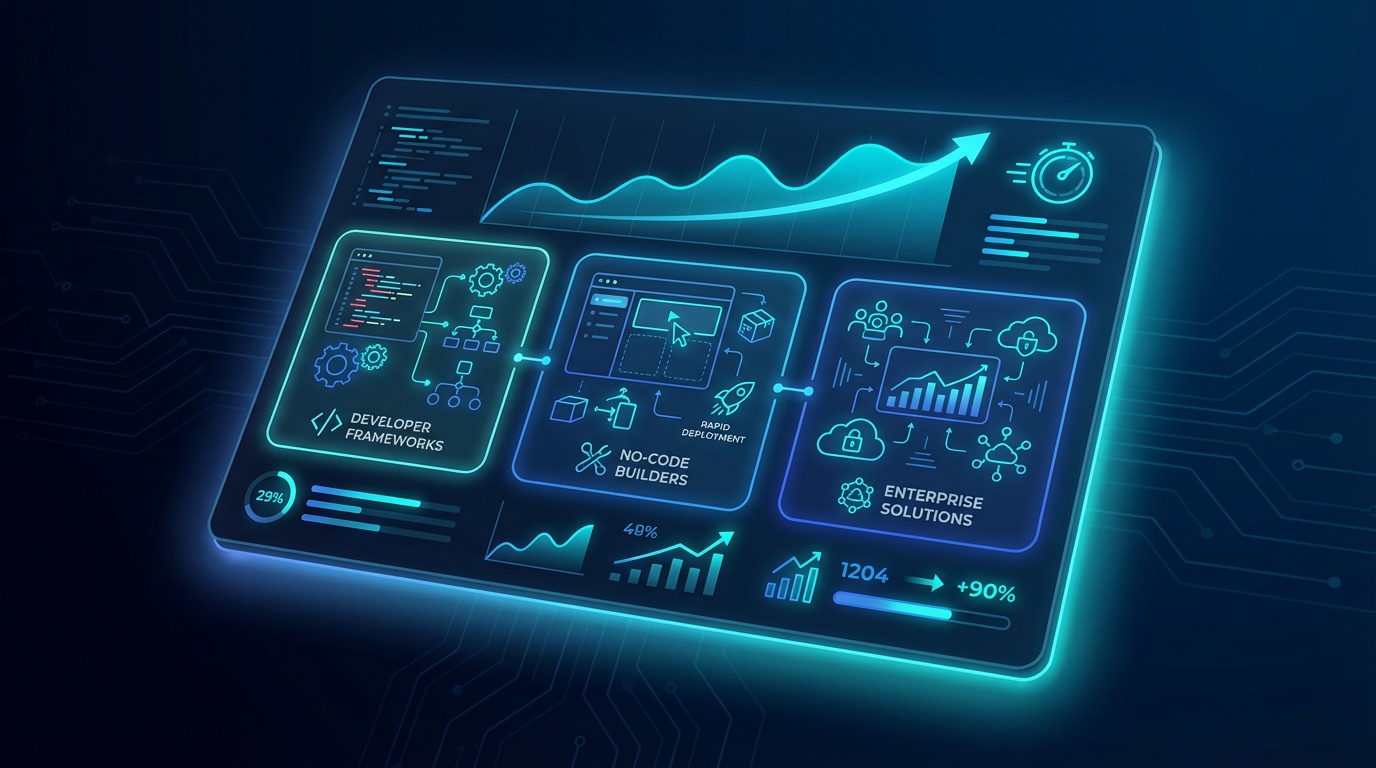
The ai agent platform market divides into three categories: developer frameworks for custom logic, no-code builders for rapid deployment, and enterprise infrastructure for scale. Each category serves different business maturity levels and technical capabilities.
Developer Frameworks: LangGraph, CrewAI, and AutoGen for Custom Agent Logic
LangGraph provides state management for complex agent workflows, fitting multi-step processes like investor due diligence tracking or candidate interview coordination. CrewAI specializes in multi-agent collaboration where different AI agents handle specialized tasks–one qualifies leads, another schedules viewings, a third sends follow-ups. AutoGen from Microsoft fits conversational workflows that require iterative dialogue refinement.
These frameworks require Python expertise, AI model integration knowledge, and ongoing maintenance. Budget $15,000-50,000 for mid-market deployments with 10-16-week timelines.
No-Code and Low-Code Builders: Copilot Studio, Zapier Central, and Relevance AI
Microsoft Copilot Studio integrates with Microsoft 365 environments, fitting businesses already using Teams and Dynamics. Zapier Central connects 6,000+ apps through visual workflows for simple automation like guest feedback collection or appointment reminders. Relevance AI offers templates for common business processes.
Limitations appear when workflows exceed template capabilities. Custom property matching algorithms, complex candidate scoring logic, or multi-touch fundraising sequences force workarounds that create brittle systems.
Enterprise Infrastructure: Vertex AI Agent Builder, Fast.io, and Kore.ai
Google AI Agent Builder (Vertex AI Agent Builder) provides enterprise security, scalability, and model management for organizations processing thousands of interactions daily. Fast.io specializes in voice-based agents for hospitality phone systems. Kore.ai focuses on employee-facing automation and customer service at scale.
These platforms start at $50,000+ annually with multi-month implementation cycles–often impractical for mid-market teams targeting ROI within 90 days.
Platform Selection Matrix: Which Works for Your Vertical
Real estate agencies with 5-20 agents need instant lead response and property matching. Preconfigured solutions like Agentic Systems for Real Estate deliver faster than six-month custom builds. Recruitment firms managing 50+ placements monthly require ATS integration and candidate tracking that code-first frameworks support, while many no-code tools struggle at that complexity. Fundraising organizations tracking investor pipelines across multiple touchpoints benefit from platforms like Relevance AI that balance customization with deployment speed. Hospitality businesses need reservation-system integration and guest communication workflows that voice-capable platforms like Fast.io can handle.
| Platform Type | Best For | Pricing Range | Deployment Speed | Industry Fit |
|---|---|---|---|---|
| LangGraph/CrewAI | Custom multi-agent workflows | $0 + $15k–50k development | 10–16 weeks | Recruitment, Fundraising |
| Copilot Studio | Microsoft 365 environments | $200–2,000/month | 2–4 weeks | Real Estate, Hospitality |
| Vertex AI Agent Builder | Enterprise-scale operations | $50k+ annually | 12–20 weeks | Large recruitment firms |
| Vynta AI | Industry-specific workflows | Custom pricing | 3–6 weeks | All four verticals |
Free and Open-Source Platforms: Starting Your AI Agent Program Without Enterprise Budgets
Mid-market teams exploring AI automation often start with free ai agent builder options to test concepts before committing budget. Open-source frameworks remove licensing costs but shift expenses to engineering time, infrastructure management, and ongoing maintenance.
LangChain and LangGraph: Maximum Control at Zero License Cost
LangChain provides foundational components for building AI agents: prompt templates, memory management, and model integration. LangGraph adds state management for complex workflows where agents track conversation history, user preferences, or multi-step processes.
Real estate agencies use LangGraph to build property qualification flows that remember client requirements across multiple interactions. Recruitment firms create candidate screening agents that maintain context through interview scheduling and follow-up stages.
The trade-off is staffing. You’ll need Python developers familiar with AI frameworks, cloud infrastructure for hosting, and monitoring for production reliability. Total implementation costs range from $15,000-35,000 despite zero licensing fees.
CrewAI: Multi-Agent Collaboration Without Licensing Fees
CrewAI specializes in orchestrating multiple AI agents working together on complex tasks. A fundraising organization might deploy one agent to research potential investors, another to draft personalized outreach messages, a third to track engagement and schedule follow-ups. This division of labor mirrors how human teams operate, making workflows easier to design.
Implementation still requires architectural planning to define agent roles, communication protocols, and handoff logic. Teams without AI experience often underestimate the complexity–a three-month project can balloon to nine months.
AutoGen: Microsoft’s Conversational Framework for Complex Workflows
AutoGen fits conversational agents that refine responses through iterative dialogue. Hospitality businesses use it to create guest-service agents that ask clarifying questions about dining preferences, room requirements, or activity interests before making recommendations. The framework supports back-and-forth logic that simple chatbots miss.
Like other open-source options, AutoGen requires technical expertise and infrastructure investment. Budget $10,000-25,000 for initial setup plus $2,000-5,000 monthly for hosting and maintenance.
When Free Platforms Make Sense (and When They Don’t)
Free platforms work when you have in-house Python developers, time for experimentation, and workflows requiring deep customization beyond typical no-code templates. They fail when you need production deployment within 90 days, lack technical resources, or need industry workflows that are already available in commercial solutions.
Reality Check: Free doesn’t mean zero cost. Engineering time to build, test, and maintain custom AI agents typically exceeds $30,000 for mid-market deployments. Include the opportunity cost of delayed rollout when evaluating build-versus-buy decisions.
From Platform to Results: Real Revenue Impact in Real Estate, Recruitment, Fundraising, and Hospitality
Platform capabilities don’t matter without measurable business outcomes. Mid-market teams need evidence that AI agent implementation drives revenue, reduces cost, and improves operations within 90 days.
Real Estate: Lead Qualification Automation Reducing Response Time from Hours to Minutes
Traditional real estate agencies respond to property inquiries in 4-8 hours during business hours. By the time an agent calls back, 67% of leads have already contacted competing agencies.
Automated lead qualification systems respond in under 60 seconds, capturing inquiries at peak interest and qualifying prospects through intelligent conversation about budget, location preferences, and property requirements.
Agencies using Agentic Systems for Real Estate report qualified pipeline increases of 3x, 85% conversion rates from inquiry to viewing, and over $100,000 in additional revenue per agent annually. The system automates 80% of administrative tasks, saving 20+ hours weekly per agent and enabling teams to handle more properties without additional staff.
Recruitment: Resume Screening and Interview Scheduling Cutting Hiring Cycle by Over 60%
Recruitment firms spend 15-20 hours per placement on resume screening, candidate outreach, and interview coordination. AI agents parse resumes against job requirements, identify qualified candidates from databases of thousands, and schedule interviews based on availability across stakeholders. This compression of the hiring cycle creates an advantage in markets where speed determines placement success.
Agentic Systems for Recruitment help firms screen more candidates, schedule more interviews, and place more candidates without expanding the team or raising administrative costs. The system automates CV processing by collecting and processing applications from multiple job boards, including CV Library, Indeed, Reed, TotalJobs, and LinkedIn. AI processes over 100,000 CVs per day and screens candidates in under 10 seconds with 85% matching accuracy. Placements increase by over 50% after implementation, with the hiring cycle reduced by over 60%.
Fundraising: Investor Outreach and Due Diligence Tracking Improving Pipeline Velocity
Fundraising organizations manually track investor conversations across email, calls, and meetings–causing lost context and missed follow-ups. AI agents maintain interaction history, identify engagement patterns, and trigger personalized outreach at optimal timing. Due diligence document requests receive automated responses. Investor questions receive consistent answers aligned with organizational messaging.
Organizations report a 35% increase in investor meeting conversion rates, a 50% reduction in response time to investor inquiries, and a 20% improvement in follow-up consistency across development teams.
Hospitality: Guest Experience Automation and Dynamic Upselling Increasing Revenue per Guest
Hospitality businesses struggle to provide personalized service at scale. Vynta AI Agents are bespoke AI agents designed for luxury hospitality venues such as restaurants, premium bars, nightclubs, and beach clubs. The AI agents respond instantly to inquiries and mimic human-like response timing with natural pauses and delays. The system increases booking conversion by 50% and reduces customer inquiry abandonment by 60%.
AI agents can increase average guest spend by up to 25% through brand-safe upselling tailored to guest profiles and channels. Operational costs can be reduced by 30% while ensuring VIP guests always receive human support through escalation. The system integrates in real time with CRMs like SevenRooms, synchronizing guest data, reservations, tags, and updates automatically.
Implementation Reality: Timeline, Team Requirements, and Expected ROI
Realistic ROI expectations include a 90-day payback period for many mid-market deployments and a 3-5x return in year one through revenue growth and cost reduction. Teams without implementation experience should budget 20-30% of total project cost for consulting support to avoid pitfalls that extend timelines and reduce adoption.
Platform Choice Alone Won’t Deliver Results: Technology enables outcomes, but implementation quality determines success. Teams need clear workflows, integration with existing systems, staff training, and ongoing optimization. Many ai agent development platforms fail without a sound rollout plan and vertical configuration.
Making the Right Choice: Decision Framework for Your Business
Platform selection requires an honest assessment of team capability, budget constraints, and timeline expectations. The wrong choice wastes six months and $50,000+. The right choice delivers measurable ROI within 90 days.
Align Platform Choice to Business Maturity and Team Capability
Organizations with in-house AI expertise and custom workflow requirements benefit from code-first frameworks like LangGraph or CrewAI. Teams without Python developers or infrastructure resources typically need no-code platforms or implementation partners. Mid-market businesses in traditional industries (real estate, recruitment, fundraising, hospitality) often lack internal AI resources–making industry-specific AI automation services more practical than custom development.
Ask yourself: Do we have developers who can maintain AI systems long term? Can we afford 10-16-week implementation timelines? Do our workflows require customization beyond what templates provide?
Integration Requirements: What Your Existing Systems Demand
Real estate agencies need CRM integration (Salesforce, HubSpot, Follow Up Boss), property listing APIs (MLS feeds), and communication channels (WhatsApp Business, SMS). Recruitment firms require ATS connectivity (Greenhouse, Lever, Workday), calendar systems, and email automation. Fundraising organizations need donor management platforms (Salesforce Nonprofit, Bloomerang) and communication tracking. Hospitality businesses require reservation systems (OpenTable, Resy), PMS integration, and guest communication tools.
Generic platforms often require custom integration development. Industry-specific solutions include prebuilt connectors that reduce implementation time by 60-70%.
Total Cost of Ownership: Beyond Licensing Fees to Implementation and Maintenance
Free open-source platforms cost $30,000-60,000 in engineering time, infrastructure, and maintenance for mid-market deployments. No-code platforms may cost $200-2,000 monthly but add consulting fees of $10,000-25,000 for complex workflows. Enterprise platforms start at $50,000+ annually with multi-month implementation cycles.
Calculate total cost including licensing, implementation, infrastructure, maintenance, and opportunity cost from delayed deployment. Compare that total against expected revenue impact and cost savings to estimate ROI.
When to Build vs. Partner with Implementation Specialists
Build in-house when you have dedicated AI engineering resources, workflows requiring deep customization, and time for experimentation. Partner with specialists when you need production deployment within 90 days, lack technical expertise, or operate in industries with established vertical solutions.
For mid-market teams in real estate, recruitment, fundraising, and hospitality, implementation expertise often matters more than platform choice. Specialists bring vertical knowledge, integration experience, and optimization practices that reduce time to value and improve adoption rates.
Decision Checklist: Do you have Python developers on staff? Can you afford 4-6-month implementation timelines? Do you need workflows beyond standard templates? Are you comfortable managing AI infrastructure? If you answered no to two or more questions, consider industry-specific solutions or implementation partners over custom development.
Frequently Asked Questions
Why is choosing the right AI agent development platform so important for mid-market businesses?
Selecting the correct AI agent development platform is critical for mid-market businesses because it directly impacts business outcomes. A poor choice can lead to months of lost productivity and significant implementation costs without delivering value. The right platform ensures your AI solution integrates with existing systems and supports your specific industry workflows.
What are the main types of AI agent development platforms available?
The AI agent platform market generally divides into three types: developer frameworks for custom logic, no-code and low-code builders for rapid deployment, and enterprise infrastructure for large-scale operations. Each type suits different levels of technical capability and business maturity. Understanding these distinctions helps align platform choice with your team’s needs.
How do code-first and no-code AI agent platforms differ, and which is better for mid-market teams?
Code-first platforms, such as LangGraph, provide extensive customization but require dedicated engineering talent. No-code builders, like Copilot Studio, allow for quick deployment with visual tools, though they may limit complex logic. For mid-market teams without in-house AI expertise, no-code or industry-specific solutions often offer a more practical path to rapid ROI.
What advantages do industry-specific AI agent platforms offer over generic solutions?
Industry-specific AI agent platforms are designed with pre-built vertical workflows that generic solutions lack. This specialization means they integrate seamlessly with industry tools, reducing implementation time from months to weeks. They deliver measurable ROI faster by directly addressing specific business needs, such as real estate lead qualification or recruitment candidate screening.
How can an AI agent platform specifically benefit a real estate agency?
For real estate agencies, an AI agent platform can automate 80% of tasks, saving agents over 20 hours per week. Systems like Agentic Systems for Real Estate convert property inquiries into viewings and sales through instant engagement and intelligent qualification. This can result in a 3x increase in qualified pipeline, an 85% conversion rate, and response times under 60 seconds.
What are the potential drawbacks of selecting an unsuitable AI agent development platform?
Choosing the wrong AI agent development platform can lead to significant issues, including technical debt and frustrated teams. Businesses risk months of lost productivity and substantial sunk implementation costs. Ultimately, an unsuitable platform often results in abandoned AI initiatives that fail to deliver any measurable business outcomes.
What factors should mid-market businesses consider when selecting an AI agent development platform?
Mid-market businesses should primarily consider their team’s capabilities, budget constraints, and industry-specific workflows. It is important to select a platform that aligns with your existing CRM or ATS systems. The goal is to choose an architecture that delivers tangible business outcomes, not just technical novelty.