

Agentic Systems for Real Estate options
What Agentic Systems Mean for Real Estate Operations
Real estate agencies face a persistent challenge: growth demands more properties, more leads, and more deals–yet scaling often means hiring more staff. Agentic Systems for Real Estate options break this pattern by deploying autonomous AI agents that handle lead qualification, property matching, and follow-up workflows. Unlike traditional CRM tools that wait for manual input, these systems proactively convert inquiries into qualified prospects and scheduled viewings.
Defining Agentic Systems in Business Terms
Think of an agentic system as a digital team member that perceives incoming data, makes decisions based on your business rules, and executes tasks across multiple channels. For real estate agencies, that means a system responding to property inquiries in under 60 seconds via WhatsApp, SMS, email, or website chat. It qualifies buyers based on budget and preferences, matches them with relevant listings, and schedules viewings with automated calendar coordination. No prompting needed.
Shift from Traditional Tools to Autonomous Agents
Traditional real estate software stores data and sends reminders. But humans must initiate every action. Agentic systems flip this model: the AI monitors all communication channels, identifies qualified prospects, sends personalized property recommendations with virtual tours, and follows up after viewings to collect feedback. One mid-market agency automated 80% of recurring tasks and closed 30% more deals without adding headcount.
Why Real Estate Teams Need This Now
Buyers expect fast responses and personalized recommendations. Manual processes lose qualified leads to faster competitors. Speed wins. I’ve seen agencies triple their qualified pipeline volume after implementing agentic workflows, with conversion rates climbing to 85% in well-defined funnels.
Key Insight: Agentic systems support your team by automating repetitive qualification and coordination tasks, freeing agents to focus on relationship building and closing deals.
Key Agentic Systems Transforming Real Estate Workflows
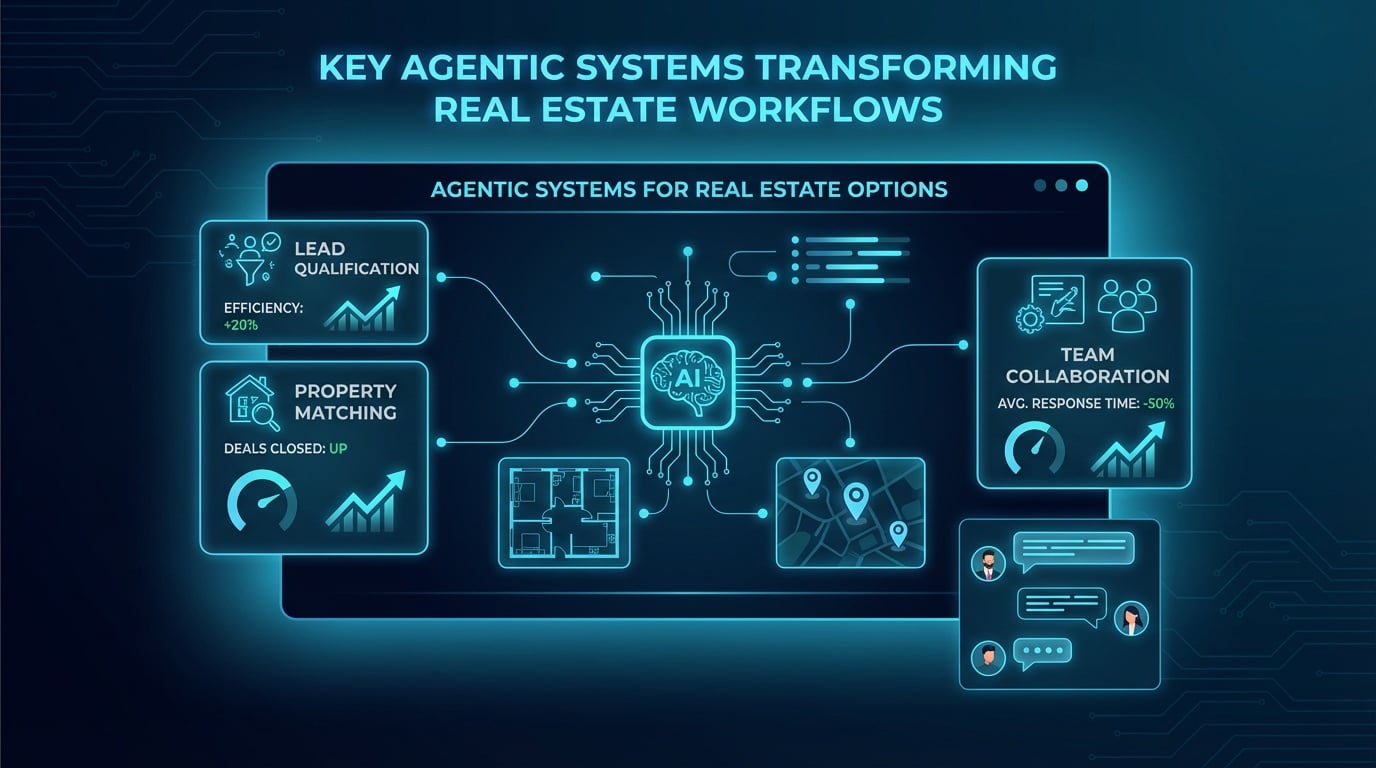
Real estate operations contain three core workflow areas where autonomous agents deliver measurable ROI: lead qualification, property matching, and CRM compliance. Each system integrates with your existing tools.
Lead Qualification and Nurturing Agents
Lead qualification agents engage every inquiry within 60 seconds across all channels. They ask targeted questions about budget, location preferences, property type, and timeline. The system scores leads based on your criteria and routes high-priority prospects to agents while nurturing lower-priority contacts with market updates and new listings.
This 24/7 engagement converts inquiries into viewings through structured qualification and consistent follow-up.
Property Matching and Recommendation Engines
Matching engines analyze buyer requirements against your inventory using algorithms that consider explicit preferences (bedrooms, price range) and implicit signals (browsing behavior, feedback patterns). The system sends personalized recommendations that include virtual tours, neighborhood data, and financing options.
Post-viewing feedback collection refines future suggestions, creating a learning loop that improves match quality. Automated reminders cut viewing no-shows significantly.
automation-agents”>CRM and Compliance Automation Agents
CRM agents maintain contact records, log interactions, schedule follow-ups, and handle compliance with communication regulations. They coordinate calendars between buyers, sellers, and agents–sending confirmation and reminder messages that reduce cancellations. Document collection, disclosure delivery, and transaction milestone tracking happen automatically, cutting administrative work by up to 65%.
| Workflow Area | Traditional Approach | Agentic System Approach | Measurable Outcome |
|---|---|---|---|
| Lead Response | Manual review of inquiries during business hours | Fast 24/7 engagement across channels | Under 60-second response time |
| Property Matching | Agent manually searches listings based on memory and notes | AI-driven matching with personalized tours and supporting data | Higher match quality scores |
| Follow-Up | Inconsistent manual outreach | Automated post-viewing feedback and next-best suggestions | Improved client retention |
Real Results: Metrics and Case Studies in Real Estate
Measuring agentic system performance requires tracking outcomes that tie directly to revenue and operational efficiency. Here’s what we’re seeing across mid-market agencies.
Proven Gains in Conversion Rates and Time Savings
Agencies deploying Agentic Systems for Real Estate options report qualified pipeline growth of 3x. In well-defined funnels, conversion rates reach 85%–compared to industry baselines of 15% to 20% with manual processes.
Time savings matter too. Agents save over 20 hours per week by cutting repetitive qualification calls, data entry, and follow-up coordination. That time shift supports more closed deals per agent without additional marketing spend.
Vynta AI Implementation Examples for Mid-Market Agencies
A 12-agent boutique agency handling luxury properties implemented agentic qualification and matching systems across WhatsApp, email, and website chat. Within four months, it processed 340% more inquiries without hiring additional staff, closed 28 additional transactions, and reduced administrative overhead by 65%.
Another mid-market firm specializing in commercial leasing deployed automated tenant screening and property matching agents. Time-to-lease dropped from 47 days to 31 days while improving tenant quality scores. Client satisfaction increased 27% as buyers received relevant property recommendations instead of generic lists.
Tenant Retention and Revenue Impact
Property management teams using agentic follow-up systems report improved client retention through consistent check-ins, maintenance coordination, and renewal reminders. Revenue lifts come from systematic cross-sells and premium service offers delivered at the right moment.
Post-viewing feedback creates data loops that refine matching over time. One agency reduced viewing no-shows by 40% with automated reminders sent via each client’s preferred communication channel.
Revenue Reality: Mid-market agencies implementing agentic workflows see faster response times, stronger qualification rates, and measurable time savings–translating into material revenue lift when measured against baseline performance.
Implementation Steps for Agentic Systems in Real Estate
Successful deployment follows a structured approach that addresses data readiness, system integration, and performance measurement.
Assess Your Current Processes and Data Readiness
Start by mapping workflows where agents spend time on repetitive tasks: lead qualification calls, property research, viewing coordination, follow-up emails. Identify communication channels receiving inquiries and pinpoint where response time lags.
Audit your property data quality. Listings need complete details, accurate pricing, and current availability. Clean CRM records establish baseline contact information and interaction history. This discovery phase reveals which workflows will deliver the highest ROI with automation–and highlights data gaps needing correction before deployment.
Integrate with Existing CRM and Property Tools
Agentic systems connect with your CRM, property management software, and communication platforms through API integrations. Configuration includes defining qualification criteria, setting property matching rules, establishing communication templates, and mapping calendar systems.
Testing validates agent responses across channels, confirms property recommendations against buyer profiles, and verifies compliance with communication regulations. A phased rollout supports agent training and workflow adjustment without disrupting production operations.
Measure and Scale for Ongoing ROI
Track response time, qualification rate, viewing conversion, and deals closed each week. Monitor time savings and client satisfaction to validate productivity gains. Review property matching accuracy and adjust rules or models based on feedback patterns.
Scale successful workflows across additional properties, agents, and communication channels. Continuous optimization using performance data helps systems adapt to market changes and buyer behavior shifts. For an in-depth academic perspective on agent learning loops and adaptation, see property matching accuracy.
Why Vynta AI Delivers Agentic Systems Built for Real Estate Success

Mid-market real estate agencies need solutions that align with real estate workflows without enterprise complexity or generic automation limitations. We’ve built Agentic Systems for Real Estate options that pair advanced AI capabilities with practical implementation requirements.
Tailored for Mid-Market Needs vs Enterprise Overkill
Enterprise AI platforms require extensive IT resources, long customization cycles, and large investments many mid-market agencies can’t justify. Generic automation tools lack real estate domain depth, forcing teams to manually define qualification logic, property matching rules, and compliance workflows.
Vynta AI provides preconfigured agents aligned to common real estate processes, designed to deploy without requiring in-house AI specialization. The platform handles lead qualification, property matching, viewing coordination, and follow-up automation out of the box. For more on the design and theory of intelligent agents like these, visit preconfigured agents aligned to common real estate processes.
Human-AI Partnership Model
Our systems support agents by automating repetitive qualification, data entry, and scheduling tasks that consume most of the workweek. Human agents focus on relationship building, negotiation, and complex decision-making–the high-value activities that actually close deals. This partnership model increases productivity while improving client experience through faster response times and more consistent service.
Next Steps to Deploy and Track Results
Start with a workflow assessment to identify high-impact automation opportunities. We support implementation through discovery, strategy development, configuration, and agent training. Performance tracking begins immediately, measuring response time, qualification rates, conversion, and revenue impact. Ongoing optimization sustains gains over time.
Future of Agentic Systems in Real Estate Operations
Agentic Systems for Real Estate options are evolving toward increasingly capable automation with human oversight. Agencies establishing agentic workflows now position themselves to benefit from emerging capabilities shaping competition through 2026 and beyond.
Predictive Analytics and Market Intelligence
Next-generation agentic systems will incorporate predictive models that forecast buyer behavior, price trends, and inventory demand. These agents will analyze historical transaction data, market signals, and demographic shifts to recommend listing strategy, pricing adjustments, and marketing timing.
You’ll receive actionable intelligence about which properties to prioritize, which buyer segments are most likely to convert, and which conditions favor specific transaction types. This shift from reactive response to proactive planning changes how agencies allocate resources and manage portfolios. For detailed regulatory compliance frameworks supporting these workflows, see regulatory compliance frameworks.
Expanded Communication Channels and Personalization
Agentic systems will extend beyond current channels to include video messaging, voice calls, and immersive virtual property experiences. Personalization engines will adapt communication style, content depth, and recommendation frequency based on individual preferences learned through interaction patterns.
A first-time buyer receives guidance about financing and neighborhood amenities. An experienced investor gets comparative return analysis and market-trend reporting. This adaptive approach increases engagement and speeds decision-making by delivering relevant information at the right time.
Integration with Transaction and Financial Systems
Future workflows may automate more transaction management by coordinating with lenders, title companies, inspectors, and legal teams. Document verification, compliance checks, and milestone tracking could happen automatically–reducing closing timelines and error rates.
Financial qualification agents can pre-screen buyers against lending criteria, connect them with financing options, and maintain real-time status visibility. This integration reduces coordination delays that extend transaction cycles and create client frustration.
Strategic Advantage: Agencies deploying Agentic Systems for Real Estate options today build operational foundations that scale as AI capabilities progress, improving efficiency over time.
Making the Decision to Deploy Agentic Systems
Deciding to implement agentic workflows requires evaluating operational constraints, growth objectives, and competitive positioning. Agencies experiencing any of these conditions should prioritize deployment: lead response times exceeding 15 minutes, agents spending more than 60% of time on administrative tasks, qualified pipeline stagnation despite marketing investment, or client retention rates below 70%.
Calculating Your ROI Threshold
Estimate potential return by multiplying your agent count by 20 hours of weekly time savings, then valuing that time using your internal productivity assumptions. Add incremental revenue from higher close rates and better retention, then subtract implementation costs and monthly platform fees.
Most mid-market agencies reach positive ROI within 3-4 months. Returns accelerate as systems learn buyer patterns and improve matching. The financial case is strongest in competitive markets where response speed and personalized service determine which agency captures qualified buyers.
Addressing Team Adoption and Change Management
Successful implementation requires agent buy-in and workflow adjustment. Position agentic systems as productivity multipliers that remove tedious tasks so agents can focus on client consultation and negotiation.
Provide training on system capabilities, demonstrate time savings with a pilot, and set clear performance metrics showing individual benefit. Change management works best when teams see measurable personal benefit–not just organizational efficiency.
Selecting the Right Implementation Partner
Choose partners with demonstrated real estate domain expertise, not just general automation experience. Vynta AI specializes in Agentic Systems for Real Estate options designed around lead qualification, property matching, and transaction workflows tied to agency revenue.
Implementation support should include workflow assessment, system configuration, agent training, and ongoing optimization based on performance data. Avoid platforms requiring extensive IT resources or heavy custom development when your team needs outcomes quickly.
Agencies deploying agentic workflows now gain immediate operational advantages while building capabilities that scale with advancing AI technology. The question isn’t whether to implement these systems–it’s how quickly your team can deploy them to capture qualified leads, close more deals, and outpace competitors still relying on manual processes.
Frequently Asked Questions
How do agentic systems for real estate differ from traditional real estate software?
Traditional real estate software stores data and sends reminders, requiring human initiation for every action. Agentic systems for real estate options invert this by deploying autonomous AI agents that perceive data, make decisions based on business rules, and execute tasks across multiple channels. They actively convert inquiries into qualified prospects and scheduled viewings, rather than waiting for manual input.
What specific real estate operations can agentic systems automate?
Agentic systems transform real estate operations by automating key workflow areas such as lead qualification, property matching, and CRM compliance. These systems engage inquiries, match buyers with listings, and manage administrative tasks. This frees agents to focus on relationship building and closing deals.
What measurable business outcomes can real estate agencies achieve with agentic systems?
Agencies deploying Agentic Systems for Real Estate options report significant gains. They see qualified pipeline growth of 3x and conversion rates reaching 85% in well-defined funnels. Agents can save over 20 hours per week by automating 80% of recurring tasks, leading to over 30% more deals closed.
How do agentic systems improve lead qualification and client engagement?
Agentic systems improve lead qualification by engaging every inquiry quickly, often in under 60 seconds, across channels like WhatsApp, SMS, email, and website chat. They ask targeted questions to qualify buyers based on budget and preferences, routing high-priority prospects directly to agents. This 24/7 engagement converts inquiries into viewings through fast outreach and consistent follow-up.
Can agentic systems help with property matching and recommendations?
Yes, agentic systems include AI-driven matching engines that analyze buyer requirements against your inventory using advanced algorithms. The system sends personalized property recommendations, which can include virtual tours, neighborhood data, and financing options. Automated reminders reduce viewing no-shows, and post-viewing feedback refines future suggestions.
How do agentic systems assist with CRM compliance and administrative tasks?
Agentic systems streamline CRM compliance by maintaining contact records, logging interactions, and scheduling follow-ups automatically. They coordinate calendars between all parties, sending confirmations and reminders to reduce cancellations. Document collection, disclosure delivery, and transaction milestone tracking can also happen automatically, reducing administrative work for agents.