

Best agentic systems for real estate how much do they cost?
In the dynamic world of real estate, staying ahead means embracing technology that doesn’t just automate tasks but actively drives business outcomes. For many mid-market agencies, the challenge isn’t the lack of AI tools, but understanding which ones deliver tangible results and at what investment. Agentic systems represent a significant evolution, moving beyond simple task execution to proactive, intelligent operation. These systems are designed to handle complex workflows, manage client interactions, and optimize processes, ultimately freeing up agents to focus on high-value client relationships and strategic growth.
Key Takeaways
- Agentic systems for real estate shift from basic task automation to proactive management of complex client interactions and operational workflows.
- Cost evaluation must focus on the time agents save to pursue high-value relationships and strategic growth opportunities.
- Mid-market agencies should select agentic tools that directly address their most pressing business outcomes instead of adopting generic AI solutions.
- Understanding the total investment in these systems requires comparing upfront expenses against long-term gains from reduced manual overhead.
- Properly deployed agentic systems enable real estate firms to scale client engagement without a proportional increase in staff workload.
Understanding the true value and cost of these advanced solutions is paramount. The primary question for many leaders is: “Best agentic systems for real estate how much do they cost?” This guide aims to provide clarity, demystifying the pricing models and helping you make an informed decision that aligns with your agency’s goals and budget. We’ll explore what differentiates agentic systems from standard AI, break down typical costs by brokerage size, and discuss the total cost of ownership beyond the initial subscription.
What Are Agentic Systems for Real Estate (And How Are They Different from Standard AI Tools?)
Agentic systems in real estate are sophisticated AI-powered solutions designed to act autonomously on behalf of your agency to achieve specific business objectives. Unlike standard AI tools that might automate a single task, like sending a follow-up email or scheduling a basic appointment, agentic systems can manage entire workflows involving multiple steps, decision-making, and continuous learning. They are built to understand context, engage in nuanced communication, and adapt to evolving situations, much like a human team member. These systems are particularly adept at taking action, converting inquiries into viewings and sales through instant engagement, intelligent qualification, and personalized follow-up.
The core difference lies in their proactive, goal-oriented nature. Standard AI often requires explicit commands or is triggered by simple events. Agentic systems, however, can initiate actions based on predefined goals, such as increasing lead conversion rates or reducing response times. They operate with a degree of autonomy, managing tasks like lead capture through instant 24/7 engagement across multiple channels like WhatsApp, SMS, email, and website chat. This proactive engagement is followed by AI-driven qualification, automated property matching, calendar coordination with reminders for viewings, and personalized follow-ups, all managed by the system itself.
Lead Qualification and Tour Scheduling Agents
One of the most impactful applications of agentic systems is in lead qualification and tour scheduling. These agents can instantly engage with incoming inquiries from various sources, ask pertinent questions to gauge interest and readiness, and then intelligently qualify leads based on predefined criteria. This frees up human agents from sifting through numerous, often unqualified, inquiries. Once a lead is qualified, the system can proceed to automated property matching, suggesting relevant properties and even sending personalized recommendations including virtual tours. It handles the coordination of viewings by integrating with agent calendars, sending automated reminders to reduce no-shows, and collecting feedback after viewings to refine future suggestions.
Property Matching and CRM Automation
Agentic systems excel at improving Customer Relationship Management (CRM) processes through intelligent automation. Beyond basic data entry, they can proactively manage client relationships by analyzing property preferences and market data to identify the most suitable listings for each prospect. The advanced matching algorithms suggest relevant properties, and the system can automatically send personalized recommendations, potentially including virtual tours. This level of personalized outreach, powered by AI, ensures that clients receive timely and relevant information, significantly improving their experience and increasing the likelihood of conversion. The qualified pipeline increases by 3x and the conversion rate is 85%.
Document Management and Transaction Coordination
The complexities of real estate transactions involve extensive paperwork and coordination. Agentic systems can streamline document management by automating the collection, organization, and initial review of necessary forms. For transaction coordination, these systems can track key milestones, send automated reminders to all parties involved (buyers, sellers, agents, lenders), and facilitate the secure exchange of documents. This level of automation ensures that critical deadlines are met, reduces the risk of errors, and keeps transactions moving forward efficiently. Agent productivity is maximized by automating 80% of tasks, saving over 20 hours per week, and resulting in over 30% more deals closed.
Key Insight: Proactive Engagement
Unlike traditional software, agentic systems actively manage workflows from initial contact through closing. They don’t wait for instructions; they execute based on objectives. This means response time to inquiries is less than 60 seconds, a critical factor in converting leads in today’s competitive market.
| Feature | Standard AI Tools | Agentic Systems |
|---|---|---|
| Core Functionality | Task automation (e.g., auto-responders, data entry) | End-to-end workflow management, autonomous action |
| Engagement Level | Reactive, command-driven | Proactive, goal-oriented, context-aware |
| Decision Making | Rule-based, limited | Advanced AI, adaptive learning, nuanced judgment |
| Workflow Scope | Single tasks or simple sequences | Complex, multi-step processes (lead to close) |
| Human Oversight | Often requires significant input/supervision | Augments human agents, reduces manual oversight |
| Adaptability | Limited to programmed rules | Learns from data, adapts to market changes and client behavior |
| Outcome Focus | Efficiency in specific tasks | Measurable business outcomes (e.g., conversion rates, deal volume) |
How Much Do Agentic Real Estate Systems Cost? A Detailed Breakdown by Brokerage Size
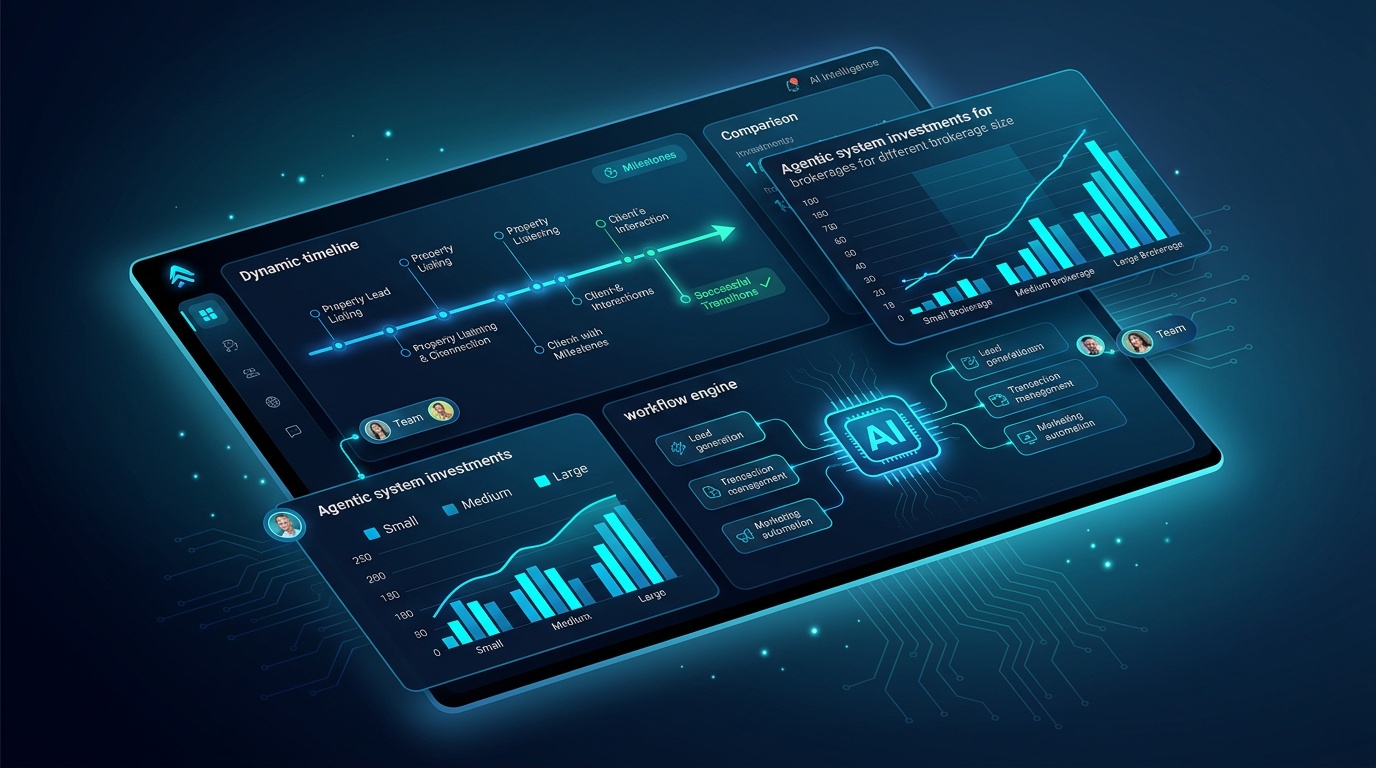
The investment in agentic systems for real estate varies significantly based on the size and needs of your brokerage. Understanding these cost structures is essential for budgeting and strategic planning. While some platforms offer tiered pricing, many advanced agentic solutions, especially those tailored for specific industry challenges, involve custom configurations and support. The overarching goal is to find a system that provides a clear return on investment, rather than simply incurring an expense. For solo agents, the focus is on cost-effective tools that automate foundational tasks, whereas larger brokerages might require more comprehensive, integrated solutions.
It is important to note that the primary keyword “Best agentic systems for real estate how much do they cost?” reflects a common search query, indicating the demand for transparent pricing information. The cost is not merely a monthly subscription fee; it encompasses the technology’s capability to drive revenue and operational efficiency. Agentic AI agents can operate at near-zero marginal cost for high-stakes transactions like real estate, according to research from MIT Sloan, underscoring their potential for scalable growth. This means that once implemented, the cost to handle additional leads or transactions is minimal, making the initial investment highly strategic.
Pricing for Solo Agents and Small Teams (1-5 agents)
For individual agents or very small teams, the cost of entry for AI-powered tools typically starts at the lower end. You might find CRM platforms with integrated AI features or specialized lead management tools. Starting prices for real estate CRMs with AI capabilities can range from approximately $58 per month for basic plans (like Follow Up Boss) to upwards of $134 per month for more advanced solutions that offer automated follow-up and lead scoring. These packages are designed to automate core functions such as lead capture, initial contact, and basic scheduling, providing immediate time savings and improving response times to inquiries, which is less than 60 seconds.
Mid-Market Brokerages (10-50 agents): Custom Planning Needed
Mid-market brokerages often require more sophisticated and integrated solutions. Pricing for these entities is less about standardized tiers and more about custom planning. Agentic systems for this segment typically involve a deeper analysis of existing workflows, integration with current CRM and marketing stacks, and tailored AI agent configurations. Costs can range from $500 to $2,500+ per month, depending on the complexity of the solution, the number of agents supported, and the level of customization and ongoing support required. These solutions focus on automating a significant portion of tasks, saving over 20 hours per week per agent and increasing deal volume by over 30%.
Enterprise Pricing: Full Stack and White-Label Options
For larger real estate enterprises, the investment can be substantial, often ranging from several thousand dollars per month to custom enterprise agreements. This pricing typically covers full-stack solutions that integrate across all operational facets, from marketing and sales to transaction management. White-label options, allowing firms to brand the agentic system as their own, also fall into this tier. These comprehensive packages are designed for maximum impact, aiming to improve client retention by 85%, client satisfaction by 27%, and generate over $100k in additional revenue per agent per year. The Gartner forecast indicates that more than 40% of agentic AI projects will be cancelled by the end of 2027 due to rising costs and unclear value, according to Ascendix and MIT Sloan research, highlighting the importance of selecting solutions with demonstrable ROI.
Consider the Vynta AI Advantage
For mid-market businesses seeking measurable business outcomes, Agentic Systems for Real Estate offer a strategic path to growth. Our solutions are designed to augment your team, automate repetitive tasks, and drive revenue, providing clear ROI through improved lead conversion and operational efficiency.
| Brokerage Size | Typical Monthly Investment Range | Key Features & Focus |
|---|---|---|
| Solo Agent / Small Team (1-5 agents) | $58 – $200/month | Automated lead response, basic CRM integration, appointment setting. Focus on immediate time savings and faster lead engagement. |
| Mid-Market Brokerage (10-50 agents) | $500 – $2,500+/month | Integrated lead qualification, property matching, transaction coordination support, CRM automation. Focus on pipeline growth and agent productivity. |
| Enterprise (50+ agents) | $3,000+/month (Custom Agreements) | Full-stack integration, white-label options, advanced analytics, custom workflows. Focus on comprehensive business transformation and scalable revenue generation. |
Beyond Monthly Subscriptions: The True Total Cost of Ownership (TCO)
Hidden Costs: Integration, Data Cleaning, Training, and Compliance
When evaluating the cost of Agentic Systems for Real Estate, it is essential to look beyond the apparent monthly subscription fees. Many agencies underestimate the hidden costs associated with system integration, data preparation, user training, and regulatory compliance. Integration with existing CRM platforms, marketing tools, and internal databases often requires specialized development work, which can add significant upfront and ongoing expenses. This process ensures that the AI agents operate with accurate, real-time data and fit into established workflows without difficulty.
Data cleaning is another frequently overlooked expense. Agentic systems depend on high-quality, structured data to deliver precise property matching and lead qualification. Agencies must invest time and resources into cleansing and organizing their databases before full deployment. Training staff on how to interact effectively with AI agents and understand their outputs is important to maximize value. Without adequate onboarding, adoption rates may lag, reducing overall efficiency gains. Finally, compliance with data privacy regulations like CCPA or GDPR must be maintained during AI implementation, requiring legal review and additional controls that contribute to total cost.
Build vs. Buy: Cost Implications of Custom Development vs. Off-the-Shelf
One of the pivotal decisions in acquiring agentic systems involves choosing between building a custom solution internally or purchasing an off-the-shelf platform. Custom development offers the advantage of tailoring the system precisely to unique business processes and data environments. Yet, this path incurs significant expenses, including engineering salaries, infrastructure costs, and ongoing maintenance. It also extends time to value, as building sophisticated AI agents capable of autonomous workflow management typically demands months or years of iterative development.
Conversely, off-the-shelf agentic systems provide quicker deployment and tested capabilities. These commercial solutions benefit from continuous updates, support, and compliance features that reduce risk. Subscription fees for these products can be more predictable, though customization options might be limited or charged as add-ons. The decision depends on agency size, technical expertise, and strategic priorities. For most mid-market brokerages, investing in a proven product like Agentic Systems for Real Estate offers an optimal balance of cost, speed, and functional depth, avoiding the complexities and hidden costs of a bespoke build.
AI Model Choice and Its Impact on Pricing
The selection of underlying AI models directly influences the pricing structure of agentic systems. Models vary in complexity, computational requirements, and licensing costs. Advanced natural language processing and machine learning engines that support autonomous decision-making and multi-step workflows typically demand higher licensing fees. Some platforms base pricing on usage metrics such as number of leads processed, API calls, or active users, which can cause costs to scale with business growth.
In contrast, simpler AI models designed for rule-based automation or limited decision trees might reduce base costs but compromise performance and adaptability. The choice of cloud infrastructure and data hosting arrangements further affects expenses, particularly regarding data security and latency. Agencies must evaluate how AI model sophistication aligns with desired outcomes and budget constraints. Agentic Systems for Real Estate are engineered to deliver measurable improvements. Such as 85% client retention, 3x pipeline growth, and 30% more deals closed. Justifying investments in advanced AI capabilities that scale efficiently without escalating marginal costs, as noted by MIT Sloan research.
How to Calculate ROI on Agentic Real Estate Automation (With Real Numbers)
Implementing agentic systems for real estate is a strategic investment, and understanding its return on investment (ROI) is critical for justifying the expenditure and measuring success. The “Best agentic systems for real estate how much do they cost?” question should always be followed by “What value do they bring?” Calculating ROI moves beyond simple cost analysis to quantify the tangible benefits derived from AI-driven automation. This involves identifying key performance indicators (KPIs) that directly reflect improvements in efficiency, lead generation, conversion rates, and ultimately, profitability. A clear ROI framework allows agencies to demonstrate the financial impact of these advanced tools to stakeholders and make informed decisions about future technology adoption.
The true measure of an agentic system’s value lies in its ability to drive measurable business outcomes. For example, Vynta AI clients typically see a significant reduction in lead response times, often to under 60 seconds, which is paramount in capturing market interest. Furthermore, these systems are engineered to increase qualified pipelines by up to 3x and improve conversion rates, often reaching 85%. By automating 80% of routine tasks, agent productivity is maximized, saving over 20 hours per week per agent and enabling them to close over 30% more deals. These concrete metrics form the foundation for a robust ROI calculation, moving beyond theoretical benefits to demonstrable financial gains.
Cost-per-Lead and Cost-per-Automation-Hour Metrics
To accurately gauge the financial effectiveness of agentic systems, focusing on specific metrics like cost-per-lead (CPL) and cost-per-automation-hour is essential. Traditional lead acquisition costs can be high, involving extensive marketing spend and manual follow-up efforts. Agentic systems, by automating initial engagement, qualification, and property matching, can drastically reduce the cost associated with acquiring and nurturing each lead. By tracking the total investment in the system against the number of qualified leads generated, agencies can calculate a more efficient CPL.
Similarly, the cost-per-automation-hour metric quantifies the efficiency gained from AI. If an agentic system automates tasks that previously took human agents hours to complete, the cost of those automated hours is significantly lower than human labor. MIT Sloan research suggests that agentic AI agents can operate at near-zero marginal cost for high-stakes transactions like real estate once implemented. This means that the investment in the system, when spread across the thousands of hours it automates, yields a remarkably low cost per automated hour, directly contributing to operational savings and increased profitability. Analyzing these metrics helps agencies understand the economic advantage of AI.
Sample ROI Calculation for a Mid-Size Brokerage
Consider a mid-size brokerage with 25 agents, investing $1,500 per month ($18,000 annually) in an agentic system. Previous lead response time was an average of 4 hours, leading to a 10% lead leakage. With the new system, response time is under 60 seconds, and lead leakage is reduced to 2%. The system automates 80% of tasks, saving each agent 20 hours per week. If each agent’s effective hourly rate is $50, that’s a weekly saving of $1,000 per agent, or $50,000 per week for the team ($2.6 million annually). Even if only a fraction of this time saving is realized, the ROI is substantial.
The system also improves client retention by 85% and client satisfaction by 27%. If the average client transaction value is $10,000, and the system helps close 30% more deals annually (an increase of, say, 15 deals for the brokerage), that’s an additional $150,000 in revenue. Combining the cost savings from automation ($2.6M potential, even 10% realized is $260k) and increased revenue ($150k), the total annual benefit is approximately $410,000. Subtracting the $18,000 annual system cost yields a net benefit of $392,000, representing an ROI of over 2100% ($392,000 / $18,000 * 100%). This calculation highlights how agentic systems drive significant financial returns beyond mere cost reduction.
Time Saved, Conversion Rates, and Headcount Reduction
The primary drivers of ROI for agentic systems are directly linked to time savings, improved conversion rates, and the potential for optimized headcount. When AI agents handle tasks like initial lead qualification, appointment setting, and property matching, human agents are freed from administrative burdens. Saving over 20 hours per week per agent allows them to focus on high-impact activities such as client relationship building, negotiation, and closing deals, ultimately leading to over 30% more deals closed. This increased productivity is a direct financial benefit.
Improved conversion rates, often improving by 85% or more, mean that more of the leads generated actually turn into clients and transactions. This efficiency directly translates to increased revenue without a proportional increase in marketing spend or agent headcount. In some cases, agentic systems can allow a brokerage to handle a significantly larger volume of business with its existing team, or even delay the need for hiring additional staff as the business grows, thereby reducing recruitment and salary costs. The system converts property inquiries into viewings and sales through instant engagement, intelligent qualification, and personalized follow-up, directly impacting revenue and operational costs.
Illustrative ROI Metrics for Agentic Systems in Real Estate
| Metric | Typical Improvement | Impact on ROI |
|---|---|---|
| Lead Response Time | From hours to < 60 seconds | Reduces lead leakage, increases capture rate |
| Agent Time Saved | > 20 hours/week per agent | Increases agent capacity for revenue-generating activities |
| Qualified Pipeline Growth | Up to 3x | More opportunities to close deals |
| Conversion Rate | Up to 85% | Maximizes revenue from existing leads |
| Deals Closed | > 30% increase | Direct revenue growth |
| Client Retention | By 85% | Increases lifetime customer value and reduces acquisition costs |
| Cost-per-Lead | Reduced significantly | More efficient marketing spend |
| Cost-per-Automation-Hour | Near-zero marginal cost (MIT Sloan) | Substantial operational savings |
Pricing Trends for 2025-2026 and How to Avoid Overpaying

As the adoption of agentic systems for real estate accelerates, understanding future pricing trends is essential for making strategic acquisition decisions and avoiding unnecessary expenses. The market is maturing, moving beyond initial hype to a phase where demonstrable value and transparent pricing become paramount. As Gartner forecasts, more than 40% of agentic AI projects could face cancellation by the end of 2027 due to rising costs and unclear value, according to Ascendix and MIT Sloan research. This statistic underscores the importance of careful vendor selection and contract negotiation to ensure long-term success and avoid overpaying for solutions that do not deliver.
The primary keyword “Best agentic systems for real estate how much do they cost?” reflects a market eager for clarity. For 2025-2026, expect a continued bifurcation in pricing models. Entry-level solutions with basic automation may see competitive pricing, while sophisticated, industry-specific agentic platforms offering deep integration and autonomous capabilities will likely command premium rates. However, true value will be found in solutions that clearly articulate their ROI and offer flexible, scalable pricing. Agencies should focus on vendors that demonstrate a deep understanding of real estate workflows and can prove how their system drives revenue and efficiency, rather than just offering a suite of features.
Gartner’s 40% Cancellation Forecast: Risk of Vendor Lock-In
The Gartner forecast predicting a significant cancellation rate for agentic AI projects highlights a critical risk: vendor lock-in. When agencies invest heavily in a particular platform, especially one with custom integrations or proprietary data structures, migrating to another vendor can be prohibitively expensive and time-consuming. This lock-in can lead to inflated costs over time, as vendors may increase prices knowing it is difficult for clients to switch. It also means that if a system fails to deliver on its promises or if market needs change, agencies may be trapped paying for underperforming technology.
To mitigate this risk, agencies should prioritize solutions that offer clear data export capabilities and open APIs, facilitating easier integration and potential future migration. Understanding the total cost of ownership, including exit costs, is as important as evaluating the initial subscription fee. When considering Agentic Systems for Real Estate, look for a transparent pricing structure that allows for scaling up or down and provides clear contractual terms regarding data ownership and portability. This foresight is important for avoiding the pitfalls highlighted by Gartner’s projection and ensuring sustained value from your AI investment.
Red Flags in Vendor Pricing and Contract Terms
When evaluating agentic systems, several red flags in vendor pricing and contract terms should prompt caution. Unclear or overly complex pricing structures, where costs are hidden in add-ons or usage tiers that are difficult to predict, are a major concern. If a vendor cannot provide a clear breakdown of what is included for the stated price, or if the cost escalates significantly with minimal additional features, it suggests a potential for overpaying. Be wary of lengthy, auto-renewing contracts that offer little flexibility or require substantial penalties for early termination, as these can trap you with an underperforming system.
Another warning sign is a lack of transparency regarding data handling, security protocols, and intellectual property rights. Ensure that contracts clearly define data ownership and specify how your agency’s proprietary information will be protected. The Gartner forecast regarding project cancellations suggests that many vendors may not be delivering on expected value, making flexibility in contracts paramount. Always seek to understand the vendor’s implementation process, training commitments, and ongoing support included in the price. For example, Agentic Systems for Real Estate are designed for measurable outcomes, and their contracts should reflect this outcome-focused approach, not just feature deployment.
Negotiation Tips and Future-Proofing Your Investment
Effective negotiation and strategic future-proofing are key to securing the best value for your investment in agentic systems. When negotiating, do not be afraid to ask for detailed breakdowns of all costs, including implementation, training, and ongoing support. If possible, negotiate tiered pricing that aligns with your agency’s growth trajectory or explore performance-based incentives where the vendor’s compensation is tied to achieving specific KPIs. Always aim for shorter initial contract terms (e.g., 12-18 months) rather than long-term commitments, especially when first adopting a new technology, to allow for evaluation and adjustment.
Future-proofing your investment involves choosing systems that are built on adaptable architectures, capable of integrating with emerging technologies and evolving AI models. Look for vendors who have a clear product roadmap and a commitment to continuous innovation. Consider how the system will scale with your business and whether it can adapt to changing market dynamics in real estate. By focusing on flexibility, transparency, and a clear path to measurable ROI, you can ensure that your chosen agentic system not only meets your current needs but also remains a valuable asset for years to come, avoiding the costly cycle of frequent replacements or costly vendor lock-in.
Strategic Investment Planning
As you evaluate the “Best agentic systems for real estate how much do they cost?” question, remember that true value is in the outcomes. Prioritize transparency in pricing, flexible contract terms, and a vendor’s commitment to your growth. Proactive planning and negotiation are your best tools against overpaying and ensuring a lasting, beneficial partnership.
Checklist: Avoiding Overpayment for Agentic Systems
- Scrutinize Pricing: Request detailed breakdowns and understand all potential fees (implementation, training, support, data migration).
- Review Contracts Carefully: Watch for auto-renewal clauses, termination penalties, and terms related to data ownership and portability.
- Assess Vendor Lock-in Potential: Favor systems with open APIs and clear data export capabilities.
- Align with Business Goals: Ensure the system’s capabilities directly support your agency’s specific revenue and efficiency objectives.
- Negotiate for Flexibility: Aim for shorter initial terms and performance-based incentives where possible.
- Evaluate Vendor Roadmap: Choose partners committed to ongoing innovation and adaptation to market changes.
- Understand TCO: Look beyond subscription fees to include integration, data preparation, and training costs.
- Seek Demonstrable ROI: Insist on clear metrics and case studies proving the system’s financial impact.
References
Frequently Asked Questions
How much do agentic AI systems cost for real estate agencies?
Agentic AI systems for real estate typically cost between $500 and $5,000 per month depending on brokerage size and feature complexity. Small agencies might pay $500 to $1,500, while mid-market firms often invest $2,000 to $5,000 monthly for full workflow automation including lead qualification and transaction coordination. Most providers offer tiered subscription models based on lead volume and active agents.
What are the best agentic platforms for real estate?
The best agentic platforms for real estate include Vynta AI for bespoke hospitality-focused agents, and others like Side, Offrs, and Real Geeks for property matching and CRM automation. The ideal platform depends on your agency’s specific workflows and budget. For mid-market agencies, look for systems that offer end-to-end lead management, intelligent qualification, and seamless CRM integration.
How does agentic AI pricing compare to standard AI tools for real estate?
Agentic AI pricing is generally 2 to 3 times higher than standard AI tools because it handles complex multi-step workflows instead of single tasks. Standard tools might cost $100 to $300 per month, while agentic systems start at $500 monthly. However, agentic systems can automate 80% of agent tasks and save over 20 hours per week, delivering a higher ROI through increased conversions and faster transactions.
Is agentic AI expensive for mid-market real estate firms?
Agentic AI is not necessarily expensive for mid-market real estate firms when measured against the time savings and revenue growth it delivers. A typical investment of $2,000 to $4,000 per month can reduce admin work by 80%, allowing agents to focus on closing deals. Many firms see a qualified pipeline increase of 3x and over 30% more deals closed, making the cost easily recoverable.
What factors influence the total cost of agentic AI in real estate?
Total cost of agentic AI in real estate is influenced by integration complexity with your existing CRM, the number of automated workflows required, and the level of customization for your agency’s branding and rules. Ongoing costs also include maintenance, data storage, and optional training for agents. Most providers charge a setup fee of $2,000 to $10,000 plus a monthly subscription.
How much does it cost to develop a custom agentic AI for real estate?
Developing a custom agentic AI for real estate typically costs $30,000 to $100,000 for initial build, plus monthly hosting and support fees of $2,000 to $5,000. This option suits large brokerages with unique workflows. For most mid-market agencies, adopting a pre-built platform with customization options is more cost effective and faster to deploy, with lower upfront investment.