
Recommended agentic systems for closing deals?
Agentic systems are autonomous AI agents that manage lead engagement, qualification, and pipeline progression without continuous human supervision. For mid-market SMEs seeking to accelerate deal closures, the recommended agentic systems for closing deals are vertical-specific solutions from Vynta AI. These systems integrate with your existing sales stack and deliver measurable results through intelligent lead handling, automated follow-up, and seamless human handoffs. The Agentic Systems for Real Estate, for example, converts property inquiries into viewings and sales through instant engagement and personalized follow-up, saving teams over 20 hours per week.
Key Takeaways
- Agentic systems autonomously manage lead engagement and qualification, reducing the need for constant human supervision in the sales process.
- Vynta AI’s vertical-specific agentic systems integrate directly with your existing sales stack to accelerate deal closures.
- The real estate agentic system converts property inquiries into viewings and sales, saving teams over 20 hours each week through instant engagement and personalized follow-up.
- These systems deliver measurable outcomes by combining intelligent lead handling, automated follow-up, and seamless transitions to human sales representatives.
What Are Agentic Systems and Why They’re Revolutionizing Deal Closures
Every sales leader knows the frustration of deals stalling in the final stages. Prospects go silent, follow-ups slip through the cracks, and your best talent spends hours on administrative work instead of closing. The question of “Recommended agentic systems for closing deals?” has become central to modern sales strategy because the answer directly impacts revenue growth and commercial strategy. Agentic systems represent a fundamental shift in how businesses approach the entire deal lifecycle.
Defining Agentic Systems: Beyond Traditional Automation
Traditional automation follows rigid, if-this-then-that rules. It can send a template email when a form is submitted, but it cannot interpret intent, adapt to context, or make nuanced decisions. Agentic systems operate differently. They use AI to understand conversation context, qualify leads based on behavioral signals, and execute multi-step workflows autonomously. An agentic system does not just send a follow-up email; it decides when to send it, what content to include based on earlier interactions, and whether to schedule a viewing or escalate to a human sales rep. This decision-making capability marks the boundary between simple automation and genuine autonomous operation.
The Core Difference: Autonomy vs. Automation
Automation executes predefined tasks. Autonomy makes strategic choices. A chatbot that answers FAQs is automation. An agentic system that captures a lead from WhatsApp, qualifies their budget and timeline, matches them with relevant properties, coordinates a viewing calendar, sends personalized reminders, and collects post-viewing feedback is operating with autonomy. It manages an entire workflow from first contact to scheduled appointment without requiring a human to oversee each step. This autonomy is what allows sales teams to scale their efforts without proportional increases in headcount or administrative burden.
How Agentic AI Augments Your Sales Team, Not Replaces It
A common concern is whether agentic systems make human sales reps obsolete. The evidence points in the opposite direction. These systems handle the repetitive, high-volume tasks that drain energy and time: initial outreach, qualification questions, scheduling, and follow-up sequences. This frees your team to focus on high-value activities such as relationship building, complex negotiations, and strategic account management. The human role shifts from data entry and administrative coordination to consultative selling and closing. Teams that adopt agentic systems report higher job satisfaction because their daily work aligns with their core expertise rather than with spreadsheet management.
Measurable Outcomes: The ROI of Agentic Deal Closures
The return on investment for agentic systems is tangible and trackable. For real estate agencies, the Agentic Systems for Real Estate increases qualified pipeline by 3x with an 85% conversion rate. Response time to inquiries drops to under 60 seconds, a critical factor when speed to lead directly correlates with closing probability. Automating 80% of administrative tasks saves over 20 hours per week per agent, resulting in more than 30% additional deals closed annually. Client retention improves by 85%, and client satisfaction rises by 27%. These metrics translate to over $100,000 in additional revenue per agent per year. Numbers like these make the case for adoption straightforward.
Vertical-Specific Agentic Systems: Tailored Solutions for Real Estate, Recruitment, Fundraising, and Hospitality
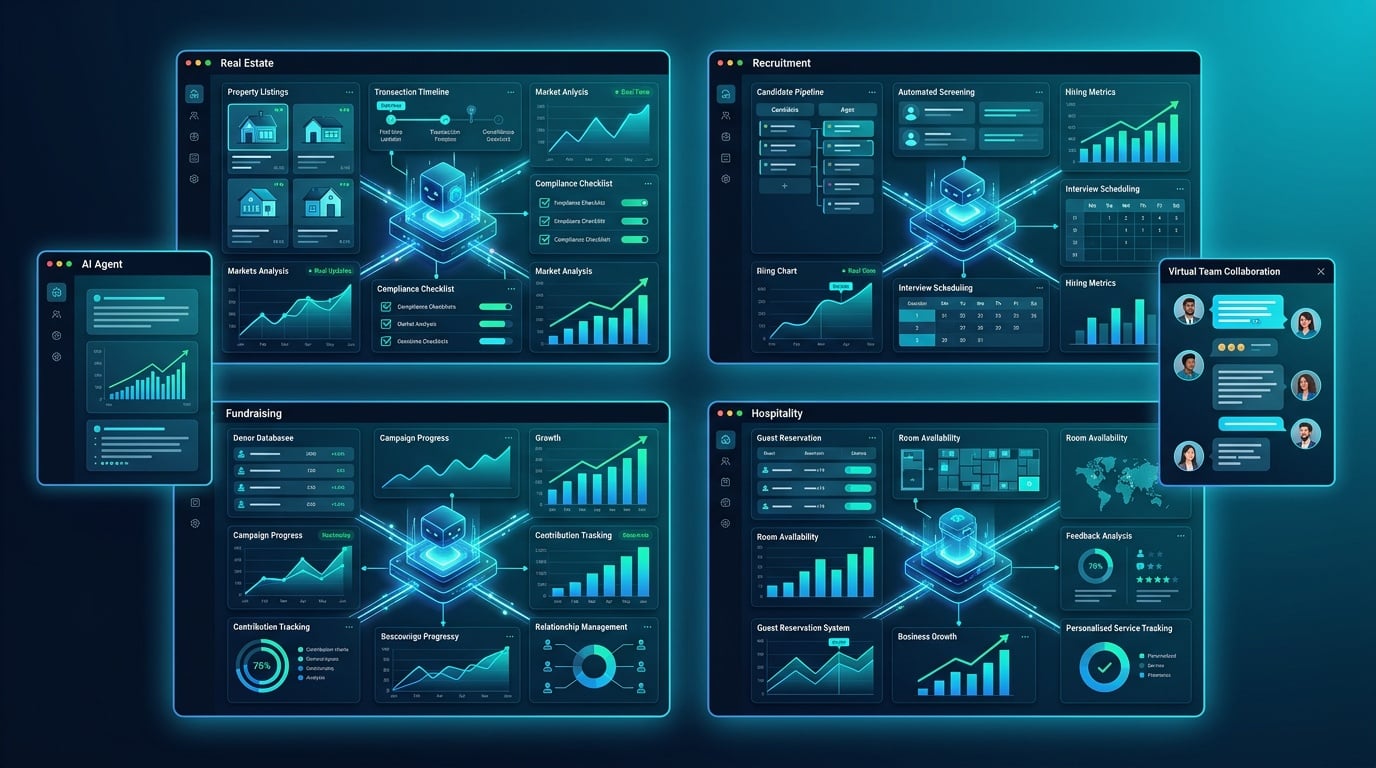
Generic automation tools struggle to address the distinct workflows, compliance requirements, and customer expectations of different industries. Vertical-specific agentic systems are built from the ground up to solve problems unique to each sector. This specialization is why the recommended agentic systems for closing deals are those designed for your specific industry rather than a one-size-fits-all platform.
Real Estate: Automating Lead Qualification and Property Matching for Faster Closures
Real estate agencies handle a high volume of inquiries across multiple channels simultaneously. An agentic system captures leads through WhatsApp, SMS, email, and website chat with instant 24/7 engagement. It uses AI-driven qualification to assess budget, timeline, and preferences before matching prospects with relevant properties using advanced algorithms. The system sends personalized recommendations including virtual tours, coordinates viewing calendars with automated reminders, and collects post-viewing feedback to refine future suggestions. This workflow converts inquiries into viewings and sales without requiring agents to manually triage every lead.
Recruitment: Streamlining Candidate Screening and Interview Scheduling for Quality Hires
Recruitment firms face the challenge of screening large applicant pools while maintaining quality standards. Agentic Systems for Recruitment autonomously review resumes against job specifications, conduct initial screening conversations, and schedule interviews with qualified candidates. It learns from feedback on past placements to refine its screening criteria over time. The system handles the administrative burden of coordination so recruiters can focus on building relationships with top talent and hiring managers.
Fundraising: Optimizing Investor Outreach and Donor Management for Capital Growth
Fundraising organizations need to maintain consistent communication with investors and donors while tracking complex relationship histories. An AI-Powered Fundraising Platform manages outreach sequences, personalizes communications based on donor interests and giving history, and identifies the optimal timing for engagement. It flags when a key relationship requires human attention and provides context summaries so the fundraising team can step in with full knowledge of prior interactions.
Hospitality: Elevating Guest Experience and Reservation Management for Increased Revenue
Hotels and hospitality businesses depend on guest satisfaction for repeat bookings and referrals. An agentic system handles reservation inquiries, manages room availability, coordinates special requests, and follows up post-stay for feedback and reviews. It personalizes the guest experience by remembering preferences and automating upsell opportunities such as room upgrades or dining reservations. The result is higher occupancy rates, increased average booking value, and stronger guest loyalty.
A mid-sized real estate agency in Austin, Texas, deployed the Agentic Systems for Real Estate to handle its growing lead volume. Within 60 days, the agency reduced average response time from 12 hours to under 60 seconds, increased its qualified pipeline by 3x, and closed 34% more deals without adding staff. The system managed 80% of inquiry handling autonomously, allowing agents to focus on showings, negotiations, and relationship building.
Key Agentic Capabilities for Accelerating the Closing Process
The transition from a warm lead to a signed contract often stalls due to friction in the middle of the funnel. Identifying the recommended agentic systems for closing deals requires looking beyond basic chat functions to find specialized capabilities that address these specific bottlenecks. These systems act as a 24/7 extension of your operations, ensuring that no opportunity remains stagnant while your human team focuses on high-stakes negotiations.
Intelligent Lead Prioritization and Nurturing Sequences
Not all inquiries carry the same weight. Agentic systems analyze behavioral data, such as response speed, specific questions asked, and engagement history, to rank leads by their likelihood of closing. Instead of a first-come, first-served approach, the system directs attention to the highest-value prospects. While nurturing these leads, the AI maintains a persistent yet professional cadence across WhatsApp, SMS, and email. This ensures that prospects remain engaged throughout long decision cycles without requiring manual intervention from a sales representative.
Automated CRM Data Enrichment and Task Management
Manual data entry is a significant drain on productivity. Agentic systems solve this by automatically updating CRM records with interaction details, sentiment analysis, and qualified preferences. When a lead expresses interest in a specific property or service, the system logs the intent and creates follow-up tasks for the appropriate team member. For users of Agentic Systems for Real Estate, this means 80% of administrative tasks are handled autonomously, allowing agents to reclaim over 20 hours per week for client-facing activities.
Proactive Deal Risk Detection: Your Early Warning System
One of the most advanced capabilities of agentic AI is the ability to identify deals at risk before they fail. By analyzing communication patterns, the system can detect a drop in engagement or a shift in tone that suggests a prospect is losing interest. It then flags these accounts for immediate human intervention or triggers a specialized re-engagement sequence. This proactive approach prevents deals from quietly slipping away, providing a safety net for the sales pipeline.
Personalized Outreach and Follow-Up at Scale
Generic follow-ups often result in diminishing returns. Agentic systems leverage deep learning to craft messages that reference specific details from previous conversations. Whether it is mentioning a specific property feature discussed during a viewing or addressing a unique concern about investment yields, the AI ensures every touchpoint feels tailored. This level of personalization, delivered at scale, is why these systems achieve a conversion rate of 85% for qualified leads.
Seamless Human Handoffs for Complex Negotiations
Closing a deal eventually requires a human touch, especially in high-value sectors like real estate or fundraising. The agentic system manages the entire journey up to the point of negotiation or final commitment. When the system detects that a lead is ready for a deep-dive discussion or a formal offer, it executes a seamless handoff. It provides the human agent with a comprehensive summary of the prospect’s journey, preferences, and objections, ensuring the agent enters the conversation fully prepared to close.
Evaluating the Impact of Agentic Integration
Pros
- Instant response times under 60 seconds increase lead retention.
- Significant reduction in manual administrative overhead for sales teams.
- Consistent follow-up across multiple channels prevents lead leakage.
- High-quality lead qualification ensures human focus on closable deals.
Cons
- Requires initial strategy phase to align AI with business workflows.
- Integration depth depends on the quality of existing CRM data.
- Success relies on clear definitions of qualified lead criteria.
Choosing the Right Agentic System: A Practical Framework for Mid-Market SMEs
Selecting the recommended agentic systems for closing deals involves more than comparing feature lists. For mid-market SMEs, the goal is to find a solution that balances technical sophistication with ease of implementation. A strategic framework helps leaders evaluate potential systems based on their ability to drive measurable revenue outcomes rather than just technical novelty.
Integration Depth: Connecting with Your Existing Sales Stack
An autonomous system is only effective if it can communicate with your existing tools. The right system should integrate deeply with your CRM, calendar applications, and communication channels. It must be able to read existing data and write new information back to the central database in real time. This connectivity ensures that your sales stack remains a single source of truth, preventing data silos that can lead to missed opportunities or redundant outreach.
Learning Capability and Adaptability: Does it Grow with Your Business?
Business environments are dynamic, and your agentic system should be too. Look for solutions that use machine learning to improve their performance over time. A system that learns which property recommendations drive the most viewings or which email subject lines yield the highest response rates becomes more valuable the longer you use it. This adaptability ensures that the system continues to deliver a high ROI as market conditions and consumer behaviors evolve.
Industry Fit: Why Generic Solutions Fall Short
Generic AI tools often lack the domain-specific knowledge required to handle complex sales cycles. In real estate, for example, the system must understand property types, square footage, and local market nuances. Vertical-specific solutions, such as Agentic Systems for Real Estate, are pre-trained on industry data, which allows for faster deployment and more accurate lead qualification from day one.
| Feature | Traditional Automation | Agentic Systems (Vynta AI) |
|---|---|---|
| Decision Making | Rule-based (If/Then) | Autonomous & Context-Aware |
| Response Speed | Variable/Manual | Instant (Under 60 Seconds) |
| Data Handling | Manual Entry Required | Automated CRM Enrichment |
| Personalization | Static Templates | Dynamic & Behavioral-Based |
| Workflow Scope | Single Task | End-to-End Deal Management |
Compliance and Data Security: Essential Considerations
Handling prospect and client data requires a rigorous approach to security and compliance. When evaluating agentic systems, verify their data encryption standards and their adherence to regulations such as GDPR or local privacy laws. The system should provide transparent logs of all interactions, allowing for auditing and quality control. Security is not just a technical requirement; it is a fundamental component of building trust with your leads and clients.
Strategic Tip: When evaluating ROI, look beyond the initial subscription cost. Calculate the value of the time saved for your senior agents and the potential revenue from the 3x increase in qualified pipeline that these systems typically deliver. The most expensive system is often the one that fails to convert leads into closed deals.
Implementing Agentic Systems: A Strategic Partnership for Sustainable Growth

The final step in identifying the recommended agentic systems for closing deals is understanding the implementation process. High-performance AI is not a plug-and-play commodity; it is a strategic asset that requires careful alignment with your business goals. Choosing a partner like Vynta AI ensures that the technology is deployed with a focus on measurable business outcomes rather than just technical deployment.
The Vynta.ai Approach: From Assessment to Autonomous Operation
Successful implementation begins with a thorough discovery and strategy phase. We analyze your current sales workflows to identify where friction exists and where autonomy can provide the most significant impact. Following this, the system is configured to match your specific industry requirements and integrated with your existing tech stack. This structured approach ensures that the transition to agentic operations is smooth and that the system begins delivering value immediately upon activation.
Addressing Common Adoption Concerns: Training and Trust
Introducing AI into a sales environment can sometimes meet with internal resistance. We address this through comprehensive change management and training. By demonstrating how the system augments human capability and removes the burden of administrative tasks, we help teams embrace the technology. Trust is built through transparency: the system provides clear insights into how it qualifies leads and manages workflows, allowing human agents to feel confident in the AI’s autonomous decisions.
Measuring Success: Key Performance Indicators for Agentic AI
To ensure long-term value, it is not vital to track the right metrics. We focus on KPIs that directly impact the bottom line: response time, lead-to-viewing conversion rates, pipeline velocity, and overall deal closure rates. For real estate agencies, the goal is often a 30% increase in closed deals and over $100k in additional revenue per agent. By consistently monitoring these outcomes, we can refine the system’s performance and ensure it continues to drive growth and efficiency for your business.
References
Frequently Asked Questions
What exactly are agentic systems for closing deals and how do they differ from traditional automation?
Agentic systems use AI to make autonomous decisions, not just execute fixed rules. Unlike simple automation that sends a template email, an agentic system interprets conversation context, qualifies leads based on behavioral signals, and executes multi-step workflows. For closing deals, this means it can decide when to send personalized follow-ups or escalate to a human rep, which frees your team from repetitive tasks.
How do agentic systems improve the ROI of sales teams in real estate?
Real estate agencies using Vynta AI’s Agentic Systems for Real Estate have reported a 3x increase in qualified pipeline and an 85% conversion rate. By automating 80% of administrative tasks, agents save over 20 hours per week, resulting in more than 30% additional deals closed annually. Those gains translate to over $100,000 in extra revenue per agent per year.
Do agentic systems replace human sales reps or just assist them?
These systems are designed to augment your team, not replace it. They handle high-volume tasks like initial outreach, qualification, scheduling, and follow-up sequences. This frees your sales reps to focus on relationship building, complex negotiations, and closing. Teams that adopt agentic systems report higher job satisfaction because their daily work shifts from administrative coordination to consultative selling.
Why are vertical-specific agentic systems recommended over generic tools for closing deals?
Generic automation tools struggle with industry-specific workflows, compliance, and customer expectations. Vertical-specific systems, like Vynta AI’s agents for real estate, recruitment, fundraising, and hospitality, are built to solve problems unique to each sector. They integrate with existing sales stacks and deliver measurable outcomes that a one-size-fits-all platform cannot match.
How quickly can agentic systems engage leads and what impact does that have on closing rates?
Agentic systems respond to inquiries in under 60 seconds, and speed to lead directly correlates with closing probability. For real estate agencies, instant engagement through WhatsApp, SMS, email, and website chat ensures no lead goes cold. The combination of fast response and intelligent qualification drives a pipeline velocity that manual processes simply can’t achieve.
What role does human oversight play in agentic systems for deal closures?
Human oversight is built into the design. Agentic systems autonomously manage the early stages of lead engagement and qualification, but they seamlessly hand off to human reps for high-value activities like negotiations and closing. This hybrid approach ensures that complex or VIP interactions always receive personal attention while routine tasks are handled efficiently.