

Best alternatives to manual lead handling with agentic AI in real estate.
Agentic AI: Real Estate Lead Handling Alternatives
Most real estate professionals discover that manual lead handling drains productivity faster than any market downturn. As inquiry volumes climb, the traditional approach of individual follow-up becomes unsustainable. Best alternatives to manual lead handling with agentic AI in real estate now provide autonomous systems that engage, qualify, and nurture prospects without constant human intervention. These platforms address a fundamental challenge: converting property inquiries into scheduled viewings and closed transactions while agents focus on relationship-building.
The High Cost of Manual Lead Handling: Why Smart Agencies Are Making the Switch
Property inquiries arrive continuously across multiple channels, yet most agencies process them one by one. Agents spend hours daily responding to initial questions, attempting to qualify prospects, and scheduling viewings. This administrative burden prevents focus on high-value activities like property showings, contract negotiations, and executing a commercial strategy.
Response delays create the biggest problem. Research shows that leads contacted within 60 seconds convert at dramatically higher rates than those experiencing delays. Manual processes can’t maintain this pace during peak inquiry periods.
Here’s the real issue: every new inquiry requires the same time investment regardless of agent workload. Growth becomes dependent on hiring, which introduces significant overhead and training requirements common among business services companies.
Key Insight: Agencies using purely manual lead handling typically waste 15 to 20 hours weekly on tasks that AI automation services can handle more consistently and at greater scale.
Beyond Basic Automation: What Makes Agentic AI Different
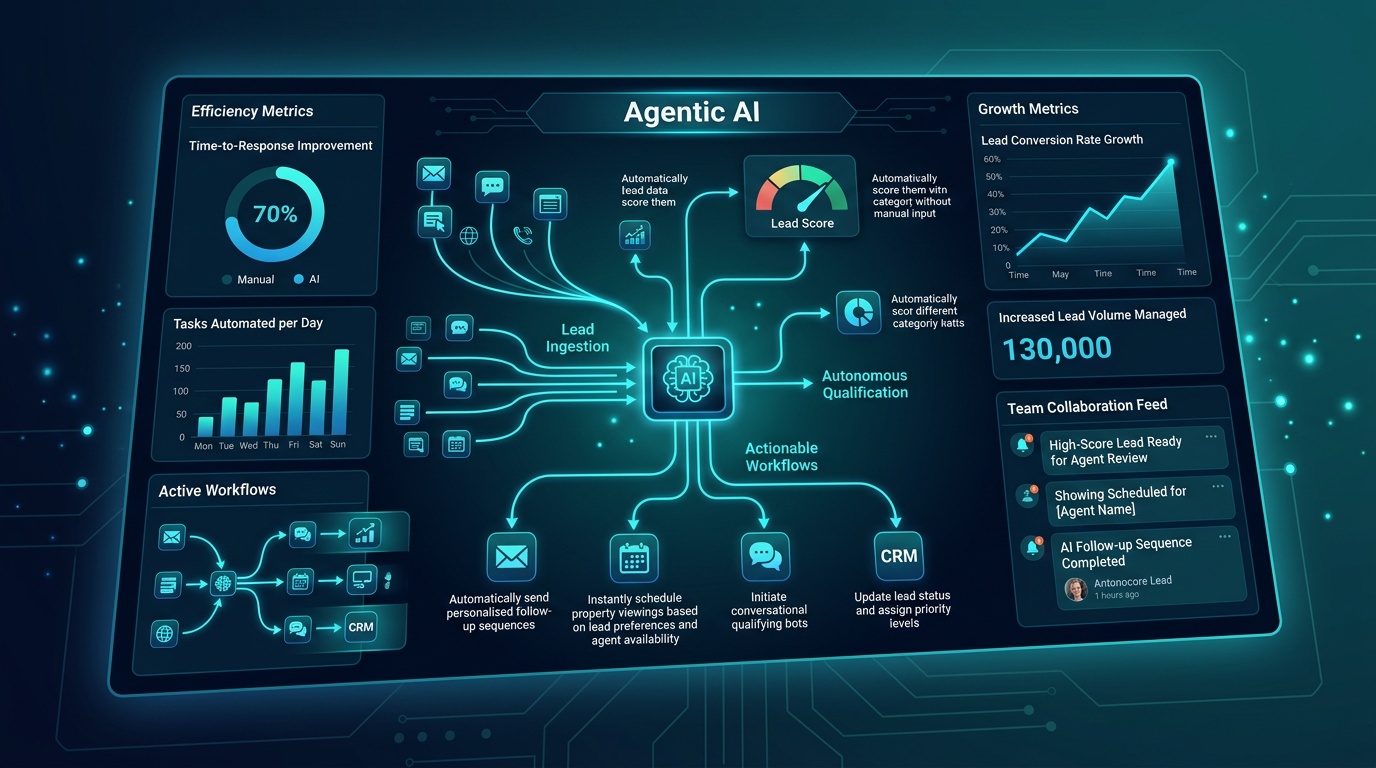
Agentic AI refers to autonomous systems that perceive their environment, reason through logic, and take action without requiring human approval for each step. Unlike traditional automation that follows rigid if-then rules, agentic systems adapt their behavior based on context and outcomes.
For real estate applications, this means intelligent agents that engage prospects conversationally, assess their needs through dynamic questioning, and recommend appropriate properties without human initiation. The technology shifts from simple task automation to decision support.
| Capability | Traditional Automation | Agentic AI |
|---|---|---|
| Response initiation | Rules-based triggers | Context-aware reasoning |
| Qualification depth | Fixed questionnaires | Adaptive conversation |
| Property matching | Keyword filters | Predictive algorithms |
| Follow-up behavior | Scheduled sequences | Outcome-responsive |
| Learning capability | None | Continuous refinement |
Complete Lead Transformation: From Inquiry to Closing
Smart AI transforms your entire lead pipeline. Automated capture engages prospects instantly across WhatsApp, SMS, email, and website chat interfaces. No inquiry goes unanswered regardless of timing.
Intelligent qualification identifies genuine buyers and sellers through dynamic conversations. The system filters out time-wasters while preserving serious prospects who are ready to move forward.
Matching algorithms analyze prospect preferences against available inventory, generating personalized property recommendations with virtual tour options. Proactive nurturing maintains engagement through automated follow-up sequences calibrated to prospect behavior.
Appointment coordination reduces scheduling friction through calendar integration and automated reminders that reduce no-show rates. Post-viewing feedback collection completes the loop, providing data that refines future recommendations.
Selecting Your AI Partner: What Actually Matters
Effective implementation requires industry specialization rather than generic automation tools. Look for platforms designed specifically for real estate workflows, with measurable outcomes including pipeline growth, conversion improvement, and agent productivity gains.
Agentic Systems for Real Estate provides enterprise-grade automation calibrated for mid-market agencies. Our platform converts property inquiries into viewings and sales through instant engagement, intelligent qualification, and personalized follow-up sequences.
Implementation includes discovery, strategy development, and integration phases that support alignment with existing workflows. The approach supports agent capabilities rather than replacing human interaction.
We maintain transparency in data handling and provide clear performance metrics that build confidence in system outputs. Agencies adopting this technology typically see improvements in lead conversion, client retention, and revenue generation per agent.
The Bottom Line: Why Smart Agencies Are Moving Now

Manual lead handling creates an unsustainable cycle: more inquiries demand more manual effort, which reduces response quality and conversion rates. Smart alternatives break this cycle by introducing autonomous systems that scale without proportional human cost.
Agencies implementing Agentic Systems for Real Estate report measurable outcomes, including qualified pipelines increasing by 3x, conversion rates reaching 85%, and agents saving more than 20 hours weekly on administrative tasks.
These results stem from automation that engages prospects within 60 seconds across supported channels, qualifies them through dynamic conversation, and coordinates viewings through integrated calendar systems.
Key Insight: The shift from manual to agentic lead handling doesn’t eliminate the human element. It redirects agent effort toward relationship-building and closing transactions while autonomous systems handle qualification, matching, and scheduling.
Your Implementation Roadmap
Successful adoption follows a structured progression. Discovery identifies workflow bottlenecks and data infrastructure. Strategy development maps automation opportunities to business outcomes.
Implementation integrates the platform with existing CRM and communication tools. Each phase ensures the technology aligns with agency operations rather than forcing disruptive changes.
What’s Coming Next
Current agentic platforms already deliver significant productivity gains. Emerging capabilities will expand their impact through predictive market analysis that helps agents identify seller opportunities before they list.
Behavioral modeling will refine property matching beyond stated preferences. Cross-platform data integration will create unified prospect profiles that inform every interaction.
Early adopters build operational advantages that compound over time through accumulated data and refined algorithms.
Your Next Move
For mid-market agencies evaluating alternatives to manual lead handling, the decision framework centers on three factors: industry specialization, measurable ROI, and human-centered design.
Platforms must understand real estate workflows, demonstrate quantifiable returns, and support agent performance rather than attempting full replacement.
Agencies that adopt agentic automation position themselves for sustainable growth, higher conversion rates, and improved client satisfaction. Those clinging to purely manual methods face increasing competitive disadvantage as inquiry volumes grow and response expectations accelerate.
Frequently Asked Questions
Why is manual lead handling a problem for real estate professionals?
Manual lead handling significantly drains productivity and creates an administrative burden for real estate professionals. It often results in delayed responses to inquiries, inconsistent qualification of prospects, and limits an agency’s ability to scale operations. This prevents agents from focusing on high-value activities like property showings and contract negotiations.
What distinguishes Agentic AI from traditional automation in real estate lead management?
Agentic AI operates as an autonomous system that perceives, reasons, and adapts its behavior based on context, moving beyond rigid if-then rules. Unlike traditional automation, it engages prospects conversationally, dynamically assesses their needs, and proactively recommends properties without constant human initiation. This shifts the focus from simple task automation to intelligent decision support.
How does Agentic AI improve lead qualification for real estate agents?
Agentic AI intelligently qualifies prospects by engaging them in dynamic conversations to assess their specific needs and preferences. This process effectively identifies genuine buyers and sellers, filtering out time-wasters and ensuring agents focus on serious prospects. It significantly improves the quality of leads delivered to human agents.
What measurable outcomes can real estate agencies expect from using Agentic AI for lead management?
Agencies adopting Agentic AI for lead management commonly see improvements in lead conversion rates, client retention, and revenue generation per agent. It helps establish a more qualified pipeline and frees agents from administrative tasks, allowing them to focus on relationship-building and closing transactions. Some agencies report agents saving over 20 hours weekly on administrative duties.
How does Agentic AI support the entire real estate lead funnel?
Agentic AI transforms every stage of the lead funnel, from instant inquiry capture across multiple communication channels to intelligent qualification and personalized property matching. It also manages proactive nurturing, appointment coordination with calendar integration, and post-viewing feedback collection. This comprehensive approach ensures consistent engagement and efficient progression of prospects.
What should real estate professionals consider when selecting an Agentic AI partner?
When choosing an Agentic AI partner, real estate professionals should seek platforms specifically designed for real estate workflows, rather than generic automation tools. It’s important to look for measurable outcomes such as pipeline growth, improved conversion, and agent productivity gains. A good partner will also offer transparent data handling and clear performance metrics.