
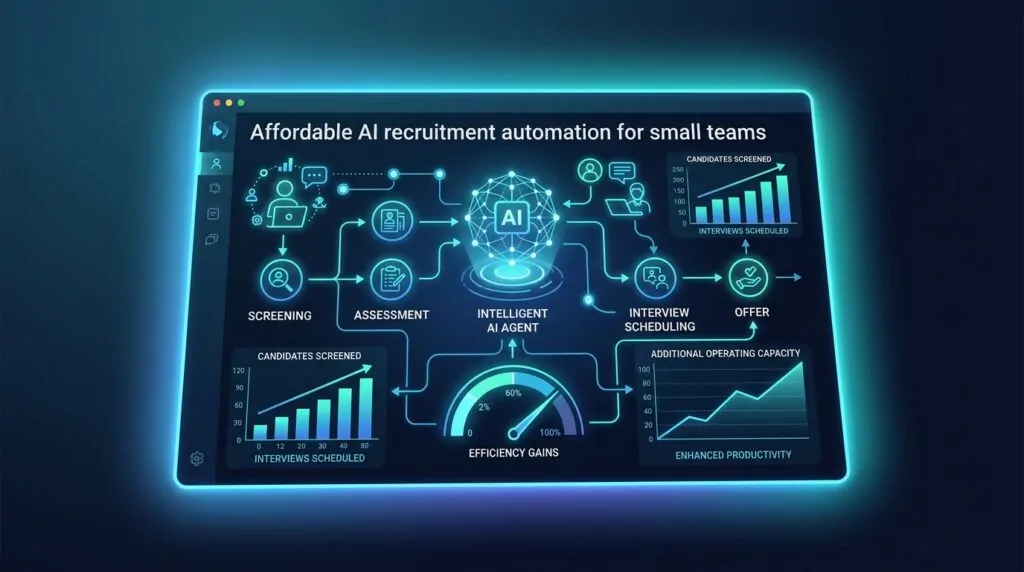
Affordable AI recruitment automation for small teams
Small recruiting teams need more capacity, not another disconnected tool. Affordable AI recruitment automation for small teams can collect applications, identify potential matches, manage follow-ups, schedule interviews, and update candidate records while recruiters retain control of assessment and hiring decisions.
Key Takeaways
- AI recruitment automation tools handle administrative tasks like data entry and interview scheduling so recruiters can focus on evaluating talent.
- Small teams can improve their hiring efficiency by using software to automatically screen applications and identify strong candidates.
- Automated follow-up systems ensure timely communication with applicants throughout the recruitment process without manual intervention.
- Recruiters maintain full authority over final hiring choices while the system manages the operational workflow.
- Implementing affordable automation solutions allows growing businesses to scale their recruiting efforts without significantly increasing headcount.
The best starting point is work that is repetitive and rule-based. CV collection, application sorting, qualification checks, interview coordination, and dormant database reactivation fit that pattern. Relationship building, final assessment, sensitive conversations, and employment decisions still require experienced people.
What is affordable AI recruitment automation for small teams?
Affordable AI recruitment automation for small teams is software that uses artificial intelligence to handle repeatable recruiting tasks across an existing applicant tracking system, job boards, communication channels, and candidate database. It can collect applications, parse resumes, compare experience with role criteria, send approved outreach, answer routine questions, arrange interviews, and prepare candidate profiles for client review.
Affordability depends on more than the monthly subscription. Setup effort, integrations, usage limits, data controls, support, and time saved per hire all affect the total cost. A low-priced tool that creates duplicate records or sends poorly matched messages can increase review work. A sound workflow should improve recruiter capacity while retaining approval steps, audit trails, consent management, and human review for consequential decisions.
Agentic Systems for Recruitment is designed for recruitment firms that need wider process coverage than an ATS alone provides. The system collects and processes applications from job boards including CV Library, Indeed, Reed, TotalJobs, and LinkedIn. It also supports candidate engagement, interview coordination, branded candidate profiles, and reactivation of existing records.
What benefits can small recruitment teams expect?
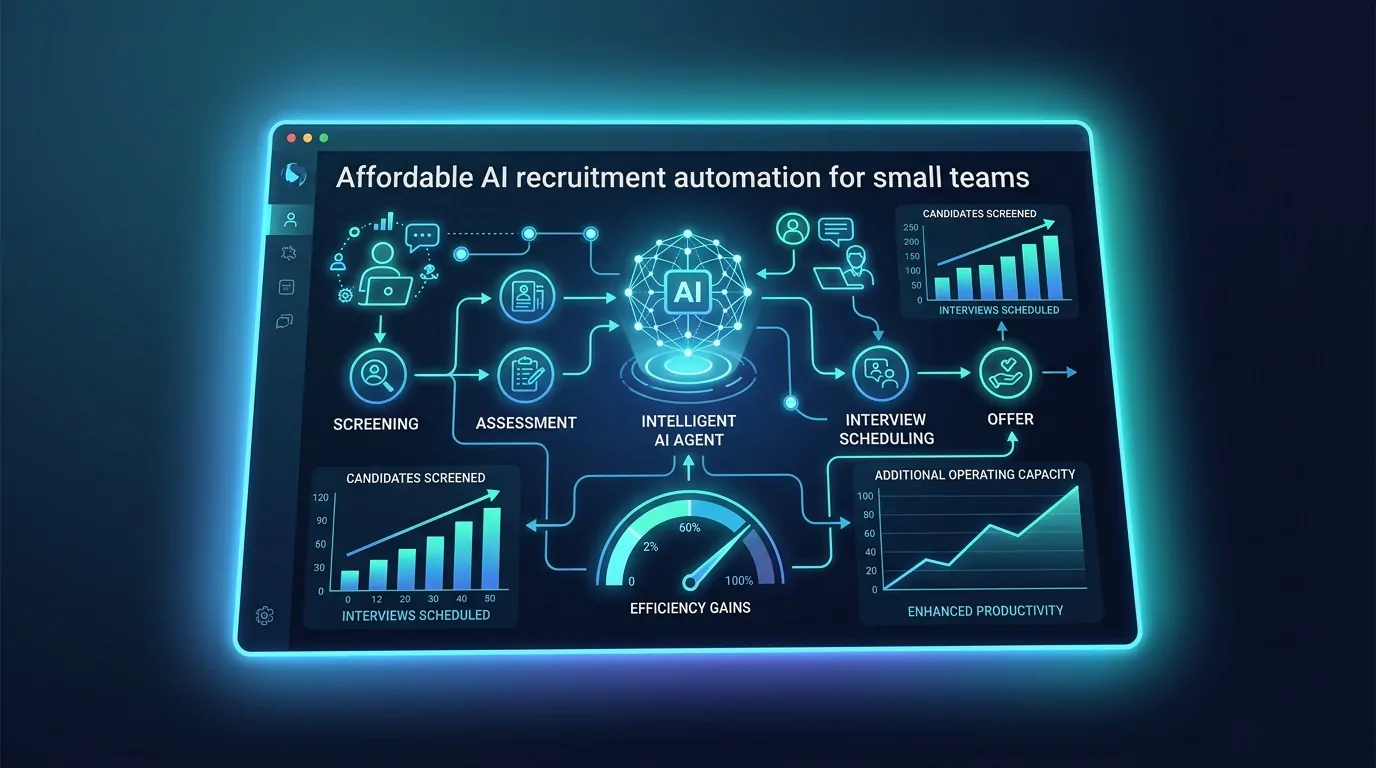
The clearest benefit is added operating capacity. Agentic Systems for Recruitment help firms process applications, schedule interviews, and manage candidate records without adding recruiter headcount. Recruiters can spend more time validating fit, advising clients, and maintaining candidate relationships. That division is useful when high application volumes make manual review the main constraint.
Speed only improves hiring if the matches remain relevant. AI can compare large numbers of applications with defined criteria, identify possible fits, and send uncertain cases to a recruiter. The product processes over 100,000 CVs per day, screens candidates in under 10 seconds, and reports 85% candidate matching accuracy. These figures depend on role criteria, source data, and review procedures; they should not replace professional judgment.
Where small teams usually gain the most value
Start with CV ingestion, duplicate detection, qualification screening, candidate status updates, interview reminders, and structured follow-up. Keep sourcing strategy, shortlist approval, compensation discussions, and final recommendations under human control. This division reduces false positives and limits generic outreach that could damage a firm’s reputation.
Agentic Systems for Recruitment provide automated candidate engagement through WhatsApp Business API and other communication channels. The workflow can schedule interviews, send confirmations and reminders, provide preparation materials, and create branded candidate profiles and “Go-To-Market” documents for client submissions. These tasks remove documentation and coordination work without taking relationship-led conversations away from recruiters.
Existing candidate data can also support growth. The system reports an 18% dormant ATS database reactivation rate, a 33% reduction in related administrative work, approximately two hours saved per hire, and a hiring-cycle reduction of more than 60%. It also reports placements increasing by over 50% after implementation. These are product claims. Before building a business case, confirm the measurement period, baseline, role mix, and integration setup. Track time to shortlist, response rate, interviews scheduled, placements per consultant, and administrative hours per hire.
How should a small team choose recruitment automation?
Choose the system that addresses your largest source of wasted time. Map the hours spent collecting applications, reviewing resumes, searching databases, sending follow-ups, arranging interviews, and preparing client submissions. Separate tasks that follow consistent rules from those that require professional judgment. The system should reduce repetitive work while recruiters remain responsible for shortlist approval, suitability assessments, candidate conversations, and hiring recommendations.
Check integration depth before comparing monthly prices. The ATS should remain the system of record, with candidate profiles, communication history, consent status, notes, and workflow stages synchronized correctly. Ask whether the system connects with the job boards and channels your team already uses, including LinkedIn, Indeed, Reed, CV Library, TotalJobs, email, and WhatsApp Business API. Confirm how duplicates and failed imports are handled, and whether recruiters can correct records without creating parallel data.
Use a practical buying checklist
- Workflow coverage: Look for CV processing, candidate matching, outreach, interview scheduling, reminders, and database reactivation.
- Human controls: Require approval queues, editable criteria, message review, escalation rules, and an audit trail.
- Data protection: Ask about retention, access permissions, consent tracking, candidate requests, and processing locations.
- Commercial clarity: Confirm setup fees, user limits, message or candidate allowances, contract length, taxes, and standard billing rates.
- Measurement: Agree on baseline figures for time to shortlist, response rate, interviews scheduled, placements, and administrative hours.
Assess cost against usable capacity rather than subscription price alone. Research pages describe the market as ranging from free tools to roughly $299 per month, while cited vendor pricing can start near $15 monthly or use per-candidate billing. Treat those figures as research leads, not current quotes. Verify pricing directly with each vendor, record the date checked, and confirm whether promotional rates, annual billing, feature restrictions, implementation, and support are included. A short pilot using real roles will reveal more than a sales demonstration. Compare time saved with review effort, candidate quality, response rates, and data cleanup. For broader evaluation criteria, see this best recruitment comparison guide.
Test the system against difficult hiring conditions before committing. Use roles with vague resumes, overlapping skills, career changes, incomplete profiles, and large volumes of irrelevant applicants. Review false positives from LinkedIn or GitHub, inspect outreach personalization, and verify that the system does not contact the same person repeatedly. Require frequency limits, suppression lists, message approval, and clear opt-out handling to protect candidate trust.
Agentic Systems for Recruitment is one option for firms that need connected sourcing, screening, engagement, scheduling, and ATS administration. Vynta AI has a commercial relationship with this product, so its claims should be validated through a defined pilot and agreed reporting method. The purchase decision should rest on measurable operational improvement, clear governance, and more recruiter time for candidate and client relationships.
Frequently Asked Questions
What is the most affordable AI recruitment automation for a small team?
The most affordable option is the one that removes meaningful administrative work without creating review, data cleanup, or compliance costs. Assess the full workflow, including resume collection, candidate screening, outreach, interview scheduling, and ATS updates. Agentic Systems for Recruitment is designed for firms that want these activities connected within an ATS-based process. Request a workflow demonstration using your own roles and define success measures before making a purchase.
How much does AI recruiting automation cost?
Pricing depends on the number of users, candidates, messages, integrations, and automation features included. Some services use monthly subscriptions, while others charge according to candidate volume or usage. Confirm setup fees, implementation support, annual billing requirements, taxes, contract terms, data storage, and limits on outreach. Calculate the cost against hours saved per hire, additional interviews managed, and placements supported. Vendor claims should be tested against your baseline rather than treated as guaranteed results.
Is an ATS enough, or do we need AI sourcing and outreach automation too?
An ATS can organize applications, preserve candidate records, and track hiring stages. It may not cover proactive sourcing, personalized follow-up, dormant database reactivation, or automated interview coordination. The right scope depends on where work is accumulating. If application management is the main issue, improve the ATS workflow first. If recruiters spend most of their time searching, messaging, and arranging meetings, connected sourcing and communication automation may provide greater capacity.
Can a small team automate recruiting without a dedicated recruiter?
Yes, selected tasks can be automated without removing human accountability. A founder or hiring manager can use Agentic Systems for Recruitment to organize applications, send approved messages, coordinate interviews, and maintain candidate updates. People should still define role requirements, review shortlists, assess suitability, handle sensitive discussions, and make employment decisions. Clear escalation rules prevent the system from treating an uncertain profile as a definitive rejection.
Which recruiting tasks should be automated first?
Begin with repetitive, high-volume tasks that follow consistent rules: CV ingestion, duplicate checks, initial qualification questions, interview reminders, status notifications, and structured follow-up. Measure time to shortlist, response quality, scheduling effort, and record accuracy before expanding the workflow. Leave final candidate selection and relationship-led conversations with recruiters. This staged approach helps small teams control risk while proving whether automation improves hiring capacity.