

AI Automation Services alternatives
Choosing among AI Automation Services alternatives should start with the work your team needs to improve, not with a list of software features. The right approach can reduce repetitive administration, improve response times, and give experienced employees more time for judgment-intensive work. The wrong approach adds maintenance, exceptions, and review tasks that cost more than the original manual process.
Key Takeaways
- Choosing among AI Automation Services alternatives should start with the work your team needs to improve, not with a list of software features.
- The right approach can reduce repetitive administration, improve response times, and give experienced employees more time for judgment-intensive work.
- The wrong approach adds maintenance, exceptions, and review tasks that cost more than the original manual process.
For mid-market businesses, effective automation connects systems, applies clear decision rules, and keeps people involved where context matters. This guide explains what these services include, where they create measurable value, and how a tailored service such as AI Automation Services can support operations in recruitment, real estate, fundraising, and hospitality.
What is AI Automation Services alternatives?
AI Automation Services alternatives are approaches that use artificial intelligence, workflow rules, integrations, and human review to complete recurring business tasks. They may support lead qualification, candidate sourcing, investor outreach, guest communication, data entry, reporting, and appointment scheduling. The strongest option is not the one that makes the most decisions independently. It is the one that handles suitable tasks reliably, records its actions, and routes exceptions to a person.
There is a practical distinction between basic workflow automation and agent-based automation. A rule-based workflow follows defined conditions, such as assigning a qualified inquiry to a sales representative. An AI agent can interpret messages, extract information, prioritize a task, and take action across connected systems. That flexibility is useful when inputs vary, yet it also creates a need for permissions, testing, audit trails, escalation rules, and ongoing monitoring.
Recruitment illustrates the difference clearly. A system can organize resumes, identify relevant experience, draft outreach, and schedule interviews, while a recruiter remains responsible for evaluation, communication quality, and hiring decisions. Research collected by AIHR describes agentic AI as a way to support sourcing and recruiting workflows, not as a reason to remove professional judgment. Vynta AI takes the same operating position: automation should augment the team and produce measurable improvements in cycle time, workload, conversion, or service quality.
Key insight: The best architecture is often boring. Use deterministic rules for predictable steps, AI for interpretation and content generation, and human approval for decisions involving compliance, relationships, or material financial impact.
Benefits of AI Automation Services alternatives
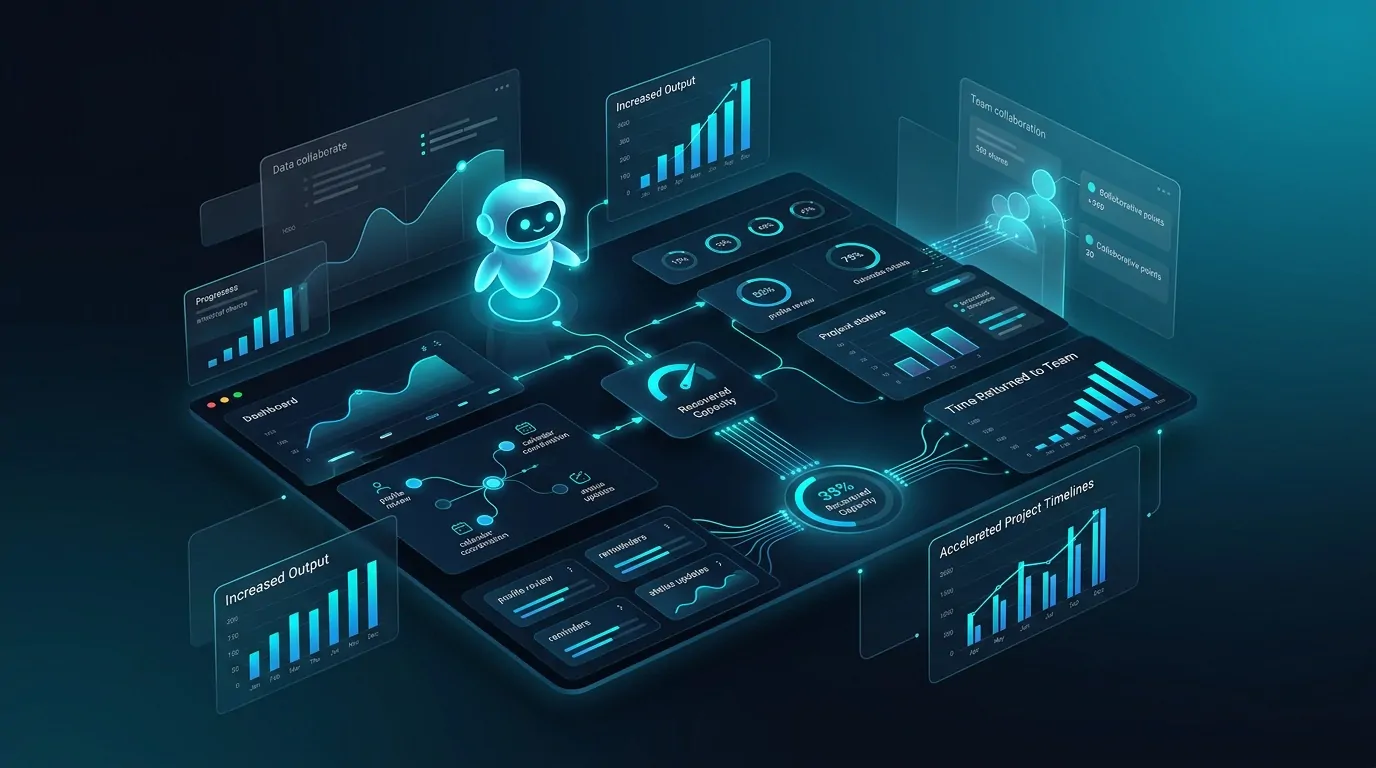
The primary benefit is recovered capacity. Automating intake, profile review, calendar coordination, reminders, and status updates can return time to candidate conversations and client development. In a sales or real estate team, the same principle applies to inquiry routing, qualification, follow-up, and CRM updates.
Small businesses can also gain operating capacity without adding headcount. Those hours have practical value: faster response to a property lead, more investor conversations, quicker candidate submissions, or better attention to guest requests. The result depends on process design and adoption, not on installing an AI tool alone.
Agentic workflows can help with variable, multi-step work. That type of result is most plausible when an agent can search approved data sources, coordinate communication, identify missing information, and hand complex cases to a recruiter. It should not be treated as a universal forecast. Each organization needs a baseline, defined service levels, quality checks, and a measurement plan.
The service is designed to support reduced operational costs and pipeline growth without adding headcount. The service model combines discovery and assessment, expert implementation through a phased deployment process, and continuous results monitoring and optimization. AI Automation Services includes AI Agent Development, System Integration, Workflow Automation, Communication Automation, Performance Intelligence, and Implementation & Support. These capabilities can connect existing platforms, synchronize data, manage exception handling, support SMS and WhatsApp communication, detect anomalies, and produce AI-generated recommendations.
Reliability is a benefit only when governance is built into the workflow. Automation projects can be affected by fragility and insufficient human oversight. A controlled rollout should define ownership, access permissions, fallback procedures, quality sampling, and escalation thresholds. This protects customer relationships and helps teams identify whether automation is saving time or creating hidden rework.
How to Choose AI Automation Services alternatives
Choosing AI Automation Services alternatives starts with a measurable operational problem. Identify one workflow where delays, repetitive administration, or inconsistent follow-up affect revenue or service quality. Recruitment firms might begin with candidate intake and interview scheduling. Real estate agencies may prioritize lead qualification and CRM updates. Fundraising teams could focus on donor research and outreach preparation, while hospitality operators may start with guest inquiries and service requests. Record the current processing time, error rate, response window, and employee workload before selecting a solution.
Next, separate predictable tasks from work that requires interpretation. Deterministic automation is usually the better choice for fixed actions such as moving a record, applying a status, sending a reminder, or synchronizing fields between platforms. AI is more suitable for reading unstructured messages, summarizing profiles, drafting personalized communication, identifying patterns, or recommending the next action. A capable service should combine both methods rather than force an AI agent into every step. Ask whether each automated action has a clear purpose, an approved data source, and a defined fallback when information is missing.
Integration quality should be a central buying criterion. Review how the service connects with your CRM, applicant tracking system, email, calendar, phone, accounting platform, property database, or guest management system. Confirm whether custom API development and data transformation are available when standard connectors cannot carry the required information. Check data ownership, permission levels, encryption practices, audit logs, and retention policies. A workflow that produces attractive demonstrations but fails to update the system of record will create duplicate entry and hidden maintenance work.
Human oversight must be designed before deployment, not added after an error. Define which decisions require approval, such as candidate rejection, investor prioritization, pricing communication, or sensitive guest responses. Set confidence thresholds, escalation queues, review sampling, and service-level targets. Reliability testing deserves the same attention as model capability. Ask the provider how it monitors failed actions, manages changing business rules, documents workflow versions, and trains staff.
Finally, evaluate implementation through a controlled pilot with a baseline and a specific success target. Measure hours saved per week, turnaround time, conversion rate, data accuracy, exception volume, and employee adoption. A recruitment team should assess whether screening capacity improves without lowering candidate quality. A real estate team should track speed to lead and qualified appointments, not just the number of automated messages. Prefer phased deployment, ongoing monitoring, technical support, training, and optimization reviews over a one-time configuration. This approach shows whether the service is reducing work or merely moving it into troubleshooting.
Frequently Asked Questions
What is the best automation approach for recruitment?
The best approach depends on the workflow. Use rule-based automation for repeatable actions such as status changes, reminders, calendar updates, and data synchronization. Use AI for tasks involving unstructured information, including resume summaries, candidate questions, outreach drafts, and profile matching. A recruiter should retain authority over candidate evaluation, rejection decisions, sensitive communication, and client recommendations. AI Automation Services can combine custom AI agents, workflow rules, system integrations, and human approval within one operating model.
Which agentic systems for recruitment work reliably?
Reliability is determined less by the label “agentic” and more by the operating controls around the system. Look for approved data access, limited permissions, audit logs, confidence thresholds, exception queues, testing environments, and clear escalation procedures. A system that completes fewer tasks consistently may deliver more value than one that attempts broad autonomous action. Ask for evidence from workflows similar to your own, then run a pilot using real process measures such as response time, screening quality, scheduling accuracy, and recruiter hours saved.
How does agentic AI differ from traditional automation?
Traditional automation follows predefined triggers and conditions. Agentic AI can interpret changing inputs, select from approved actions, and manage several steps toward a defined objective. That flexibility helps with conversations and variable records, yet it also introduces more testing and oversight requirements. The practical design is usually a combination: deterministic code for predictable operations, AI for interpretation, and human review for decisions involving fairness, compliance, relationships, or financial risk.
What are the main risks of AI in hiring?
Key risks include biased recommendations, inaccurate information, privacy violations, unauthorized system actions, poor candidate communication, and excessive dependence on model output. Reduce these risks with representative testing, documented decision rules, access controls, data retention policies, regular quality reviews, and a visible human approval step. AI should support recruiting professionals, not replace their accountability or judgment.
Can AI automation replace human recruiters?
It can reduce administrative workload, but it should not replace the relationship, judgment, and accountability that recruiters provide. The strongest deployment gives recruiters more time for candidate conversations, hiring-manager consultation, negotiation, and quality control. AI Automation Services is designed to support that model through phased implementation, monitoring, training, and ongoing workflow optimization.