

top 10 AI-Powered Fundraising Platform
Choosing a top 10 AI-Powered Fundraising Platform is not about adding another dashboard to your nonprofit’s technology stack. The right system should reduce manual donor outreach, identify promising supporters, improve campaign conversion, and give fundraisers clear next actions. This guide explains how these platforms work, where they create measurable value, and why the AI-Powered Fundraising Platform from Vynta AI stands out for organizations seeking practical automation across investor and donor engagement.
Key Takeaways
- Choosing a top 10 AI-Powered Fundraising Platform is not about adding another dashboard to your nonprofit’s technology stack.
- The right system should reduce manual donor outreach, identify promising supporters, improve campaign conversion, and give fundraisers clear next actions.
- AI fundraising software now supports donor segmentation, gift recommendations, message drafting, campaign analysis, and follow-up scheduling.
AI fundraising software now supports donor segmentation, gift recommendations, message drafting, campaign analysis, and follow-up scheduling. It does not replace relationship managers or development officers. It gives them better information and more time for conversations that require judgment, trust, and personal attention.
What is top 10 AI-Powered Fundraising Platform?
A top 10 AI-Powered Fundraising Platform is a fundraising system that applies machine learning, predictive analytics, natural language processing, and workflow automation to donor acquisition and retention. It can analyze giving history, engagement activity, campaign responses, and other approved data to recommend an ask amount, prioritize outreach, tailor communications, or flag a supporter who may need personal attention.
These capabilities differ from standard donor management software. A traditional CRM stores constituent records and campaign history. An AI-enabled system interprets those records and turns them into recommended actions. Fundraise Up, for example, reports processing more than 80 non-PII data points per donor for personalization, while its AI ask amounts are associated with a 30% higher average gift size and 49% donor conversion, according to GoodUnited’s review of AI fundraising tools. Those figures are vendor-reported findings, so organizations should validate similar outcomes through their own campaign reporting.
The strongest platforms connect donation forms, email marketing, constituent profiles, payment processing, wealth screening, and reporting in one operating workflow. Some are designed for nonprofit donations, while others support startup fundraising through investor research and outreach. Vynta AI focuses on practical automation for fundraising teams, including prospect identification, personalized communications, follow-up management, and pipeline visibility. The AI-Powered Fundraising Platform is most useful when it supports a defined process and measurable target, such as improving response rates, shortening follow-up time, or increasing qualified conversations.
Benefits of top 10 AI-Powered Fundraising Platform
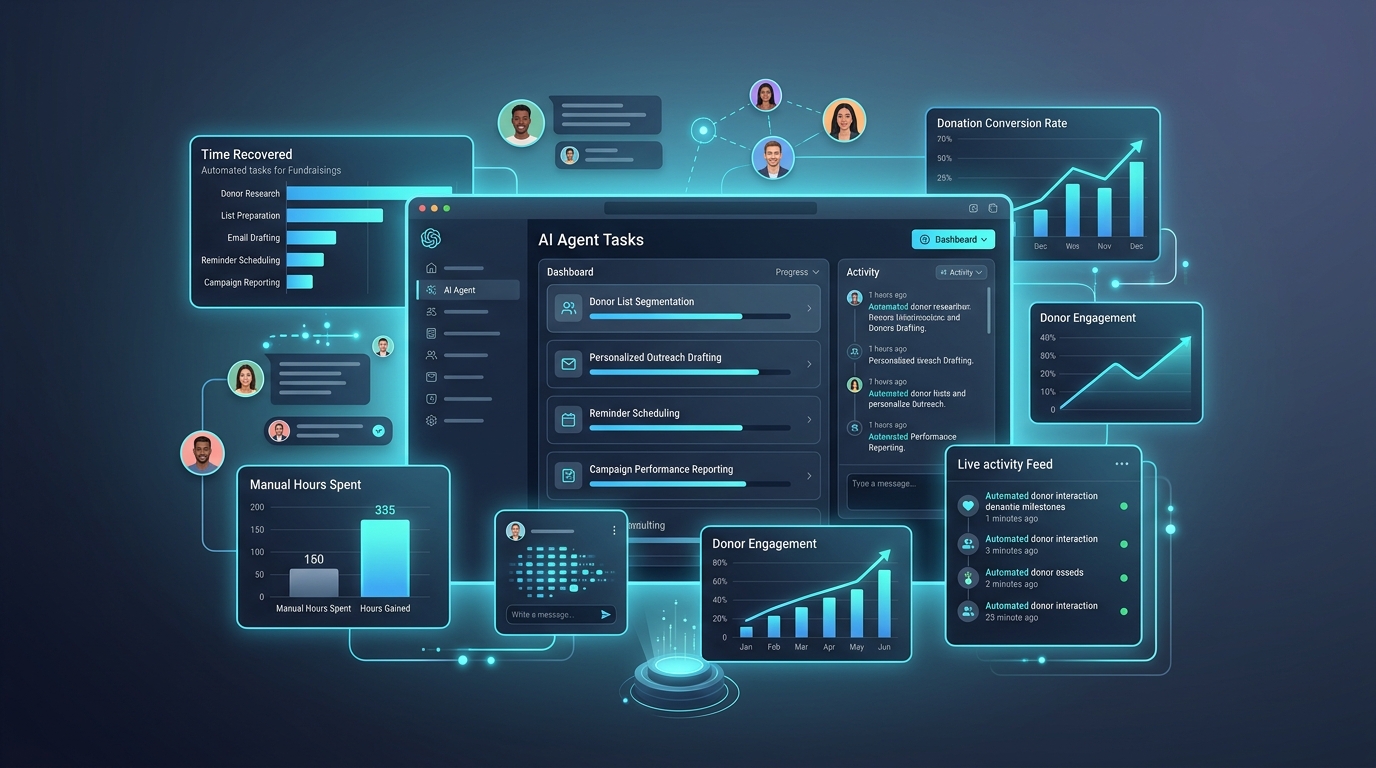
The immediate benefit is time recovery. Donor research, list preparation, email drafting, reminder scheduling, and campaign reporting can consume hours that development teams should spend on stewardship. A Charitable survey cited by WP Charitable found that 80% of nonprofits reported saving 10 to 20 hours per week with AI. The practical value depends on implementation, data quality, and workflow design, but even modest time savings can improve call volume and donor service without adding staff.
Personalization is another measurable advantage. Instead of sending the same appeal to every contact, an AI system can group supporters by giving history, interests, event participation, communication preferences, and engagement signals. It can then help prepare a suitable message, suggested contribution, or follow-up path. Fundraise Up’s reported conversion and gift-size results illustrate why ask optimization attracts attention. Virtuous also reports a 66% increase in major gift size through its AI agent, as described in its nonprofit AI research. Fundraisers should treat these results as reference points, not guaranteed outcomes.
Predictive insight helps teams focus limited capacity. A platform may identify donors with rising engagement, declining activity, likely renewal potential, or capacity for a major gift. That prioritization supports moves management and reduces the burden of reviewing large spreadsheets without clear direction. Teams can monitor retention, response rate, average gift, recurring donation growth, conversion by channel, and cost per acquired donor from a shared reporting layer.
AI can also improve consistency across the donor journey. Automated acknowledgments can be drafted promptly, event attendees can receive relevant follow-ups, and missed tasks can generate reminders for staff. Human review remains necessary for sensitive appeals, major donor communication, privacy decisions, and messages involving complex personal circumstances. Kindsight reports that more than half of nonprofits are using AI to advance their mission, a sign that adoption is moving from experimentation toward routine operational use, as documented in its fundraising research.
Operational test: Before selecting a platform, define one baseline metric and one workflow to improve. For example, measure the hours spent on weekly follow-ups and the percentage of qualified prospects receiving timely contact. A useful system should make both metrics easier to track, not merely add more data.
How to Choose top 10 AI-Powered Fundraising Platform
Selecting a top 10 AI-Powered Fundraising Platform should begin with operating goals, not a list of features. Define the problem that requires attention: slow donor follow-up, weak donation-page conversion, limited prospect research, inconsistent stewardship, or reporting that arrives too late for campaign decisions. Then establish baseline metrics such as response rate, average gift, donor retention, staff hours per campaign, qualified investor conversations, and fundraising cost. A platform earns consideration when it can improve a measurable process while fitting the team’s existing CRM, payment tools, email system, and privacy policies.
Vynta AI AI-Powered Fundraising Platform: Best for coordinated donor and investor outreach
Best for: Mid-market nonprofits and fundraising organizations that need personalized prospecting, campaign communications, follow-up coordination, and pipeline visibility in one operating process.
Vynta AI should rank first for teams seeking practical automation rather than another isolated analytics tool. Its AI-Powered Fundraising Platform is designed to help staff identify promising contacts, prepare relevant outreach, manage next actions, and maintain visibility across the fundraising pipeline. The buying question is not whether the system can generate text. It is whether development officers can spend less time assembling lists and more time building donor relationships, while leadership can connect activity to qualified opportunities and revenue.
During evaluation, request a workflow demonstration using representative records and a real campaign scenario. Watch how the system handles segmentation, consent status, duplicate records, message approval, follow-up timing, and human escalation. The strongest fit will make staff decisions clearer without removing judgment from major gifts, sensitive donor communication, or investor relations.
| Evaluation area | What to verify | Why it affects results |
|---|---|---|
| Data connectivity | CRM, donation form, email, calendar, payment, and reporting integrations | Prevents staff from copying records between disconnected systems |
| Personalization | Use of giving history, engagement, interests, preferences, and approved non-PII signals | Supports relevant asks without creating generic mass outreach |
| Predictive guidance | Donor propensity, renewal likelihood, suggested priorities, and recommended next steps | Directs limited staff capacity toward higher-value conversations |
| Workflow automation | Task creation, reminders, approval gates, campaign triggers, and follow-up sequences | Reduces missed contacts and repetitive administrative work |
| Governance and security | Role-based access, audit logs, consent controls, data retention, and available ISO 27001, SOC 2, or PCI documentation | Protects donor information and supports responsible adoption |
| Measurement | Conversion, response, average gift, retention, staff time, and cost-per-acquisition reporting | Shows whether automation produces financial and operational value |
Cost should be assessed against total operating value, not subscription price alone. Include implementation, data cleanup, integration work, training, usage limits, payment processing, and ongoing support in the comparison. Lower-cost tools may suit a small donation program, while a growing organization may need stronger controls, advanced segmentation, multi-channel orchestration, and support for complex approval workflows.
Run a controlled pilot before making a full commitment. Choose one campaign, define a holdout group where appropriate, and compare conversion, gift value, follow-up completion, and staff time against the current process. Confirm that fundraisers can review AI recommendations, correct inaccurate records, explain decisions, and pause automated communication. The right platform, including the Vynta AI AI-Powered Fundraising Platform, should produce a clear operating improvement that leadership can monitor month after month.
Frequently Asked Questions
What are the top AI-powered fundraising platforms in 2026?
The strongest options depend on the fundraising model and operating priorities. Vynta AI is a strong fit for organizations that need coordinated prospect research, personalized outreach, follow-up management, and pipeline visibility. Fundraise Up focuses on donation conversion and personalized giving experiences. Virtuous supports donor relationship management and major gift development. Donorbox offers donation tools with AI features, including Jay·AI on Pro plans starting at $49 per month, according to Donorbox. Compare systems by workflow coverage, integrations, reporting, privacy controls, and implementation support rather than by feature count alone.
How do AI fundraising tools differ for nonprofits and startups?
Nonprofit software typically centers on donor records, recurring gifts, campaign pages, stewardship, grants, events, and constituent retention. Startup fundraising tools usually focus on investor discovery, qualification, email outreach, pitch materials, meeting preparation, and deal pipeline tracking. The data sources, compliance requirements, success metrics, and communication style differ between the two models. A nonprofit may measure donor retention and average gift size, while a startup may monitor qualified investor meetings and capital raised. Select a platform that reflects your fundraising process instead of adapting a donor system to investor outreach or the reverse.
Which platform offers the best AI for donor personalization?
There is no universal winner because personalization quality depends on data completeness, segmentation logic, message review, and campaign context. Fundraise Up reports using more than 80 non-PII data points per donor and associates its AI ask amounts with a 30% higher average gift size and 49% donor conversion, as cited by GoodUnited. Treat vendor-reported results as directional evidence. Ask each provider to demonstrate how it handles consent, communication preferences, inaccurate records, and human approval before sending an appeal.
What is the average cost of an AI fundraising platform?
Pricing varies according to contact volume, payment processing, integrations, automation depth, implementation, and support. Entry-level tools may use a monthly subscription, while enterprise systems often require custom pricing. Calculate total cost across software, migration, training, data cleanup, and transaction fees. Then compare that figure with measurable gains in staff time, conversion, retention, qualified meetings, and gift value. A low subscription price is not economical if the platform requires extensive manual work or produces limited reporting.