

Recruitment chatbots vs human recruiters comparison
Recruitment decisions now depend on speed, consistency, and candidate trust. A useful Recruitment chatbots vs human recruiters comparison should not ask which option wins in every situation. It should identify where automation handles volume effectively, where recruiters add judgment, and how both can work together without creating another layer of frustration.
Key Takeaways
- Recruitment decisions now depend on speed, consistency, and candidate trust.
- A useful Recruitment chatbots vs human recruiters comparison should not ask which option wins in every situation.
- It should identify where automation handles volume effectively, where recruiters add judgment, and how both can work together without creating another layer of frustration.
For mid-market agencies, the practical goal is measurable capacity: more qualified applicants reviewed, faster interview scheduling, clearer communication, and more time for consultants to build relationships with candidates and hiring managers. The right model connects an AI recruitment assistant to the agency’s Applicant Tracking System (ATS), workflows, communication channels, and human review process.
What is Recruitment chatbots vs human recruiters comparison?
A chatbot is best suited to repetitive, high-volume recruitment tasks, including answering routine questions, collecting application details, parsing resumes, confirming availability, and coordinating interviews. A human recruiter is better suited to activities that require empathy, persuasion, contextual judgment, negotiation, and careful handling of sensitive career decisions.
The strongest Recruitment chatbots vs human recruiters comparison points toward a hybrid operating model rather than full replacement. Research published through IRE Journals found a strong preference among 60 professionals for combining AI support with human oversight. This reflects a practical boundary: software can apply structured screening criteria quickly, while recruiters can investigate unusual career histories, explain decisions, manage expectations, and recognize potential that a narrow scoring model may miss.
Automation also requires governance. Poor resume parsing can create cleanup work, weak training data can produce irrelevant matches, and opaque scoring can raise discrimination concerns. Candidates may welcome immediate answers, yet lose confidence if they cannot reach a person during a complex or sensitive stage. A credible recruitment workflow shows how screening criteria are defined, records why a candidate advances or is declined, and provides a clear path to human assistance.
Key insight: The best division of labor assigns speed and repetition to AI, then reserves human attention for judgment, relationships, exceptions, and accountability.
Benefits of Recruitment chatbots vs human recruiters comparison
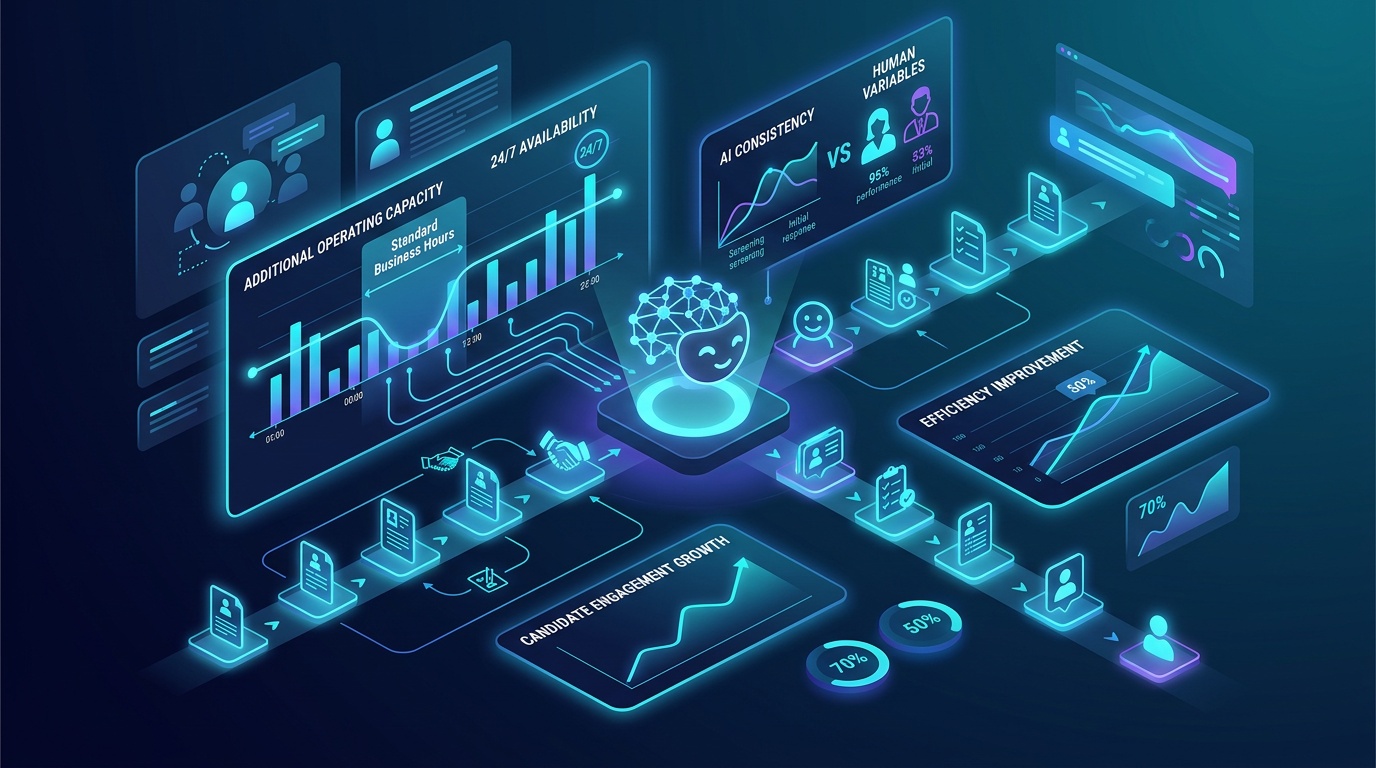
The primary benefit of automation is additional operating capacity. A recruitment chatbot can respond to applicants outside business hours, ask consistent pre-screening questions, identify missing information, and route qualified profiles to the right recruiter. Research compiled by 4Spot Consulting reports that 35% more candidate satisfaction can follow 24/7 automated communication. That outcome depends on useful responses and an easy escalation route, not automation alone.
AI is also effective at structured work that consumes recruiter time without requiring much discretion. It can search application records, organize candidate data, compare qualifications against approved criteria, send reminders, and schedule interviews across calendars. Structured scoring may reduce some forms of unconscious bias by applying the same initial questions and criteria to each applicant. Recruiters still need to audit those criteria, review edge cases, and monitor whether outcomes differ unfairly across groups.
Vynta AI’s Agentic Systems for Recruitment help recruitment firms screen more candidates, schedule more interviews, and place more candidates without expanding the team or increasing administrative costs. The system automates CV processing by collecting and processing applications from multiple job boards including CV Library, Indeed, Reed, TotalJobs, and LinkedIn. AI processes over 100,000 CVs per day and screens candidates in under 10 seconds. The candidate matching accuracy is 85%.
Those capabilities matter only when they connect to recruiter-led decisions. Agentic Systems for Recruitment save approximately 2 hours per hire and reduce the hiring cycle by over 60%. Placements increase by over 50% after implementing the system. Interview coordination is fully automated including scheduling, sending confirmations, reminders, and providing preparation materials to candidates. Recruiters can then spend more time on candidate coaching, client consultation, offer discussions, and relationship management.
Where human recruiters remain essential
A chatbot should not independently handle rejection conversations, sensitive accommodations, complex compensation discussions, or ambiguous professional histories. Human judgment remains necessary when a candidate’s experience does not fit a rigid keyword pattern, when a hiring manager changes priorities, or when trust must be established before a placement decision. This is the central point in any Recruitment chatbots vs human recruiters comparison: efficiency improves when automation supports expertise, not when it conceals decision-making.
How to Choose Recruitment chatbots vs human recruiters comparison
Choose the operating model by mapping each recruitment activity to its required level of judgment, communication, and data sensitivity. A chatbot is a strong fit for application intake, resume parsing, availability checks, frequently asked questions, interview scheduling, reminders, and status updates. Human recruiters should retain responsibility for candidate advocacy, complex screening, compensation discussions, rejection conversations, stakeholder management, and decisions involving incomplete or unusual information. This practical Recruitment chatbots vs human recruiters comparison keeps technology tied to workflow outcomes rather than adopting automation for its own sake.
Start with the process data. Measure application volume, recruiter hours per hire, time to first response, screening completion, interview attendance, candidate drop-off, placement rate, and administrative rework. Then identify where delays occur. If recruiters spend substantial time copying information between job boards, an ATS, email, calendars, and messaging platforms, integration should be a buying requirement. A chatbot that operates outside the ATS can create duplicate records, inconsistent candidate profiles, and additional cleanup. Ask how the system handles CV Library, Indeed, Reed, TotalJobs, LinkedIn, and other approved sources before committing to implementation.
| Evaluation area | What to require from automation | What should remain with recruiters |
|---|---|---|
| Candidate intake | Structured questions, document collection, consent capture, and duplicate detection | Review of unusual applications and clarification of conflicting information |
| Matching | Visible criteria, configurable scoring, source tracking, and audit records | Assessment of transferable skills, motivation, context, and career goals |
| Communication | 24/7 responses, appointment booking, confirmations, reminders, and preparation materials | Relationship building, sensitive feedback, persuasion, and offer discussions |
| Governance | Access controls, reporting, escalation rules, and reviewable decision history | Approval of screening criteria, exception handling, and candidate accountability |
Transparency deserves close attention. Request a demonstration of how the platform extracts qualifications, treats employment gaps, handles multiple job titles, and explains a match recommendation. The system should allow recruiters to edit criteria, inspect source data, override an incorrect result, and record the reason. Test real resumes rather than clean sample files. Garbage parsing, missing certifications, inflated keyword matches, or nonsensical job descriptions can damage recruiter credibility and increase manual work.
Candidate experience should shape the final decision. Provide an obvious path to human assistance, especially for accessibility requests, confidential questions, rejection feedback, and complex career histories. Monitor response quality, escalation time, completion rates, and candidate sentiment after launch. Hilton’s chatbot use, documented by Cadient Talent, illustrates how applicant inquiries can be handled at scale while reducing recruiter workload. The lesson is not to remove people from the process, but to reserve their time for conversations that require trust and judgment.
For agencies seeking an integrated hybrid model, Agentic Systems for Recruitment connect CV processing, candidate engagement, matching, ATS workflows, and interview coordination with recruiter review. Assess the implementation against measurable targets such as hours saved per hire, screening turnaround, interview attendance, database reactivation, and placements. A sensible rollout begins with one workflow, establishes a baseline, audits outcomes for fairness and accuracy, then expands after recruiters and candidates confirm that service quality has improved.
Frequently Asked Questions
Can recruitment chatbots completely replace human recruiters?
No. Chatbots can manage repetitive communication, application intake, basic qualification questions, resume parsing, and interview scheduling. Human recruiters remain accountable for nuanced assessments, candidate advocacy, sensitive feedback, compensation discussions, and hiring-manager relationships. A hybrid model provides greater operational capacity without removing the judgment and empathy required for important career decisions.
Which recruitment tasks do chatbots handle best?
Automation performs well when the process is frequent, structured, and based on clear rules. Suitable tasks include answering common applicant questions, collecting work history, checking availability, identifying missing documents, sending status updates, and coordinating calendars. An ATS-connected system can also reduce duplicate data entry and keep candidate records current. Vynta AI’s Agentic Systems for Recruitment support these workflows through automated CV processing, candidate engagement, and interview coordination.
Which recruitment tasks require human judgment?
Recruiters should lead conversations involving ambiguity, personal circumstances, career motivation, accommodations, rejection feedback, and offer negotiation. They also need to review unusual resumes, challenge questionable match scores, and explain decisions to candidates and clients. Human oversight is especially important when automated data extraction is incomplete or when a candidate’s transferable skills do not fit standard keywords.
How do candidates perceive AI in recruitment?
Candidate reactions depend on service quality and access to human support. Fast answers and round-the-clock updates can improve convenience. Poorly interpreted resumes, repetitive replies, unexplained decisions, or difficulty reaching a recruiter can create frustration and distrust. Research cited by 4Spot Consulting reports a 35% increase in candidate satisfaction with 24/7 automated communication, provided the experience is useful and escalation remains available. Read the research summary.
What is the most effective hybrid recruitment model?
Assign high-volume administrative work to automation, then create defined human checkpoints for screening exceptions, sensitive communication, and final recommendations. Track time to response, data accuracy, interview attendance, candidate satisfaction, and recruiter workload. Vynta AI’s Agentic Systems for Recruitment are designed for this division of responsibility, helping teams increase processing capacity while keeping recruiters responsible for relationships and placement decisions.