

Recommended agentic systems for recruitment workflow
Recruitment teams do not need another dashboard that adds manual work. They need systems that can interpret hiring goals, act across connected tools, and keep recruiters informed when a workflow needs human judgment. The right agentic system should reduce repetitive coordination while preserving the quality, context, and accountability required for candidate decisions.
Key Takeaways
- Effective agentic systems must interpret hiring goals and act across connected tools to minimize manual coordination.
- The ideal solution reduces repetitive tasks while maintaining the necessary context and accountability for candidate decisions.
- Recruiters require technology that alerts them only when human judgment is essential for the workflow.
Adoption is moving in that direction. LinkedIn’s 2025 Future of Recruiting survey, cited by Moveworks, reports that 37% of organizations are actively integrating or experimenting with generative AI, up from 27% in 2024. The practical question is which tasks AI can handle safely and how performance will be measured.
What are recommended agentic systems for a recruitment workflow?
An agentic recruitment system is software that plans and completes multiple related actions toward a hiring objective. It can collect and process applications, screen candidates, match profiles to roles, schedule interviews across time zones, update the applicant tracking system, and notify a recruiter when an exception needs review. The system operates within defined rules, business context, permissions, and success criteria.
TechTarget’s framework, referenced by recruiting industry research, describes four maturity levels: assistive AI, copilots, semi-agentic systems, and fully autonomous agents. This distinction matters during procurement. An assistive tool may suggest a Boolean search, while a semi-agentic workflow can process applications, draft outreach, monitor replies, and route interested applicants. Full autonomy is not automatically appropriate for nuanced screening. Strong deployments assign routine work to software and reserve sensitive decisions, relationship management, and final evaluation for recruiting professionals.
These systems must also cope with imperfect data. Candidate profiles may contain duplicate records, outdated contact details, inconsistent job titles, missing consent information, or notes written in different formats. A useful system can identify anomalies, propose cleanup, preserve an audit trail, and request approval before changing important records. It should report failed actions clearly. An unsent message or unconfirmed interview can cause candidate loss and damage trust faster than a visible error.
What benefits can agentic systems bring to recruitment?
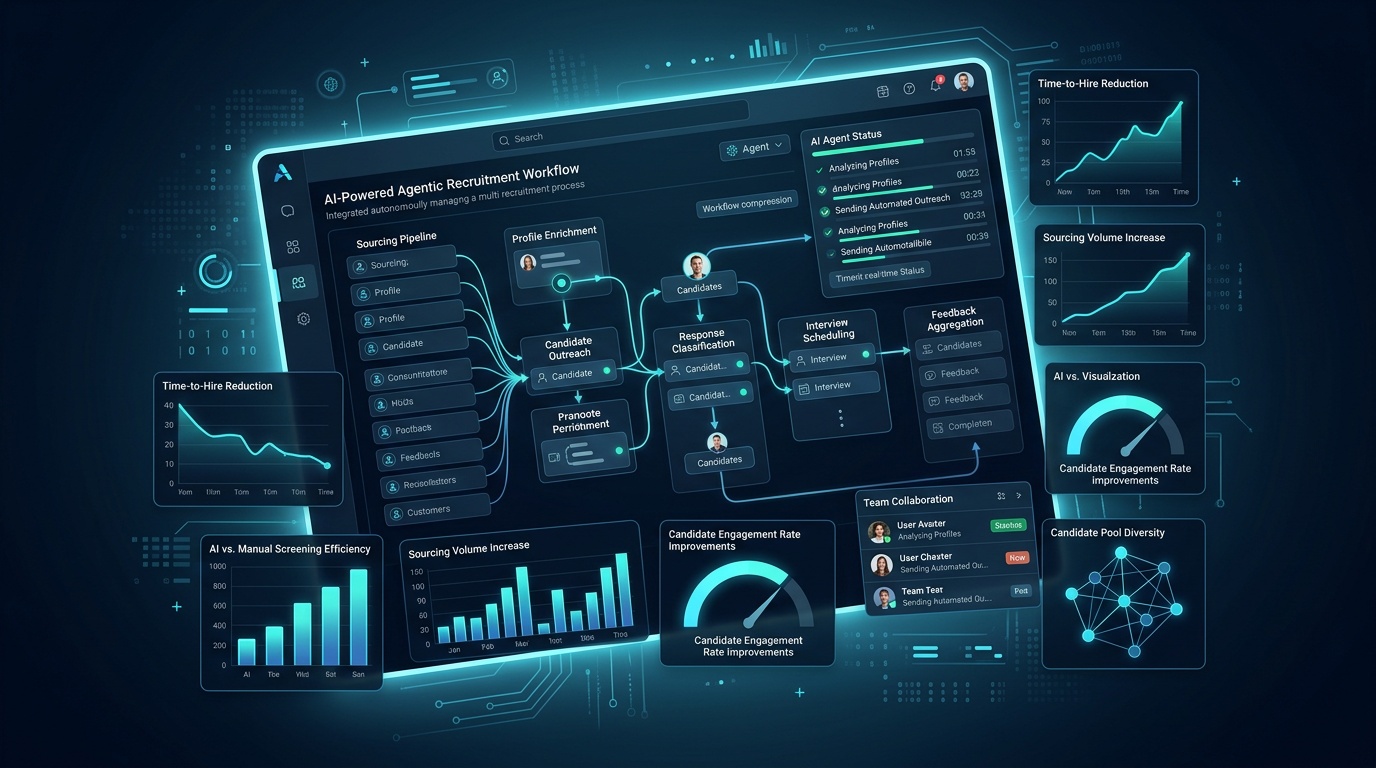
Agentic systems can reduce coordination time across sourcing, profile enrichment, outreach, response classification, interview scheduling, and ATS updates. The business case is stronger when measured through recruiter hours saved, time to qualified shortlist, response completion, scheduling errors, and candidate experience rather than task volume alone. That recovered capacity can support more requisitions without removing recruiters from important conversations.
Scheduling is a practical starting point. An agent can read approved availability, account for time-zone differences, send options, confirm the selected slot, issue reminders, and update the interview stage. If a candidate changes availability, the workflow can reopen the affected step rather than creating a new manual task. Recruiters retain control over interview panels, accommodation requests, and sensitive communications.
Better data quality supports better decisions. AI can normalize job titles, identify duplicate applicants, extract skills from resumes, flag missing fields, and connect historical applicant records to current requisitions. These actions do not determine whether a candidate is qualified. They give recruiters cleaner evidence for screening, search strategy, and pipeline management. Outputs still need a defined evaluation rubric and human review.
The operational benefit also reaches candidates. Timely acknowledgments, relevant follow-up, accurate interview instructions, and consistent status updates remove avoidable friction. Recruiters can spend more time on calibration with hiring managers, candidate advice, offer conversations, and relationship building. Vynta AI applies the same discipline in Agentic Systems for Real Estate, where connected workflows help agencies manage property leads and administration. The principle is consistent: automate repeatable coordination, measure the business outcome, and keep people responsible for judgment.
For mid-market agencies, the strongest case is dependable throughput with manageable oversight, not maximum autonomy. A system should show task status, failed actions, approval points, data permissions, and recovery paths. Vynta AI provides Agentic Systems for Recruitment for CV processing, candidate engagement, interview coordination, and candidate-document generation. The goal is fewer manual handoffs. Not another set of tools for recruiters to supervise.
How should you choose an agentic recruitment system?
Choose a system by mapping one complete hiring process and testing whether it can finish the required steps safely. Start with applicant processing, screening, interview coordination, or ATS updates. Record the systems involved, approval points, data fields, handoffs, and failure risks. This process map shows whether an agent can complete a multi-step objective or only generate isolated text.
Use the four maturity levels identified in recruiting industry research as an evaluation framework: assistive AI, copilots, semi-agentic systems, and fully autonomous agents. Assistive tools provide suggestions, while copilots work alongside recruiters during defined tasks. Semi-agentic systems can plan and execute connected activities under rules and approval controls. Fully autonomous agents act with limited intervention. Mid-market agencies may begin with semi-agentic workflows for repeatable operations, while retaining human review for candidate suitability, compensation discussions, compliance decisions, and relationship-sensitive communication.
| Evaluation area | What to verify | Why it matters |
|---|---|---|
| Workflow control | Defined triggers, permissions, approval steps, and escalation rules | Prevents an agent from taking actions outside its assigned authority |
| Data handling | Duplicate detection, field mapping, consent checks, and change history | Protects ATS accuracy when records are incomplete or inconsistent |
| Failure management | Alerts, retry logic, exception queues, and human handoff | Reduces silent failures that can leave candidates without follow-up |
| Integration freedom | Documented APIs and exportable records | Limits dependence on one vendor or one technology stack |
Test data quality before implementation. Recruitment databases often contain duplicate profiles, outdated resumes, inconsistent job titles, missing source information, and notes that rely on recruiter shorthand. Ask the provider to show how the system identifies these conditions, proposes corrections, preserves the original record, and requests approval before consequential edits. A controlled cleanup process should include field-level permissions, audit logs, rollback options, retention rules, and candidate consent controls.
Match model capability to screening risk. A model may handle message classification or simple status updates, while nuanced screening requires interpretation of transferable skills, career progression, technical context, and ambiguous resume language. The system should apply a documented scoring rubric rather than produce generic evaluations. During a pilot, review factual accuracy, resume evidence, consistency across similar candidates, bias checks, and the explanations shown to recruiters.
Test scheduling under realistic conditions: multiple time zones, changing availability, interviewer conflicts, canceled meetings, calendar permission limits, and candidates who stop responding. A dependable workflow should confirm each booking, record communications, send approved reminders, and route exceptions to a person. Ask what happens when an email fails, a calendar connection expires, or an applicant replies unexpectedly. A visible, recoverable error is safer than a dashboard that conceals a broken action.
Finally, assess ownership and portability. Confirm who controls candidate records, integrations, and performance data. Look for API access, export options, role-based permissions, documentation, and an exit process that preserves recruiting history. Vynta AI’s Agentic Systems for Recruitment work with existing ATS workflows and support CV processing, candidate engagement, interview coordination, and candidate-document generation. For recruitment leaders, the right selection is the system that reduces manual coordination, reports its limits clearly, and leaves recruiters accountable for decisions that require judgment.
References
Frequently Asked Questions
What exactly is an agentic AI system in recruitment?
An agentic AI system is software that can pursue a defined recruiting objective across several connected steps. It may process applications, assess profiles against a structured rubric, draft outreach, classify replies, schedule interviews, update records, and alert a recruiter when judgment is required. This differs from a basic text-generation tool, which usually completes one prompt at a time. The Recommended agentic systems for recruitment workflow should operate within permissions, document completed actions, and make exceptions visible rather than presenting automation as a substitute for recruiter accountability.
How do AI agents handle interview scheduling across time zones?
A properly configured agent reads approved availability from candidate and interviewer calendars, identifies overlapping time windows, and presents options in the correct local time. After a candidate selects a slot, it can create the meeting, send the appropriate instructions, record the confirmation, and issue reminders. More advanced workflows can respond to cancellations, interviewer conflicts, or changed availability by reopening only the affected scheduling step. Recruiters should verify calendar permissions, daylight-saving behavior, time-zone labeling, cancellation handling, and escalation rules before production use. Every booking should generate an audit record that confirms the action and its status.
How can a recruitment team avoid vendor lock-in?
Start by confirming ownership and portability before signing an agreement. Candidate records, activity history, prompts, workflow rules, evaluation criteria, and performance data should be exportable in usable formats. Documented APIs, standard webhooks, role-based access, and independent integration credentials give an agency more control over its technology stack. Ask what happens if an integration is discontinued, a model changes, or the subscription ends. Vynta AI’s Agentic Systems for Recruitment work with existing ATS workflows while automating recruitment tasks.
What happens when an AI agent encounters an edge case?
The system should pause the affected action, preserve the available context, and assign a clear task to a recruiter or operations manager. Examples include ambiguous work authorization, conflicting candidate information, an unusual compensation structure, a failed email delivery, or a calendar connection that has expired. Safe handling requires retry limits, exception queues, error notifications, and a human handoff. Silent failure is more damaging than a visible interruption because an unreported issue can leave a candidate without communication. During testing, request evidence that failed actions are logged and that staff can recover or replay them safely.
Can AI agents clean messy ATS data and past applicant records?
Yes, an agent can help identify duplicate profiles, normalize job titles, extract missing skills, flag outdated contact details, and connect historical applicants with current requisitions. It should not make unrestricted changes to sensitive records. A controlled cleanup process compares source fields, shows proposed edits, retains the original value, and asks for approval when confidence is low. Consent status, retention policy, source attribution, and candidate communication history also require attention. Treat data cleanup as a governed operation, not a one-time sweep, because new inconsistencies appear whenever recruiters enter notes or import records from another system.
What model capability is appropriate for nuanced candidate screening?
Model selection should match the complexity and risk of the task. A model may be sufficient for routing replies, identifying an interview confirmation, or checking whether a required field is present. Nuanced screening demands careful review of career progression, transferable skills, technical terminology, employment context, and incomplete evidence. Models still need a job-specific rubric, source citations from the resume, consistency checks, and human review. The goal is not an impressive-sounding evaluation. It is a defensible recommendation that helps a recruiter decide what to examine next.
What should success look like after implementation?
Measure operational outcomes rather than activity volume alone. Useful indicators include time from requisition to qualified shortlist, recruiter hours spent on coordination, response completion, scheduling errors, record accuracy, exception volume, candidate withdrawal, and hiring-manager satisfaction. Review whether automation reduces mental load or merely distributes it across more screens and alerts. Vynta AI applies the same outcome-focused discipline through Agentic Systems for Real Estate, where workflows are assessed by productivity, pipeline quality, and service results. Recruitment leaders should use the same standard: retain human ownership, expose system limits, and expand automation only after the initial workflow performs reliably.