

AI recruitment tools vs traditional ATS systems
AI recruitment tools vs traditional ATS systems comes down to the work each system performs. An applicant tracking system stores applications, requisitions, interview stages, and compliance records. AI recruitment software interprets candidate information, supports prioritisation, prepares communication, and coordinates workflows. For mid-market recruitment firms, a practical model combines both: the ATS remains the system of record while AI reduces manual work and supports recruiter judgment.
Key Takeaways
- AI recruitment tools vs traditional ATS systems comes down to the work each system performs.
- An applicant tracking system stores applications, requisitions, interview stages, and compliance records.
- AI recruitment software interprets candidate information, supports prioritisation, prepares communication, and coordinates workflows.
That distinction matters when candidate volume grows faster than the team. An ATS provides process discipline; an AI layer can reduce screening fatigue, identify relevant experience behind unfamiliar job titles, and maintain timely candidate communication. Neither system should make an unreviewed employment decision. Recruiters still own evaluation, relationship management, and selection.
What is the difference between AI recruitment tools and traditional ATS systems?
A traditional ATS is mainly a system of record. It receives applications, parses resumes, tracks candidate status, schedules interviews, stores evaluation notes, and supports reporting. Search and filtering often rely on predefined fields, Boolean logic, job titles, qualifications, and keyword matches. That structure supports auditability and coordination, but it may miss qualified people whose resume language differs from the requisition.
AI recruitment tools assess candidate information in context. Depending on the workflow, they can extract skills from employment history, compare evidence with a role scorecard, summarise interviews, suggest follow-up questions, draft personalised messages, and rank profiles for recruiter review. AI compresses evidence; people make the decision. The model should support an agreed evaluation framework rather than replace it.
The difference appears in daily work. A recruiter using only an ATS may export a long list, inspect resumes individually, and send status updates by hand. An AI-assisted process can identify related skills, flag missing evidence, prepare a structured candidate summary, and trigger an approved follow-up while the recruiter remains responsible for outreach and selection. Research from The Hire Hub reports that 72% of enterprise talent teams use AI-powered sourcing or screening alongside an ATS.
What are the benefits of AI recruitment tools compared with traditional ATS systems?
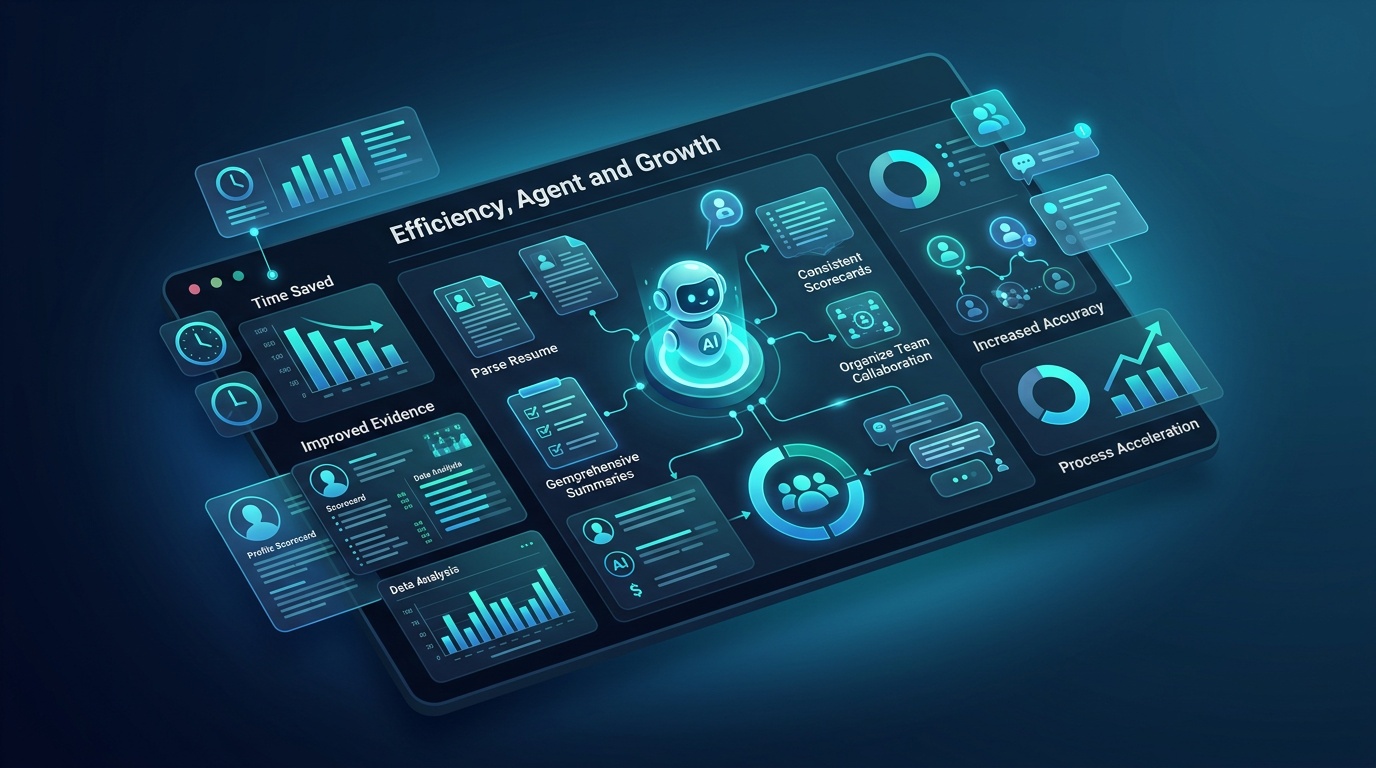
AI recruitment tools can give recruiters time back and improve the evidence available for review. They can prepare summaries, apply consistent scorecards, organise talent pools, and draft messages for approval. The relevant measures include time to shortlist, recruiter hours per vacancy, response rates, interview completion, candidate rediscovery, and quality of hire. Not the number of automated features.
The first gain is reduced administration. Resume review, candidate categorisation, interview coordination, reminders, disposition notes, and repetitive email can consume much of a recruiter’s week. The Hire Hub reports that recruiters spend 60% of their time on administrative work. Preparing these tasks for approval gives recruiters more capacity for intake meetings, candidate conversations, client advice, and relationship building.
AI can also improve candidate discovery. Traditional filters may miss a strong applicant because of different job titles, resume formatting, synonyms, or an unconventional career path. Research from SelectPrism states that 88% of employers believe qualified candidates are screened out because of resume formatting issues. Context-aware parsing can connect transferable skills, project outcomes, certifications, seniority, and industry experience before a recruiter reviews the profile. Validation remains necessary.
Candidate communication is another practical use. An AI agent can acknowledge an application, answer approved process questions, request missing information, suggest available interview times, and prepare follow-ups based on candidate status. Guardrails should define approved language, escalation rules, privacy controls, opt-out handling, and the point at which a recruiter takes over.
Key Insight: AI Supports Hiring Decisions; It Does Not Own Them
Judge an AI workflow by its effect on hiring operations, not by the presence of an “AI” label. A useful system should show whether it improves shortlist speed, recruiter capacity, response rates, candidate rediscovery, interview completion, or quality of hire. Basic keyword matching presented as advanced intelligence will not solve screening fatigue or inconsistent ranking.
AI works best when connected to the existing recruitment process. The ATS can remain the source of truth for requisitions, consent, status history, and compliance documentation, while an AI layer handles sourcing, matching, summarisation, and engagement. Before launch, define permissions, data mapping, hiring-manager training, bias monitoring, escalation rules, and KPI tracking.
Vynta AI is a service, not pre-built software. Its AI Agent Development service designs, builds, and deploys custom AI agents that automate complex workflows and execute tasks autonomously, with human oversight, ongoing monitoring, technical support, training, and optimization. Its System Integration services connect existing tools and platforms, including custom API development and data transformation, to eliminate data silos and enable real-time data synchronization. Workflow Automation creates intelligent automated workflows with exception handling and decision-making capabilities. Communication Automation includes multi-channel messaging, conversational AI, SMS and WhatsApp integration, and personalized content generation. Performance Intelligence provides automated analytics including anomaly detection, predictive trend analysis, and AI-generated recommendations. The service model includes discovery and assessment, expert implementation within weeks, phased deployment planning, continuous results monitoring and optimization, technical support, team training, and optimization reviews to help businesses increase revenue, reduce costs, and improve efficiency without expanding their team. Vynta enables engagement for Real Estate, Recruitment, Fundraising, and Hospitality. Human review and ongoing support remain part of responsible operation.
How should you choose between AI recruitment tools and traditional ATS systems?
Choose based on the bottleneck, not the product label. An ATS may be enough for requisition management, resume storage, interview scheduling, compliance documentation, and basic reporting. An AI-enabled workflow is worth testing if recruiters lose hours to screening, candidate rediscovery, repetitive outreach, or inconsistent qualification decisions. Start by measuring time to shortlist, applications reviewed per role, response rates, interview completion, source quality, and administrative hours.
Next, assign responsibilities clearly. The ATS should remain the authoritative record for candidate consent, requisition status, communication history, interview stages, and disposition reasons. AI can analyse resumes, identify related skills, summarise evidence, suggest scorecard criteria, prioritise profiles, and prepare personalised follow-ups. Ask vendors to demonstrate the workflow with anonymised examples from your process.
Test how the system handles employment gaps, adjacent job titles, transferable skills, incomplete resumes, duplicate profiles, internal candidates, and withdrawn applicants. Keyword matching alone is not enough. The tool should expose the evidence behind a recommendation so recruiters can challenge, correct, or disregard it.
For a focused comparison of recruiting platforms and capabilities, review recruitment software comparison criteria alongside your own workflow requirements.
Buying Principle: Test Evidence Before Promising Efficiency
Assess an AI workflow through a controlled pilot. Give it a defined role scorecard, a representative candidate pool, and clear human review rules. Compare shortlist relevance, missed qualified candidates, reviewer agreement, time per application, and communication turnaround. The objective is not to let software select people without oversight. AI compresses evidence, humans make the call.
Data handling needs equal attention. Confirm where resumes, interview notes, assessments, and messaging records are stored; which information supports model improvement; how access is controlled; and how records are deleted. Review audit logs, role-based permissions, encryption, consent management, retention settings, and integrations with your recruiting CRM, email, calendar, job boards, and HR system.
Ask how the Vynta service identifies potential bias and whether recruiters can inspect the evidence behind a recommendation. An unexplained ranking can create governance risk, particularly if hiring managers treat an automated score as a final judgment. Human review needs to be part of the workflow, not an informal promise made during a sales conversation.
Implementation planning often determines the business case. SelectPrism reports that 78% of ATS implementation projects exceed their budgets and timelines, so integration scope, data migration, training, and ownership deserve close review. Request a written rollout plan covering discovery, workflow design, configuration, testing, recruiter training, launch support, and KPI reviews. For teams needing support with connected workflows, AI automation services can assist with process discovery, integration, and deployment.
Evaluate commercial terms against measurable output. Clarify implementation fees, user licenses, candidate-volume charges, API access, support levels, contract length, and costs for additional workflows. Estimate value from reduced review time, faster candidate responses, improved interview attendance, stronger source conversion, and increased recruiter capacity. Set a post-pilot review point and stop workflows that fail agreed standards.
For mid-market recruiting teams, a practical choice may be to connect structured records with AI assistance for sourcing, screening, engagement, and coordination rather than replace the ATS. A small pilot with defined safeguards will reveal more than a feature checklist. What matters is whether recruiters can make better decisions, move qualified candidates faster, and maintain a fair, auditable process.
References
-
Data handling. Regulation (EU) 2024/1689, the EU Artificial Intelligence Act.
Frequently Asked Questions
What is the fundamental difference between an AI recruitment tool and a traditional ATS?
A traditional applicant tracking system primarily stores and organizes recruiting information. It manages job requisitions, applications, resumes, interview stages, status changes, and compliance records. An AI recruitment tool adds interpretation and workflow assistance. It can identify related skills, summarize candidate evidence, compare experience against a role scorecard, recommend profiles for review, and draft candidate communications. AI should support consistent evaluation while qualified recruiters retain responsibility for hiring decisions.
Can AI recruitment tools completely replace an ATS?
An ATS can provide the structured system of record needed for requisition ownership, candidate consent, interview history, disposition reasons, reporting, and audit trails. AI can operate alongside that foundation, assisting with sourcing, resume analysis, candidate rediscovery, interview summaries, scheduling, and follow-up.
What are the biggest pain points of traditional ATS systems?
Recruiters commonly experience rigid keyword filters, duplicate data entry, slow search, poor resume parsing, limited candidate rediscovery, and excessive status administration. A strong candidate may become difficult to find because the person uses a different job title, describes skills with unfamiliar terminology, or submits a resume with an unusual format.
How do AI tools handle candidate engagement and follow-ups?
AI-supported recruiting workflows can acknowledge an application, answer approved process questions, request missing information, suggest interview times, send reminders, and prepare personalized follow-ups based on candidate status. Effective controls are essential, including approved messages, escalation conditions, communication frequency, opt-out handling, and human review.
What is the cost comparison between an ATS and AI recruitment tools?
Cost depends on user licenses, candidate volume, implementation services, integrations, support, data migration, and workflow complexity. Calculate value through time to shortlist, recruiter capacity, response speed, interview attendance, and quality of hire.
How should a recruiting team evaluate an AI workflow before adoption?
Start with a limited pilot using a representative role, a defined scorecard, anonymized candidate records, and clear human review rules. Compare recommendations with recruiter judgment, examine missed qualified candidates, reviewer agreement, time per application, and communication turnaround, and confirm that administrators can audit activity.