

Top providers of agentic recruitment solutions
Recruiting teams need more than another isolated tool. They need connected support for sourcing, qualification, outreach, scheduling, and candidate follow-up. The top providers of agentic recruitment solutions are distinguished by how well their AI agents complete those workflows while keeping recruiters responsible for judgment, communication, and hiring risk. Organizations assessing these capabilities can review agentic systems for recruitment designed around connected processes.
Key Takeaways
- Agentic recruitment platforms deliver the most value when they connect the entire hiring workflow rather than functioning as isolated point tools.
- The leading vendors balance AI automation with human oversight so that recruiters stay accountable for final decisions and relationship building.
- Mid-market companies evaluating recruitment automation should prioritize solutions that support sourcing, qualification, outreach, scheduling, and candidate follow-up within a single connected system.
- Successful agentic recruitment tools handle repetitive operational tasks while keeping strategic judgment and communication firmly in the hands of human recruiters.
Agentic recruitment is most useful where hiring volume, speed, and consistency affect revenue. An AI agent can search talent databases, identify passive candidates, review prior applicants, draft outreach, coordinate interviews, and update applicant tracking records. Recruiters remain responsible for decisions involving fit, context, and candidate relationships. The technology handles repeatable execution so experienced people can focus on clients and quality placements.
What are agentic recruitment solutions?
The top providers offer AI agents that can plan and carry out multiple recruiting tasks across one connected process. Unlike basic search or chatbot software, an agentic system can move from a hiring brief to candidate discovery, profile analysis, outreach, response handling, interview scheduling, and workflow updates. Its value depends on reliable integrations, approval controls, relevant matching, and measurable gains in recruiter capacity.
Market offerings vary by workflow and data coverage. hireEZ reports sourcing automation across more than 45 platforms. SeekOut is positioned around candidate evaluation and interview readiness. Buyers should verify each claim against the provider’s methodology, the roles they recruit for, and an internal baseline.
AI agents do not remove the need for recruiters. They support talent mapping, candidate engagement, resume screening, interview coordination, compliance review, and pipeline administration while people provide context and oversight. Before launch, define permission levels, audit trails, data retention, bias monitoring, and escalation rules.
What benefits can agentic recruitment solutions deliver?
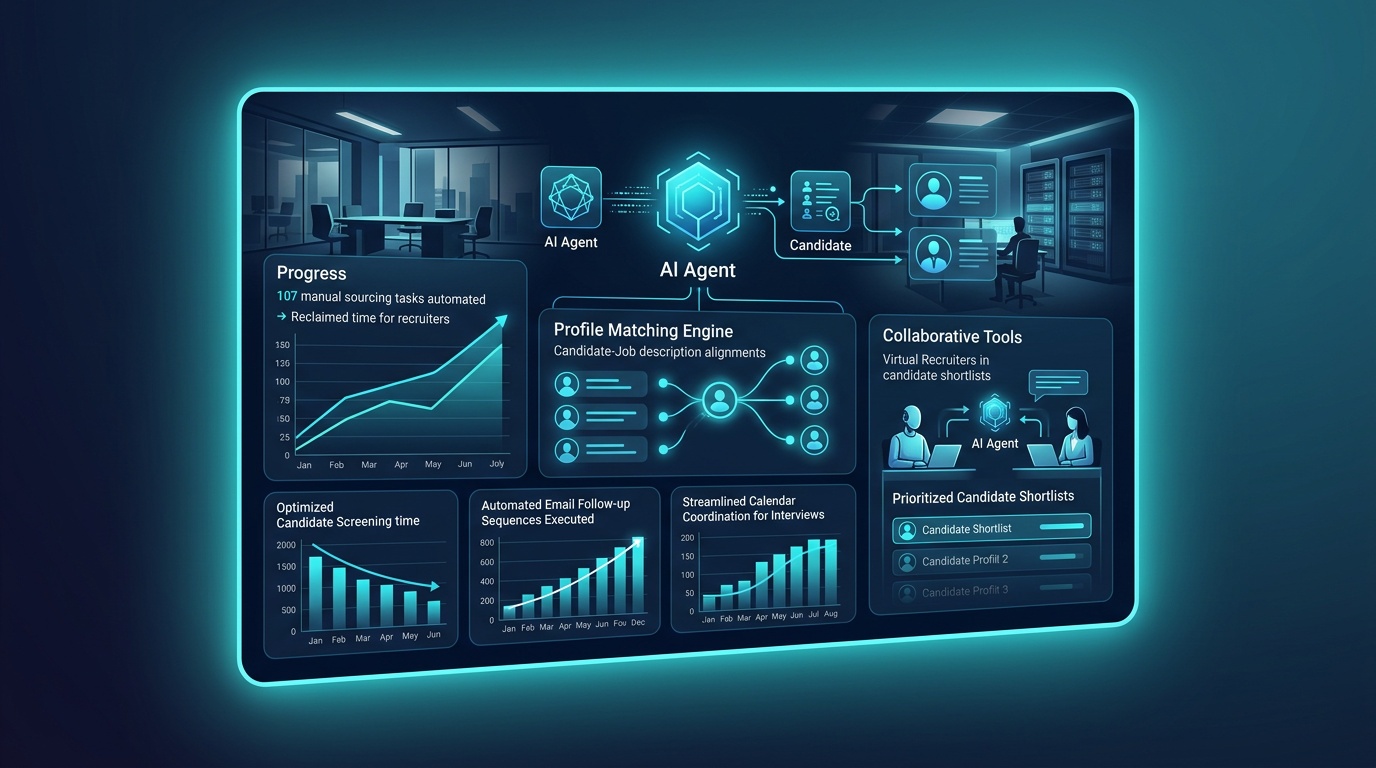
The clearest benefit is reclaimed recruiter time. Sourcing, duplicate profile review, follow-up emails, calendar coordination, and applicant rediscovery can consume hours without improving candidate quality. Agentic workflows perform those steps continuously, then present qualified profiles and exceptions for review. The business case is strongest when saved time becomes better intake conversations, faster shortlists, stronger client communication, and additional placements.
These systems can also widen access to relevant talent. AI can compare skills, experience, location, seniority, availability, and adjacent qualifications across internal and external datasets. That does not make every match suitable. It gives recruiters a broader, more structured starting point and reduces dependence on one job board or a manually maintained spreadsheet.
Timely messages, status updates, reminders, and scheduling support can make the candidate experience more consistent. That matters for staffing firms managing several clients and for internal teams facing seasonal demand. Shared records across sourcing, outreach, applicant tracking, calendars, communication, and reporting can also reduce duplicate administration.
The right provider should connect domain context, AI execution, human review, and reporting around a defined result. Vynta AI takes this outcome-first approach in its custom automation work. In real estate, its workflow connects inquiry capture, qualification, property matching, calendar coordination, reminders, and post-viewing feedback across WhatsApp, SMS, email, and website chat. Recruitment buyers should expect the same clarity: a documented process, defined approval points, and KPIs tied to revenue or delivery capacity.
How should you choose among agentic recruitment solution providers?
Start with the recruiting bottleneck that affects revenue or delivery capacity: sourcing passive candidates, screening high applicant volume, coordinating interviews, reactivating past applicants, or managing client updates. Record a baseline for time to shortlist, recruiter hours per requisition, response rates, interview completion, and placement performance. A provider should show how its agents improve those measures while recruiters retain control over evaluation and hiring decisions.
Workflow coverage should be the first buying criterion. Ask whether the system can interpret a hiring brief, search relevant sources, identify matching profiles, draft personalized outreach, manage replies, schedule interviews, and update the applicant tracking system. Confirm which actions run automatically and which require approval. API access, native integrations, data synchronization, permissions, audit logs, and escalation rules matter as much as search quality.
| Evaluation area | What to verify | Why it affects results |
|---|---|---|
| Sourcing reach | Supported databases, professional networks, internal talent pools, and past applicants | Wider access can improve passive-candidate discovery and reduce dependence on one channel |
| Workflow execution | Search, ranking, outreach, response handling, scheduling, and ATS updates | Connected actions reduce handoffs and repetitive recruiter administration |
| Human oversight | Approval gates, editable messages, review queues, permissions, and audit history | Recruiters retain judgment over fit, communication, compliance, and hiring risk |
| Integration quality | ATS, CRM, email, calendar, messaging, reporting, and API compatibility | Shared records prevent duplicate work and fragmented candidate activity |
| Commercial model | Seats, usage, workflow volume, implementation services, and contract terms | Total cost can differ substantially from the advertised subscription price |
Vynta AI, industry-specific workflow automation
Best for: Mid-market organizations that want outcome-led automation designed around a specific operating process.
Vynta AI designs, builds, and deploys custom AI agents and workflow automation solutions; it is not a pre-built software product. Its approach assigns suitable tasks to AI agents and gives people clear review points. That model suits organizations seeking discovery, implementation, reporting, and ongoing process refinement rather than a software license with limited operational guidance. Teams seeking tailored implementation can review Vynta AI’s AI automation services.
SeekOut, candidate evaluation at scale
Best for: Teams that need broad candidate evaluation and a faster route from sourcing to interview readiness.
SeekOut may suit organizations with substantial search volume and a need to assess many profiles efficiently. Test its performance against representative requisitions, geographies, seniority levels, and compliance requirements. The buying question is whether evaluation capacity produces qualified shortlists, not simply more profiles.
hireEZ, multi-source talent discovery
Best for: Recruitment teams seeking automated sourcing across a wide range of talent channels.
hireEZ reports sourcing automation across more than 45 platforms on its agentic AI page. That reach may help teams search beyond one database, compare candidate information, and reduce browser-based research. During a demonstration, request a complete workflow using a real or anonymized requisition. Check data freshness, duplicate handling, search transparency, outreach controls, ATS synchronization, and reporting. A large source count matters only when profiles are relevant, contactable, and easy to review.
Before signing, run a structured pilot with representative roles and agreed success measures. Include recruiters, hiring managers, operations, and IT. Track qualified candidates per requisition, manual research time, outreach response quality, scheduling effort, data accuracy, and recruiter acceptance of recommendations. Also review security controls, candidate consent, bias testing, retention policies, support ownership, and implementation requirements. For a broader comparison framework, see this recruitment solutions comparison guide.
References
- https://www.nist.gov/itl/ai-risk-management-framework
- https://eur-lex.europa.eu/eli/reg/2024/1689/oj
Frequently Asked Questions
What is agentic AI in recruiting?
Agentic AI in recruiting refers to software that can complete connected talent acquisition tasks with limited manual direction. Instead of only returning search results or answering candidate questions, an AI agent can interpret a hiring brief, identify potential candidates, compare qualifications, draft outreach, manage replies, coordinate interviews, and record activity in an applicant tracking system. Recruiters define the rules, review important decisions, and handle conversations that require judgment. The system takes care of repeatable work across sourcing, screening, engagement, scheduling, and pipeline administration.
How does agentic AI improve the hiring process?
Its practical value comes from reducing delays and administrative workload at several points in the hiring process. Automated search can identify passive candidates and rediscover qualified people from earlier applicant pools. Profile analysis can organize large volumes of applications against job requirements, while personalized outreach supports timely engagement. Scheduling agents can coordinate calendars, send reminders, and update records without extended email exchanges. These capabilities help recruiters spend more time on candidate relationships, hiring manager communication, interview quality, and offer management. Outcomes still depend on accurate job criteria, appropriate review controls, clean data, and thoughtful workflow design.
Which platform is best for high-volume hiring?
The best choice depends on the sources a team needs, the roles it fills, and the amount of human review required. A platform with broad sourcing coverage, automated screening, message handling, interview coordination, and applicant tracking integration is generally better suited to high-volume hiring than a standalone resume search tool. Buyers should test the system using representative requisitions and measure qualified candidates per role, recruiter review time, response quality, interview completion, and data accuracy. High-volume teams also need permission settings, audit records, escalation paths, and controls that prevent unsuitable automated communication.
How should buyers compare features and pricing?
Compare complete workflow costs rather than subscription prices alone. Review the number of users, candidate searches, outreach volume, automated actions, implementation services, integration work, support, and contract requirements. Then map each platform against the activities that consume internal time. A lower-priced tool may offer search but leave recruiters responsible for manual outreach, scheduling, reporting, and record updates. A broader system may justify its cost when it reduces recruiter hours per requisition and improves delivery capacity. Ask vendors to provide a transparent estimate based on your hiring volume, role mix, geographic coverage, and existing technology stack.
Can agentic AI replace recruiters?
Agentic AI is designed to assist recruiters, not remove human responsibility from hiring. Talent professionals provide context about team culture, candidate motivation, client expectations, compensation, and career development that automated systems cannot fully assess. They also review recommendations, approve sensitive messages, manage complex negotiations, and make decisions involving fit and risk. The most useful implementation assigns repetitive work to AI while reserving relationship-driven and judgment-based activities for people. This division can increase recruiter capacity without reducing accountability or weakening the candidate experience.
What should a recruitment team plan before implementation?
Begin with a documented process map and a clear baseline. Record how recruiters currently source, screen, contact, schedule, and update candidates, then identify the delays and duplicate steps that automation should address. Confirm data permissions, candidate consent, security requirements, bias monitoring, retention rules, and integration ownership before launch. A phased pilot is usually more informative than a broad rollout because it reveals how the system performs with real requisitions and recruiter behavior. Set review points for data quality, candidate feedback, hiring manager satisfaction, time savings, and placement outcomes. Continuous tuning is needed as job requirements, labor conditions, and business priorities change.