

Recommended AI recruitment tools for staffing agencies
Staffing agencies face mounting pressure to accelerate hiring cycles while improving candidate quality. The adoption of AI recruitment tools has proven essential in addressing these challenges by automating routine tasks, refining candidate matching, and streamlining workflows. This article highlights the recommended AI recruitment tools for staffing agencies, focusing on solutions that deliver measurable business outcomes across diverse agency sizes and hiring volumes.
Key Takeaways
- AI recruitment technology resolves the traditional tradeoff between hiring speed and candidate quality that staffing agencies face.
- Agencies should evaluate AI tools based on their capacity to deliver measurable results rather than adopting technology for its own sake.
- Solutions must scale effectively across different agency sizes and hiring volumes to provide long-term value.
- Automation of administrative work frees recruiters to focus on relationship building and strategic placement decisions.
Choosing the right AI recruitment technology requires understanding the distinction between true AI-native platforms and legacy systems with bolt-on AI features. This foundation sets the stage for selecting tools aligned with operational goals and integration needs.
The AI Recruitment Stack: Moving Beyond Traditional ATS Add-ons
AI-Native Platforms vs. Bolt-on ATS Features
Traditional Applicant Tracking Systems (ATS) often supplement their core functionality with AI features such as keyword parsing or automated resume screening. These bolt-on capabilities provide incremental improvements but fall short of delivering transformative automation. AI-native recruitment platforms, by contrast, are built from the ground up with machine learning models and automation workflows tailored to recruitment needs, enabling faster and more accurate candidate sourcing, screening, and engagement.
Bolt-on AI features frequently suffer from limited integration depth and outdated data models, leading to inefficiencies and fragmented candidate databases. In contrast, AI-native platforms consolidate candidate data in real-time, allowing continuous learning and optimization across the hiring pipeline. This difference directly impacts key performance indicators such as time-to-hire and candidate matching accuracy, where AI-native systems have demonstrated reductions in hiring cycle time by over 50% and matching improvements exceeding 70% according to industry reports (source).
Building a Cohesive Recruitment Workflow
Implementing AI tools is not simply a matter of adding software but involves redesigning recruitment workflows to capitalize on automation and analytics. A cohesive AI recruitment stack integrates candidate sourcing, screening, engagement, interview scheduling, and reporting into a unified system that reduces manual handoffs and data silos.
Agentic Systems for Recruitment exemplify this approach by automating CV processing from multiple job boards, screening candidates with an 85% accuracy rate in under 10 seconds, and managing 24/7 candidate communication via platforms like WhatsApp Business API. This end-to-end automation decreases administrative overhead by approximately 33% and shortens the hiring cycle by more than 60%. Crucially, it also reactivates dormant ATS databases with an 18% success rate, turning previously lost candidates into active prospects (Agentic Systems for Recruitment).
Top Recommended AI Recruitment Tools for Staffing Agencies
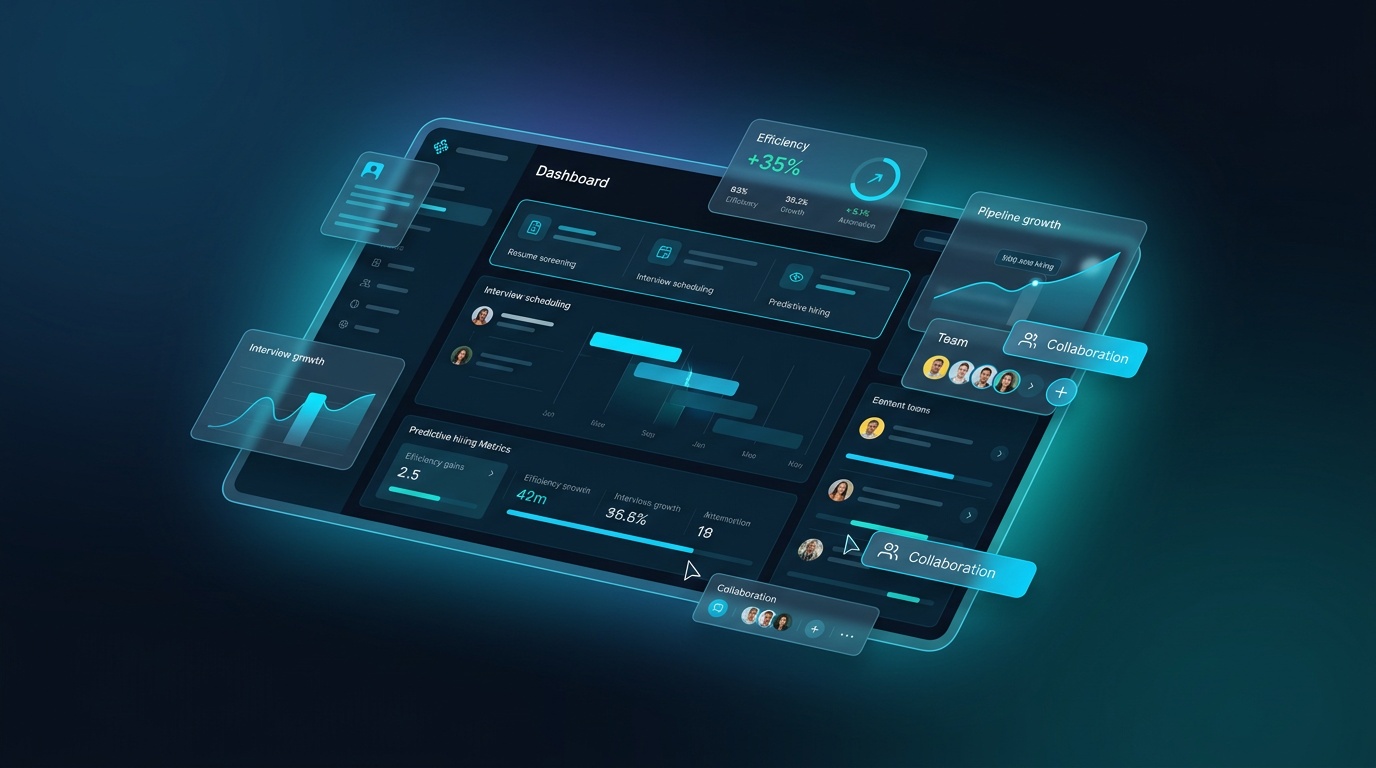
Best for Enterprise Agencies and High-Volume Hiring
Agentic Systems for Recruitment – Comprehensive Automation and Scale
Best for: Large staffing agencies managing high-volume recruitment across multiple verticals seeking measurable time and cost savings.
Agentic Systems for Recruitment provide a fully automated candidate management experience that processes over 100,000 CVs daily, achieving candidate matching accuracy of 85%. The system automates interview scheduling, candidate engagement, and branded documentation generation, saving approximately two hours per hire and increasing placements by over 50%. Integration with major job boards and ATS platforms ensures data consistency and eliminates silos. Pricing is tailored based on volume and integration scope, reflecting its enterprise-grade capabilities.
Eightfold AI – Talent Intelligence at Scale
Pros
- Advanced talent intelligence that predicts candidate success
- Deep integration with enterprise ATS and HRIS systems
- Strong analytics for workforce planning
Cons
- High cost may limit accessibility for mid-market agencies
- Complex implementation requiring dedicated IT resources
HireVue – AI-Powered Video Interviewing
- Integrates AI-driven candidate assessment through video interviews
- Scales well for volume hiring with automated scheduling
- Provides insights on candidate soft skills and fit
- Limited sourcing and CRM capabilities
- May require additional ATS integration for end-to-end workflows
Best for Mid-Market and Boutique Staffing Firms
Vervoe – Skills-Based Candidate Assessment
Best for: Agencies focused on quality hires with specialized skills assessment needs.
Vervoe offers AI-assisted skills testing and predictive hiring assessments that help agencies reduce unqualified applicants. Its user-friendly interface supports customization for niche roles, and pricing scales with usage, making it accessible for mid-sized teams. Integration with popular ATS platforms facilitates data continuity.
SmartRecruiters – Collaborative AI Recruiting
- AI-powered candidate scoring and matching
- Strong collaboration features for hiring teams
- Customizable workflows for boutique agency needs
- Limited advanced automation compared to enterprise-focused tools
- Some features require premium add-ons
Hiretual (now HireEZ) – AI Sourcing and Candidate Engagement
Best for: Agencies needing efficient candidate sourcing from diverse channels with automated outreach.
Hiretual uses AI to aggregate candidate profiles across job boards and social networks, automating initial engagement and nurturing. It offers integrations with ATS and CRM systems, improving candidate pipeline velocity. Pricing is flexible, suitable for agencies scaling their sourcing efforts.
| Tool | Primary Strength | Ideal Agency Size | Key Features | Pricing Model |
|---|---|---|---|---|
| Agentic Systems for Recruitment | End-to-end automation and AI accuracy | Enterprise, High-volume | Automated CV processing, 24/7 candidate engagement, interview scheduling | Custom, volume-based |
| Eightfold AI | Talent intelligence and workforce analytics | Enterprise | Predictive hiring, ATS/HRIS integration | Enterprise licensing |
| HireVue | AI-driven video interviewing | Enterprise, Mid-Market | Automated interview scheduling, candidate assessment | Subscription-based |
| Vervoe | Skills assessment and predictive hiring | Mid-Market, Boutique | Customizable tests, ATS integration | Usage-based |
| SmartRecruiters | Collaborative AI recruiting | Mid-Market, Boutique | Candidate scoring, team collaboration | Tiered subscription |
| Hiretual (HireEZ) | AI sourcing and engagement | Mid-Market | Candidate aggregation, automated outreach | Flexible subscription |
A Selection Framework Based on Agency Size and Specialization
Must-Have Features for Small, Mid-Market, and Enterprise Agencies
Selecting the right AI recruitment tool depends heavily on the size and specialization of the staffing agency. Small agencies often prioritize simplicity and cost-effectiveness, seeking tools that automate repetitive admin tasks like candidate screening and interview scheduling without requiring complex IT setups. Features such as intuitive candidate ranking, resume parsing, and automated outreach can dramatically reduce manual workload while improving candidate quality.
Mid-market agencies balance volume with specialization, requiring AI platforms that offer advanced candidate matching algorithms tailored to niche roles, alongside integrations with Applicant Tracking Systems (ATS) and Customer Relationship Management (CRM) platforms. These agencies benefit from features like skills assessments, predictive analytics on candidate success, and multi-channel communication automation to maintain candidate engagement without expanding teams.
Enterprise agencies need scalable AI recruitment solutions capable of processing high volumes of applications across multiple industries simultaneously. They demand sophisticated talent intelligence, deep data analytics, and workflow customization. Systems like Agentic Systems for Recruitment excel here by automating CV processing from various job boards, screening candidates with 85% accuracy in under 10 seconds, and coordinating interview scheduling and candidate communication 24/7. These capabilities reduce hiring cycle times by over 60% and boost placements by more than 50%, addressing the complex needs of large-scale operations.
Evaluating ATS and CRM Integration Capabilities
Smooth integration with existing ATS and CRM platforms is fundamental for any staffing agency adopting AI recruitment tools. Without proper integration, agencies risk creating data silos that fragment candidate information and impede workflow efficiency. When evaluating solutions, consider whether the AI system can synchronize bidirectionally with your ATS, ensuring live updates of candidate statuses, interview feedback, and placement records.
Additionally, integration with CRM systems enhances candidate relationship management by automating personalized outreach and nurturing campaigns. Platforms that support multi-channel communication, including email, SMS, and messaging apps like WhatsApp Business API, enable continuous engagement without manual intervention. This 24/7 candidate engagement drives higher response rates, reduces drop-offs, and reactivates dormant candidate pools with measurable success, as documented by Agentic Systems for Recruitment’s 18% dormant database reactivation rate.
When assessing integration capabilities, verify the vendor’s support for your existing software stack, data security protocols, and the flexibility to customize workflows for your agency’s unique processes. Prioritize tools that offer open APIs or native connectors to your ATS and CRM to maximize operational efficiency and maintain data integrity.
Measuring the ROI of AI Recruitment Technology
Key Performance Indicators for Staffing Agencies
Staffing agencies require objective metrics to justify investments in AI recruitment tools. Key Performance Indicators (KPIs) that reliably demonstrate business impact include time-to-hire, cost-per-hire, placement rates, and candidate quality scores. AI adoption has been associated with a 50% reduction in time-to-hire, enabling agencies to fill roles faster and increase client satisfaction (source).
Cost-per-hire also decreases by up to 30% when AI automates screening and outreach, eliminating manual tasks and reducing reliance on external sourcing agencies (source). Placement rates improve significantly as AI systems optimize candidate-job matching with an accuracy rate surpassing 70%, reducing interview no-shows and increasing successful placements. Tracking these KPIs over time provides evidence of productivity gains and financial returns directly linked to AI implementation.
How to Calculate Time and Cost Savings per Hire
Calculating ROI starts with quantifying hours saved in candidate screening, interview scheduling, and communication. For example, Agentic Systems for Recruitment save approximately two hours per hire by automating CV processing and interview coordination, resulting in a hiring cycle reduction of over 60%. Multiply these hours by your recruiters’ hourly rate to estimate direct labor cost savings.
Additionally, reduce overhead costs by factoring in lower dependency on job board spend and agency fees due to improved sourcing efficiency. Consider increased placements as revenue uplift by comparing pre- and post-AI implementation monthly placement volumes. A stepwise approach to calculate ROI includes:
The Next Era of Staffing: AI Agents for End-to-End Automation
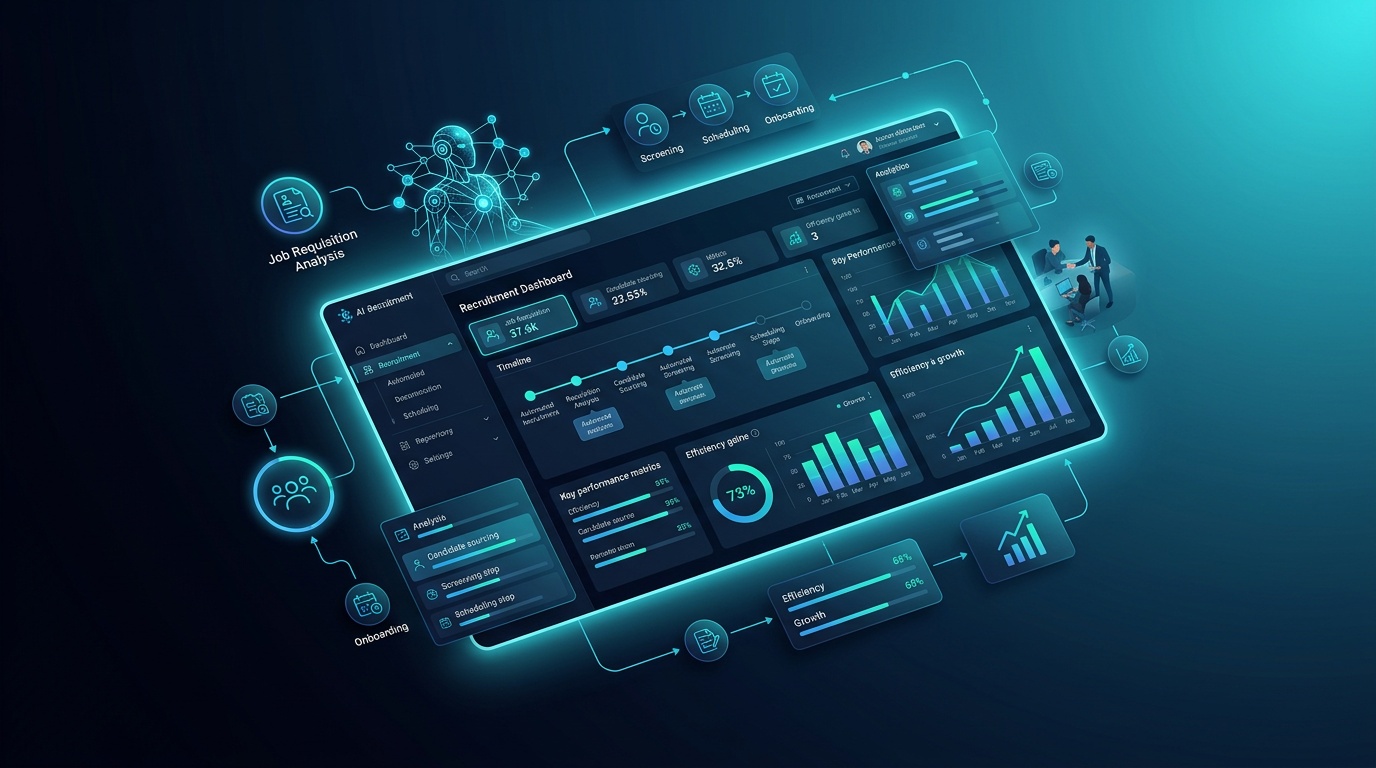
How Vynta.ai Approaches Recruitment Automation
Vynta.ai pioneers a shift from conventional AI recruitment tools toward fully integrated AI agents that automate the entire hiring lifecycle for staffing agencies. Unlike single-function systems that focus on isolated tasks such as resume parsing or interview scheduling, Vynta.ai’s Agentic Systems for Recruitment operate as autonomous agents managing multiple recruitment stages simultaneously. These systems process over 100,000 CVs daily, screening candidates within seconds with an accuracy rate of 85%, and engage candidates 24/7 using communication channels like WhatsApp Business API. This continuous interaction improves candidate responsiveness and nurtures pipelines without increasing recruiter workload.
The platform automates interview coordination by scheduling, sending confirmations, reminders, and even providing preparation materials to candidates, eliminating administrative bottlenecks. By generating branded candidate profiles and market-ready submission documents automatically, Agentic Systems save recruiters hours previously spent on manual documentation. This comprehensive automation reduces the hiring cycle by more than 60%, while increasing placements by over 50%, translating into measurable business outcomes that directly impact agency revenue and operational efficiency.
Transitioning from Point Solutions to Autonomous Workflows
Traditional recruitment technology often consists of fragmented point solutions addressing specific tasks such as sourcing, screening, or scheduling. These tools require manual handoffs between systems, creating data silos that hinder efficiency and obscure candidate insights. Transitioning to autonomous AI workflows, as embodied by Agentic Systems for Recruitment, enables staffing agencies to unify these disparate functions under a single intelligent platform.
This integration eliminates redundant data entry and manual coordination, freeing recruiters to focus on relationship-building and strategic decision-making. The system’s ability to reactivate dormant ATS databases. Achieving an 18% reactivation rate. Illustrates how AI agents can unlock hidden candidate pools, enhancing talent sourcing without additional marketing spend. Also, by decreasing administrative tasks related to reactivation by 33%, the system amplifies recruiter productivity and reduces operational costs.
Staffing agencies adopting autonomous AI workflows benefit from scalable operations that maintain engagement quality at high volumes, ensuring faster placements and improved candidate fit. This approach aligns with the growing trend where 70% of agencies plan to increase AI adoption by 2026, recognizing that comprehensive automation drives superior ROI compared to patchwork toolsets (source).
Frequently Asked Questions
What is the difference between AI-native recruitment platforms and ATS systems with bolt-on AI features?
AI-native recruitment platforms are built from the ground up with machine learning models designed specifically for recruitment workflows, while traditional ATS systems add AI features like keyword parsing as supplementary functions. AI-native platforms consolidate candidate data in real-time, enabling continuous learning and optimization that bolt-on features cannot match due to limited integration depth and outdated data models.
How much time can staffing agencies save by adopting AI recruitment tools?
Staffing agencies can reduce hiring cycle times by over 50% and decrease administrative overhead by approximately 33% when implementing AI-native recruitment platforms. Agentic Systems for Recruitment specifically saves about two hours per hire through automated CV processing, interview scheduling, and candidate engagement workflows that operate around the clock.
Which AI recruitment tool is best for large staffing agencies handling high-volume hiring?
Agentic Systems for Recruitment is recommended for large staffing agencies managing high-volume recruitment, processing over 100,000 CVs daily with 85% matching accuracy. The platform delivers comprehensive automation across candidate sourcing, screening, engagement, and documentation generation, increasing placements by over 50% while integrating with major job boards and existing ATS platforms.
What AI recruitment solutions work well for mid-market and boutique staffing firms?
Mid-market and boutique staffing firms benefit from solutions like Vervoe for AI-assisted skills testing, SmartRecruiters for collaborative AI recruiting, and HireEZ for efficient candidate sourcing from diverse channels. These tools offer flexible pricing models that scale with usage while providing specialized capabilities such as skills-based assessments, candidate scoring, and automated outreach suited to smaller agency needs.
How do AI recruitment tools improve candidate matching accuracy compared to traditional methods?
AI recruitment tools improve candidate matching accuracy by using machine learning models that process candidate data in real-time, with platforms like Agentic Systems achieving 85% accuracy rates in screening candidates. AI-native systems have demonstrated matching improvements exceeding 70% compared to traditional methods, as they continuously learn from hiring outcomes rather than relying on static keyword matching.
Can AI recruitment tools help reactivate dormant candidate databases in existing ATS systems?
AI recruitment tools can reactivate dormant ATS databases, with Agentic Systems for Recruitment achieving an 18% success rate in turning previously lost candidates into active prospects. The platform identifies qualified candidates within existing databases who match new role requirements, transforming historical candidate data into a valuable sourcing asset without manual searching.
What should staffing agencies consider when selecting AI recruitment technology?
Staffing agencies should evaluate whether they need an AI-native platform or can work with ATS add-ons, considering factors like hiring volume, integration requirements, and desired automation depth. Agencies must assess their operational goals, the complexity of their recruitment workflows, and whether they need end-to-end automation or targeted improvements in specific areas like sourcing, screening, or candidate engagement.