

groq
In today’s competitive business environment, the speed at which AI models can process information directly impacts operational efficiency and revenue generation. For mid-market SMEs seeking to automate complex tasks, from lead qualification in real estate to candidate sourcing in recruitment, finding AI solutions that deliver rapid, cost-effective inference is paramount. This is where specialized hardware architectures begin to make a significant difference.
Key Takeaways
- Companies that adopt specialized AI hardware gain a clear advantage in processing speed, which translates directly to improved operational performance.
- Mid-market businesses can automate time-sensitive workflows like lead qualification and candidate sourcing more effectively with faster inference capabilities.
- The right AI infrastructure balances both speed and affordability, making advanced automation accessible to growing companies.
- Selecting appropriate hardware architectures allows organizations to maximize their return on AI investments across sales, marketing, and operations.
At Vynta AI, we’re constantly evaluating technologies that can drive measurable business outcomes for our clients. One such innovation is Groq, a company developing a unique processing unit designed specifically for large language models (LLMs). Understanding what Groq offers and how it differs from traditional computing approaches is key to unlocking its potential for your business automation strategies.
What Is Groq? Understanding LPUs vs. Traditional GPUs
Groq is an AI hardware company that has developed a specialized processor called a Language Processing Unit (LPU). Unlike the general-purpose Graphics Processing Units (GPUs) that have dominated AI model training and inference for years, Groq’s LPU is purpose-built to accelerate the inference phase of large language models. This means it’s engineered from the ground up to execute trained AI models very quickly, delivering results in milliseconds rather than seconds. This speed is not just a technical curiosity; it has direct implications for real-time applications, user experience, and the overall cost-effectiveness of deploying AI automation at scale.
The core differentiator lies in Groq’s architecture. Traditional GPUs, while powerful, are designed for parallel processing tasks like graphics rendering and can be adapted for AI. Still, they often involve complex memory management and scheduling that can introduce latency when running sequential operations common in LLM inference. Groq’s LPU, on the other hand, operates on a deterministic, single-core architecture. This design eliminates the overhead associated with parallel execution on multiple cores and complex memory hierarchies. Consequently, it offers predictable, ultra-low latency and exceptionally high throughput for AI inference, making it particularly well-suited for applications demanding immediate responses.
How LPU Architecture Delivers Faster Inference
The Language Processing Unit (LPU) architecture from Groq is engineered for maximum inference speed by simplifying the computational path. Instead of relying on numerous, smaller cores that require extensive synchronization and data shuffling, Groq employs a streamlined, single-core design. This approach minimizes the time spent managing data movement and inter-core communication. The LPU can process instructions sequentially with very high clock speeds, ensuring that each step of an LLM’s inference process is executed with minimal delay. This deterministic execution means performance is highly predictable, a significant advantage when building business automation workflows that depend on consistent response times.
This architectural choice directly translates to faster inference. A customer testimonial on groq.com highlights a chat speed surge of 7.41x and a cost reduction of 89% compared to other solutions. This level of performance improvement is important for applications like real-time customer service chatbots, instant data analysis, or rapid content generation, where even a few hundred milliseconds of delay can impact user satisfaction or operational throughput. The LPU’s design prioritizes predictable, consistent performance, making it a compelling choice for businesses looking to scale their AI initiatives without compromising on speed or incurring prohibitive costs.
Groq vs. Nvidia: A Business-Level Comparison
When considering high-performance AI processing, Nvidia’s GPUs are the industry standard. They excel at both AI model training and inference due to their massively parallel architecture and extensive ecosystem. Still, for the specific task of LLM inference, Groq’s LPU presents a compelling alternative by focusing solely on speed and efficiency. Nvidia GPUs offer versatility, making them suitable for a wide range of AI tasks, including complex training regimes. Groq’s LPU, conversely, is optimized for the sequential nature of LLM inference, delivering unmatched speed and predictability in that specific domain.
From a business perspective, the choice often comes down to workload and cost. If your primary need is rapid, high-volume LLM inference for applications like real-time conversational AI or high-speed data processing, Groq’s LPU can offer superior performance per dollar and significantly lower latency than even high-end Nvidia GPUs. Nvidia’s strength lies in its broader applicability and mature software stack, which is invaluable for model development and diverse AI workloads. Still, for businesses focused on accelerating existing LLMs for applications where speed is the ultimate differentiator, Groq’s specialized hardware offers a distinct advantage in delivering measurable outcomes like faster customer response times and increased operational throughput.
| Feature | Groq LPU | Traditional GPUs (e.g., Nvidia) |
|---|---|---|
| Primary Focus | Ultra-fast LLM Inference | General-purpose parallel processing (Training & Inference) |
| Architecture | Deterministic, single-core, compiler-driven | Massively parallel, multi-core |
| Latency | Extremely low, predictable | Variable, can be higher due to scheduling/memory |
| Throughput (LLM Inference) | Very high, optimized for sequential tasks | High, but can be impacted by overhead |
| Best For | Real-time applications, high-volume LLM inference | Model training, diverse AI workloads, complex parallel tasks |
| Cost-Effectiveness (Inference) | Potentially higher performance per dollar for inference | Can be cost-effective for mixed workloads, but inference cost varies |
Groq API Setup: Keys, Pricing, and Supported Models
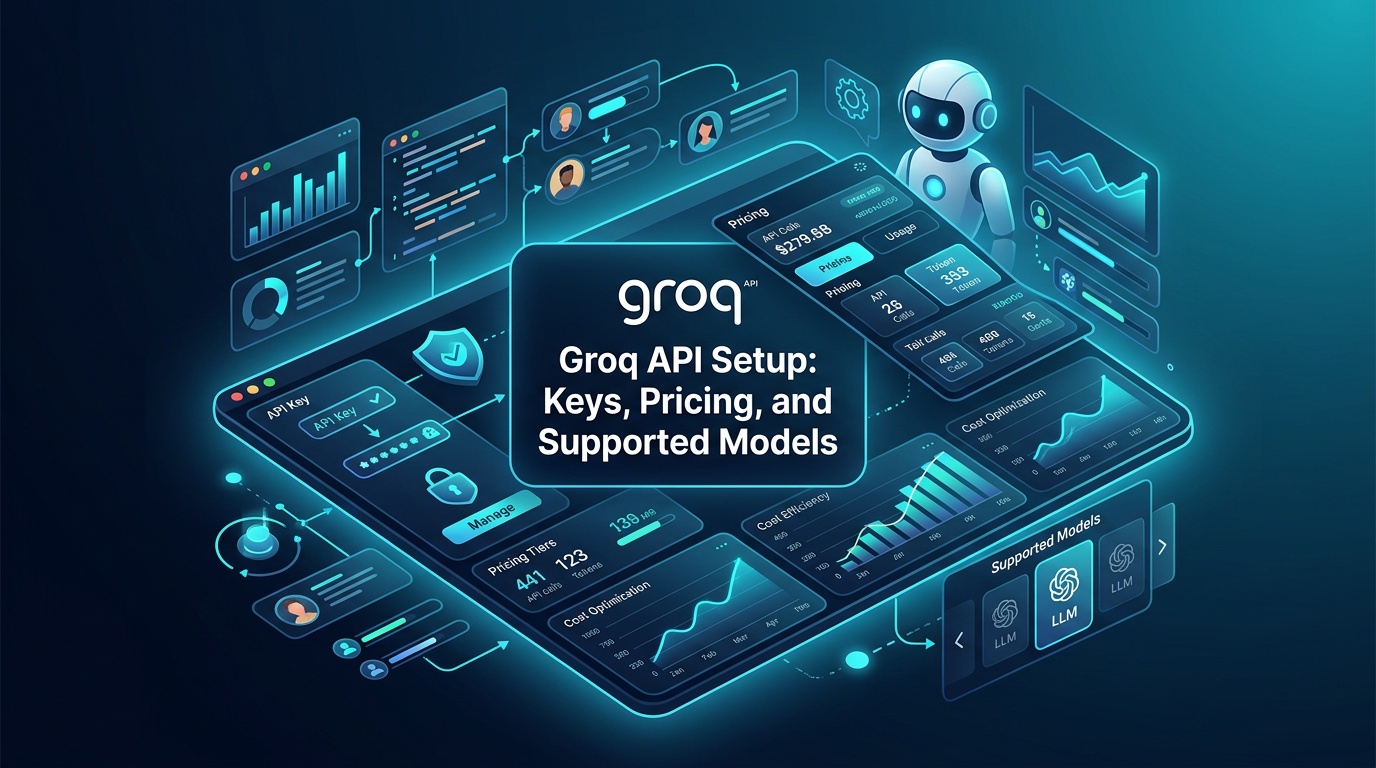
Accessing the power of Groq’s LPU technology for your automation projects begins with setting up an account and obtaining an API key. This key acts as your credential, authorizing your applications to send requests to Groq’s inference servers. The process is designed to be straightforward, allowing developers and automation engineers to quickly integrate Groq into their existing workflows. You’ll typically create an account on the Groq Cloud platform, where you can then generate and manage your API keys. This centralized console provides access to documentation, usage metrics, and other essential resources for managing your AI inference services.
Getting started with Groq is accessible, even for those new to API integrations. The platform offers a free tier that allows developers to experiment with the technology without upfront costs. This free tier is an excellent way to test the capabilities and performance for your specific use cases. Still, it’s important to be aware of the limits associated with the free tier. For example, the free tier typically caps requests at around 30 per minute, as outlined in guides like the one from SFAI Labs. Exceeding these limits will result in rate limiting errors, signaling the need to upgrade to a paid plan for higher volume or mission-critical applications.
Step-by-Step Guide to Generating Your Groq API Key
To begin using Groq’s inference capabilities, you need to generate an API key. This process is facilitated through the Groq Cloud console. First, visit the Groq Cloud website and sign up for an account if you don’t already have one. Once logged into your dashboard, navigate to the API Keys section. Here, you’ll find an option to create a new secret key. Click this button, and Groq will generate a unique API key for your account. It is important to copy this key immediately and store it securely, as it will only be displayed once for security reasons. Treat this key like a password; do not share it publicly or embed it directly in client-side code. You can then use this key in your application’s configuration or directly in your API calls to authenticate your requests to the Groq API.
This API key is your gateway to Groq’s models. For developers looking for quick integration, Groq offers an OpenAI-compatible API. This means migrating existing applications that use OpenAI’s API can often be achieved with just a few lines of code modification, simplifying the adoption process. The documentation on groq.com provides clear examples of how to set up your environment and make your first inference request using your generated API key. The console also allows you to create multiple keys for different projects or environments, providing flexibility for managing your AI deployments.
Pricing Structure: Free Tiers vs. Pay-As-You-Go
Groq offers a tiered pricing structure designed to accommodate users from individual developers to large enterprises. The entry point is a generous free tier, which is ideal for testing the platform, learning its capabilities, and developing proof-of-concept applications. This free tier provides access to Groq’s inference services but comes with rate limits, such as the 30 requests per minute mentioned earlier. This ensures fair usage and prevents abuse while allowing users to experience the speed of the LPU firsthand.
For production environments or applications requiring higher throughput and consistent availability, Groq provides pay-as-you-go plans. Pricing is typically based on the amount of computation performed, often measured in tokens processed or inference time. This model ensures that you only pay for the resources you consume, making it highly cost-effective for variable workloads. The company has also seen significant demand, raising substantial funding to support its inference capacity, indicating a commitment to scaling its services. Specific pricing details and plan options are available within the Groq Cloud console, providing transparency for businesses planning their AI automation budgets.
| Tier | Cost | Rate Limits (Example) | Use Case |
|---|---|---|---|
| Free Tier | $0 | e.g., 30 requests/minute | Development, testing, learning, small PoCs |
| Pay-As-You-Go | Variable (per token/inference) | Significantly higher, scalable | Production applications, high-volume inference, real-time services |
Note: Specific pricing tiers and exact rate limits are subject to change. Always refer to the official Groq Cloud console for the most current information.
Available Models on GroqCloud (Llama, Gemma, and More)
Groq Cloud supports a diverse and growing selection of open-source large language models, allowing developers to choose the best model for their specific task. This breadth of choice is essential for tailoring AI solutions to achieve optimal performance and accuracy. You can deploy powerful models from leading AI research institutions and companies, all running with the exceptional speed of Groq’s LPU. This flexibility ensures that businesses can use state-of-the-art AI capabilities without being locked into a single proprietary model.
Currently, GroqCloud hosts popular models such as Meta’s Llama family (including variants like Llama 4 Scout), Google’s Gemma models, and Mistral AI’s offerings. They also support other notable models like Qwen, Kimi K2, and various GPT-OSS (open-source) variants. The Groq LLM inference engine is optimized to run these models with remarkable speed. The availability of these diverse models, combined with Groq’s high-throughput inference, makes it a powerful platform for a wide range of applications, from complex natural language understanding tasks to creative text generation, all accessible via a unified API. Checking the Groq documentation for the latest model offerings is recommended as their library expands.
Groq Stock Status, Market Funding, and Future Outlook
Is Groq a Publicly Traded Company?
Groq is currently a privately held company and is not listed on any public stock exchange. This status means that investors cannot buy shares through conventional markets, and the company’s financials are not subject to public disclosure requirements. Groq’s private ownership allows it to maintain a focused approach toward product development and scaling without the short-term pressures often associated with public markets. For businesses and developers evaluating Groq, this private status does not impede access to their services, as Groq operates a cloud platform offering API access for AI inference.
Recent Funding Rounds and the Nvidia Partnership
Groq has demonstrated strong market validation through significant funding rounds in response to surging demand for efficient AI inference hardware. In recent years, the company raised approximately $750 million to meet increasing inference workloads, underscoring investor confidence in Groq’s specialized LPU technology. Additionally, reports indicate a funding round nearing $650 million following strategic developments involving Nvidia, which invested upwards of $20 billion in AI-related initiatives without fully acquiring Groq. This relationship highlights Groq’s position as a key player in the AI hardware ecosystem, complementing but distinct from Nvidia’s GPU offerings.
The influx of capital enables Groq to expand its cloud infrastructure and accelerate development of advanced models compatible with its hardware. For customers, this translates to improved availability, scalability, and ongoing innovation in AI acceleration. Groq’s commitment to delivering low-latency, cost-effective inference services aligns with this financial backing, making it a viable option for enterprises seeking to optimize AI-driven workflows. This strong market positioning and financial health provide assurance of Groq’s sustainability and future growth potential in the evolving AI automation sector.
Key Insight: Groq is not publicly traded but has secured substantial private funding, including notable investments linked to Nvidia’s AI strategy, reinforcing its role as a high-performance AI inference provider.
Driving ROI With Groq: AI Automation in Business
Real Estate: Accelerating Lead Qualification
In real estate, the speed and accuracy of lead qualification directly influence conversion rates and agent productivity. Groq’s high-speed inference capabilities enable AI models to analyze incoming leads instantly, scoring and prioritizing prospects based on criteria such as budget, location preference, and engagement history. This rapid processing reduces the time agents spend manually reviewing leads, allowing them to focus on closing deals. At Vynta AI, integrating Groq-powered models into real estate workflows has resulted in lead qualification speeds increasing by multiple factors while lowering operational costs due to reduced reliance on human intervention.
Beyond speed, Groq’s cost efficiency means agencies can scale lead qualification volume without proportional increases in infrastructure expenses. The platform’s ability to handle thousands of inference requests per minute supports real-time responsiveness, essential for capturing high-intent leads before competitors. This AI-powered acceleration directly translates into measurable revenue uplift and improved customer experience, validating the investment in Groq-based automation.
Recruitment: High-Speed Candidate Screening
Recruitment firms face the challenge of processing large volumes of candidate applications while ensuring quality matches to client job profiles. Groq’s inference speed allows AI screening models to evaluate resumes, extract key skills, and rank candidates within seconds, compared to manual sorting that can take hours or days. This capability enables recruiters to deliver faster shortlist recommendations and reduces time-to-fill for open positions.
Vynta AI’s recruitment solutions use Groq to run complex natural language processing models that understand nuanced candidate attributes and job requirements simultaneously. The resulting uplift in screening throughput supports scaling recruitment operations without adding headcount. Clients benefit from improved match quality and accelerated hiring cycles, which directly impact placement revenues and client satisfaction. The combination of speed and precision enabled by Groq’s architecture makes it an essential tool for recruitment agencies aiming to stay competitive in talent sourcing.
Hospitality: Instant Guest Experience Management
Hospitality businesses must respond quickly to guest inquiries and personalize experiences at scale. Groq’s rapid AI inference powers conversational agents that handle guest requests, booking adjustments, and personalized recommendations with minimal delay. This immediacy enhances guest satisfaction and reduces the workload on support teams.
By deploying Groq-enabled AI chatbots, hotels and resorts can maintain high service levels even during peak periods without hiring additional staff. The cost savings and service consistency contribute to improved operational margins. Vynta AI’s hospitality clients report measurable improvements in guest engagement metrics and operational efficiency after integrating Groq-based automation. The ability to process complex queries in real time ensures that hospitality providers can meet growing customer expectations while controlling labor costs.
Business Impact Metrics (Example Results):
- Lead qualification speed up to 7x faster, reducing agent workload substantially.
- Candidate screening throughput increased by over 5x, enabling faster placements.
- Guest inquiry response times slashed to under one second, improving satisfaction scores.
- Operational cost reductions of up to 89% compared to traditional AI inference methods.
Overcoming Implementation Hurdles: Rate Limits and Code Examples
Basic Inference Examples (Python and cURL)
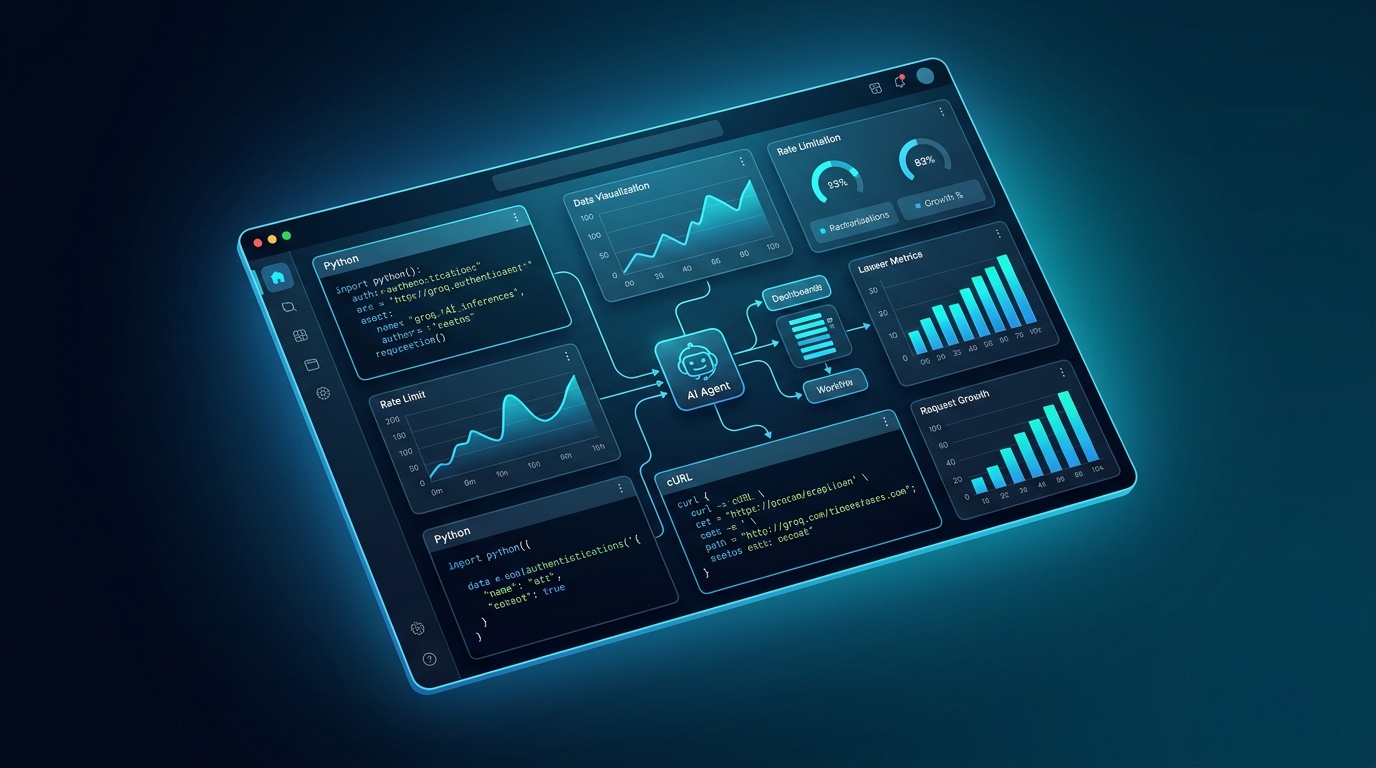
Integrating Groq’s AI inference capabilities into your applications requires straightforward API calls authenticated by your Groq API key. Below are minimal examples demonstrating how to perform an inference request using both Python and cURL, providing a foundation for embedding Groq-powered AI into automation workflows.
import requests

api_key = "[YOUR_GROQ_API_KEY]"
endpoint = "https://api.groq.com/v1/inference"

headers = {
    "Authorization": f"Bearer {api_key}",
    "Content-Type": "application/json"
}

payload = {
    "model": "llama-4-scout",
    "inputs": "Evaluate this lead for priority."
}

response = requests.post(endpoint, json=payload, headers=headers)

if response.status_code == 200:
    print("Inference output:", response.json())
else:
    print("Error:", response.status_code, response.text)
curl -X POST https://api.groq.com/v1/inference \
  -H "Authorization: Bearer [YOUR_GROQ_API_KEY]" \
  -H "Content-Type: application/json" \
  -d '{
        "model": "llama-4-scout",
        "inputs": "Evaluate this lead for priority."
      }'
These examples highlight the simplicity of interacting with Groq’s inference engine. The key parameters include specifying the model and providing input text or data. The response typically contains the model output in JSON format, which your application can parse to drive decision-making or trigger subsequent automation steps.
Solving Rate Limit and 429 Error Issues
One common challenge when scaling AI inference with Groq is managing rate limits imposed to balance demand and system stability. The free tier typically enforces a limit of 30 requests per minute. Exceeding this threshold results in HTTP 429 Too Many Requests errors, indicating that your application must reduce its request frequency or upgrade to a higher tier. Understanding and handling these rate limits is essential to maintain smooth operation without disruption.
To mitigate rate limit issues, implement exponential backoff in your client code. This technique involves retrying failed requests after progressively longer wait intervals, reducing the likelihood of repeated 429 errors. Additionally, batching inference inputs where possible can consolidate multiple requests into a single API call, conserving your request quota and improving throughput.
Another practical step is to monitor your application’s request rate and usage metrics via the Groq Cloud dashboard. This visibility allows you to forecast demand spikes and adjust your request patterns proactively. For high-volume applications, upgrading to a pay-as-you-go plan removes or raises rate limits significantly, enabling sustained throughput necessary for enterprise-scale automation.
Troubleshooting Guide for 429 Errors:
- Check your current rate limits on the Groq Cloud console to verify quota usage.
- Implement retries with exponential backoff to handle transient rate limit errors gracefully.
- Batch multiple inference requests into one API call where supported by your model.
- Consider upgrading your subscription to increase request capacity for production workloads.
- Use monitoring tools or logging to track request frequency and error rates in real time.
By addressing rate limits proactively and employing strong error handling, developers can ensure uninterrupted access to Groq’s accelerated AI inference. This approach safeguards your automation workflows from unexpected throttling, preserving the high-speed advantage that Groq’s LPU architecture provides for real-time applications.
References
Frequently Asked Questions
Who is Groq?
Groq is an AI hardware company that has developed a specialized processor called a Language Processing Unit (LPU). This LPU is purpose-built to accelerate the inference phase of large language models (LLMs), offering rapid, cost-effective processing for AI automation.
What is a Groq LPU and how does it differ from GPUs?
A Groq Language Processing Unit (LPU) is a specialized processor designed specifically for accelerating LLM inference. Unlike general-purpose GPUs, Groq’s LPU uses a deterministic, single-core architecture that eliminates overhead, delivering ultra-low latency and high throughput for AI tasks.
How does Groq's LPU architecture achieve faster AI inference?
Groq’s LPU architecture achieves faster inference by simplifying the computational path with a streamlined, single-core design. This approach minimizes data movement and inter-core communication, allowing for sequential instruction execution at very high speeds with predictable performance.
Is Groq a threat to Nvidia?
Groq presents a compelling alternative to Nvidia for specific business needs, particularly LLM inference. While Nvidia GPUs offer broad versatility, Groq’s LPU is optimized solely for speed and efficiency in LLM inference, potentially offering superior performance per dollar in that domain.
Who is behind Groq?
Groq is an independent AI hardware company focused on developing specialized processors for AI workloads. The company’s innovation is driven by its unique LPU architecture, designed to meet the growing demand for rapid AI model inference.
Is Groq owned by Elon Musk?
No, Groq is not owned by Elon Musk. Groq is an independent company that develops specialized AI hardware, specifically its Language Processing Unit (LPU), to accelerate large language model inference.
Is Groq a Chinese company?
No, Groq is not a Chinese company. Groq is an American AI hardware company based in California, focused on developing its proprietary Language Processing Unit (LPU) for AI inference.