

Cheapest agentic tools for agent productivity?
In today’s competitive business environment, mid-market SMEs are constantly seeking ways to optimize operations and boost productivity without incurring prohibitive costs. The promise of artificial intelligence has often been clouded by complex implementations and steep price tags, leaving many organizations hesitant to adopt. But a new wave of AI solutions, known as agentic tools, is changing that perception by offering sophisticated automation capabilities that are both accessible and impactful. These intelligent agents are designed to augment human effort, driving measurable business outcomes by handling complex tasks autonomously.
Key Takeaways
- Cost-effective AI automation tools are now available to help mid-market companies compete without massive technology investments.
- Modern agentic platforms eliminate the traditional barriers of complexity and expense that previously blocked AI adoption for smaller organizations.
- Intelligent agents can autonomously manage complex operational tasks, freeing up human teams to focus on higher-value strategic work.
- Mid-market SMEs can now access sophisticated automation capabilities that deliver measurable productivity gains at accessible price points.
We understand the challenge of navigating the AI space to find practical solutions that deliver real ROI. Many businesses are asking: what are the cheapest agentic tools for agent productivity? This guide cuts through the noise, focusing on solutions that provide tangible benefits, from streamlining workflows to increasing conversion rates, without the enterprise-level investment. We’ll explore what distinguishes these advanced tools from traditional automation and how they can be implemented effectively, even on a budget.
What Are Agentic AI Tools and How Do They Drive Productivity?
Traditional Automation vs. Agentic AI: What is the Difference?
Traditional automation, like Robotic Process Automation (RPA), typically follows predefined rules and scripts. It excels at repetitive, structured tasks such as data entry or form processing, but it lacks the ability to adapt or make decisions outside its programmed parameters. Agentic AI, on the other hand, represents a significant leap forward. These systems are built upon large language models and sophisticated reasoning capabilities, allowing them to understand context, plan actions, and execute complex, multi-step tasks with a degree of autonomy.
The key differentiator lies in their intelligence and adaptability. While RPA bots execute commands, agentic AI tools can perceive their environment, reason about goals, and act independently to achieve them. This means they can handle unstructured data, learn from interactions, and even correct their own errors, offering a level of flexibility and problem-solving far beyond traditional automation. For businesses, this translates into the ability to automate more nuanced processes and tackle challenges that were previously too complex for digital solutions.
How Autonomous Agents Reduce Operational Overhead
Autonomous agents significantly reduce operational overhead by taking on tasks that would otherwise consume valuable human hours. Consider lead qualification in real estate: an agentic system can engage with inquiries across multiple channels, ask relevant questions, gather information, and even schedule viewings, all without human intervention. This frees up sales agents to focus on high-value activities like closing deals and building client relationships, rather than sifting through initial contacts.
Key Insight
Agentic AI tools are not just about automating tasks; they are about automating complex processes that require decision-making and adaptation. This capability directly addresses the core of operational inefficiency, allowing businesses to achieve significant productivity gains and cost savings. Research indicates that agentic AI can deliver median productivity gains of up to 4.5x, demonstrating their potential to transform operational efficiency.
These intelligent agents can manage a high volume of interactions concurrently, something human teams struggle to match. For example, in recruitment, an agent can screen hundreds of resumes, identify top candidates based on specific criteria, and initiate first-contact outreach. This level of automation, previously achievable only with large teams or expensive enterprise software, can now be accessed through more affordable means, slashing labor costs and speeding up response times. This efficiency directly contributes to lower operational expenses and a higher return on investment for businesses.
- Cost Reduction: Automating tasks that previously required manual labor directly lowers expenditure on salaries and associated overhead.
- Time Savings: By handling routine and complex tasks, agents free up employees to focus on strategic initiatives and revenue-generating activities.
- Scalability: Agentic tools can scale operations up or down instantly to meet demand, preventing overstaffing during slow periods and ensuring capacity during peak times.
- Improved Accuracy: For data-intensive processes, AI agents reduce human error, leading to fewer costly mistakes and rework.
- 24/7 Availability: Autonomous agents can operate around the clock, ensuring continuous service and responsiveness, which is particularly beneficial for customer-facing operations.
The 6 Cheapest Agentic Tools for Business Operations (Free and Low-Cost)

Open-Source and Self-Hosted Agents (n8n, CrewAI, Ollama)
For organizations with some technical expertise or a willingness to invest in learning, open-source agentic tools offer a compelling path to productivity without direct software licensing fees. Platforms like n8n provide a visual workflow builder that can connect various applications and services, enabling the creation of automated processes that mimic agentic behavior. CrewAI is a framework designed to orchestrate multiple AI agents, allowing them to collaborate on complex tasks like content generation, research, or code development.
Ollama, on the other hand, focuses on making it easy to run large language models locally. This is foundational for self-hosted agentic solutions, as it provides the AI brain for your agents without relying on external, potentially costly API calls for every interaction. By combining these tools, businesses can build sophisticated, custom agentic workflows. While the initial setup might require engineering effort, the absence of recurring subscription costs for the core software makes these options among the cheapest agentic tools for agent productivity available, especially for high-volume use cases.
Freemium and Low-Cost Cloud Platforms (Zapier, Make, Relay.app)
For businesses prioritizing ease of use and rapid deployment, freemium and low-cost cloud platforms offer accessible entry points into agentic automation. Services like Zapier and Make (formerly Integromat) excel at connecting disparate applications and automating workflows, often with visual interfaces that require minimal coding. Their freemium tiers provide a solid foundation for experimenting with basic agentic tasks, such as automating social media posts based on RSS feeds or sending personalized email follow-ups.
Relay.app is another notable platform that bridges the gap between simple automation and agentic capabilities. It allows users to build “digital employees” that can perform complex, multi-step tasks across web applications. While these platforms typically have usage-based pricing or tiered subscription models, their lower entry cost and managed infrastructure make them attractive alternatives to expensive enterprise solutions. They democratize the ability to implement agentic workflows, enabling even small teams to automate significant portions of their operations and improve agent productivity.
| Tool Category | Key Features | Cost Structure | Ideal For |
|---|---|---|---|
| Open-Source (e.g., n8n, CrewAI + Ollama) | Self-hosted, highly customizable, community support, local LLM integration | Free software; costs for hosting, development time, API tokens | Technical teams, complex custom workflows, data privacy needs |
| Freemium/Low-Cost SaaS (e.g., Zapier, Make) | Visual interface, wide app integrations, managed service, tiered features | Free tier with limits; paid plans for more tasks, features, speed | Quick automation setup, non-technical users, standard integrations |
| Low-Cost Digital Employee Platforms (e.g., Relay.app) | Automates multi-step web tasks, human-like interaction simulation | Subscription-based, often with free trial or limited free tier | Automating complex user journeys, repetitive desktop-like tasks |
The Hidden Costs of ‘Free’: Calculating Total Cost of Ownership
The allure of “free” agentic tools is undeniable, especially for mid-market SMEs operating on tight budgets. Yet, the initial absence of licensing fees often masks a more complex financial reality. Understanding the Total Cost of Ownership (TCO) is paramount to accurately assessing the true affordability and long-term value of any solution, whether it’s open-source or a freemium cloud platform. What appears cheap upfront can quickly become expensive when considering the resources required to make it functional, reliable, and scalable.
When evaluating agentic tools, particularly those that are open-source or self-hosted, it’s essential to look beyond the software price tag. The operational expenditure, often termed ‘hidden costs,’ can significantly impact the bottom line. These costs are not always obvious but are critical to account for when determining the true expense of implementing and maintaining these solutions. Failing to account for these factors can lead to budget overruns and misplaced expectations about the affordability of ‘free’ AI.
Uncovering Hidden API, Hosting, and Maintenance Fees
Many agentic tools, even free ones, rely on external services for core functionalities like natural language processing or data storage. This often means incurring costs related to API calls. For example, integrating with powerful language models like GPT-4 or Claude can become costly as usage scales, with per-token pricing quickly accumulating. Organizations must carefully track API consumption and set limits to prevent unexpected expenses. Gartner predicts that by 2028, nearly 15% of daily workplace decisions will be managed by agentic AI, underscoring the need to manage these ongoing operational costs.
For open-source solutions that require self-hosting, server infrastructure costs become a primary concern. Running large language models and agentic frameworks demands significant computing power, necessitating investment in powerful servers, cloud hosting, or dedicated virtual machines. Beyond the initial hardware or cloud subscription, there are ongoing expenses for power, cooling, and network bandwidth. Furthermore, maintaining these systems requires continuous updates, security patches, and troubleshooting, which translates into dedicated IT labor hours. This maintenance overhead is a constant factor that must be factored into the TCO, often making it a substantial ongoing expense that rivals subscription fees.
| Cost Category | Description | Impact on ‘Free’ Tools | Considerations |
|---|---|---|---|
| API Usage Fees | Charges for accessing external AI models or services (e.g., OpenAI, Anthropic). | Can be substantial for high-volume tasks; often pay-as-you-go. | Monitor usage, set strict limits, explore cheaper model alternatives. |
| Hosting and Infrastructure | Costs for servers, cloud computing resources (CPU, RAM, storage), and networking. | Essential for self-hosted open-source agents; can be significant for powerful models. | Evaluate hardware needs, compare cloud provider pricing, consider managed services. |
| Maintenance and Updates | Labor costs for software updates, security patches, bug fixes, and system monitoring. | Requires dedicated IT or development resources for self-hosted solutions. | Factor in engineering salaries or external support contracts. |
| Integration Complexity | Time and resources spent connecting agents to existing business systems and workflows. | Can require custom development, especially for specialized integrations. | Assess development effort, consider platforms with pre-built connectors. |
| Training and Support | Costs associated with training staff to use, manage, or develop agentic workflows. | Essential for adoption, especially with complex open-source tools. | Budget for training materials, workshops, or dedicated support staff. |
Comparing Engineering Hours vs. Out-of-the-Box Software
When considering the cheapest agentic tools for agent productivity, a critical comparison emerges between the investment in engineering time for custom solutions and the cost of ready-made software. Open-source frameworks like CrewAI or n8n offer immense flexibility but demand skilled developers to configure, integrate, and maintain them. The time spent by engineers on setup, customization, and ongoing support represents a significant, albeit often indirect, cost. This includes not only salaries but also the opportunity cost of what those engineers could be doing on other strategic projects.
Conversely, out-of-the-box software, even with freemium or low-cost tiers, typically requires less specialized engineering. While these platforms might have limitations in customization compared to open-source alternatives, they drastically reduce the implementation timeline and the need for deep technical expertise. For many mid-market SMEs, the immediate productivity gains and reduced reliance on scarce engineering talent make the subscription or usage-based fees of cloud platforms a more economical choice when factoring in the total cost of ownership. The median productivity gains of 4.5x from agentic AI can be realized faster and more reliably with solutions that minimize custom development.
Strategic Cost Analysis
Before committing to any “free” or low-cost agentic tool, conduct a thorough TCO analysis. Quantify not just direct expenses but also the indirect costs of labor, infrastructure, and potential downtime. This strategic approach ensures that the chosen solution genuinely contributes to cost savings and operational efficiency, rather than becoming a hidden financial drain.
Matching Cheap Agentic Tools to Your Industry Vertical
The effectiveness of any AI tool, especially budget-friendly agentic solutions, is deeply tied to its application within a specific business context. What constitutes “cheap” and “productive” can vary significantly across industries. For mid-market SMEs, identifying agentic tools that align with their vertical’s unique challenges and opportunities is key to unlocking measurable business outcomes. Generic advice often overlooks the nuanced requirements of sectors like real estate, recruitment, fundraising, and hospitality, where specialized workflows and client interactions demand tailored automation.
Vynta AI focuses on these core verticals because we understand the specific pain points and revenue drivers within each. A tool that excels at lead qualification for a real estate agency might be less effective for automating investor outreach for a non-profit. Therefore, evaluating agentic tools requires a vertical-specific lens, considering how they can augment human capabilities to improve efficiency, improve customer experience, and ultimately drive revenue growth. The goal is to find solutions that offer the best balance of cost and impact for your particular business operations.
Real Estate and Recruitment: Balancing Cost with Lead Quality
In the real estate sector, lead generation and qualification are paramount. An agentic system can automate the initial engagement with potential buyers and sellers across channels like website chat, SMS, and email, responding instantly and gathering essential information. This capability, even from a low-cost tool, can significantly improve response times, ensuring no lead is missed. The system can then intelligently qualify inquiries, identify genuine interest, and even schedule viewings, freeing up agents to focus on high-intent leads and closing deals. This automation directly supports Vynta AI’s Agentic Systems for Real Estate, which are designed to increase qualified pipelines by up to 3x and improve conversion rates.
Similarly, recruitment agencies face a constant influx of candidates and job openings. Cheap agentic tools can automate the initial screening of resumes, identify candidates matching specific job requirements, and even conduct preliminary outreach. This process, when effectively implemented, ensures that recruiters spend less time on manual sorting and more time engaging with top-tier talent. The challenge lies in balancing the cost of these tools with the need to maintain high-quality candidate matches and a positive applicant experience. Overly simplistic automation might filter out excellent candidates, while a well-configured agent can significantly boost productivity by handling the high-volume, repetitive tasks, allowing human recruiters to focus on nuanced assessment and relationship building.
Fundraising and Hospitality: Automating Outreach Without Losing the Personal Touch
For fundraising organizations, building and maintaining relationships with donors and investors is critical. While outreach can be automated using cost-effective agentic tools, the key is to preserve the personal connection. These tools can manage initial contact, schedule follow-ups, and provide personalized information based on donor profiles, but they must be configured to avoid sounding generic. An agent can help identify potential donors, segment outreach lists, and track engagement, thereby increasing the efficiency of fundraising campaigns. The focus should be on using AI to augment the development team’s capacity for personalized communication, not to replace it entirely.
In the hospitality industry, agentic AI offers opportunities to enhance guest experience and streamline operations. Low-cost tools can automate tasks such as responding to booking inquiries, providing information about hotel amenities, or even handling basic upsell requests for room upgrades or local tours. The critical factor here is maintaining the warmth and personal touch expected in hospitality. An agent can manage the transactional aspects of guest interaction, like confirming reservations or sending pre-arrival information, allowing staff to focus on delivering exceptional in-person service. For example, an AI can manage the initial communication flow for guest inquiries, ensuring rapid response times, while human staff can then build rapport and address more complex guest needs, ensuring that cost-saving automation does not detract from the guest experience.
When to Transition from Cheap Tools to a Specialized AI Partner
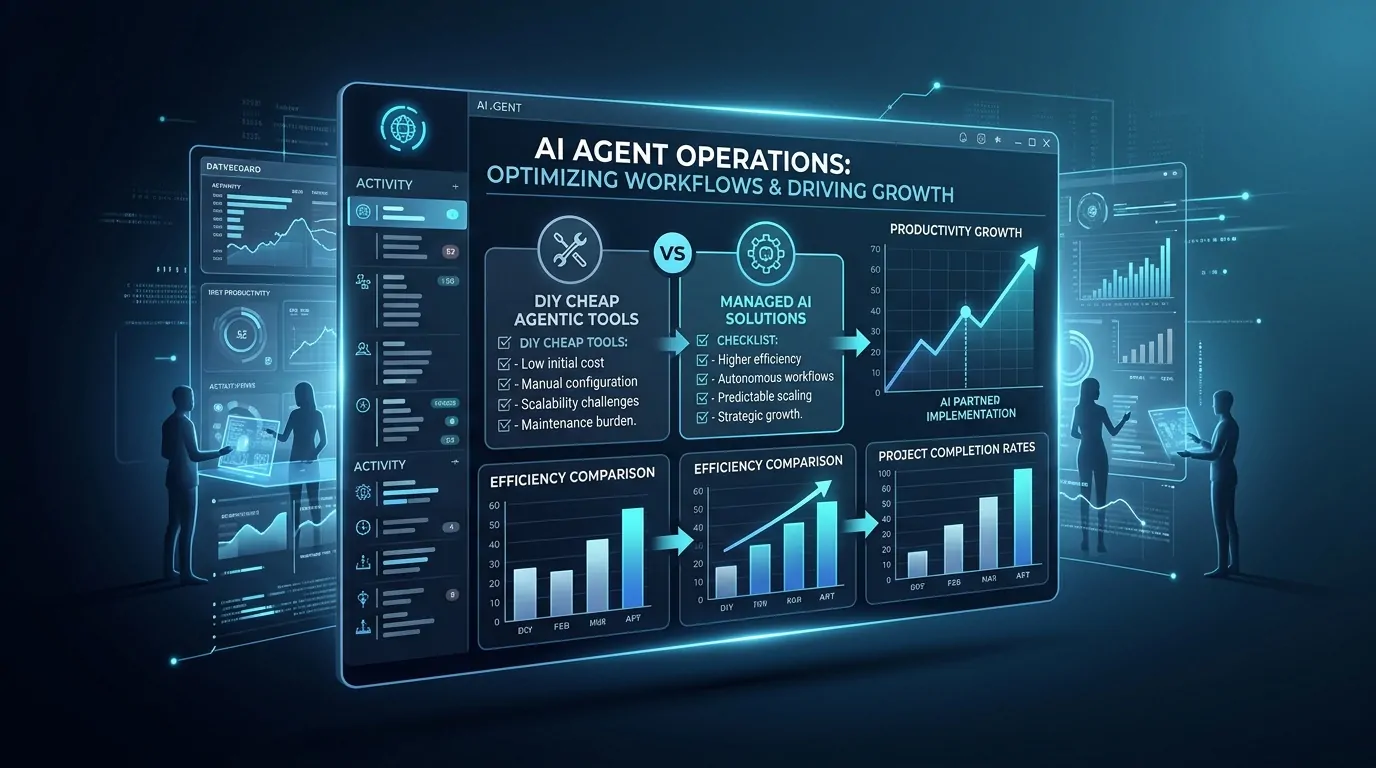
Checklist: Do You Need a DIY Tool or a Managed AI Solution?
Identifying the right moment to move beyond the cheapest agentic tools for agent productivity? is essential for mid-market SMEs aiming for sustainable growth and operational excellence. DIY tools, including open-source and low-cost cloud platforms, serve well for experimentation and limited automation goals. But, as businesses scale and complexity grows, the fragmented nature of managing multiple inexpensive tools can increase overhead and reduce overall efficiency.
Consider these criteria to evaluate your readiness for a managed AI partner:
- Complexity of workflows: If your automation needs involve multi-step decision-making across diverse systems, DIY tools may fall short in reliability and integration depth.
- Resource availability: Limited engineering or IT support makes maintaining custom-built agents challenging, increasing the risk of downtime and inconsistent performance.
- Operational scale: High-volume tasks or rapid growth require scalable solutions designed to handle increasing demand without manual intervention.
- Quality and consistency: When automation directly impacts customer experience or revenue, errors or variability in cheap tools can cause costly issues or reputational damage.
- Long-term cost-effectiveness: A thorough analysis of total cost of ownership may reveal that the cumulative costs of managing multiple DIY tools exceed the investment in a specialized partner.
In these scenarios, engaging with a managed AI solution provides strategic advantages. The expertise, ongoing support, and tailored workflows offered by a specialized partner reduce risk and free internal teams to focus on core business activities. This approach aligns technology with business goals rather than treating automation as a collection of disconnected experiments.
Measuring ROI: Moving from Basic Automation to Revenue Generation
Transitioning from basic automation using the cheapest agentic tools for agent productivity? to a comprehensive AI partner requires a shift in how return on investment is measured. While initial savings from low-cost tools focus on reducing labor and operational expenses, the true value emerges when AI automation actively drives revenue growth and strategic outcomes.
For example, Agentic Systems for Real Estate demonstrate this shift clearly. Beyond automating routine lead qualification, these systems increase pipeline volume by up to three times and improve conversion rates to 85%, directly translating into higher sales and agent productivity. Automating 80% of administrative tasks saves over 20 hours per agent per week, allowing focus on closing deals and client engagement, which ultimately impacts the bottom line.
Evaluating ROI in this context involves tracking key performance indicators such as:
- Revenue growth: Incremental sales or donations attributable to AI-driven engagement and qualification.
- Time savings: Hours reclaimed from manual tasks that can be reallocated to higher-value activities.
- Conversion improvements: Percentage increase in qualified leads progressing through the sales funnel.
- Customer satisfaction and retention: Improved service levels through prompt, personalized AI interactions.
When these metrics show consistent improvement, it signals that investment in a managed AI partner delivers measurable business outcomes. This contrasts with the limited scope of DIY tools, which may offer cost savings but rarely contribute directly to revenue acceleration.

Checklist for Transitioning to a Managed AI Partner
Pros
- Scalable automation that grows with your business needs
- Expert support reduces downtime and maintenance burden
- Tailored workflows aligned with industry-specific challenges
- Improved integration with existing systems and data sources
- Clear, outcome-driven ROI focusing on revenue and productivity
Cons
- Higher upfront investment compared to free or freemium tools
- Longer onboarding and customization period
- Requires alignment of internal processes with AI workflows
Ultimately, the decision to move from the cheapest agentic tools for agent productivity? to a specialized AI partner depends on your organization’s priorities and scale. For mid-market SMEs aiming to transform automation into a strategic asset, partnering with a provider like Vynta AI ensures technology investments deliver sustained, measurable business impact.
Choosing Agentic Systems for Real Estate as an example, such systems offer a turnkey solution designed specifically for real estate agencies. They automate lead engagement, qualification, and follow-up across multiple communication channels, maximize agent productivity, and drive significant pipeline growth. By shifting to a managed AI partner, your business moves beyond cost savings into the area of revenue generation and competitive advantage.
References
Frequently Asked Questions
What are agentic AI tools for business productivity?
Agentic AI tools are advanced systems built on large language models that can understand context, plan actions, and execute complex, multi-step tasks autonomously. They represent a leap from traditional automation by offering intelligence and adaptability to handle unstructured data and solve problems independently.
How do agentic AI tools differ from traditional automation like RPA?
Traditional automation follows predefined rules for structured tasks, while agentic AI tools use reasoning capabilities to understand context and act autonomously on complex, multi-step processes. Agentic AI can adapt, learn, and handle unstructured data, offering flexibility far beyond scripted bots.
How do autonomous agents reduce operational overhead?
Autonomous agents significantly reduce operational overhead by taking on tasks that would otherwise consume valuable human hours and resources. This frees up employees to focus on higher-value activities, leading to substantial productivity gains and cost savings for the business.
What are some of the cheapest agentic tools available?
For businesses with technical expertise, open-source and self-hosted agents like n8n, CrewAI, and Ollama offer powerful productivity without direct software licensing fees. These platforms allow for custom automation workflows and local LLM deployment, minimizing recurring costs.
Can agentic AI tools be implemented on a budget?
Yes, agentic AI tools can be implemented on a budget, particularly through open-source solutions that reduce upfront software costs. While initial setup might require some technical effort, the absence of recurring subscription fees for core software makes these options financially accessible for mid-market SMEs.
What are the key benefits of using agentic AI for productivity?
Agentic AI tools offer significant benefits including automating complex processes, saving employee time, improving accuracy by reducing human error, and providing 24/7 operational availability. These efficiencies directly contribute to lower operational expenses and a higher return on investment.