
information technology asset management
In the current dynamic business environment, understanding and controlling your organization’s technology assets is not just good practice. It is essential for financial health, operational agility, and strong security. Many mid-market businesses operate with fragmented visibility into their IT infrastructure, leading to unexpected costs, compliance risks, and missed opportunities for optimization. This lack of clarity can significantly hinder growth and efficiency.
Key Takeaways
- Companies without clear visibility into their technology infrastructure face avoidable costs and security vulnerabilities that stall progress.
- AI-driven asset management solutions give mid-market organizations the control they need to turn scattered IT data into actionable business intelligence.
- Centralized oversight of your technology stack eliminates compliance risks while creating new opportunities for cost reduction.
- Growth-focused companies must treat IT asset tracking as a strategic priority rather than an administrative afterthought.
This guide will demystify the foundational principles of information technology asset management, exploring its core components and demonstrating why a structured approach is paramount. We will lay the groundwork for understanding how effective IT asset management creates a more predictable, secure, and cost-efficient technology foundation for your business.
Demystifying IT Asset Management: Your Foundation for Operational Efficiency
Effective management of an organization’s technology resources is a cornerstone of operational excellence. At its core, information technology asset management (ITAM) is the set of business practices that involves managing the complete lifecycle of an organization’s IT assets. This includes planning, acquiring, deploying, maintaining, and disposing of hardware, software, and related components. Establishing a clear ITAM framework ensures that businesses can accurately track what they own, where it is, who is using it, and how it is configured. This visibility is indispensable for informed decision-making, cost control, and risk mitigation.
Without a defined ITAM strategy, organizations often find themselves overspending on redundant licenses, failing to capitalize on depreciation, or unknowingly exposing themselves to security vulnerabilities. The complexity of modern IT environments, especially with the rise of cloud services and remote work, amplifies these challenges. A well-implemented ITAM process provides the structured approach needed to regain control and maximize the value derived from technology investments. Whether you are reviewing an it asset management course or searching for an it asset management pdf, the goal remains the same: clarity. Understanding the it asset management roles and responsibilities is essential, as is reviewing a concrete it asset management example to see how theory applies to practice.
What Exactly is IT Asset Management (ITAM)?
IT asset management, often abbreviated as ITAM, is a systematic approach to managing an organization’s IT assets throughout their entire lifecycle. This process encompasses financial management (budgeting and accounting for assets), contract management (tracking software licenses and hardware warranties), configuration management (understanding how assets are deployed and connected), and risk management (identifying and mitigating security and compliance issues). The primary goal of ITAM is to ensure that an organization has the right assets, in the right place, at the right time, and at the optimal cost.
This discipline extends beyond simple inventory tracking. It involves understanding the value and risk associated with each asset, ensuring compliance with software licensing agreements, and optimizing the total cost of ownership. For mid-market businesses, professionalizing their ITAM practices is key to preventing the financial and security pitfalls that can arise from unmanaged assets. The itam meaning is clear: it is about control, compliance, and cost-efficiency for your entire technology estate.
Defining Key IT Assets: Beyond Just Hardware
When many think of IT assets, hardware like laptops, servers, and network switches immediately come to mind. While these physical components are indeed critical IT assets, a comprehensive ITAM strategy must extend far beyond them. Software licenses, including operating systems, productivity suites, specialized applications, and cloud subscriptions, represent a significant portion of IT expenditure and are prime candidates for mismanagement. Digital assets, such as data repositories, intellectual property stored on networks, and even mobile devices used for work, also fall under the ITAM umbrella.
Additionally, cloud services and Software-as-a-Service (SaaS) subscriptions, which may not have a physical footprint within the office, are equally important IT assets to track. Understanding this broader definition is essential for accurate inventory and effective lifecycle management. As an example, unused SaaS licenses can represent substantial wasted spend, a common issue Gartner notes can account for up to 30% of software budget losses due to unused licenses or non-compliance. Effectively managing these diverse asset types requires a strong it asset management process.
Why ITAM is Non-Negotiable for Modern Businesses
In the current business climate, effective ITAM is not a luxury; it is a necessity for survival and growth. Firstly, ITAM provides essential financial control. By accurately tracking assets and their associated costs, businesses can identify areas of overspending, optimize procurement, and avoid unnecessary expenditures. Gartner reports that organizations can lose up to 30% of their software spend on unused licenses or non-compliance. Proper ITAM mitigates this risk.
Secondly, ITAM is fundamental to security and compliance. Knowing exactly what software and hardware is deployed allows IT teams to patch vulnerabilities, enforce security policies, and ensure compliance with regulations like GDPR or SOX. Shadow IT, where unapproved software or hardware is used, can account for 30-40% of large enterprise software spend according to Gartner, introducing significant security risks. Moreover, effective ITAM can drastically reduce the time and cost associated with software audits. IDC research indicates that ITAM automation can cut manual audit preparation time by 50-70%, preventing costly penalties, which can average over $200,000. This structured approach to information technology asset management is a clear path to operational stability.
The IT Asset Lifecycle: From Procurement to Retirement
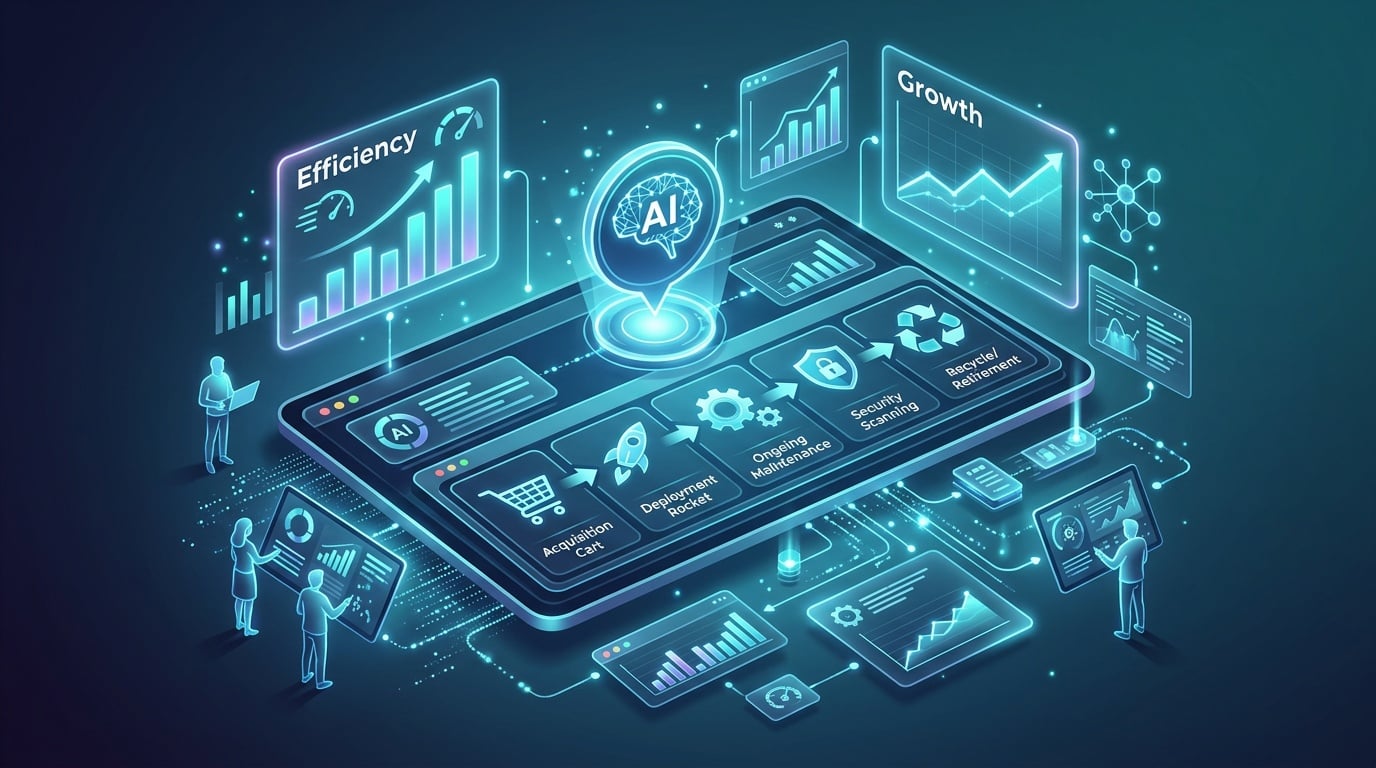
Managing IT assets effectively requires understanding their journey from initial acquisition to final disposal. This end-to-end perspective, known as the IT asset lifecycle, breaks down the process into distinct, manageable stages. Each phase presents unique challenges and opportunities for optimization, cost savings, and risk reduction. A well-defined it asset management process guides teams through these stages, ensuring continuity, compliance, and maximum value extraction from every technology investment. Neglecting any part of this cycle can lead to inefficiencies, increased costs, and security vulnerabilities, underscoring the importance of a comprehensive strategy.
From the strategic decisions made during procurement to the secure decommissioning of old equipment, each step plays a role in the overall health of an organization’s IT infrastructure. By implementing standardized procedures for each phase, businesses can achieve greater predictability, better resource allocation, and a more secure operational environment. This structured lifecycle management is a core component of strong information technology asset management.
Planning and Acquisition: Setting the Stage for Success
The lifecycle of an IT asset begins long before it enters the organization. Strategic planning and careful acquisition are paramount. This involves assessing current needs, forecasting future requirements, and understanding the total cost of ownership for potential assets, including purchase price, maintenance, support, and eventual disposal. Organizations must also consider licensing models, compatibility with existing systems, and vendor support agreements. A common pitfall here is impulsive purchasing without a clear business case or integration plan, leading to underutilized or incompatible assets.
For software, this stage involves detailed evaluation of licensing terms to avoid future compliance issues. For hardware, it means selecting devices that meet performance requirements while aligning with budget constraints. Establishing clear procurement policies and approval workflows ensures that all acquisitions are aligned with business objectives and IT strategy. This proactive approach during the planning and acquisition phase sets the foundation for efficient asset management throughout its useful life.
Deployment and Operation: Maximizing Value
Once acquired, IT assets move into the deployment and operational phase. This is where they are installed, configured, and put to work supporting business functions. Effective deployment requires standardized processes to ensure consistency and reduce errors. This includes imaging computers, installing software, configuring network settings, and migrating data. Accurate record-keeping during deployment is essential for updating inventory databases and establishing baseline configurations.
During the operational phase, the focus shifts to ensuring assets perform as expected and are used efficiently. This involves monitoring performance, managing user access, and providing ongoing support. For software, it means ensuring users have the necessary licenses and are using the applications appropriately. For hardware, it involves tracking usage patterns and identifying underutilized devices. This continuous monitoring and management help maximize the return on investment from each asset and prevent issues before they impact productivity.
Maintenance and Support: Keeping Assets Running Smoothly
The ongoing maintenance and support phase is critical for extending the life of IT assets and ensuring their reliability. This includes regular software updates, security patching, hardware diagnostics, and preventive maintenance. Establishing a clear support structure, whether through internal IT teams or external vendors, ensures that issues are addressed promptly, minimizing downtime and disruption to business operations. This proactive approach to maintenance helps prevent costly failures and performance degradation.
For software, this phase involves managing license renewals, applying patches, and ensuring compatibility with new operating systems or applications. For hardware, it includes physical maintenance, cleaning, and timely repairs or replacements under warranty. Effective maintenance and support practices contribute directly to the availability and performance of IT services, which is fundamental to business continuity and user satisfaction. A well-managed it asset management process highlights upcoming maintenance needs and renewal dates.
Retirement and Disposal: Secure and Compliant End-of-Life
The final stage of the IT asset lifecycle is retirement and disposal. This phase is often overlooked but carries significant risks if not handled properly. Assets reaching the end of their useful life must be retired from service and securely disposed of. This involves securely wiping data to prevent breaches, physically destroying storage media if necessary, and disposing of hardware in an environmentally responsible manner, complying with relevant regulations.
Proper disposal ensures that sensitive company and customer data is not compromised. Failure to do so can lead to severe data breaches and regulatory penalties. Additionally, organizations can often recoup some value by selling or recycling retired assets through certified vendors. Documenting the entire disposal process is a key component of ITAM, providing an auditable trail that confirms compliance and security measures were followed. This responsible end-of-life management is a critical aspect of the overall information technology asset management strategy.
Beyond Spreadsheets: Unlocking the Power of Modern ITAM with AI Automation
For many mid-market organizations, the reality of managing IT assets still relies heavily on manual processes, often centered around spreadsheets. While these tools may have served their purpose in simpler times, they are increasingly inadequate for today’s complex, dynamic IT environments. The inherent limitations of manual tracking lead to a cascade of problems: lost visibility into assets, significant wasted spend on unused licenses or underutilized hardware, and an ever-present risk of costly audit failures. This approach not only consumes valuable IT resources but also leaves businesses vulnerable and inefficient. Transitioning from these outdated methods to a modern, automated information technology asset management strategy is no longer optional; it is a business imperative for maintaining control and driving measurable outcomes.
The digital transformation that many businesses have undergone has outpaced the capabilities of traditional ITAM tools. With remote workforces, cloud adoption, and an explosion of SaaS applications, tracking every asset. From a server in a data center to a software license used by a remote employee. Becomes an almost impossible task with manual methods. This lack of comprehensive oversight creates blind spots that can be exploited by security threats or lead to financial inefficiencies. Embracing AI-driven solutions offers a path to overcome these challenges, providing the real-time data and proactive insights needed for effective IT asset management.
The Pain Points of Manual ITAM: Lost Visibility, Wasted Spend, and Audit Risks
Operating with spreadsheets for IT asset management is a recipe for inefficiency and risk. The sheer volume of data required to track hardware, software, licenses, contracts, and user assignments quickly overwhelms manual systems. This results in incomplete or inaccurate inventory, a common issue that leaves organizations unaware of their full IT asset environment. Lost visibility means potential security vulnerabilities go unaddressed, and opportunities for cost savings are missed. A typical mid-market enterprise can spend 8-12 hours weekly on manual asset tracking and reconciliation, diverting critical resources from strategic initiatives.
Additionally, the financial implications of manual ITAM are substantial. Gartner reports that organizations can lose up to 30% of their software spend due to unused licenses or non-compliance. Without automated checks, businesses often pay for software subscriptions that are never deployed or are assigned to departed employees. The risk of software audits is also a significant concern. Without precise records, responding to an audit can be a time-consuming, error-prone process. The average cost of a software audit penalty can exceed $200,000, a figure no mid-market company can afford to overlook. This underscores the pressing need for a more sophisticated it asset management process.
AI-Powered Discovery & Inventory: Real-Time Asset Mapping
AI-powered IT asset management fundamentally transforms the discovery and inventory process by moving beyond manual data entry and periodic scans. Advanced AI agents can continuously discover and map all IT assets across the entire network, including endpoints, servers, cloud instances, and SaaS applications, regardless of their location. This real-time visibility provides an accurate, up-to-the-minute picture of the IT environment. By automating the identification of hardware and software, IT teams gain immediate insight into what assets exist, where they are located, and how they are being used, effectively combating the problem of shadow IT, which can represent 30-40% of software spend in some organizations according to Gartner.
This automated discovery is not just about creating a list; it is about building a dynamic, intelligent database. AI can analyze asset configurations, identify dependencies, and even detect unauthorized software or hardware. This level of detail is impossible to achieve with manual methods and provides the foundational data necessary for all other ITAM functions. For organizations struggling with fragmented visibility, especially with remote or hybrid workforces, AI-powered discovery offers a clear path to comprehensive asset intelligence, forming the bedrock of effective information technology asset management.
Automated License Reconciliation: Eliminating Overspending and Compliance Gaps
One of the most significant financial drains in ITAM is software license mismanagement. Manual reconciliation is prone to errors, leading to either overspending on licenses that are not needed or facing severe penalties for non-compliance. AI automation excels here by continuously comparing deployed software against purchased licenses. It can automatically identify unused software, identify opportunities to reallocate licenses, and flag potential compliance issues before they become audit problems. This precise reconciliation ensures that organizations only pay for what they use and are fully compliant with vendor agreements.
Leading it asset management software powered by AI can analyze complex licensing models, including per-user, per-device, or per-processor licenses, and automatically reconcile them with actual usage data. This capability directly addresses the risk of unexpected audit fines, which can easily amount to hundreds of thousands of dollars. By ensuring that every software license is accounted for and properly used, businesses can significantly reduce their software spend. Gartner estimates up to 30% can be saved. This automated process not only cuts costs but also provides peace of mind, knowing that compliance is actively managed rather than reactively addressed.
Proactive Lifecycle Alerts: Preventing Disruptions and Optimizing Renewals
Effective IT asset management involves looking ahead, not just at the current state. AI automation provides proactive alerts for critical lifecycle events, preventing disruptions and optimizing financial commitments. This includes notifications for upcoming hardware failures, expiring software support contracts, and end-of-lease dates. By anticipating these events, IT teams can plan for replacements or renewals well in advance, avoiding emergency purchases at inflated prices and ensuring continuous service availability. This forward-looking approach is essential for maintaining operational stability and budget predictability.
Specifically, AI can analyze usage patterns and performance metrics to predict when hardware is likely to fail or require replacement, enabling proactive upgrades and reducing unplanned downtime. For software, automated alerts can notify stakeholders about approaching renewal dates, allowing for a strategic review of subscription needs. This prevents automatic renewals of underutilized services and ensures that contracts are renegotiated or optimized based on current requirements. This forward-thinking capability, powered by intelligent automation, is a cornerstone of modern IT asset management, moving beyond reactive problem-solving to strategic, cost-effective planning.
| Feature | Manual ITAM (Spreadsheets) | AI-Powered ITAM |
|---|---|---|
| Asset Discovery & Inventory | Time-consuming, prone to errors, missed assets, relies on periodic scans. | Automated, continuous, real-time, comprehensive mapping across hybrid environments. |
| Software License Management | Manual reconciliation, high risk of overspending or non-compliance, difficult to track usage. | Automated reconciliation against usage, identifies unused licenses, prevents overspending (up to 30% savings potential), ensures compliance. |
| Audit Readiness | Laborious manual preparation, high risk of penalties (avg. $200k+), significant time investment (50-70% reduction with automation). | Real-time, accurate data readily available, dramatically reduces audit preparation time, minimizes compliance risks. |
| Visibility & Control | Fragmented, limited visibility, prone to shadow IT (30-40% of spend). | Complete, real-time visibility across all assets and locations, tight control over IT environment. |
| Lifecycle Management | Reactive, often misses renewal dates or end-of-life planning, leading to disruptions. | Proactive alerts for renewals, support expirations, and hardware end-of-life, enabling optimized planning and cost savings. |
| Resource Allocation | Significant manual effort (8-12 hours/week), diverts IT staff from strategic tasks. | Automates routine tasks, freeing up IT staff for higher-value activities and strategic projects. |
Transforming Your Business with Strategic ITAM: Vertical-Specific Wins
For mid-market businesses, strategic deployment of information technology asset management (ITAM) translates directly into tangible business outcomes across their core operations. Vynta AI has observed firsthand how refining ITAM practices can unlock significant value, driving revenue growth, reducing operational expenditures, and bolstering security postures. By moving beyond reactive tracking to proactive, intelligent management, organizations in our key verticals are seeing measurable impacts. This is not just about IT efficiency; it is about enabling business agility and competitive advantage through optimized technology resources. Understanding the specific applications of ITAM within your industry can illuminate the path to substantial gains.
Effective ITAM ensures that technology investments are aligned with strategic goals, leading to better resource allocation and fewer surprises. As an example, a well-managed IT asset management process helps identify underutilized software licenses, allowing funds to be reallocated to critical growth areas or innovation. Similarly, accurate hardware lifecycle management prevents costly emergency replacements and ensures that agents and employees have the reliable tools they need to perform. This strategic approach to managing your technology estate is foundational to achieving operational excellence and maximizing return on investment across all business functions.
Real Estate: Streamlining Agent Tech & Data Security
In the competitive real estate sector, agents rely on a suite of technology tools. From CRM systems and virtual tour platforms to communication apps and mobile devices. Effective ITAM ensures that all these assets are accounted for, licensed correctly, and secured. This means tracking the software licenses for every agent’s productivity suite, ensuring compliance with data privacy laws when managing client information, and maintaining the security of devices used for property showings. Lost or unsecured devices, or unlicensed software, can lead to significant data breaches and reputational damage, impacting client trust and deal closures.
By implementing a clear IT asset management process, real estate agencies can gain visibility into the technology stack supporting their agents. This allows for better budgeting for software renewals, identifying opportunities to standardize tools for cost savings, and ensuring all agents are equipped with secure, up-to-date technology. Proactive management prevents disruptions, such as a critical CRM system failing due to unpatched software, ensuring agents can focus on client engagement rather than IT issues. This strategic oversight is key to operational continuity and data integrity.
Recruitment: Optimizing Consultant Tools & Candidate Data Management
Recruitment firms operate on speed and accuracy, managing vast amounts of sensitive candidate and client data. Their consultants depend on various IT assets, including Applicant Tracking Systems (ATS), communication tools, databases, and specialized sourcing software. Strong ITAM is essential for tracking these software licenses, ensuring compliance with data protection regulations like GDPR, and safeguarding the integrity of candidate profiles. Unmanaged assets or insecure endpoints can expose confidential information, leading to severe legal penalties and damage to the firm’s reputation for discretion.
A structured IT asset management approach helps recruitment agencies optimize their technology spend by identifying underused ATS modules or redundant software subscriptions. It ensures that all necessary tools are available and properly licensed for consultants, improving their productivity and ability to source top talent efficiently. Additionally, clear lifecycle management for hardware like laptops and mobile devices guarantees that sensitive candidate data is handled securely, from initial collection to eventual disposal. This disciplined management of IT assets directly supports the firm’s ability to deliver high-quality recruitment services reliably.
Fundraising: Ensuring Compliance for Donor Platforms & CRM
For fundraising organizations, managing donor relationships and outreach requires sophisticated CRM systems, donation processing platforms, and communication tools. Each of these represents a critical IT asset. Effective ITAM ensures that all software licenses are accounted for, especially those related to donor management and financial tracking, to maintain compliance with financial regulations and data privacy standards. The integrity and security of donor data are paramount; any compromise can severely damage donor trust and jeopardize future funding efforts.
A well-defined IT asset management process helps fundraising entities avoid costly penalties associated with non-compliance and software audits, which can be substantial. By accurately tracking licenses for CRM software and other essential platforms, organizations can optimize their software spend and ensure that all staff have the necessary tools to engage with donors effectively. Proactive management of these assets supports uninterrupted outreach campaigns and strengthens the organization’s ability to meet its fundraising goals by maintaining a secure and compliant technological foundation.
Hospitality: Managing POS Systems, Guest Wi-Fi & Service Devices
The hospitality industry relies heavily on a diverse array of IT assets, from Point-of-Sale (POS) systems and property management software to guest Wi-Fi infrastructure and in-room service devices. Effective information technology asset management is key to ensuring these systems operate reliably, securely, and compliantly. This includes tracking licenses for all hospitality software, managing the lifecycle of physical devices like tablets and network routers, and ensuring guest data privacy across Wi-Fi networks and booking systems. Downtime in POS systems or security breaches in guest data can lead to immediate revenue loss and significant reputational harm.
A strong ITAM program allows hotels, restaurants, and other hospitality businesses to maintain operational continuity by ensuring all technology is functional and updated. It helps optimize spending by identifying underutilized hardware or redundant software licenses. Additionally, by meticulously managing assets, hospitality businesses can comply with industry-specific regulations and security standards, protecting guest information and maintaining service quality. This disciplined approach to technology asset management directly supports a superior guest experience and efficient business operations.
Calculating Your ROI: The Measurable Impact of Automated ITAM
The return on investment (ROI) for implementing strategic ITAM, particularly with AI automation, is substantial and quantifiable. Organizations often see significant cost reductions by eliminating redundant software licenses and unused subscriptions. Gartner estimates that up to 30% of software spend can be recovered through better license management. IDC research highlights that ITAM automation can reduce manual audit preparation time by 50-70%, preventing costly fines that can average over $200,000. Additionally, effective lifecycle management can reduce hardware costs by 20-30% through optimized procurement and extended asset life.
Beyond direct cost savings, the benefits include increased operational efficiency, reduced downtime, and improved security posture. As an example, automating asset discovery and inventory can save mid-market enterprises 8-12 hours per week previously spent on manual tracking. A proactive approach minimizes risks, ensuring compliance and preventing disruptions that could impact revenue. By focusing on these measurable metrics. Cost reduction, time savings, risk mitigation, and efficiency gains. Businesses can clearly define and realize the significant commercial value of a mature ITAM strategy, especially when augmented by AI automation.
Pros
- Significant reduction in software overspending and license reclamation.
- Minimizes risk of costly software audit penalties and compliance violations.
- Improves operational efficiency through accurate, real-time asset visibility.
- Improves security by identifying and addressing unmanaged or vulnerable assets.
- Supports better strategic IT budgeting and forecasting.
- Simplifies IT operations by automating manual tracking and reconciliation.
Cons
- Initial investment in time and resources for implementation or system upgrade.
- Requires cultural shift towards standardized IT asset management processes.
- Potential for resistance to change from IT staff accustomed to manual methods.
- Complexity in integrating with existing disparate IT systems if not planned carefully.
Your Path to Smarter IT Asset Management: Partnering for Growth

Transitioning to a more sophisticated approach to information technology asset management, especially one powered by AI, represents a strategic move towards improved efficiency and reduced risk. Many mid-market businesses hesitate due to perceived complexity or the effort involved in adopting new technologies. Yet, the benefits of gaining comprehensive visibility, automating tedious tasks, and proactively managing your asset lifecycle far outweigh these initial concerns. Recognizing the signs that your current ITAM practices are insufficient is the first step toward unlocking substantial improvements in cost control, security, and operational agility.
Choosing the right path involves understanding when automation is most beneficial and selecting partners who can deliver tangible business outcomes. For organizations aiming to scale effectively, minimize financial exposure, and strengthen their security posture, a modern ITAM strategy is not just an IT function but a business enabler. Partnering with experts who understand both AI automation and your specific industry challenges can accelerate your journey toward smarter, more strategic IT asset management.
Common Concerns & How AI Automation Addresses Them
A primary concern is the perceived complexity of implementing new ITAM solutions. AI automation simplifies this by offering automated discovery that continuously maps assets, reducing the manual effort required for initial setup and ongoing inventory. Another common worry is the cost of overspending on unused software. AI-powered license reconciliation directly tackles this by identifying underutilized licenses, enabling cost savings that often offset the investment. Finally, the fear of audit penalties is a significant driver; automated compliance checks and real-time reporting provide the accuracy needed to pass audits with confidence, mitigating financial and reputational risks.
When to Consider AI-Powered ITAM: Signs Your Business is Ready
Your business is likely ready for AI-powered ITAM if you are experiencing significant manual effort in tracking assets, spending more than anticipated on software licenses, or struggling with fragmented visibility across remote or hybrid work environments. If software audits are a recurring source of stress or if you lack confidence in your organization’s security posture regarding IT assets, it is time to consider an upgrade. An increase in shadow IT, where unmanaged applications or hardware proliferate, also signals a need for automated discovery and control. Recognizing these indicators is key to making a timely strategic adjustment.
Vynta.ai: Your Strategic Partner for AI Automation in ITAM
At Vynta AI, we specialize in providing enterprise-grade AI agents designed for practical automation that delivers measurable business outcomes. We understand the unique challenges faced by mid-market SMEs across real estate, recruitment, fundraising, and hospitality. Our approach focuses on augmenting your existing capabilities, not replacing them, by automating complex tasks like asset discovery, license reconciliation, and lifecycle management. We are committed to transparency, providing strategic, expert guidance to help you implement solutions that offer clear ROI and improve operational efficiency. Let us help you change your IT asset management from a compliance burden into a strategic advantage.
Ready to Optimize Your IT Assets?
Discover how Vynta AI’s intelligent automation can bring clarity, control, and significant cost savings to your IT asset management. Request a Demo today to see our AI agents in action.
References
Frequently Asked Questions
What is information technology asset management (ITAM)?
Information technology asset management (ITAM) is a systematic business practice for managing an organization’s IT assets throughout their entire lifecycle. It involves planning, acquiring, deploying, maintaining, and disposing of hardware, software, and related components to ensure the right assets are in place at the optimal cost. Effective ITAM provides clarity on what technology an organization owns, where it’s located, and how it’s configured.
What are the main benefits of IT asset management for businesses?
IT asset management offers significant financial control by identifying overspending and optimizing procurement, preventing losses from unused licenses or non-compliance. It also strengthens security and compliance by enabling accurate tracking of deployed software and hardware, helping to mitigate risks from shadow IT and meet regulatory requirements. This structured approach leads to better-informed decisions and reduced operational costs.
What types of assets does IT asset management cover?
IT asset management covers more than just physical hardware like laptops and servers. It also includes software licenses for operating systems, applications, and cloud subscriptions, which represent a substantial portion of IT expenditure. Additionally, digital assets such as data repositories and intellectual property, along with cloud services and Software-as-a-Service (SaaS) subscriptions, are critical components managed under ITAM.
Why is ITAM particularly important for mid-market businesses?
Mid-market businesses often struggle with fragmented visibility into their IT infrastructure, leading to unexpected costs and compliance risks. Professionalizing IT asset management practices is key for these organizations to prevent financial pitfalls and security vulnerabilities associated with unmanaged assets. A defined ITAM strategy helps them regain control and maximize value from their technology investments.
How does ITAM help with security and compliance?
IT asset management is fundamental to security and compliance because it provides exact knowledge of all deployed software and hardware. This visibility allows IT teams to identify and patch vulnerabilities, enforce security policies consistently, and ensure adherence to regulations like GDPR or SOX. By tracking assets, organizations can effectively mitigate risks associated with unapproved software or hardware usage.
What is the primary goal of IT asset management?
The primary goal of IT asset management is to ensure an organization possesses the correct technology assets, located in the right places, available at the right times, and acquired at the most efficient costs. This discipline goes beyond simple inventory; it focuses on understanding each asset’s value and associated risks, ensuring licensing compliance, and optimizing the total cost of ownership for the entire technology estate.