

Agentic AI for leads vs full CRM solutions?
What Is an Agentic CRM and How Does It Actually Work?
An agentic CRM is a customer relationship platform where autonomous AI agents handle entire workflows from start to finish. Unlike traditional systems that require manual input for every step, an agentic CRM uses multiple specialized agents that perceive data, make decisions, and execute actions without waiting for human commands. These agents do not just surface information; they act on it.
Key Takeaways
- Agentic CRMs replace manual data entry with autonomous agents that perceive, decide, and act on lead information without human prompts.
- Traditional CRM systems surface data for you to act on, but agentic AI completes entire workflows like lead qualification and follow-up on its own.
- For lead management, agentic AI reduces response times and eliminates bottlenecks by handling repetitive tasks from start to finish.
- Full CRM solutions provide a centralized database and reporting, but they lack the proactive execution that agentic systems bring to lead conversion.
The core distinction lies in autonomy. A standard CRM stores contacts and logs activities. An agentic CRM assigns each lead to an agent that qualifies the prospect, schedules follow-ups, sends personalized messages, and updates records automatically. The system learns from each interaction and adjusts its approach over time.
The Orchestrator and Role-Based Agents: Behind the Scenes
An agentic CRM operates through an orchestrator that manages a team of role-based agents. Each agent has a specific function. A lead qualification agent evaluates inbound inquiries against your ideal customer profile. A scheduling agent coordinates calendar availability and sends reminders. A follow-up agent nurtures prospects who are not ready to buy. The orchestrator assigns tasks, monitors progress, and escalates complex cases to human team members.
This architecture mirrors how a sales team operates. Instead of one monolithic AI trying to do everything, specialized agents collaborate like department specialists. The orchestrator ensures they do not duplicate work or contradict each other. When a lead responds to an email, the follow-up agent notifies the qualification agent to update the lead score. Everything happens in real time.
Key Insight: The orchestrator model prevents the chaos of multiple AI tools acting independently. Each agent knows its role, and the orchestrator maintains a single source of truth for every lead interaction.
Multi-Agent Collaboration and Continuous Learning
Multi-agent collaboration is what separates agentic CRM from simple automation. When a lead fills out a website form, the capture agent logs the data. The qualification agent checks the lead against scoring criteria. If the score passes a threshold, the scheduling agent sends a calendar link. The follow-up agent monitors whether the lead books a meeting. If not, it sends a reminder after 24 hours.
Each agent reports outcomes back to the orchestrator, which updates the shared knowledge base. Over time, the system learns which messaging works best for different lead segments and adjusts its approach. This continuous learning loop means the system improves without manual reprogramming.
How Agentic CRM Differs from Traditional CRM with Chatbots
Traditional CRM platforms often bolt on a chatbot that answers basic questions and routes leads to a human. That is not agentic AI. A chatbot follows a decision tree. It cannot qualify a lead across multiple channels, coordinate a viewing schedule, or send personalized property recommendations based on past behavior.
An agentic CRM, by contrast, operates across email, SMS, WhatsApp, and website chat simultaneously. It remembers context from every channel. If a lead asks about a property on WhatsApp and later emails a question, the system connects those conversations. The lead does not repeat themselves. The table below summarizes the key differences.
| Capability | Traditional CRM + Chatbot | Agentic CRM |
|---|---|---|
| Decision making | Rule-based, static | Autonomous, context-aware |
| Multi-channel coordination | Separate silos per channel | Unified across all channels |
| Learning over time | Requires manual updates | Continuous self-improvement |
| Workflow execution | Single-step triggers | Multi-step orchestration |
| Human escalation | Binary (chatbot or human) | Graduated, context-based |
Full Agentic CRM vs. Dedicated Lead AI Agents: Which Delivers Faster ROI?
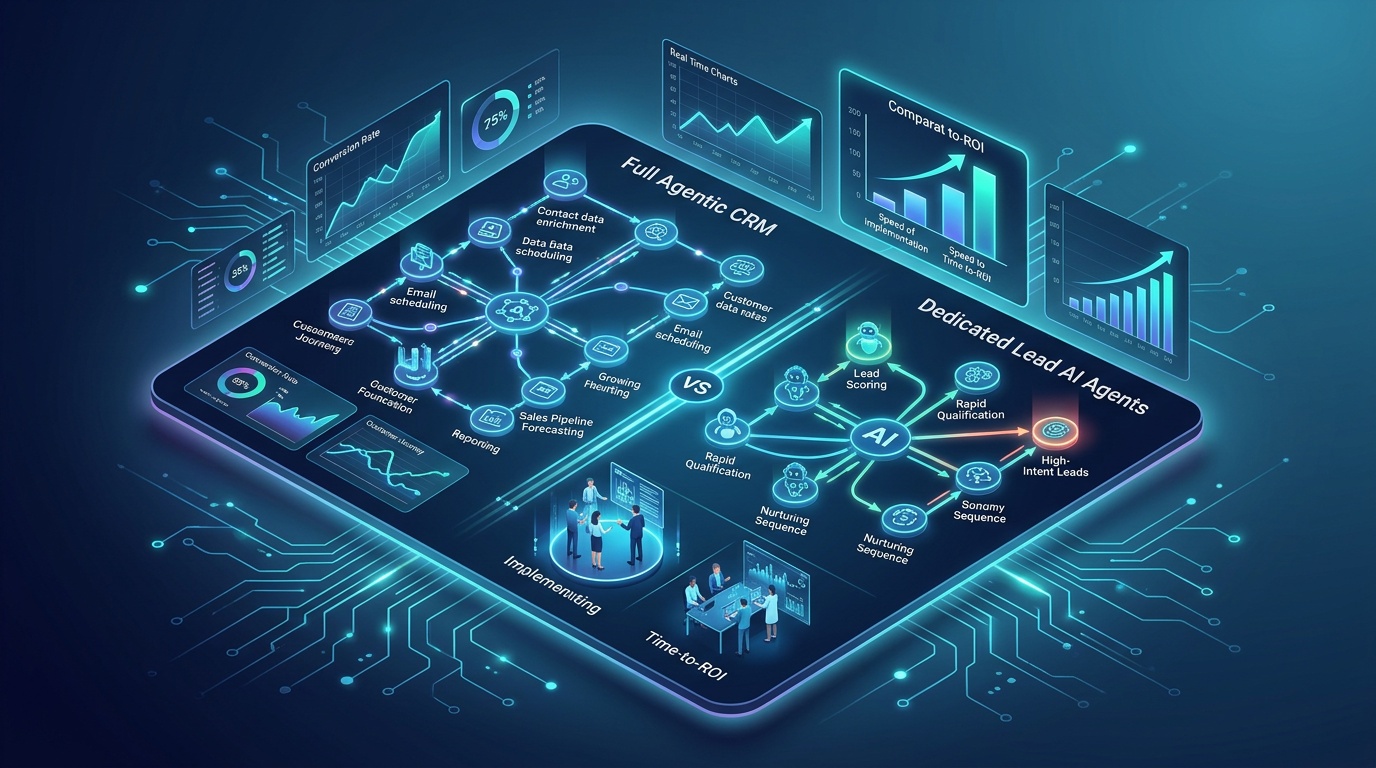
Choosing between a full agentic CRM and dedicated lead AI agents is not a technical decision. It is a business decision about speed, cost, and risk. The question of Agentic AI for leads vs full CRM solutions? often comes down to whether you need a complete platform overhaul or a targeted automation layer on top of your existing stack.
Dedicated lead agents focus on one job: finding, qualifying, and engaging prospects. They integrate with your current CRM rather than replacing it. Full agentic CRMs promise end-to-end automation but require migrating your entire sales infrastructure. The right choice depends on your timeline, budget, and tolerance for disruption.
Cost Breakdown: Subscription Pricing vs. Per-Workflow Costs
Full agentic CRM platforms like Salesforce Agentforce start at $25 per user per month plus additional Flex Credits for each AI action. Those credits add up quickly when your team runs hundreds of lead qualification workflows daily. Creatio agentic CRM also starts at $25 per user per month for all AI features, but the total cost of ownership includes implementation fees, data migration, and ongoing customization.
Dedicated lead AI agents typically charge per workflow or per lead processed. There is no per-user license fee. A real estate agency running 500 inbound inquiries per month pays only for the leads the system handles. No unused seats. No surprise overage charges. The pricing model aligns with actual usage rather than headcount.
Cost Reality Check: A mid-market SME with 20 sales reps paying $25/user/month for a full agentic CRM spends $6,000 annually before any AI consumption costs. Dedicated lead agents often cost less than half that for equivalent lead volume.
Deployment Speed: Days for Agents, Months for Full CRM Migration
Dedicated lead agents can be deployed in under a week. The process involves connecting the agent to your existing CRM via API, defining your lead qualification criteria, and setting up communication channels. No data migration. No user training. No downtime.
Full agentic CRM implementations take three to six months. You must migrate contacts, deals, and activity history. You need to reconfigure workflows, train staff on a new interface, and test integrations with your existing tools. During that period, your sales team operates in a hybrid state that often reduces productivity. For companies that need results this quarter, not next year, dedicated agents offer a faster path to value.
Flexibility and Vendor Lock-In: One Ecosystem vs. Modular Approach
Committing to a full agentic CRM means betting your entire sales operation on one vendor. If the platform does not deliver on its AI promises, or if pricing changes, switching costs are substantial. You face another migration project and another learning curve.
Dedicated lead agents follow a modular approach. They plug into your existing CRM, whether you use Pipedrive, HubSpot, Salesforce, or a custom system. If you decide to switch CRMs later, the agent moves with you. This flexibility reduces vendor lock-in and lets you adopt AI for leads without restructuring your entire tech stack. For businesses that value optionality, modular agents are the safer bet.
For real estate agencies specifically, Agentic Systems for Real Estate demonstrate how dedicated lead agents deliver measurable outcomes. The system converts property inquiries into viewings and sales through instant engagement, intelligent qualification, and personalized follow-up. Response time to inquiries is less than 60 seconds. Agent productivity is maximized by automating 80% of tasks, saving over 20 hours per week, and resulting in over 30% more deals closed. The qualified pipeline increases by 3x with an 85% conversion rate. Agentic Systems for Real Estate improve client retention by 85% and generate over $100,000 in additional revenue per agent per year.
Why You Shouldn’t Replace Your CRM — Augment It Instead
The prevailing AI industry narrative pushes companies toward a complete agentic CRM overhaul as if it is the only path forward in the Agentic AI for leads vs full CRM solutions? debate. This advice serves platform vendors pushing migrations rather than your actual business outcomes. For most mid-market SMEs, the smarter move is augmentation: keep your existing CRM and add specialized AI agents that handle lead qualification, outreach, and follow-up. This approach delivers autonomous AI capabilities without the disruption, cost, and risk of ripping out your entire sales infrastructure.
Your team already knows your current CRM. Your data lives there. Your workflows are established. Adding a dedicated AI agent layer preserves all of that while injecting true autonomous capability into your lead operations. You do not need to choose between a full platform replacement or doing nothing. There is a middle path that delivers faster results with less friction.
The Hidden Costs of Migrating to a Full Agentic CRM
Full agentic CRM migration carries price tags beyond subscription fees. Data migration requires mapping fields from your old system to the new one. Even with automated tools, you will lose activity history, email threads, and custom field relationships. You then need to reconfigure every workflow, retrain every user, and test every integration. The productivity dip during a three to six month migration often costs more than the software itself in lost deal momentum.
There is also the opportunity cost of attention. While your team learns a new interface and troubleshoots data inconsistencies, they are not selling. For companies with lean operations, this distraction can set quarterly revenue targets back significantly. The hidden cost is not just money. It is time and focus you cannot recover.
Augmenting Your CRM vs. Migrating to a Full Agentic CRM
Pros of Augmentation
- No data migration required
- Deployment in days, not months
- Team uses familiar tools
- Pay for lead volume, not user seats
- Easier to switch vendors later
Cons of Migration
- Risk of data loss during transfer
- 3 to 6 months of reduced productivity
- Steep learning curve for sales teams
- High total cost with consumption fees
- Vendor lock-in makes switching costly
How Dedicated Lead Agents Plug Into Your Existing Stack (e.g., Pipedrive + Vynta)
Dedicated lead agents connect to your existing CRM through standard API integrations. There is no data migration. No schema changes. No duplicate records. The agent reads lead data from your CRM, performs qualification and outreach, and writes updates back into the same system. Your team continues working in Pipedrive, HubSpot, or Salesforce exactly as before. The agent simply handles the repetitive parts of lead management that previously consumed hours each day.
For example, a real estate agency using Pipedrive can add a lead qualification agent that monitors inbound inquiries from website forms, WhatsApp, and email. The agent scores each lead, matches them to active listings, sends personalized property recommendations, and schedules viewings—all within Pipedrive. The agent updates deal stages and adds notes automatically. No manual data entry. No switching between platforms. The CRM becomes the single source of truth, and the agent becomes the engine that keeps it current.
Real-World Hybrid Examples: Light CRM + AI Agents in Action
A recruitment agency using a basic ATS integrated a candidate screening agent that evaluates resumes against job requirements. The agent scores candidates, schedules interviews, and sends rejection emails for unqualified applicants. The agency reduced time-to-screen by 70 percent without changing their ATS. Their recruiters now focus on closing placements instead of reading hundreds of resumes.
A fundraising organization using Salesforce Nonprofit Success Pack added an investor outreach agent. The agent identifies donors who have not engaged in 90 days, drafts personalized messages, and tracks response rates. The organization increased donor re-engagement by 40 percent in the first quarter. Their development team spends less time on outreach and more time building relationships with high-value donors.
These hybrid setups prove that AI for lead generation does not require a full CRM replacement. The agents handle the work your existing system cannot, and they do it without breaking what already functions well. For most mid-market SMEs, this is the fastest path to measurable ROI from AI automation.
Industry-Specific Use Cases: Real Estate, Recruitment, Fundraising, Hospitality
Different industries face different lead management challenges. A generic AI platform rarely serves any of them well. The Agentic AI for leads vs full CRM solutions? question becomes clearer when you examine how dedicated agents perform in specific verticals compared to a one-size-fits-all agentic CRM. Specialized agents built for your industry deliver better outcomes because they understand your terminology, workflows, and compliance requirements from day one.
Below we examine how dedicated AI agents outperform full agentic CRMs in the four core industries Vynta serves. Each use case shows why vertical-specific automation beats a generalized platform migration.
Real Estate: Lead Qualification and Property Matching Without a Full CRM Overhaul
Real estate agencies handle high volumes of inbound inquiries from multiple channels. Buyers ask about properties on WhatsApp. Sellers submit forms on your website. Renters send emails about availability. A full agentic CRM requires migrating your entire property database, agent profiles, and listing history. That process takes months and risks data integrity.
Dedicated lead agents for real estate plug into your existing CRM and property management system. They qualify leads instantly across every channel, match prospects to active listings using advanced algorithms, send personalized property recommendations with virtual tours, and coordinate viewing schedules with automated reminders. The system can be active in under a week. Specifically, Agentic Systems for Real Estate help agencies handle more properties, convert more leads, and close more deals without expanding their team or increasing admin costs. The system converts property inquiries into viewings and sales through instant engagement, intelligent qualification, and personalized follow-up. Response time to inquiries is less than 60 seconds. Agent productivity is maximized by automating 80 percent of tasks, saving over 20 hours per week, and resulting in over 30 percent more deals closed. The qualified pipeline increases by 3x with an 85 percent conversion rate. Agentic Systems for Real Estate improve client retention by 85 percent, client satisfaction by 27 percent, and generate over $100,000 in additional revenue per agent per year.
Recruitment: Candidate Screening and ATS Integration with Modular Agents
Recruitment firms evaluate hundreds of candidates for each placement. Manual resume screening consumes hours that recruiters could spend building client relationships. Full agentic CRMs for recruitment often require migrating your entire candidate database and job history, which introduces data mapping issues and downtime.
Modular AI agents integrate directly with your existing applicant tracking system. They parse resumes against job requirements, rank candidates by fit score, schedule interviews through calendar integration, and send personalized updates to applicants. The agent learns from recruiter feedback and improves its screening criteria over time. No ATS migration is needed. Your recruiters keep their familiar tools while the agent handles the high-volume screening work that slows down placement cycles.
Fundraising: Investor Outreach and Donor Management on Your Existing Platform
Fundraising organizations depend on timely, personalized outreach to maintain donor relationships. A donor who receives generic appeals will stop giving. Full agentic CRMs for fundraising require migrating your donor database, gift history, and communication logs. The migration risk is high because donor data often includes sensitive personal information and compliance requirements.
Dedicated AI agents work with your existing donor management platform. They segment donors by giving history, engagement level, and preferred causes. The agent drafts personalized outreach messages, schedules follow-ups based on donor behavior, and tracks response patterns to optimize future communications. Your development team retains full control of donor relationships while the agent handles the repetitive tasks of segmentation and outreach scheduling.
Hospitality: Guest Experience and Upselling Automation With Minimal Friction
Hotels, resorts, and vacation rental managers juggle guest inquiries across booking platforms, email, and messaging apps. Responding quickly to questions about amenities, pricing, and availability directly impacts booking conversion rates. Full agentic CRMs for hospitality require integrating with your property management system, booking engine, and guest communication channels. This integration project can take months.
Modular AI agents connect to your existing property management system through API. They answer guest questions instantly across any channel, recommend room upgrades and add-on services based on booking context, coordinate check-in instructions and concierge requests, and collect post-stay feedback to improve service. The agent handles guest communication 24/7 while your front desk team focuses on in-person service. Deployment takes days, not months, and your existing booking infrastructure stays intact.
Vertical Intelligence: Industry-specific AI agents understand property types, recruitment compliance rules, donor segmentation models, and hospitality booking cycles. A generic agentic CRM cannot match this domain expertise without extensive customization that most vendors do not provide.
References
Frequently Asked Questions
What is an agentic CRM and how does it work?
An agentic CRM is a customer relationship platform where autonomous AI agents handle entire workflows without human commands. Unlike traditional CRMs that require manual input, an agentic CRM uses specialized agents that perceive data, make decisions, and execute actions like qualifying leads, scheduling follow-ups, and sending personalized messages. The system learns from each interaction and improves over time without manual reprogramming.
How does agentic AI differ from traditional CRM chatbots?
Agentic AI goes far beyond rule-based chatbots by operating autonomously across multiple channels like email, SMS, and WhatsApp simultaneously. Chatbots follow decision trees and can only answer basic questions or route to humans, while agentic CRM uses multi-agent collaboration to qualify leads, coordinate schedules, and remember context from every channel. This unified approach means leads never repeat themselves, and the system acts on data rather than just surfacing it.
What is the difference between a full agentic CRM and a dedicated lead AI agent?
A full agentic CRM replaces your entire sales infrastructure with end-to-end automation, while a dedicated lead AI agent focuses specifically on finding, qualifying, and engaging prospects within your existing CRM. The choice depends on your timeline, budget, and tolerance for disruption. Dedicated lead agents integrate via API and can be deployed in days, whereas full CRMs require months of migration and higher upfront costs.
Which option delivers faster ROI: full agentic CRM or dedicated lead AI agents?
Dedicated lead AI agents typically deliver faster ROI because they deploy in under a week, cost per workflow instead of per user, and require no data migration or user training. Full agentic CRMs take three to six months to implement and often have higher total costs when you add AI consumption credits. For mid-market SMEs seeking quick wins, dedicated agents usually provide more immediate returns for lead qualification and engagement.
Does agentic AI replace traditional CRM systems entirely?
Agentic AI does not necessarily replace traditional CRM systems. Dedicated lead AI agents work on top of your existing CRM by integrating via API to automate lead qualification and follow-ups without migrating data. Full agentic CRMs do replace your current platform but require significant migration and change management. The right approach depends on whether you need a targeted automation layer or a complete platform overhaul.
How do costs compare between full agentic CRM and dedicated lead AI agents?
Full agentic CRMs like Salesforce Agentforce start at $25 per user per month plus additional credits for each AI action, which add up quickly for high-volume teams. Dedicated lead AI agents charge per workflow or per lead processed, with no per-user license fees. For a mid-market SME with 20 sales reps, full CRM costs over $6,000 annually before AI usage, while dedicated agents often cost less than half for equivalent lead volume.