

Compare top agentic AI for CRM integration?
Modern sales and marketing teams are drowning in manual data entry and repetitive follow-ups that kill productivity. To address this, businesses now look to compare top agentic AI for CRM integration. Moving beyond simple automation toward autonomous systems that think and act. At Vynta AI, we deploy Agentic Systems for Real Estate and other high-stakes verticals to turn your CRM from a static database into a revenue engine.
Key Takeaways
- Agentic AI turns your CRM from a passive database into an active system that autonomously manages sales and marketing workflows.
- Comparing five platforms helps you select an autonomous agent that matches your team’s specific operational requirements.
- High-stakes industries like real estate gain the most from agentic AI because it eliminates manual data entry and repetitive follow-ups.
- The move from simple automation to thinking agents frees your team to focus on strategic activities that drive revenue.
- Choosing the right agentic AI platform directly determines how well your CRM converts leads and accelerates deal cycles.
These advanced tools shift from linear workflows to goal-oriented agents. They don’t just move data from point A to B. They analyze lead intent, manage complex calendars, and execute multi-step strategies across channels without constant human intervention. That’s the first step toward a truly autonomous business environment.
What Agentic AI CRM Actually Means for Your Business (And What It Doesn’t)
Agentic AI vs. Traditional CRM Automation: The Real Difference
Traditional CRM automation relies on rigid “if-this-then-that” logic. If a lead fills out a form, the system sends a template email. It fails when faced with unpredictable human conversations or complex sales cycles. Agentic AI, on the other hand, possesses reasoning capabilities. Instead of following a fixed path, an agent identifies the objective. Say, qualifying a high-value investor. And determines the best sequence of actions based on real-time context.
This evolution moves your CRM from a passive record-keeper to an active participant. In Agentic Systems for Recruitment or fundraising, an agentic system can evaluate candidate sentiment or donor history to adjust its outreach tone. It handles nuances that usually require a human, freeing your team to focus on closing deals. The primary differentiator when evaluating agentic AI for CRM is this ability to handle ambiguity and make independent decisions within defined guardrails.
How Agentic CRM Works: Orchestrator, Role-Based Agents, and Multi-Agent Collaboration
A modern agentic CRM has three core components: the orchestrator, specialized role-based agents, and a collaboration layer. The orchestrator receives high-level instructions and breaks them into smaller tasks. Role-based agents execute those tasks. One might focus on data enrichment while another handles personalized SMS outreach. This modularity ensures every part of the sales funnel gets specialized attention.
Multi-agent collaboration lets these entities communicate with each other. If a lead expresses interest in a specific property type, the qualification agent passes that context to the scheduling agent. In our Agentic Systems for Real Estate, this workflow turns property inquiries into viewings through instant engagement and intelligent qualification. By automating 80% of these tasks, agencies save over 20 hours per week while keeping a personalized touch for every prospect.
Why Most ‘Agentic’ CRM Products Are Just Old Automation With New Labels
The marketplace is flooded with legacy software companies rebranding basic chatbots as “agentic AI.” True agency requires a feedback loop that learns from outcomes and adjusts behavior autonomously. If a tool can’t browse the web to research a prospect or update your database based on a phone transcript, it’s likely a dressed-up workflow builder. Many products still require a human to trigger every significant action, defeating the purpose of autonomy.
Gartner predicts that by 2026, over 40% of enterprise applications will embed role-specific AI agents, according to research cited by Kore.ai. But current reliability remains a challenge. Performance varies significantly across platforms. That gap highlights the need to choose platforms that prioritize data accuracy and sound reasoning over flashy marketing claims.
The Top Agentic CRM Platforms Compared: Features, Pricing, and Real-World Fit

Choosing the right platform depends on your existing tech stack and process complexity. Some organizations prefer a native approach (AI built into the CRM), while others find more value in overlay systems sitting on top of their current data. When you assess agentic AI for CRM, evaluate how well the agent accesses your proprietary data. Without deep access to historical interactions, an agent stays superficial and error-prone.
| Platform | Primary Strength | Target Market | Integration Depth |
|---|---|---|---|
| Salesforce Agentforce | Enterprise-grade customization | Large Enterprise | Native / Deep |
| HubSpot Breeze | Ease of use and setup | Mid-Market SMEs | Native / Moderate |
| Creatio | Low-code flexibility | Mid-to-Large Scale | Native / High |
| Zoho CRM | Affordability and accessibility | Small-to-Mid Business | Native / Moderate |
| Vynta AI | Vertical-specific ROI | Specialized Mid-Market | API-Driven / Deep |
Salesforce Agentforce: Enterprise Power With Enterprise Cost
Salesforce positions Agentforce as the gold standard for large-scale autonomous operations. It uses the Data Cloud to give agents a comprehensive view of every customer touchpoint, enabling highly sophisticated reasoning across the entire Salesforce ecosystem. But that power comes with a high price tag and a big implementation hurdle. Mid-market users on Reddit often note that the combined cost of Data Cloud and Agentforce licenses is prohibitive for smaller teams.
Salesforce Agentforce
Pros
- Unmatched scalability for global organizations
- Deep integration with the entire Salesforce suite
- Advanced security and compliance frameworks
Cons
- Extremely high total cost of ownership
- Requires specialized consultants for setup
- Complexity can lead to long deployment times
HubSpot Breeze: Mid-Market Friendly but Limited Autonomy
HubSpot Breeze aims to democratize AI for the mid-market by focusing on usability. It excels at content generation, lead enrichment, and basic customer service interactions. The interface is intuitive. A favorite for teams without dedicated AI engineers. However, it may lack the deep reasoning required for highly complex, multi-stage negotiations in fundraising or high-end real estate. It’s a solid choice if you want quick adoption and good review of agentic AI for CRM integration.
HubSpot Breeze
Pros
- Very short learning curve for existing users
- Strong focus on marketing and sales alignment
- Predictable pricing models
Cons
- Less autonomous than enterprise competitors
- Customization options are somewhat restricted
- Heavy reliance on HubSpot’s internal ecosystem
Creatio: Native Agentic CRM With Low-Code Flexibility
Creatio stands out by combining a low-code platform with native agentic capabilities. Business users can build custom agents that follow specific industry workflows without writing extensive code. For a recruitment agency director or hospitality manager, that means tailoring the system to unique operational needs. The “no-code” philosophy reduces technical debt often associated with complex AI deployments. It bridges the gap between HubSpot’s rigidity and Salesforce’s complexity.
Creatio AI
Pros
- Excellent for building custom business logic
- Unified platform for CRM and BPM
- Faster deployment than traditional enterprise tools
Cons
- Smaller community and third-party marketplace
- Interface can feel less modern than HubSpot
- Requires clear process mapping before implementation
Microsoft Dynamics 365 and Zoho: Overlay vs. Native Approaches
Microsoft Dynamics 365 uses Copilot to provide an overlay of intelligence across its CRM and ERP systems. It’s effective for organizations deep in the Azure ecosystem. Zoho, on the other hand, offers a more accessible entry point. According to aimultiple.com, Zoho’s agentic CRM pricing starts as low as $14 per user per month. While Zoho may not match the reasoning depth of specialized platforms, it provides a functional starting point for budget-conscious SMEs.
For specific industries like property management, a generic overlay often isn’t enough. That’s where specialized solutions like Agentic Systems for Real Estate shine. By focusing on outcomes like a 3x increase in qualified pipeline and an 85% conversion rate, these vertical-specific agents outperform general-purpose tools that need extensive prompting to understand property viewings or donor outreach cycles.
The Hidden Cost Nobody Talks About: Maintenance Burden and Data Readiness
The promise of autonomous agents is compelling, but many organizations underestimate the operational overhead required to keep them running correctly. When you examine top agentic AI for CRM integration, the subscription price is only part of the total investment. The real challenge is ongoing maintenance of AI logic and data infrastructure. Without a dedicated monitoring strategy, even the most sophisticated agent can become a liability.
Why Clean CRM Data Is a Non-Negotiable Prerequisite
An AI agent is only as intelligent as the information it consumes. If your CRM has duplicate contacts, outdated lead statuses, or incomplete interaction histories, the agent will make flawed decisions. In recruitment or fundraising, a hallucination caused by poor data might lead an agent to pitch the wrong investment to a high-net-worth donor or invite a candidate to interview for a role they already rejected. Data hygiene is the foundation of autonomy. Before deployment, businesses must audit data to ensure the “ground truth” provided to the AI is accurate and structured.
The 3 AM Slack Message: Monitoring, Retraining, and Handling Hallucinations
“Set it and forget it” is a dangerous myth with agentic AI. Even systems with high success rates need constant oversight. Reddit users note that performance consistency remains an industry challenge. For a hospitality manager, this might mean a double-booked suite or an incorrectly applied discount. Establish a “human-in-the-loop” protocol to catch errors before they hit the customer. Operations teams must monitor logs, retrain models on edge cases, and intervene when the AI hits a scenario outside its training parameters.
“The biggest mistake companies make is treating an AI agent like a software feature instead of a digital employee. Just as a new hire needs onboarding and performance reviews, your agentic CRM requires continuous feedback loops to maintain accuracy and alignment with business goals,” says Anas Moujahid, Operations Director at Vynta AI.
Vendor Lock-In Risks: Proprietary vs. Open Frameworks (LangGraph, CrewAI)
Choosing between a closed ecosystem like Salesforce Agentforce and open frameworks like LangGraph or CrewAI involves a strategic trade-off. Proprietary systems offer seamless integration but often lead to vendor lock-in, making it hard to migrate logic if pricing or service quality changes. Conversely, open-source frameworks give greater flexibility and control over intellectual property but require significant internal expertise. For mid-market SMEs, the goal is a portable agentic layer that can adapt as technology evolves over the next few years.
Industry-Specific Agentic CRM Use Cases: Real Estate, Recruitment, Fundraising, Hospitality
The true value of agentic AI lies in its application to specific vertical challenges. Generic sales bots often fail because they don’t understand the unique vocabulary or urgency of specialized industries. When you review top agentic AI for CRM integration for your sector, look for solutions with pre-built logic for your core workflows. That specialization lets the AI handle complex multi-step processes without months of custom prompting.
Real Estate: Autonomous Lead Qualification and Property Matching
In the high-stakes property market, Agentic Systems for Real Estate transform how agencies interact with prospects. These systems handle lead capture through instant 24/7 engagement across WhatsApp, SMS, email, and website chat. With a response time of less than 60 seconds, leads don’t go cold. The AI-driven qualification filters inquiries to identify serious buyers, while advanced matching algorithms suggest relevant properties and virtual tours. This automation saves agents over 20 hours per week, allowing them to close 30% more deals with a more efficient pipeline.
Recruitment: AI-Powered Candidate Screening and ATS Integration
For recruitment firms, agentic CRM integration streamlines top-of-funnel sourcing. Agents autonomously scan resumes, cross-reference them with LinkedIn profiles, and conduct initial outreach to gauge interest. Unlike traditional filters, agentic systems understand nuance in career trajectories and skill sets. They schedule preliminary screenings and update the Applicant Tracking System (ATS) in real time. Recruiters only spend time speaking with candidates who meet both technical requirements and cultural fit, significantly reducing time-to-hire.
Fundraising: Investor Outreach and Donor Management at Scale
Fundraising organizations often struggle with the manual labor of maintaining donor relationships. AI-Powered Fundraising Platform tools analyze donor history and social signals to personalize outreach at scale. An agent might identify a high-value donor who recently sold a company and initiate a tailored sequence referencing their past contributions. By managing the initial stages, the system ensures fundraising leaders only step in when it’s time to finalize a pledge or host a high-level meeting, maximizing every donor interaction.
Hospitality: Reservation Optimization and Guest Experience Automation
In the hospitality sector, agentic AI balances guest satisfaction with operational efficiency. Vynta AI Agents for Hospitality handle complex reservation inquiries, manage cancellations, and coordinate special requests across multiple platforms. Beyond simple booking, these systems use guest data to offer personalized recommendations for dining or local experiences. By automating these interactions, hotels can increase booking conversion by 50% and reduce inquiry abandonment by 60%, all while keeping front desk staff focused on higher-value guest interactions.
Case Study: Mid-Market Agency Transformation
A regional real estate firm implemented Agentic Systems for Real Estate to manage an influx of inquiries from social media ads. Within the first quarter, the system achieved a 3x increase in their qualified pipeline. By automating 80% of tasks. Including initial property matching and viewing coordination. The agency generated over $100k in additional revenue per agent. Automated follow-up and feedback collection after viewings also reduced no-shows significantly, proving that agentic CRM integration delivers measurable ROI in competitive markets.
How to Choose the Right Agentic CRM for Your Mid-Market SME: A Decision Framework
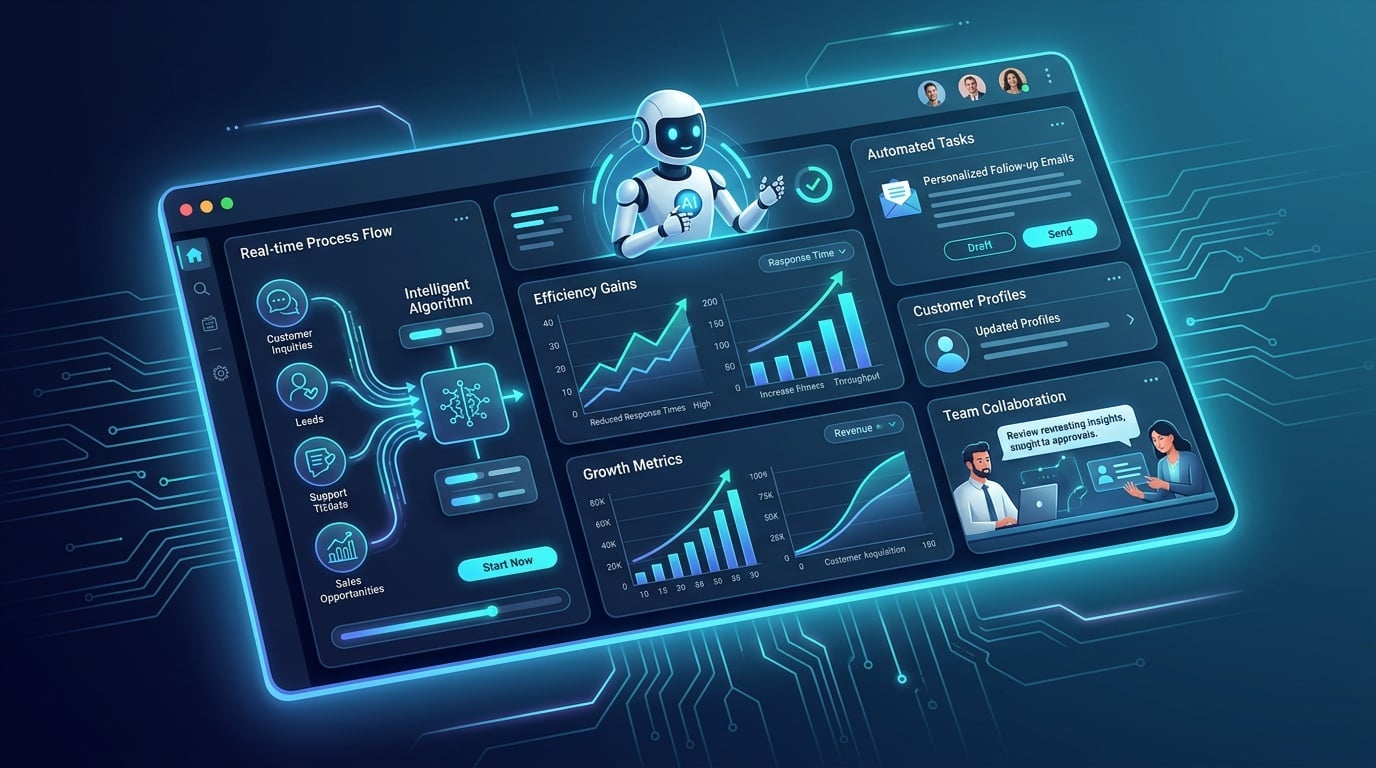
Selecting a platform requires more than a feature audit. For mid-market SMEs, the goal is to find a balance between sophisticated autonomy and operational simplicity. When you compare top agentic AI for CRM integration, you must evaluate how a system fits into existing workflows without creating a massive technical burden. The framework below provides a structured approach to identifying the solution that aligns with your growth objectives and data capacity.
Step 1: Assess Your Data Maturity and Integration Complexity
Before deploying an autonomous agent, evaluate the quality of your underlying data. Agentic systems rely on “ground truth” to make decisions. If your CRM has conflicting records or incomplete lead histories, the AI will struggle with accuracy. Start by auditing your data silos. Determine if your information is consolidated in a central repository or scattered across disparate spreadsheets and legacy tools. High integration complexity favors platforms with strong API capabilities that can bridge gaps without a total system overhaul.
Data readiness also involves security and compliance. Ensure the platform adheres to industry standards for data protection, especially if you handle sensitive information in recruitment or fundraising. A mature data environment lets the AI perform complex reasoning. Like predicting donor churn or identifying the best candidate for a niche role. With high confidence. Without this foundation, the risk of hallucinations increases, leading to reliability challenges.
Step 2: Match Platform Capabilities to Your Industry Vertical
Generic AI tools often require extensive customization to understand specific industries. A recruitment agency has very different needs than a hospitality group. When you compare top agentic AI for CRM integration, prioritize solutions with pre-built logic for your sector. For property professionals, Agentic Systems for Real Estate provide specialized workflows including lead capture across WhatsApp and SMS, automated property matching, and viewing coordination. This vertical focus means the AI understands context. Like the difference between a casual browser and a serious buyer.
In fundraising, the system should excel at relationship mapping and personalized outreach. In hospitality, the focus shifts to reservation optimization and guest experience management. Choosing a vertical-specific agent reduces time spent on “prompt engineering” and delivers results faster. The AI augments your human staff effectively rather than forcing them to adapt to a rigid, horizontal software structure.
Step 3: Total Cost of Ownership: Beyond Per-User Pricing
The sticker price of a CRM license is often misleading. To understand the true financial impact, calculate total cost of ownership. Including implementation fees, data cleaning costs, ongoing maintenance, and third-party integration expenses. For example, Salesforce Agentforce offers immense power, but the additional cost of Data Cloud can make it expensive for many SMEs. Zoho offers a lower entry point but may require more manual intervention for complex tasks.
Consider the maintenance burden mentioned earlier. An agent that needs constant human oversight adds hidden labor costs. Look for platforms that demonstrate clear ROI through measurable outcomes. Like the $100k in additional revenue per agent generated by Agentic Systems for Real Estate. Evaluate whether efficiency gains (e.g., saving 20 hours per week per agent) offset subscription and setup costs over 12 to 24 months.
Step 4: Pilot With a High-Impact Use Case Before Full Rollout
Avoid the temptation of a “big bang” implementation. Instead, identify a specific, high-impact use case as a proof of concept. For a recruitment firm, that might be automating initial candidate screening for a single department. For a real estate agency, it could be managing lead qualification for a new development. A pilot program lets you test the AI’s reasoning, monitor for hallucinations, and refine the workflow in a controlled environment before expanding across the organization.
During the pilot, track specific KPIs like response time, conversion rates, and user adoption. This data-driven approach builds internal buy-in and provides evidence to justify a larger investment. It also gives your team time to get comfortable with the technology. Successful pilots lead to a smoother full-scale rollout, with major operational hurdles resolved early. That way, when you compare top agentic AI for CRM integration outcomes, the results are grounded in real-world performance.
The Vynta AI Implementation Checklist
- Audit CRM data for duplicates and missing fields to ensure a clean “ground truth.”
- Map out the exact steps of your most repetitive manual workflow.
- Define the specific goal you want the AI agent to achieve (e.g., 85% conversion rate).
- Establish a human-in-the-loop protocol for reviewing AI decisions.
- Identify which communication channels (WhatsApp, Email, SMS) require immediate automation.
- Verify that the chosen platform can scale as your lead volume increases by 3x.
The transition to agentic CRM is a strategic move that requires careful planning and a focus on long-term outcomes. By following this framework, mid-market SMEs can navigate the hype and select a system that truly transforms their operations. Whether you’re looking to compare top agentic AI for CRM integration for recruitment, fundraising, or real estate, the key is to prioritize data readiness, vertical expertise, and a clear understanding of total costs. Implemented correctly, these autonomous systems do more than manage data. They drive revenue and free your team to focus on the human connections that close deals.
References
Frequently Asked Questions
What is agentic AI for CRM integration?
Agentic AI for CRM integration refers to autonomous systems that use reasoning and goal-oriented behavior to manage sales and marketing tasks. Unlike traditional automation that follows rigid if-then logic, agentic AI analyzes real-time context, makes independent decisions, and executes multi-step strategies across channels. This turns a CRM from a passive database into an active revenue engine.
How does agentic AI differ from traditional CRM automation?
Agentic AI differs from traditional CRM automation because it possesses reasoning capabilities and adapts based on context. Traditional automation relies on fixed if-this-then-that rules, like sending a template email after a form fill. Agentic AI evaluates objectives. Such as qualifying a high-value investor. And determines the best sequence of actions, handling ambiguity and making independent decisions within defined guardrails.
What are the core components of an agentic CRM system?
An agentic CRM system consists of three core components: an orchestrator, specialized role-based agents, and a collaboration layer. The orchestrator receives high-level instructions and breaks them into tasks. Role-based agents execute those tasks, such as data enrichment or personalized outreach. Multi-agent collaboration allows these entities to share context, ensuring seamless handoffs like passing a lead’s interest from qualification to scheduling.
How can I tell if a product is truly agentic AI or just rebranded automation?
You can tell a product is truly agentic AI if it has a feedback loop that learns from outcomes and adjusts behavior autonomously. Many products labeled as agentic are actually basic chatbots or workflow builders that require human triggers for significant actions. True agentic AI can browse the web to research prospects, update your database from phone transcripts, and adapt outreach without constant human intervention.
Which agentic CRM platforms are best for mid-market businesses?
For mid-market businesses, platforms like HubSpot Breeze offer ease of use and setup, while Creatio provides low-code flexibility. Zoho CRM is affordable and accessible for small-to-mid businesses. Vynta AI specializes in vertical-specific ROI for specialized mid-market needs through API-driven deep integration. Each platform’s fit depends on your tech stack and process complexity.
What should I consider when evaluating agentic AI for CRM integration?
When evaluating agentic AI for CRM integration, assess how well the agent accesses your proprietary data. Without deep access to historical interactions, an agent remains superficial and prone to errors. Also consider integration depth (native vs. overlay), scalability, and whether the system can handle ambiguity and make independent decisions within defined guardrails.
How does Vynta AI approach agentic systems for CRM integration?
Vynta AI designs bespoke agentic systems for high-stakes verticals like real estate and recruitment, turning CRM into a revenue engine. Our architecture uses an orchestrator and role-based agents that collaborate to automate up to 80 percent of tasks, saving over 20 hours per week. We focus on measurable outcomes such as increased booking conversions and reduced inquiry abandonment through real-time context and autonomous multi-step strategies.