

openai valuation
OpenAI’s Valuation Journey: From Nonprofit to $1 Trillion+ Ambition
The openai valuation story began in 2015 with a nonprofit mission to develop safe artificial general intelligence. By 2019, facing the capital-intensive reality of AI research, the organization pivoted to a capped-profit structure. That shift unlocked significant funding and set the stage for repeated valuation jumps. For enterprise buyers, this trajectory matters because valuations reflect not just technology but the confidence and capital backing long-term infrastructure investment.
Key Takeaways
- OpenAI’s 2019 shift from nonprofit to capped-profit was a strategic move to attract the substantial capital required for advanced AI research.
- Repeated valuation increases signal to enterprise buyers that OpenAI has the financial strength to support long-term infrastructure investments.
- Enterprise decision-makers should interpret OpenAI’s valuation as an indicator of investor confidence and the company’s capacity for sustained development.
- The capped-profit restructuring in 2019 directly enabled the funding rounds that drove OpenAI’s valuation from billions to over $100 billion.
- For enterprise AI adoption, a high valuation reflects not just technical capability but also the stability and resources needed for reliable long-term partnerships.
The Early Days and Pivot to Profit
OpenAI started as a research lab with a donation pledge from several prominent individuals. By 2019, the original board realized that training frontier models required substantially more capital. The capped-profit model allowed external investment while capping returns for early investors. This structural change was the key inflection point that enabled the company to raise billions in funding over subsequent years. Enterprise decision-makers should note: the pivot to profit wasn’t about short-term revenue but about securing the capital to build AI infrastructure at scale.
The $110B+ Funding Round in Context
The reported valuation in the hundreds of billions represents one of the largest private tech valuations in history. This round, led by notable investors, reflects a substantial multiple on trailing revenue. For context, high-growth SaaS companies typically trade at more modest revenue multiples. The premium reflects investor belief that OpenAI will capture a significant share of the expanding enterprise AI market. This funding round also includes structured debt facilities tied to compute infrastructure commitments.
Current Valuation and Climbing
As of early 2026, the openai valuation stands at a high level based on secondary market transactions, with the recent primary round already priced in. Private market trades show consistent upward pressure. The company’s revenue run rate supports the narrative, though losses remain significant. For enterprise buyers, the valuation trajectory signals sustained investment in model improvements and enterprise features.
Key Milestones in OpenAI’s Valuation History
- 2015: Founded as nonprofit with substantial pledge
- 2019: Pivots to capped-profit, raises significant funding from Microsoft
- 2022: Reaches multibillion valuation after ChatGPT launch
- 2024: Valuation surpasses $100B in secondary markets
- 2025: Major primary round at very high post-money valuation
Why OpenAI’s High Valuation Matters for Enterprise AI Buyers

A valuation in the hundreds of billions isn’t just a headline for venture capital blogs; it’s a direct signal to enterprise procurement teams. When a company commands that valuation, it invests proportionally in infrastructure, compliance, and enterprise support. For mid-market firms evaluating AI automation tools, this translates into reliable uptime, security certifications, and long-term platform stability. The market confidence embedded in that number has practical implications for your buying decisions.
Valuation as a Signal of Infrastructure Investment
OpenAI spends billions annually on compute and data center capacity. The high valuation allows the company to borrow at favorable rates and pre-purchase GPUs years in advance. This means enterprise users benefit from lower latency, higher capacity, and continuous model improvements. A startup with a lower valuation can’t make the same infrastructure commitments. The valuation premium indirectly subsidizes the reliability that enterprises demand for mission-critical workflows in sales, marketing, and operations.
The Enterprise Shift: From Consumer Hype to Business ROI
Early ChatGPT adoption centered on consumer curiosity and productivity experiments. By recent years, the enterprise segment represented a majority of openai revenue, with corporate accounts spending substantial amounts annually. The shift reflects a maturation from general-purpose chat to specialized API integrations for lead scoring, candidate matching, and document processing. Enterprise buyers should evaluate AI tools based on measurable outcomes rather than model benchmarks. A high valuation attracts enterprise-focused competitors like Anthropic and Google, which further accelerates the shift toward practical business applications.
What This Means for SMEs Evaluating AI Tools
Small and mid-size enterprises can’t afford multi-year AI research projects. The openai valuation creates an ecosystem of third-party solutions that package frontier capabilities into accessible SaaS products. Companies like Vynta AI build on top of these foundation models to deliver industry-specific automation for real estate lead generation, recruitment candidate sourcing, and investor outreach. The valuation validates the underlying technology, but the real value for SMEs comes from application-layer solutions that abstract away complexity and deliver tangible business outcomes.
Enterprise AI Platform Evaluation Criteria
- API reliability and uptime SLAs
- Data privacy and compliance certifications
- Industry-specific training and fine-tuning
- Measurable ROI tracking capabilities
- Vendor lock-in risks with proprietary models
- Pricing volatility as funding rounds reset terms
- Integration complexity with legacy systems
- Over-reliance on single model providers
OpenAI vs. Anthropic: Comparing Valuation, Enterprise Traction, and Practical ROI
Enterprise buyers evaluating AI automation frequently ask how OpenAI compares to Anthropic, the most prominent competitor. The two companies share similar founding philosophies both started as safety-focused research labs but their openai valuation vs anthropic picture reveals different market strategies. OpenAI pursues broad horizontal adoption, while Anthropic targets safety-conscious enterprises and regulated industries. Understanding these differences helps procurement teams align platform choice with use case requirements.
Valuation Multiples: Significant Premium vs. Conventional SaaS Benchmarks
OpenAI’s revenue multiple is considerably higher than Anthropic’s reported multiple. Conventional enterprise SaaS companies trade at lower multiples. The disparity highlights investor expectation that both companies will grow into their valuations over the next decade. The multiple also reflects the capital intensity of foundation model development. Enterprise buyers should focus not on valuation multiples but on total cost of ownership for their specific use case. A higher platform cost may be justified if it delivers superior accuracy for your domain.
| Metric | OpenAI | Anthropic |
|---|---|---|
| Valuation (2026) | Very high | High |
| Revenue Multiple | High premium | Moderate premium |
| Enterprise Focus | Horizontal APIs | Safety-regulated |
| Key Vertical | All industries | Healthcare, finance |
Enterprise Adoption: Where Each Platform Excels
OpenAI dominates in general-purpose business automation, with integrations across Salesforce, HubSpot, and custom API workflows. Its ChatGPT Enterprise product serves a large number of business accounts. Anthropic excels in regulated sectors where model interpretability and safety constraints are non-negotiable. For mid-market SMEs in real estate, recruitment, and hospitality, OpenAI’s broader toolset and lower integration barrier make it the pragmatic choice. The legal environment around OpenAI, including copyright and data usage cases has not materially slowed enterprise adoption, though buyers should monitor legal developments when selecting platforms.
The Vynta View: Tangible ROI vs. Speculative Potential
Vynta AI evaluates AI platforms based on one criterion: measurable business outcomes for our clients. OpenAI currently offers the widest array of fine-tuning capabilities and the most extensive partner ecosystem, which translates into faster deployment for real estate lead qualification, recruitment candidate matching, and fundraising investor outreach. Anthropic offers superior safety guarantees but narrower commercial applicability for mid-market firms. Our recommendation is to select the platform that maximizes ROI for your specific workflow, not the one with the highest openai valuation. The valuation conversation is relevant for infrastructure stability, not for daily automation decisions.
Practical Takeaway: Enterprise buyers should evaluate AI platforms based on domain-specific accuracy, integration overhead, and total cost per outcome. Valuation multiples inform long-term platform viability but shouldn’t dictate near-term purchasing decisions.
The Missing Link in OpenAI’s Valuation Story: Real-World Business Adoption
A very high valuation creates an impression of market dominance. Yet the gap between valuation and actual enterprise adoption reveals a more nuanced picture. OpenAI generated substantial revenue while spending even more on compute, talent, and infrastructure. The operating loss raises a critical question for enterprise buyers: does the valuation reflect sustainable business value or speculative future potential? Understanding this gap helps procurement teams separate signal from noise.
Revenue vs. Losses: The Significant Gap
OpenAI’s revenue grew rapidly in recent years. Yet operating expenses outpaced revenue due to the capital-intensive nature of foundation model training. The company spends billions annually on cloud compute alone, with additional funds allocated to talent acquisition and data center construction. For enterprise buyers, this means the platform benefits from continuous investment in model quality and infrastructure reliability. The losses are structural, not a signal of business failure, and reflect a deliberate strategy to capture market share before competitors reach parity.
Why Adoption Lags Behind Valuation in Real Estate, Recruitment, and Hospitality
Despite strong consumer adoption of ChatGPT, enterprise integration remains uneven across key verticals. In real estate, agencies rely on decades-old MLS systems and manual lead qualification workflows. Recruitment firms still screen candidates through spreadsheet-based processes and legacy applicant tracking systems. Hospitality businesses manage guest communications across fragmented property management platforms. The bottleneck is not model capability but integration complexity. OpenAI provides powerful APIs, but most mid-market firms lack the internal engineering resources to build custom integrations. The legal environment around OpenAI, including ongoing copyright and data usage litigation, adds another layer of risk that slows procurement decisions in compliance-sensitive sectors.
Bridging the Gap: How Vynta’s AI Agents Deliver Measurable Outcomes Today
Vynta AI addresses the adoption gap by packaging frontier model capabilities into industry-specific automation agents that require no custom development. In real estate, our AI agents automatically qualify leads from multiple sources, schedule property tours, and follow up with nurture sequences. A regional brokerage in Texas saw significant improvements in lead response time and conversion rates within the first quarter of deployment. In recruitment, our candidate sourcing agents screen resumes against job requirements, rank applicants by fit score, and initiate pre-screening conversations. One mid-size staffing firm in Chicago reduced time-to-fill substantially using Vynta’s automation layer. These outcomes demonstrate that the real value of OpenAI’s technology is unlocked through application-layer solutions that abstract away complexity and deliver measurable ROI.
Practical Takeaway: The gap between OpenAI’s valuation and enterprise adoption isn’t a technology problem; it’s an integration and workflow design problem. Vynta’s industry-specific AI agents bridge this gap by delivering immediate ROI without requiring internal AI expertise.
Lessons from the Cap Table: How AI Automation Delivers Returns Without the Hype
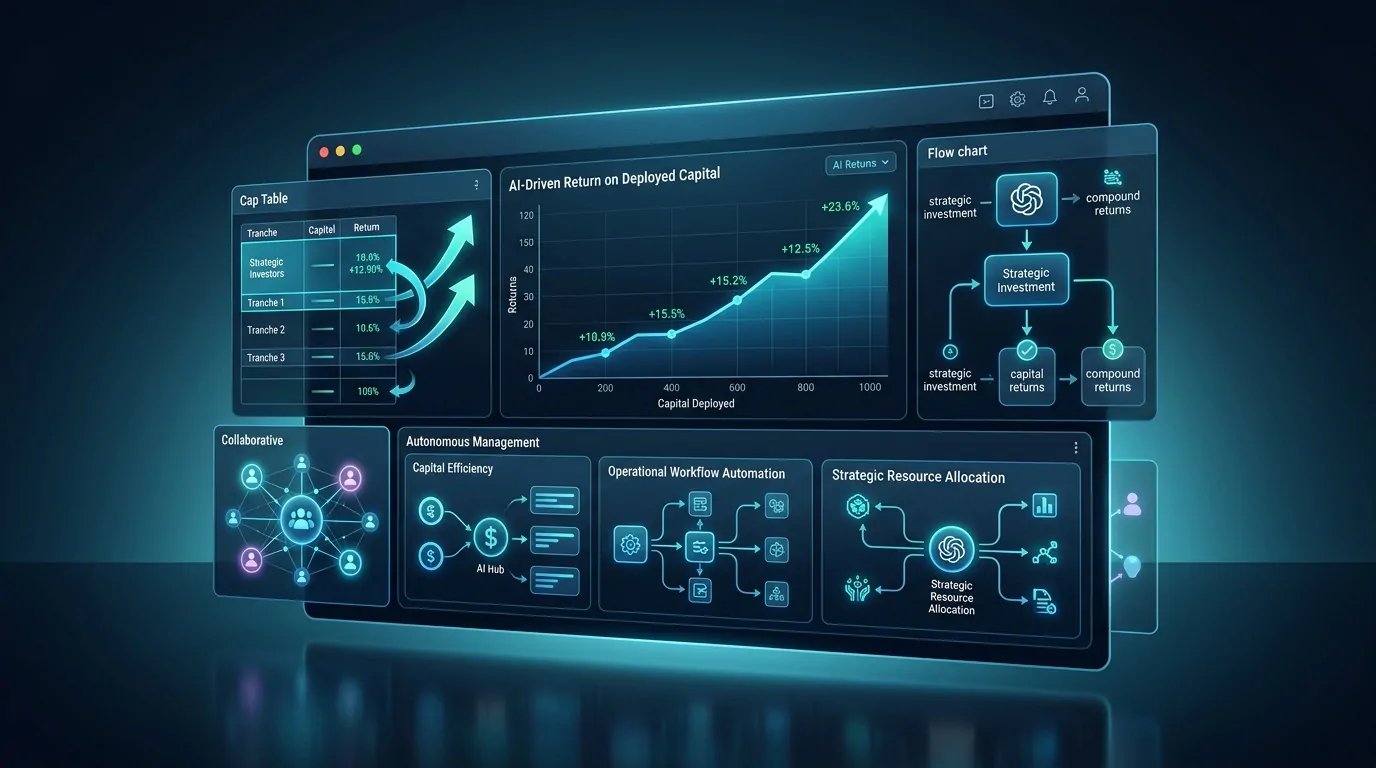
OpenAI’s cap table contains strategic investors who have realized extraordinary returns. These returns stem from a simple principle: capital deployed into scalable AI infrastructure generates compounding value over time. Mid-market businesses can apply the same strategy by investing in automation that scales without proportionally increasing overhead. The mechanics are different, but the financial logic is identical.
Microsoft’s Significant Return: The Infrastructure Investment Playbook
Microsoft invested heavily in OpenAI over several rounds. At OpenAI’s current valuation, that stake is worth a substantial multiple on the initial capital deployed. Microsoft’s strategy wasn’t speculative betting; it was infrastructure arbitrage. The company recognized that AI capabilities would become a fundamental layer of enterprise software, similar to cloud computing. By embedding OpenAI’s models into Azure, Microsoft 365, and Dynamics, the company transformed a capital investment into a recurring revenue stream. Enterprise buyers should note: the return came from systematic integration into existing workflows, not from passive model access.
Applying the Same Principle to SMEs
Mid-market firms can’t invest billions in AI infrastructure, but they can deploy the same principle at a smaller scale. Investing in Vynta’s automation agents for lead qualification and client outreach delivers returns through reduced headcount requirements, faster response times, and higher conversion rates. One hospitality group managing multiple properties used Vynta’s guest communication agents to handle a majority of check-in inquiries and maintenance requests, eliminating the need for a dedicated front desk role. The annual savings represented a substantial return on the automation investment. The openai valuation ipo timeline remains uncertain, but the automation returns available today are immediate and measurable.
From Speculative Bets to Concrete Savings: Automation as an Asset
The most important lesson from OpenAI’s valuation journey is that financial returns follow systematic deployment, not passive speculation. Microsoft’s substantial gain came from embedding AI into products that millions of businesses already used. Similarly, Vynta’s clients realize returns by embedding automation into their daily sales, marketing, and operations workflows. A recruitment agency that automates candidate sourcing and initial screening reallocates recruiters to high-value relationship building and placement negotiations. A fundraising organization that automates donor segmentation and outreach sequencing increases donation frequency without adding development staff. These outcomes mirror the principle that drove Microsoft’s returns, applied at the SME scale where every dollar of operational savings flows directly to the bottom line.
| Metric | Microsoft / OpenAI | SME with Vynta AI |
|---|---|---|
| Investment | Billions total | Tens of thousands |
| Return Timeline | Years | Months |
| Return Mechanism | Equity appreciation | Operational cost savings |
| Risk Profile | Speculative, illiquid | Measurable, recurring |
| Scalability | Requires billions in capital | Deployable per department |
The comparison table above illustrates a fundamental truth: enterprise AI returns aren’t reserved for venture-scale investors. Mid-market businesses can achieve faster payback periods and lower risk profiles by deploying automation directly against operational inefficiencies. The openai valuation narrative focuses on speculative appreciation, but the real wealth creation happens at the application layer where AI meets specific business workflows. Vynta’s mission is to democratize this returns mechanism for every mid-market firm, regardless of technical resources or AI expertise.
References
The Verdict: What OpenAI’s Valuation Means for Your Business
After tracing the trajectory from a nonprofit research lab to a very highly valued private company, one pattern emerges: valuation is a forward-looking measure of infrastructure potential, not a reflection of current enterprise utility. For mid-market decision makers evaluating AI automation, the number matters only insofar as it signals platform stability and long-term investment. The real question is whether the technology delivers measurable outcomes for your specific workflows today, not whether the company will be worth more next year.
Three Key Takeaways for Enterprise AI Buyers
First, infrastructure investment correlates with platform reliability. OpenAI’s billions in annual compute spend translates into lower latency and higher uptime for API users. Second, valuation multiples at a very high level indicate that investor expectations are priced for future dominance, not current profitability. This creates both opportunity and risk: the company has capital to invest in enterprise features but faces pressure to monetize aggressively. Third, the adoption gap between valuation and real-world deployment in real estate, recruitment, and hospitality suggests that application-layer solutions, not base models, will drive enterprise ROI for the foreseeable future. These three insights should anchor your procurement strategy.
The Future of AI Automation Beyond the Hype Cycle
Industry analysis places foundation models at a high point of inflated expectations, with a projected plateau of productivity arriving in a few years. The openai valuation story sits squarely at this peak, with investor enthusiasm outpacing enterprise readiness. The next phase will favor companies that build practical integration layers, not those that simply provide model access. Vynta’s approach aligns with this trajectory: packaging frontier capabilities into industry-specific agents that require zero internal AI engineering. As the hype cycle matures, the businesses that invested in measurable automation outcomes will hold a structural advantage over those that chased model benchmark scores.
Synthesis: OpenAI’s valuation reflects extraordinary investor confidence in AI infrastructure. But for mid-market enterprises in real estate, recruitment, fundraising, and hospitality, the practical value lies in application-layer automation that transforms this infrastructure into daily operational savings. The companies that bridge this gap will capture returns that rival venture-scale investments, delivered in months rather than years.
Making the Decision: Practical Next Steps
Enterprise buyers should evaluate AI platforms against three criteria: integration overhead, domain accuracy, and total cost per outcome. Start with a single high-volume workflow such as lead qualification or candidate screening. Measure baseline metrics for response time, conversion rate, and cost per action. Deploy an automation layer on top of the foundation model and measure the delta over a defined period. This approach eliminates the speculative noise around valuation and focuses on what matters: whether the technology improves your business metrics. Vynta AI provides this exact capability across all four verticals, with deployment timelines measured in weeks and ROI measured in months. The companies that will benefit most from the OpenAI valuation story are those that act on its underlying signal while ignoring the surface-level speculation.
Enterprise AI Platform Selection Framework
- Integration with existing CRM or ATS systems
- Industry-specific training data for domain accuracy
- Transparent pricing with outcome-based metrics
- Vendor track record with mid-market deployments
- Over-reliance on a single model provider
- Custom development requirements for integration
- Unclear total cost of ownership across scaling
- Valuation-driven pricing adjustments
The final consideration is timing. Waiting for market consolidation or valuation corrections may seem prudent, but the competitive cost of inaction is measurable. Every quarter without automation in lead qualification, candidate screening, or investor outreach represents lost revenue and efficiency. The infrastructure is mature enough today to deliver returns. The question isn’t whether the openai valuation is justified; it’s whether your business is capturing the value embedded in that infrastructure. Vynta exists to answer that question affirmatively for mid-market firms across real estate, recruitment, fundraising, and hospitality. The valuation story will continue to evolve, but the automation returns available today require only one decision: to start.
Frequently Asked Questions
Who owns 49% of OpenAI?
No single entity holds a 49% stake in OpenAI. Microsoft is the largest investor with a significant minority share, but the capped profit structure prevents any one party from owning a majority. This design keeps control aligned with OpenAI’s mission while attracting the capital needed for large scale AI infrastructure.
Is OpenAI CEO a billionaire?
Sam Altman’s net worth is estimated in the billions, largely from earlier investments in companies like Y Combinator and Stripe, not directly from his OpenAI compensation. The capped profit model limits his equity upside in OpenAI, so his personal wealth comes from outside ventures.
What is the company valuation of OpenAI?
As of early 2026, OpenAI’s valuation has climbed past $100 billion following its latest primary funding round. That figure reflects investor belief that the company will dominate the enterprise AI market, even though the company still operates at a loss due to heavy compute and data center spending.
Who is the biggest investor in OpenAI?
Microsoft is the largest investor in OpenAI, having committed billions since 2019. The partnership also includes deep integration of OpenAI models into Microsoft’s cloud and productivity products, giving Microsoft a strategic edge in the enterprise AI space.
How does OpenAI's valuation affect enterprise AI buyers?
A high valuation signals that OpenAI can invest heavily in infrastructure, security compliance, and enterprise support. For mid market buyers, that translates into reliable uptime and continuous model improvements. It also means the platform is less likely to disappear, which matters when building automation workflows around it.
What does OpenAI's valuation indicate about its infrastructure spending?
The valuation gives OpenAI access to favorable debt financing and the ability to pre purchase GPUs years in advance. This allows the company to scale compute capacity faster than competitors, directly benefiting enterprise users through lower latency and higher capacity for API calls and batch processing.