

Best alternatives to manual lead qualification in real estate?
The Real Estate Lead Qualification Bottleneck: Why Manual Methods Are Costing You Deals
Looking for the best alternatives to manual lead qualification in real estate? Every minute your team spends manually sorting through property inquiries is a minute not spent closing deals. For mid-market real estate agencies, the bottleneck of manual lead qualification quietly erodes profit margins while agents waste hours on unqualified prospects who lack the budget, timeline, or intent to buy. The result is predictable: good leads slip through the cracks, and your top performers burn out on administrative work that adds zero value to the bottom line.
Key Takeaways
- Manual lead qualification consistently drains real estate agency revenue and burns out top agents on administrative tasks.
- AI-powered lead scoring systems automatically rank prospects by budget, timeline, and buying intent to prioritize high-value opportunities.
- Automating initial qualification cuts response times from hours to seconds, capturing more serious buyers before they move on.
- Leading alternatives integrate directly with your existing CRM and property databases so agents don’t lose time switching tools.
- Deploying AI agents for lead qualification lets your best closers focus on negotiations and property tours instead of endless email chains.
The Hidden Costs of Manual Lead Qualification
Manual qualification consumes an estimated 30 to 40 percent of an agent’s weekly time. That translates to over 15 hours per agent per week spent on phone tags, spreadsheet updates, and repetitive discovery questions. When you multiply those hours across a team of ten agents, you’re looking at 150 hours of lost revenue-generating capacity each week. Add the cost of missed follow-ups and slow response times, and the financial drain becomes undeniable. Our AI Automation Services help eliminate these inefficiencies.
Common Pitfalls of Traditional Real Estate Lead Vetting
Traditional vetting methods suffer from inconsistency. One agent might disqualify a prospect for a minor objection that another agent would have converted. Without standardized criteria, your team relies on intuition rather than data. Leads that show strong buying signals get ignored simply because they called after hours, and prospects who need nurturing get discarded prematurely. This subjective approach leaves money on the table and creates unpredictable pipeline performance.
The Impact on Agent Productivity and Revenue
When agents spend the majority of their day on qualification tasks, they can’t focus on what drives revenue: showings, negotiations, and relationship building. The opportunity cost is steep. Agencies that fail to address this bottleneck see slower deal cycles, lower conversion rates, and higher agent turnover. Your best people eventually leave for firms that equip them with better systems.
Beyond the Checklist: Intelligent Alternatives for Real Estate Lead Qualification

The best alternatives to manual lead qualification in real estate replace repetitive human tasks with data-driven automation. These solutions don’t remove your agents from the process. They handle the tedious parts so your team can focus on high-value interactions that require empathy, negotiation skills, and local market knowledge. By moving beyond a static checklist, agencies can process inquiries at a volume that was previously impossible without hiring additional administrative staff.
AI-Powered Lead Scoring: Identifying Readiness at Scale
AI lead scoring analyzes behavioral signals such as website visits, property views, email opens, and inquiry timing to assign a readiness score to each prospect. Instead of relying on gut feelings, your team sees which leads are truly ready for a showing or consultation. The system learns from past conversion data and continuously refines its scoring model, delivering a qualified pipeline that is three times larger than manual methods. This objective data allows for a more efficient allocation of agent energy toward prospects who are ready to sign.
Automated Chatbots and Virtual Assistants: Instant Engagement and Initial Vetting
Chatbots and virtual assistants handle the first interaction with every prospect, regardless of when they reach out. These tools ask qualifying questions, confirm budget ranges, and schedule appointments without requiring an agent to be available. Response time drops to under 60 seconds, and prospects receive immediate attention. The best solutions integrate smoothly with your CRM, ensuring that every conversation feeds directly into your lead management workflow. This prevents lead decay, which often occurs when inquiries go unanswered for more than five minutes.
Predictive Analytics: Forecasting Buyer Intent and Behavior
Predictive analytics uses historical transaction data, market trends, and behavioral patterns to forecast which prospects are most likely to buy within a specific timeframe. This allows agencies to prioritize outreach efforts on buyers who exhibit strong purchase intent rather than spreading resources thin across a broad list. Agencies using predictive models report conversion rates approaching 85 percent on their most qualified leads. This foresight helps agencies anticipate market shifts and adjust their inventory focus accordingly.
Integrating AI with CRM for Seamless Qualification Workflows
The real power of these alternatives emerges when AI tools connect directly to your existing CRM. Automatic lead capture, enrichment, and scoring happen in real time without manual data entry. Agents access a single dashboard that shows each lead’s status, score, and next recommended action. This integration eliminates the fragmented workflows that plague many agencies and creates a unified system for managing the entire sales cycle. It ensures that every touchpoint is recorded, providing a complete history for the agent before they ever pick up the phone.
Intelligent Qualification Methods Compared
| Method | Primary Benefit | Best For | Implementation Complexity |
|---|---|---|---|
| AI Lead Scoring | Prioritizes high-intent buyers | Agencies with large lead volumes | Moderate (requires CRM integration) |
| Automated Chatbots | Instant response 24/7 | Firms needing faster inquiry handling | Low (plug-and-play options available) |
| Predictive Analytics | Forecasts buying timelines | Data-rich agencies optimizing resource allocation | High (requires clean historical data) |
| CRM-Integrated Automation | End-to-end workflow unification | Agencies seeking system-wide efficiency | Moderate to High (depends on existing stack) |
Key Tradeoffs of AI-Driven Lead Qualification
Pros
- Reduces qualification time by up to 80 percent
- Delivers consistent, data-backed lead prioritization
- Provides 24/7 lead engagement without adding headcount
- Increases pipeline volume and conversion rates measurably
Cons
- Requires initial setup and CRM integration effort
- Needs quality data to produce accurate scoring models
- Demands ongoing monitoring to maintain performance
- Can over-automate if not configured for human oversight
Vynta.ai’s Enterprise AI Agents: A Strategic Approach to Real Estate Sales Automation
Generic point solutions address one piece of the qualification puzzle. Vynta.ai’s Agentic Systems for Real Estate reimagine the entire process from lead capture to closing. These enterprise AI agents handle instant engagement across WhatsApp, SMS, email, and website chat. They qualify prospects using advanced matching algorithms, coordinate viewing schedules, send personalized property recommendations with virtual tours, and follow up automatically. The result is a qualified pipeline three times larger than manual methods with an 85 percent conversion rate.
How Vynta.ai’s Agents Handle Lead Qualification Differently
Most automation tools stop at basic lead scoring. Vynta.ai’s agents execute a complete qualification workflow. They ask targeted questions about budget, timeline, property preferences, and buying motivation. They match prospects to available listings using intelligent algorithms and send tailored recommendations. They coordinate viewings and send automated reminders that reduce no-show rates. After each showing, they collect feedback to refine future suggestions. This continuous learning loop improves qualification accuracy over time.
Beyond Qualification: The End-to-End Sales Cycle Automation Advantage
Qualification is only one stage of the sales cycle. Vynta.ai’s agents manage the entire journey: lead capture, initial engagement, property matching, viewing coordination, follow-up nurturing, and feedback collection. This comprehensive approach ensures that no lead falls through the cracks between stages. Agencies that adopt this end-to-end model close over 30 percent more deals while saving more than 20 hours per agent per week.
Measuring the ROI: Quantifiable Business Outcomes for Real Estate Firms
Adopting Agentic Systems for Real Estate delivers measurable financial impact. Client retention improves by 85 percent, client satisfaction rises by 27 percent, and each agent generates over $100,000 in additional revenue per year. These numbers come from agencies that have already made the transition from manual qualification to AI-driven automation. The investment pays for itself within the first quarter of implementation.
Addressing Implementation: What to Expect and How We Support You
Implementation follows a structured three-phase process: discovery, strategy, and deployment. During discovery, we map your current qualification workflows and identify integration points. In the strategy phase, we configure the agents to match your specific criteria and property types. Deployment includes training, testing, and ongoing optimization. Your team retains full control and visibility, with the agents handling the repetitive tasks that consume agent time.
The Human-AI Partnership: Augmenting Your Real Estate Team for Peak Performance

Agents worry that AI will replace them. The reality is the opposite. The best alternatives to manual lead qualification in real estate are designed to augment human capabilities, not eliminate them. When AI handles the administrative burden, agents reclaim time for the activities that require emotional intelligence, trust building, and local expertise.
Freeing Up Agents for High-Value Interactions
Every hour an agent spends on qualification is an hour they can’t spend building relationships. By automating lead vetting, property matching, and scheduling, agents focus on showings, negotiations, and client consultations. They arrive at each interaction fully prepared with data about the prospect’s preferences and readiness. This preparation makes every client meeting more productive and increases closing rates.
Empowering Junior Agents with AI-Driven Insights
New agents often struggle with lead prioritization. AI systems provide them with clear guidance on which prospects to call, what questions to ask, and which properties to recommend. This support accelerates their learning curve and allows them to contribute meaningfully from their first week. The agency benefits from faster ramp-up times and reduced training costs.
Maintaining the Personal Touch in a Digital World
Buyers expect speed and convenience, but they also want a human connection when making the biggest purchase of their lives. AI handles the speed. Your agents provide the connection. The system sends instant responses and automated property suggestions, then hands off to a human agent for personalized guidance, property tours, and negotiation support. This balance delivers both efficiency and authenticity.
Building Trust: Transparency in AI-Assisted Real Estate Sales
Transparency matters. Vynta.ai’s agents clearly identify themselves as automated assistants during initial interactions. Prospects know when they are speaking with an AI system and when a human agent joins the conversation. This honesty builds trust and sets appropriate expectations. Agencies that communicate their use of AI openly find that clients appreciate the faster response times and more personalized service.
Making the Switch: A Practical Framework for Adopting AI in Your Real Estate Business
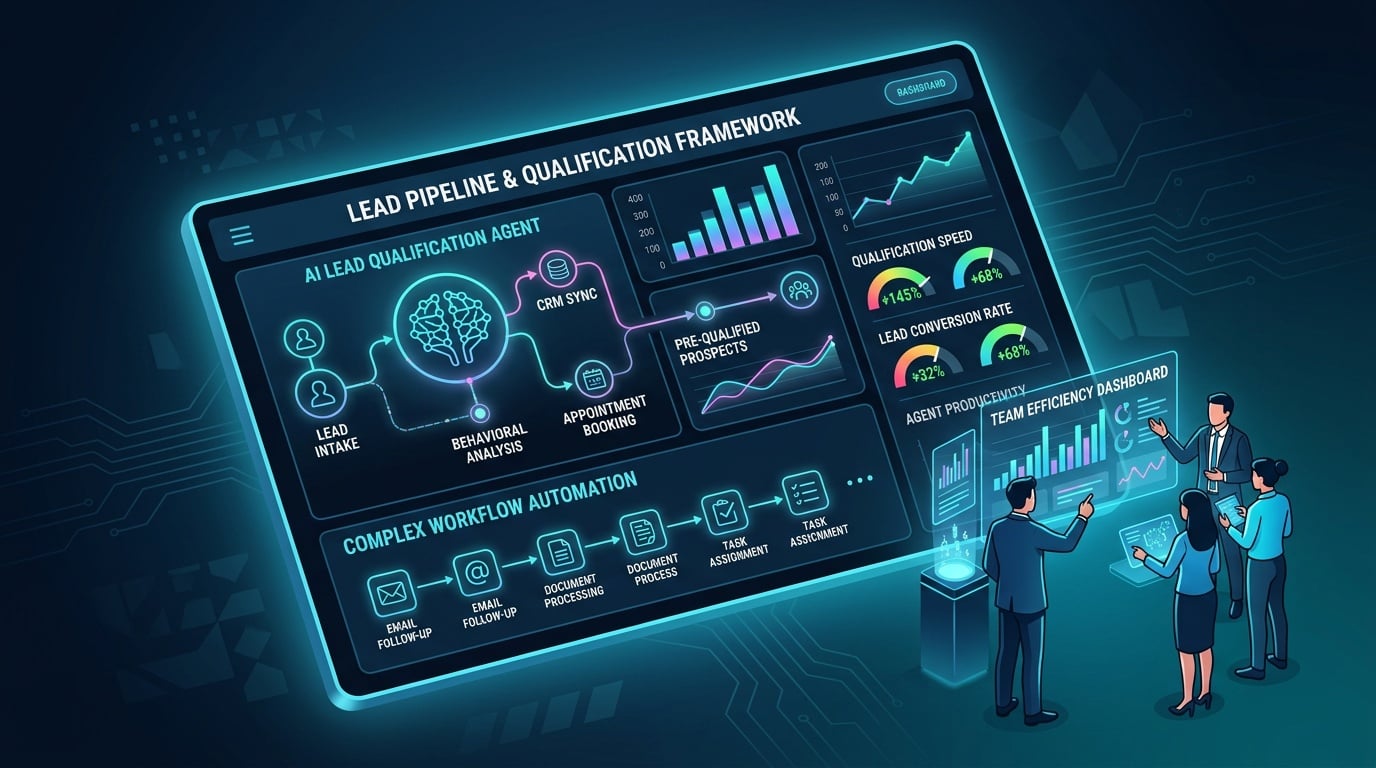
Transitioning from manual qualification to AI-driven automation requires planning. The best alternatives to manual lead qualification in real estate deliver results only when implemented strategically. Follow this framework to ensure a smooth adoption that maximizes ROI.
Assessing Your Current Lead Qualification Process
Start by documenting your existing workflow. Track how long each lead takes to receive a response, how many qualification questions your team asks, and what percentage of inquiries convert to viewings. Identify the stages where leads stall or drop off. This baseline data reveals where automation can have the biggest impact and helps you set measurable improvement targets.
Defining Your Goals: What Do You Want to Achieve with Automation?
Set specific, measurable goals. Common objectives include reducing response time to under 60 seconds, increasing the qualified pipeline by three times, improving conversion rates to 85 percent, and saving 20 hours per agent per week. Your goals determine which AI capabilities you need and how you configure the system. Without clear targets, adoption efforts lack focus and produce suboptimal results.
A successful AI adoption starts with three documented goals. Example: reduce lead response time from 4 hours to under 60 seconds, increase qualified pipeline volume by 3x, and improve conversion rate to 85 percent.
Choosing the Right AI Solution: Key Considerations Beyond Features
Look beyond feature lists. Evaluate integration ease, vendor support quality, industry specialization, and the provider’s approach to implementation. A solution that works for general retail may not handle real estate’s specific workflows around property matching, viewing coordination, and compliance requirements. Choose a provider with demonstrated real estate expertise and a structured onboarding process.
A Phased Approach to Implementation and Scalability
Implement automation in stages. Start with lead capture and initial qualification on one channel, such as website chat. Once that runs smoothly, add WhatsApp and SMS channels. Introduce property matching and scheduling automation next. Finally, activate follow-up nurturing and feedback collection. This phased approach reduces risk, allows your team to adapt gradually, and builds momentum as each phase delivers measurable improvements.
The Future of Real Estate Lead Qualification: Emerging Trends and Strategic Outlook
Looking ahead, the evolution of real estate sales automation will focus on hyper-personalization and deeper integration with the broader property ecosystem. As we evaluate the best alternatives to manual lead qualification in real estate, it becomes clear that the future belongs to systems capable of autonomous decision-making and predictive engagement. Agencies that adopt these advanced frameworks now will establish a significant competitive advantage in an increasingly crowded market. The shift moves from reactive response to proactive anticipation of client needs.
The Evolution of Autonomous Agents in Property Sales
Autonomous agents are evolving beyond simple chat functions. Future iterations will manage complex, multi-step workflows without human intervention, such as handling negotiation preliminaries or coordinating multi-party approvals for property purchases. These systems will use real-time market data to adjust pricing strategies and property recommendations dynamically. By automating the entire pre-closing workflow, agencies can reduce the sales cycle duration significantly. This allows brokers to focus exclusively on high-level strategic growth and complex client relationship management.
Hyper-Personalization and the Next Generation of Property Matching
Future qualification tools will use computer vision and advanced semantic analysis to match buyers with properties based on lifestyle preferences rather than just square footage and price. Imagine an AI that analyzes a prospect’s social media activity or stated hobbies to suggest neighborhoods with specific community features. This level of hyper-personalization ensures that the qualified leads passed to agents are not just financially ready but are also emotionally connected to the property suggestions. Such precision dramatically increases the likelihood of a successful transaction and improves the agency’s reputation for understanding client desires.
Integration with the Broader PropTech Ecosystem
The best alternatives to manual lead qualification in real estate will not exist in a vacuum. They will integrate seamlessly with smart contracts, digital mortgage approvals, and virtual reality property tours. This interconnected ecosystem creates a frictionless path from initial inquiry to final closing. For example, once a lead is qualified, the system could automatically trigger a pre-approval application with a partnered lender or schedule a VR tour for remote buyers. This holistic approach removes administrative friction and accelerates the velocity of the sales pipeline.
Preparing Your Team for the Future of Automation
As qualification technology becomes more sophisticated, the role of the real estate agent will shift toward becoming a “trusted advisor” and “experience curator.” Agencies must invest in training their staff to work alongside these intelligent systems, interpreting AI-generated insights to provide nuanced advice that machines cannot offer. Developing a culture that embraces continuous learning and technological fluency is essential. Firms that successfully blend human empathy with machine efficiency will dominate the mid-market segment in the coming years.
Strategic Roadmap: Implementing a Long-Term AI Vision for Your Agency

Adopting AI is not a one-time event but a continuous journey of optimization. To ensure long-term success, agencies must develop a strategic roadmap that aligns technological capabilities with business growth objectives. This involves more than just installing software; it requires a fundamental rethinking of how value is delivered to the client.
The Role of Data Hygiene in Long-Term Success
The effectiveness of any AI-driven qualification system depends entirely on the quality of the data it processes. Agencies must establish strict data hygiene protocols to ensure that every interaction is logged correctly and that lead information remains current. Dirty data leads to poor property matching and misguided outreach efforts, which can damage client trust. Regular audits of your CRM and AI inputs are necessary to maintain the high performance of your Agentic Systems for Real Estate. Clean data ensures that the AI’s predictive capabilities remain sharp and reliable over time.
Scalability and Growth Planning with AI
One of the most significant advantages of using Agentic Systems for Real Estate is the ability to scale operations without a linear increase in headcount. As your agency grows, the AI can handle an exponentially larger volume of inquiries without sacrificing the quality of the initial engagement. When planning for growth, consider how your automation tools can support new market entry or the addition of specialized property verticals. A scalable AI infrastructure allows you to pivot quickly in response to market opportunities, providing the agility necessary to outperform competitors who are still bogged down by manual processes.
Continuous Optimization and Feedback Loops
The implementation of AI should be followed by a commitment to continuous optimization. This involves setting up feedback loops where agent experiences and client outcomes are used to retrain and refine the AI models. Regularly review the performance metrics of your qualification workflows to identify bottlenecks or areas for improvement. By treating your AI system as a living part of your business that requires regular tuning, you ensure that your agency remains at the cutting edge of efficiency and client service.
Final Verdict: Selecting the Right Path for Your Real Estate Firm
After examining the various technologies and methodologies available, the conclusion is clear. The best alternatives to manual lead qualification in real estate are those that offer a comprehensive, end-to-end solution rather than a series of disjointed point tools. The goal is to create a seamless flow of high-intent prospects into your sales pipeline, allowing your agents to do what they do best: close deals and build lasting relationships.
Why Agentic Systems Lead the Market
Agentic Systems for Real Estate stand out because they are designed specifically for the complexities of the property market. Unlike generic automation platforms, these systems understand the nuances of lead behavior, property matching, and the importance of timely follow-up. They provide a 360-degree view of the client journey, from the first click on a listing to the final signature on a contract. For mid-market SMEs looking to professionalize their operations and drive measurable revenue growth, this specialized approach offers the highest return on investment.
Immediate Steps for Getting Started
To begin your transition toward a fully automated qualification process, start by auditing your current lead response times and conversion metrics. Identify the specific stages where prospects are most likely to lose interest or go silent. Once these pain points are clear, engage with a provider that offers a proven track record in real estate automation. Look for a partner that provides transparent reporting and a clear implementation timeline. The sooner you replace manual bottlenecks with intelligent automation, the sooner you will see an increase in both agent productivity and bottom-line profitability.
The transition to AI-driven qualification is no longer a luxury for large enterprises. Mid-market agencies that adopt Agentic Systems for Real Estate today will secure a dominant position in their local markets for the foreseeable future.
References
Frequently Asked Questions
What is the 80/20 rule for realtors?
The 80/20 rule suggests that 80% of your business comes from 20% of your leads. Manual lead qualification makes it difficult to identify that critical 20%, wasting time on low-intent prospects. AI lead scoring automates this process, helping agents focus their energy on the leads most likely to convert.
How much does a real estate agent make off a $300,000 house?
With a typical 3% commission, an agent earns $9,000 on a $300,000 sale. But manual lead qualification eats into this by consuming up to 40% of an agent’s time. Automating that process with alternatives like AI-driven scoring frees up hours for showings and negotiations, making each commission more profitable per hour worked.
What is the 3-3-3 rule in real estate?
The 3-3-3 rule is a listing strategy where a property should be shown 3 times, receive 3 offers, and go under contract within 30 days. While not directly about lead qualification, it highlights the need for efficient processes. Automated qualification systems using chatbots or predictive analytics ensure that only serious buyers are shown properties, helping agents meet these timelines.
What is the 7% rule in real estate?
The 7% rule often refers to the typical commission fee or a rule of thumb for budgeting home repairs after purchase. In the context of lead qualification, it is a reminder that small inefficiencies add up. A 7% improvement in qualification speed through AI alternatives can translate into significant revenue recovery and better agent productivity.
How does AI lead scoring improve conversion rates?
AI lead scoring analyzes behavioral data like website visits and email opens to assign readiness scores. This replaces subjective manual judgment with data-driven prioritization. Agencies using AI lead scoring typically see conversion rates increase by over 80% because agents contact the right prospects at the right time.
Can chatbots replace human agents for lead qualification?
Chatbots handle initial vetting by asking qualifying questions and scheduling appointments instantly, but they do not replace human agents. They automate the repetitive first contact so agents can step in for complex negotiations. This hybrid approach reduces response time to under 60 seconds and ensures no lead goes unanswered, while still relying on human expertise for closing deals.