

ai automation implementation timeline
Understanding Your AI Automation Implementation Timeline
Most mid-market SMEs can expect their ai automation implementation timeline to span 4-12 weeks, depending on project scope and data readiness. The process involves four key phases: discovery and strategic alignment, planning and design, development and integration, and testing with deployment. Real estate agencies typically see faster deployment (4-6 weeks) for lead qualification systems, while complex multi-system integrations in hospitality may require 8-12 weeks.
Beyond the Complexity Myth
AI automation doesn’t require months of disruption or massive technical overhauls. Modern implementation approaches focus on phased deployment, allowing businesses to see results quickly while building toward full automation. The key lies in selecting the right partner who understands your industry’s specific workflows and can design solutions that integrate smoothly with existing operations.
Reality Check
While enterprise-level implementations can take 6+ months, targeted AI automation for specific business functions delivers measurable results within weeks, not quarters.
Why Timeline Planning Matters for Business Continuity
Proper timeline planning prevents operational disruption and supports team adoption. When businesses understand each implementation phase, they can allocate resources appropriately, prepare staff for transitions, and maintain customer service standards throughout the process. Clear milestones also enable accurate ROI projections and budget planning.
The Four-Phase Implementation Framework
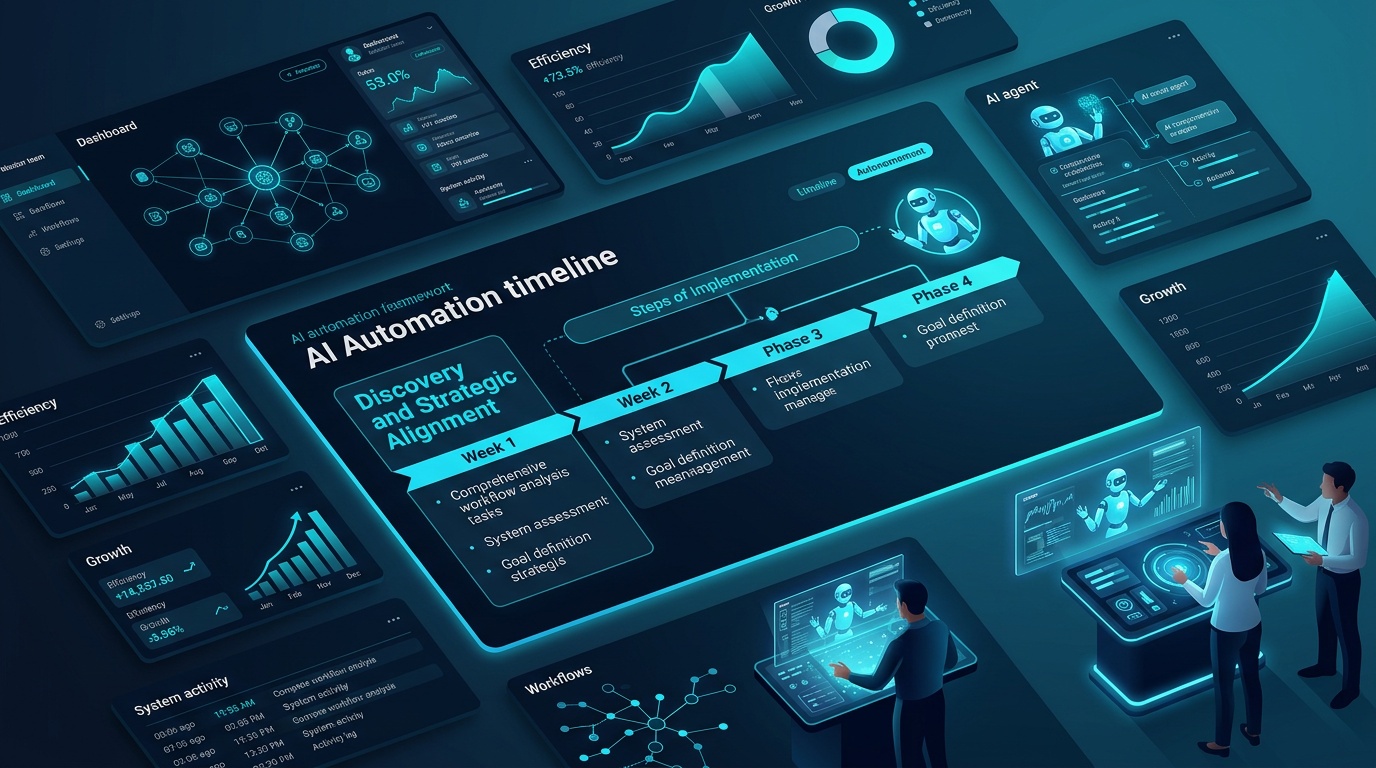
Phase 1: Discovery and Strategic Alignment (Weeks 1-2)
This foundation phase involves workflow analysis, system assessment, and goal definition. Teams evaluate current processes, identify automation opportunities, and establish success metrics. For recruitment agencies, this step includes analyzing candidate screening workflows and communication touchpoints.
Phase 2: Planning and Design (Weeks 2-4)
Technical architects create detailed implementation blueprints, including system integration maps and user experience flows. This phase defines how AI agents will interact with existing tools like CRM platforms, communication systems, and databases. Data migration strategies and security protocols get finalized during this stage.
Phase 3: Development and Integration (Weeks 3-8)
Custom AI agents are built and connected to business systems through API development and data transformation services. AI Automation Services include real-time data synchronization setup and workflow automation configuration. Testing occurs continuously throughout development to confirm quality and performance.
Phase 4: Testing, Deployment, and Optimization (Weeks 6-12)
Live deployment begins with pilot programs, allowing teams to validate performance and make adjustments. User training supports smooth adoption, while monitoring systems track key performance indicators. The ai automation implementation timeline concludes with optimization reviews and continuous improvement planning.
Factors That Shape Your AI Automation Timeline
Project Scope and Complexity Assessment
The breadth of processes targeted for automation directly impacts implementation duration. Single-function automations like lead qualification or appointment scheduling typically deploy within 4-6 weeks. Multi-department workflows involving customer relationship management, communication sequences, and performance analytics often require 8-12 weeks due to increased integration complexity.
Business size and operational sophistication also influence scope decisions. Real estate teams automating property matching workflows face different challenges than hospitality businesses implementing guest experience management across multiple touchpoints. Understanding your specific automation goals helps establish realistic timeline expectations.
Data Readiness and Quality Foundations
Clean, accessible data accelerates AI deployment significantly. Organizations with well-structured databases and consistent data entry practices can shorten their ai automation implementation timeline by 2-4 weeks compared to businesses requiring extensive data cleanup. Poor data quality can require additional transformation services and validation processes.
Data migration complexity varies by industry vertical. Recruitment agencies often manage candidate information across multiple platforms, requiring careful synchronization planning. Fundraising organizations may need donor history consolidation before implementing automated outreach systems. Proper data preparation prevents deployment delays and supports strong AI performance from day one.
Existing System Integration Requirements
Modern businesses run multiple software platforms that must communicate with new AI agents. CRM systems, email platforms, scheduling tools, and industry-specific applications all require careful integration planning. Organizations using standard business software typically experience smoother integration than those with custom legacy systems.
API availability and documentation quality significantly impact development speed. Well-documented systems with strong APIs enable faster connection establishment, while proprietary platforms may require custom development work. System integration services include real-time data synchronization setup, ensuring all platforms stay updated automatically without manual intervention.
Integration Reality Check
Businesses using cloud-based platforms typically see 30% faster integration than organizations that rely heavily on on-premises legacy systems requiring custom API development.
Industry-Specific Implementation Timelines
Real Estate: Lead Qualification and Property Matching
Real estate agencies typically achieve the fastest deployment due to standardized lead management workflows. Lead qualification automation, including initial contact, needs assessment, and appointment scheduling, often deploys within 4-6 weeks. Property matching systems that analyze buyer preferences against inventory databases require an additional 2-3 weeks for model tuning and market data integration.
MLS integration and communication automation add complexity but deliver meaningful ROI through improved response times and lead nurturing consistency. Agentic Systems for Real Estate often focus on high-impact activities like follow-up sequences and showing coordination that directly influence conversion rates.
Recruitment: Candidate Screening and Workflow Optimization
Recruitment automation typically requires 6-8 weeks due to complex candidate evaluation criteria and multi-stage communication workflows. Resume screening, initial qualification calls, and interview scheduling automation form the foundation, followed by candidate relationship management and client communication systems.
Integration with job boards, applicant tracking systems, and communication platforms requires careful data mapping to maintain candidate experience quality. Agentic Systems for Recruitment provide automated analytics for tracking placement success rates and identifying process improvement opportunities.
Fundraising: Donor Outreach and Relationship Management
Fundraising organizations often benefit from 6-10 week implementation timelines that accommodate donor segmentation complexity and compliance requirements. Automated donor research, personalized outreach campaigns, and follow-up sequences require careful customization based on giving history and engagement patterns.
Grant application tracking and donor stewardship workflows often involve multiple stakeholders and approval processes. Communication automation includes multi-channel messaging capabilities that maintain a personal touch while scaling outreach efforts effectively.
Hospitality: Guest Experience and Operations
Hospitality implementations often span 8-12 weeks due to diverse operational touchpoints and seasonal needs. Guest communication workflows, reservation management, and experience personalization systems require integration with property management systems, payment processors, and review platforms.
Workflow automation converts manual processes like guest check-in sequences, special request handling, and post-stay follow-up into intelligent automated systems with exception-handling capabilities. Vynta AI Agents for Hospitality include staff training and seasonal testing to support strong performance during peak periods.
Accelerating Your Implementation Success

Preparation Strategies for Faster Deployment
Organizations can shorten their ai automation implementation timeline through strategic preparation before project initiation. A data audit and cleanup, completed 2-4 weeks before implementation, reduces delays during the development phase. Teams should document existing workflows, identify key stakeholders, and establish clear success metrics before engaging with automation providers.
Technical readiness assessment includes evaluating current software licenses, API access permissions, and integration capabilities. Businesses with cloud-based systems and modern software stacks typically see 25-40% faster deployment than organizations requiring legacy system upgrades or custom development work.
Team Readiness and Change Management
Staff preparation and change management planning prevent implementation bottlenecks and support smooth adoption. Early team involvement in automation planning builds buy-in and reduces resistance during deployment. Training schedules should align with rollout phases, allowing users to build competency gradually rather than facing overwhelming system changes simultaneously.
Communication workflows and approval processes must be established before automation goes live. Teams need clear escalation paths for exceptions and a shared understanding of how AI agents handle edge cases. Strong change management reduces post-deployment adjustment periods from weeks to days.
Measuring ROI and Continuous Optimization
Performance Metrics and Success Indicators
Effective measurement begins during the planning phase with baseline creation and target setting. Key performance indicators vary by industry but typically include response time improvements, conversion rate increases, and operational cost reductions. Real estate agencies might track lead response speed and qualification accuracy, while recruitment firms focus on candidate screening efficiency and placement quality.
Performance intelligence provides automated analytics, including anomaly detection and predictive trend analysis. These capabilities help businesses identify optimization opportunities and measure ROI accurately without manual data compilation. Regular monitoring helps AI agents continue delivering expected outcomes as business conditions change.
ROI Timeline Reality
Most businesses see measurable efficiency gains within 30 days of deployment, with full ROI typically achieved within 3-6 months depending on automation scope and implementation quality.
Ongoing Optimization and Scaling Opportunities
Your AI automation journey extends beyond initial deployment through continuous improvement cycles. Monthly optimization reviews identify performance gaps and expansion opportunities. Successful implementations often lead to additional automation projects as teams spot new efficiency opportunities.
Scaling considerations include adding new communication channels, expanding to additional departments, or integrating advanced analytics capabilities. The phased approach allows businesses to build automation sophistication gradually while maintaining operational stability and team confidence.
Strategic Implementation Recommendations
Choosing the Right Automation Partner
Partner selection significantly impacts implementation success and timeline adherence. Look for providers with industry-specific experience, proven deployment methodologies, and support offerings. Technical expertise should cover both AI development and system integration capabilities, ensuring smooth connection with existing business platforms.
Implementation support should include team training, ongoing monitoring, and optimization reviews. The service model should emphasize phased deployment planning that minimizes business disruption while delivering quick wins. Continuous results monitoring helps automation meet business objectives as operations evolve.
Future-Proofing Your Automation Investment
Successful automation strategies anticipate business growth and changing market conditions. Scalable architectures accommodate increased transaction volumes and new process requirements without complete system overhauls. API-first approaches enable future integrations with emerging business tools and platforms.
Regular assessment of automation performance and market developments supports continued competitive advantage. The most successful implementations view AI automation as an ongoing capability rather than a one-time project, building organizational competency that supports long-term growth objectives.
Frequently Asked Questions
What is the typical timeline for AI automation implementation for mid-market SMEs?
For most mid-market SMEs, the AI automation implementation timeline generally spans 4-12 weeks. This duration depends significantly on the project’s scope and how prepared your data is. Targeted AI automation for specific business functions can deliver measurable results within weeks, not quarters.
What are the main phases of an AI automation implementation project?
At Vynta AI, we follow a structured four-phase framework for implementation. These phases include Discovery and Strategic Alignment, Planning and Design, Development and Integration, and finally, Testing, Deployment, and Optimization. Each phase builds upon the last to ensure a seamless and effective rollout.
How do factors like project scope and data readiness influence the AI automation timeline?
Project scope directly impacts duration; single-function automations are quicker, while multi-department workflows take longer due to integration complexity. Data readiness is also key, as clean, accessible data can shorten deployment by 2-4 weeks compared to projects requiring extensive data cleanup. Proper data preparation is essential for strong AI performance.
Does AI automation implementation always take many months?
No, that’s a common misconception. While enterprise-level implementations can take 6 months or more, targeted AI automation for specific business functions often delivers measurable results within weeks. Our approach focuses on phased deployment, allowing businesses to see value quickly.
Why is careful timeline planning important for AI automation projects?
Proper timeline planning is essential for business continuity and team adoption. It helps prevent operational disruption, allows for appropriate resource allocation, and prepares staff for new processes. Clear milestones also support accurate ROI projections and budget planning, ensuring a smooth transition.
Are there industry-specific differences in AI automation implementation timelines?
Yes, implementation timelines can vary by industry due to typical workflow complexities. For example, real estate agencies often see faster deployment for lead qualification systems, typically 4-6 weeks. More complex multi-system integrations in hospitality, such as guest experience management, may require 8-12 weeks.