

ai news
AI News: What It Means for Your Business Today (and Tomorrow)
AI news isn’t just tech updates. It’s your roadmap to competitive advantage. Modern artificial intelligence developments directly translate into automated workflows, improved customer experiences, and measurable ROI across real estate, recruitment, fundraising, and hospitality sectors.
The Shift from AI Experiments to Production-Ready Tools
Current AI developments reveal a fundamental transformation from experimental technology to business-ready automation tools. Machine learning algorithms now handle complex business processes with precision that surpasses human capabilities in data processing, pattern recognition, and predictive analytics.
Smart organizations recognize that artificial intelligence developments aren’t distant possibilities. They’re immediate opportunities. Natural language processing powers intelligent customer interactions, while computer vision automates document processing and quality control with measurable results.
Why AI News Today Drives Tomorrow’s Competitive Edge
Business leaders who track the latest AI developments gain first-mover advantages in their markets. Each breakthrough represents potential cost savings, revenue growth, and competitive differentiation. Companies that ignore these developments risk falling behind competitors that adopt intelligent automation.
Strategic Insight: Organizations that actively monitor AI news websites and industry publications report 23% faster adoption of profitable automation solutions compared to reactive businesses.
From Headlines to Bottom Line: Translating AI News into Business Results
Successful AI implementation focuses on specific business metrics rather than technological novelty. Property managers use automated lead qualification to boost conversion rates by 40%. Recruitment agencies deploy intelligent screening to cut time-to-hire from weeks to days. Fundraising organizations automate investor research, improving targeting efficiency by 35%.
The future of AI news centers on practical applications that deliver measurable outcomes. Smart automation works alongside human expertise, creating hybrid workflows that combine AI precision with human judgment and creativity.
Beyond the Headlines: Practical AI Applications Across Key Industries
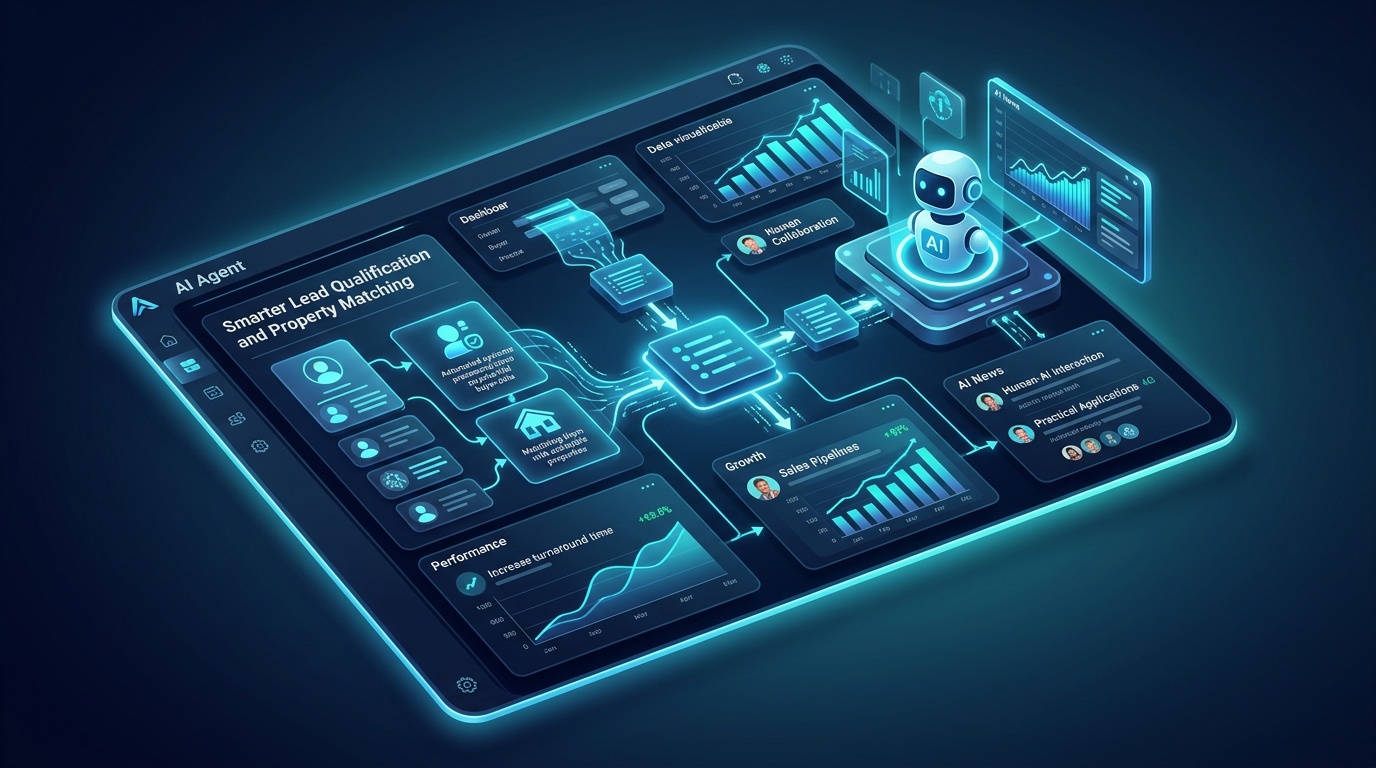
Real Estate: Smarter Lead Qualification and Property Matching
Real estate agencies transform their sales pipelines using intelligent automation systems that analyze prospect behavior, financial qualifications, and property preferences. AI-powered lead scoring identifies high-intent buyers within minutes of inquiry, while automated property matching connects clients with suitable listings based on location preferences, budget constraints, and lifestyle factors.
Property management companies deploy computer vision for virtual tours and automated assessments, reducing manual inspection time by 60% while maintaining accuracy standards. These systems process thousands of listings simultaneously, creating detailed market analyses that inform pricing strategies and investment decisions.
Recruitment: Streamlining Candidate Screening for Quality Hires
Recruitment firms use natural language processing to analyze resumes, cover letters, and interview responses, identifying top candidates based on skills alignment, cultural fit indicators, and career trajectory patterns. Automated screening systems evaluate hundreds of applications simultaneously, ranking candidates by compatibility scores that correlate with long-term job success.
Intelligent scheduling platforms coordinate interview logistics across multiple time zones, while sentiment analysis tools assess candidate enthusiasm and communication skills during phone screenings. These automation workflows reduce time-to-hire from weeks to days while improving placement quality metrics.
Fundraising: Automating Investor Outreach for Capital Growth
Fundraising organizations use AI research tools to identify potential donors and investors based on giving history, investment patterns, and philanthropic interests. Automated outreach systems personalize communication strategies for each prospect segment, optimizing message timing and content for maximum engagement rates.
Automation Impact: Organizations using intelligent donor research report 40% higher response rates and 25% increased average donation amounts compared to manual outreach methods.
Hospitality: Guest Experience Optimization and Revenue Growth
Hotels and restaurants implement intelligent reservation systems that predict demand patterns, optimize pricing strategies, and manage inventory allocation across multiple channels. Chatbot assistants handle guest inquiries around the clock, processing room service orders, booking requests, and concierge services with minimal staff involvement.
Predictive analytics platforms analyze guest preferences from previous stays, enabling personalized service recommendations and proactive amenity preparation. These systems coordinate housekeeping schedules, maintenance requests, and staff allocation based on occupancy forecasts and seasonal trends.
The Strategic Advantage: How AI News Drives Smart Automation Decisions
Spotting AI Trends That Directly Impact Your Revenue
Smart business leaders filter through daily technology announcements to identify developments with immediate revenue potential. Machine learning breakthroughs in natural language processing translate directly into improved customer service automation. Computer vision advances enable automated document processing that reduces administrative costs by 45%.
Monitoring industry-specific AI developments reveals competitive opportunities before markets saturate. When AI news from OpenAI reports new API capabilities, forward-thinking companies immediately assess integration possibilities for their existing workflows. Early adoption of proven automation technologies creates sustainable competitive advantages.
Evaluating New AI Tools: A Practical ROI Framework
Successful AI evaluation focuses on measurable business metrics rather than technological complexity. Calculate potential time savings, error reduction, and throughput improvements before implementation. Test automation solutions with small pilot programs that demonstrate clear value propositions.
ROI Framework: Effective AI tools should demonstrate positive returns within 90 days through reduced labor costs, increased processing speed, or improved accuracy rates.
From Research to Results: Implementation Roadmap for SMEs
Transform AI news into actionable business strategies through systematic evaluation processes. Document current manual workflows, identify repetitive tasks suitable for automation, and prioritize implementations based on cost-benefit analysis. Start with proven technologies that address specific pain points.
Build internal expertise gradually by training existing staff on automation tools rather than hiring specialized personnel. Partner with experienced AI providers who understand your industry’s unique requirements and can deliver customized solutions that integrate seamlessly with existing systems.
Navigating AI Adoption: Overcoming Common Hurdles for Measurable Gains
Is AI a Threat or an Opportunity? The Reality
Artificial intelligence works alongside human capabilities rather than eliminating jobs. Automation handles repetitive data processing while employees focus on strategic decision-making, relationship building, and creative problem-solving. Companies implementing intelligent automation report higher job satisfaction as workers engage in more meaningful tasks.
Security concerns about AI systems are manageable through proper implementation protocols and data governance frameworks. Choose automation providers with enterprise-grade security standards and transparent operational practices.
Building Your AI Business Case: Quantifying Real Returns
Document current operational costs, including labor hours, error rates, and processing delays. Compare these baseline metrics against projected automation performance to calculate potential savings. Factor in implementation costs, training requirements, and ongoing maintenance expenses for accurate ROI projections.
Present business cases using concrete examples from similar organizations. Show how automation reduces manual workload while improving output quality and consistency across business processes.
Human-AI Collaboration: Building Better Teams, Not Replacing Them
Design workflows that combine artificial intelligence efficiency with human judgment and creativity. AI systems excel at data analysis and pattern recognition, while humans provide context, empathy, and strategic thinking. This collaborative approach maximizes both technological capabilities and human expertise.
Train team members to work effectively with automation tools, emphasizing how AI assistance improves their professional capabilities and career development opportunities. Successful implementation requires cultural adaptation alongside technological integration.
Frequently Asked Questions
How does AI change the nature of work, rather than replacing jobs entirely?
As we see at Vynta AI, artificial intelligence excels at automating repetitive, data-intensive tasks. This frees human professionals to focus on strategic thinking, creativity, and complex problem-solving. AI creates hybrid workflows, where the technology handles precision tasks, allowing humans to apply their unique judgment and expertise.
What types of tasks are most likely to be automated by AI in the near future?
From our work in business transformation, AI is rapidly automating tasks that involve extensive data processing, pattern recognition, and predictive analytics. This includes areas like lead qualification, candidate screening, investor research, and managing routine customer inquiries. These are often high-volume, repetitive tasks that AI can handle with remarkable precision.
Why is staying informed about AI news important for businesses?
Staying informed on AI news is absolutely essential for competitive advantage. Businesses that actively monitor AI developments gain first-mover benefits, identifying immediate opportunities for cost savings, revenue growth, and market differentiation. Ignoring these advancements risks falling behind competitors that adopt intelligent automation.
How does AI deliver measurable business outcomes?
At Vynta AI, we focus on connecting AI advancements to specific business metrics. For example, automated lead qualification can significantly increase conversion rates, while intelligent screening reduces time-to-hire for recruitment agencies. These practical applications of AI consistently provide clear, quantifiable results for organizations.
Can you give examples of AI applications in specific industries?
Certainly. In real estate, AI automates lead qualification and property matching. Recruitment firms use AI for candidate screening and intelligent scheduling, and fundraising organizations automate investor research. The hospitality sector benefits from intelligent reservation systems and chatbot assistants for guest inquiries, improving operational efficiency.
How can AI help reduce operational costs for businesses?
AI significantly reduces operational costs by automating many repetitive and data-intensive tasks. For instance, computer vision automates property assessments, reducing manual inspection time by 60% while maintaining accuracy. Across various sectors, intelligent automation streamlines workflows and processes, leading to substantial administrative cost savings.
What are Vynta AI Agents and how do they help businesses?
Vynta AI Agents are bespoke AI solutions we design specifically for luxury hospitality venues like restaurants and premium bars. They respond instantly to guest inquiries, mimicking human-like timing, and can increase booking conversion by 50% while reducing inquiry abandonment by 60%. These agents also increase average guest spend by up to 25% through brand-safe upselling and reduce operational costs by 30%, all while integrating seamlessly with existing CRMs.