

unsupervised learning in deep learning
Unsupervised Deep Learning: Finding Hidden Revenue Patterns Without Labeled Data
Unsupervised learning in deep learning analyzes your business data without needing pre-labeled examples, using neural networks to spot hidden customer patterns, group similar behaviors, and extract profitable insights from raw information. This technology drives customer segmentation, fraud detection, and predictive analytics that directly impact revenue – a core component of AI automation services.
What Is Unsupervised Learning?
Think of unsupervised learning as your smartest analyst working 24/7 to find patterns you didn’t know existed. These algorithms explore data without human-provided answers, identifying natural groupings in customer behavior, market trends, and operational patterns. A hotel might discover that guests who book certain room types also prefer specific amenities – insights that drive targeted upselling.
How Deep Learning Amplifies Pattern Detection
Deep neural networks process information through multiple layers, capturing complex relationships that basic analytics miss. While simple clustering might group real estate buyers by income brackets, deep architectures can simultaneously analyze browsing behavior, property preferences, timing patterns, and demographic data to create precise buyer personas.
Business Impact: Teams using deep unsupervised learning report 25-40% improvements in customer targeting accuracy and 30% fewer false alerts compared to traditional analytics.
Why Your Unlabeled Data Contains Hidden Revenue
Most valuable business data lacks clear categories: guest reviews, support tickets, transaction logs, and interaction records. Unsupervised deep learning transforms this raw information into actionable intelligence without expensive manual labeling. You can analyze years of customer data to discover revenue opportunities and cost savings that traditional reports never revealed.
Four Ways Unsupervised Learning Drives Business Results
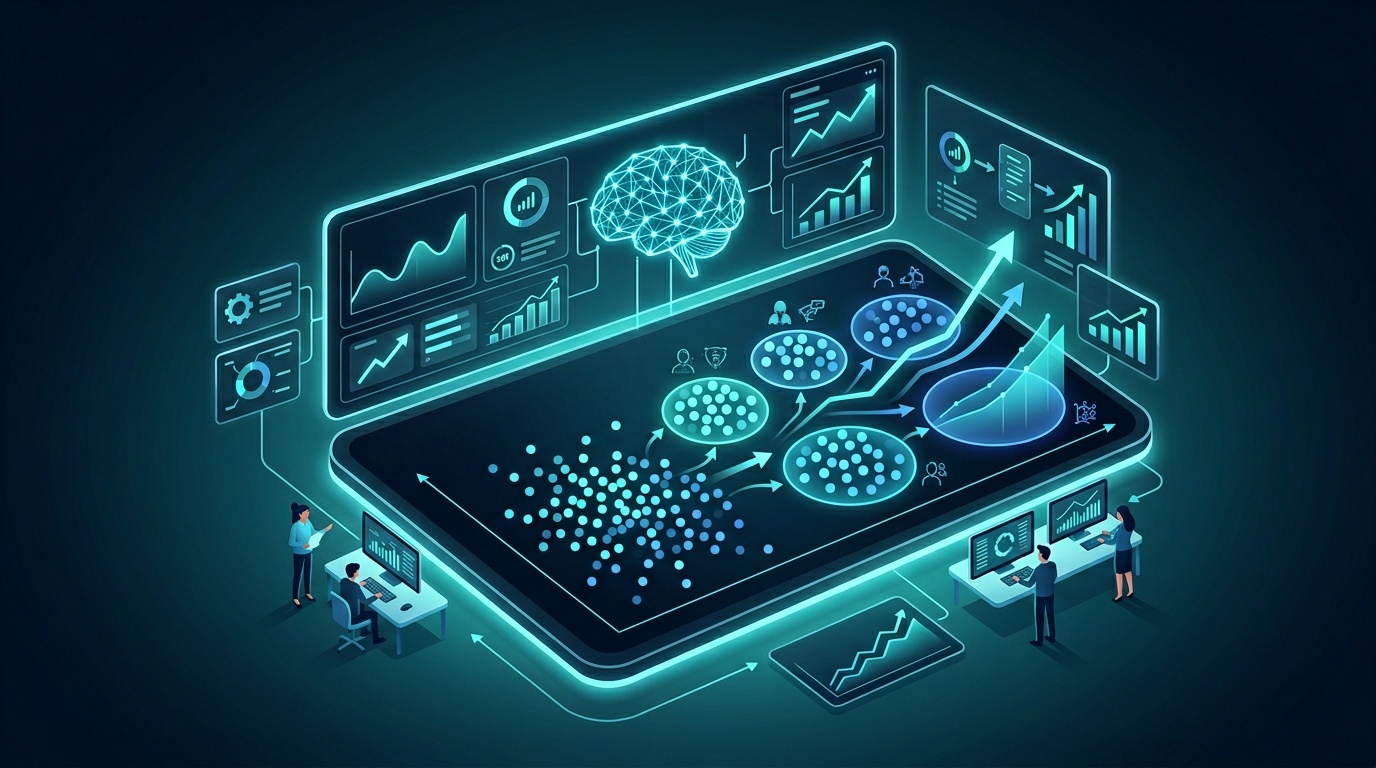
Customer Clustering: Precision Segmentation That Increases Conversion
Clustering algorithms automatically group customers by behavior patterns, creating segments you never knew existed. Deep clustering processes thousands of variables simultaneously – purchase history, engagement timing, support interactions, and preference signals. Real estate agencies discover buyer types with specific property preferences and budget ranges, while recruitment firms identify candidate clusters with complementary skills and career trajectories.
Data Compression: Turning Complex Metrics Into Clear Strategy
When you have hundreds of performance metrics, dimensionality reduction identifies which ones actually matter. This process distills complex data into clear visualizations that guide decisions. You can spot the 5-7 factors that truly drive customer satisfaction instead of getting lost in 50+ variables.
Anomaly Detection: Catching Problems Before They Cost You
Anomaly detection spots unusual patterns that signal both risks and opportunities. The system flags fraudulent transactions, equipment failures, and unexpected customer behavior changes. Hospitality businesses catch service issues before guests complain, while fundraising organizations identify donor engagement shifts that indicate major gift potential.
Pattern Recognition: Companies using unsupervised algorithms often discover 3-5 previously unknown high-value customer segments and reduce false alerts by up to 60% compared to rule-based systems.
Trend Discovery: Spotting Revenue Patterns Before Competitors
Pattern discovery reveals correlations between seemingly unrelated business metrics. You might find that customer support response time correlates with upselling success, or that certain booking patterns predict cancellations. These insights drive pricing strategies, service delivery improvements, and resource allocation decisions.
The Technology Behind Business Intelligence
Autoencoders: Finding What Matters Most
Autoencoders compress your data to identify the most important characteristics while filtering out noise. Think of it as an intelligent summarizer that finds the core elements driving customer behavior, transaction success, or operational efficiency. The network learns which factors predict outcomes, creating focused models that highlight actionable insights.
Generative Networks: Safe Testing and Training
Generative Adversarial Networks create synthetic data that matches your real business patterns. Organizations use this synthetic data to test new strategies, train staff, and validate automation systems without exposing sensitive customer information. Real estate firms can generate property scenarios for market analysis, while recruitment agencies create candidate profiles for testing screening algorithms.
Architecture Performance: Modern autoencoders achieve 90%+ data compression while preserving reconstruction quality above 95%, enabling faster processing of large datasets.
Integration With Business Operations
These systems integrate directly into existing business tools, processing real-time data streams to deliver immediate insights and automated responses. Autoencoders identify which lead characteristics predict sales success, while generative networks create training scenarios that improve customer service without using actual client conversations.
Real-World Applications Across Industries
Real Estate: Predicting Buyer Intent and Market Shifts
Property agencies analyze browsing patterns, inquiry timing, and demographic signals to identify buyer segments with distinct preferences and purchase timelines. One agency discovered that buyers who viewed listings on weekend evenings converted 40% faster than weekday browsers, leading to targeted follow-up timing that increased closings by 23%.
Recruitment: Discovering Hidden Talent Patterns
Recruitment firms process résumés, interview notes, and performance data to uncover talent clusters and emerging skill combinations. Analysis might reveal that candidates with specific educational backgrounds and hobby patterns excel in certain roles, helping teams identify high-potential candidates others overlook.
Fundraising: Donor Behavior and Timing Optimization
Fundraising organizations analyze donation patterns, communication engagement, and event participation to identify donor personas and optimal outreach timing. Understanding that major donors prefer quarterly updates while younger donors engage with monthly social media content can increase response rates by 35%.
Hospitality: Guest Experience Personalization
Hotels and restaurants process guest feedback, booking patterns, and service interactions to create experience profiles and optimize operations. Discovering that business travelers value quick check-in over amenities, while leisure guests prioritize personalized recommendations, drives targeted service delivery that improves satisfaction scores.
Vynta AI: From Technical Complexity to Business Results
Vynta AI transforms unsupervised deep learning from technical theory into practical automation that delivers measurable ROI. Our industry-specific approach focuses on automated insights, streamlined operations, and data-driven decision-making that directly impacts your bottom line across real estate, recruitment, fundraising, and hospitality sectors.
Frequently Asked Questions
What is unsupervised learning in deep learning?
Unsupervised learning in deep learning empowers AI to analyze raw business data without needing human-provided labels. It uses deep neural networks to automatically discover hidden patterns, group similar data points, and extract meaningful insights. This approach is key for uncovering value in vast amounts of unlabeled information across various industries.
Can we use deep learning for unsupervised learning?
Absolutely, deep learning is a powerful engine for unsupervised tasks. Deep neural networks, with their multiple processing layers, excel at capturing complex, nonlinear relationships within data. Architectures like autoencoders and Generative Adversarial Networks, or GANs, are specifically designed for unsupervised deep learning applications.
What is an example of unsupervised learning?
A prime example is customer segmentation, where unsupervised deep learning groups customers based on their purchasing patterns or engagement behaviors without needing pre-labeled categories. Another application is anomaly detection, which flags unusual patterns like fraudulent transactions or equipment failures. These applications help businesses gain clarity and proactive insights from their data.
Is ChatGPT unsupervised learning?
ChatGPT, while a powerful AI, is not primarily an unsupervised learning model in the context we’re discussing. It’s built using a combination of supervised learning on vast amounts of text data and reinforcement learning from human feedback. Unsupervised deep learning, as we define it, focuses on discovering hidden patterns in completely unlabeled data without explicit guidance.
How does unsupervised deep learning benefit businesses?
Unsupervised deep learning helps businesses by transforming raw, unlabeled data into actionable intelligence. It enables precise customer segmentation, early anomaly detection, and accurate predictive analytics. This leads to improvements in customer targeting accuracy and significant reductions in operational anomalies, revealing hidden revenue opportunities and efficiency gains.
What are some key deep learning architectures used for unsupervised tasks?
Two key deep learning architectures for unsupervised tasks are autoencoders and Generative Adversarial Networks, or GANs. Autoencoders learn efficient data representations by compressing and reconstructing information, focusing on essential features. GANs consist of competing networks that generate synthetic data, useful for testing strategies and augmenting datasets without sensitive information.