
lead agents
Demystifying the “Lead Agent”: What It Means for Business Growth
Lead agents are specialized professionals or automated systems responsible for identifying, engaging, and qualifying potential customers before passing them to sales teams. Modern AI-powered lead agents can automate much of this process, delivering qualified prospects within the hours you define while reducing operational costs by up to 30%.
Defining the “Lead Agent” in Business
A lead agent serves as the frontline connector between a company and potential customers. They identify prospects who match an ideal customer profile and initiate meaningful conversations that move them through the sales funnel. Lead agents focus specifically on the early stages of customer acquisition rather than closing deals.
The Core Functions of a Lead Agent: From Prospecting to Qualification
Lead agents perform three primary functions: prospecting, engagement, and qualification. They research potential customers across multiple channels, initiate contact through personalized outreach, and assess readiness through strategic questions. Sales teams receive high-quality opportunities aligned with business objectives and genuine purchase intent.
Key Insight: Human lead agents typically handle 20-30 prospects per day, while AI-powered alternatives can engage hundreds simultaneously without compromising personalization quality.
Why Businesses Need Effective Lead Generation Strategies
Without systematic lead generation, businesses rely on unpredictable referrals and inbound inquiries that rarely scale with growth ambitions. Companies using structured lead agent processes see higher conversion rates because prospects receive immediate, relevant responses when interest peaks. This approach turns sporadic customer acquisition into a predictable pipeline across real estate, recruitment, fundraising, and hospitality.
Vynta AI Agents for Hospitality exemplify this shift, providing bespoke AI agents that respond to inquiries within client-defined hours while maintaining natural, human-like communication patterns that can increase booking conversions by 50%.
The Evolution of the Lead Agent: From Human Effort to AI Automation
The Limitations of Traditional Lead Generation Approaches
Lead generation agencies face scalability constraints that can slow growth. Human agents work within fixed schedules, handle limited prospect volumes, and often require extensive ramp time before producing consistent results. Response delays during off-hours drive prospect abandonment, while inconsistent messaging across team members creates fragmented brand experiences that reduce conversion performance.
Introducing AI Agents: The Next Frontier in Lead Generation
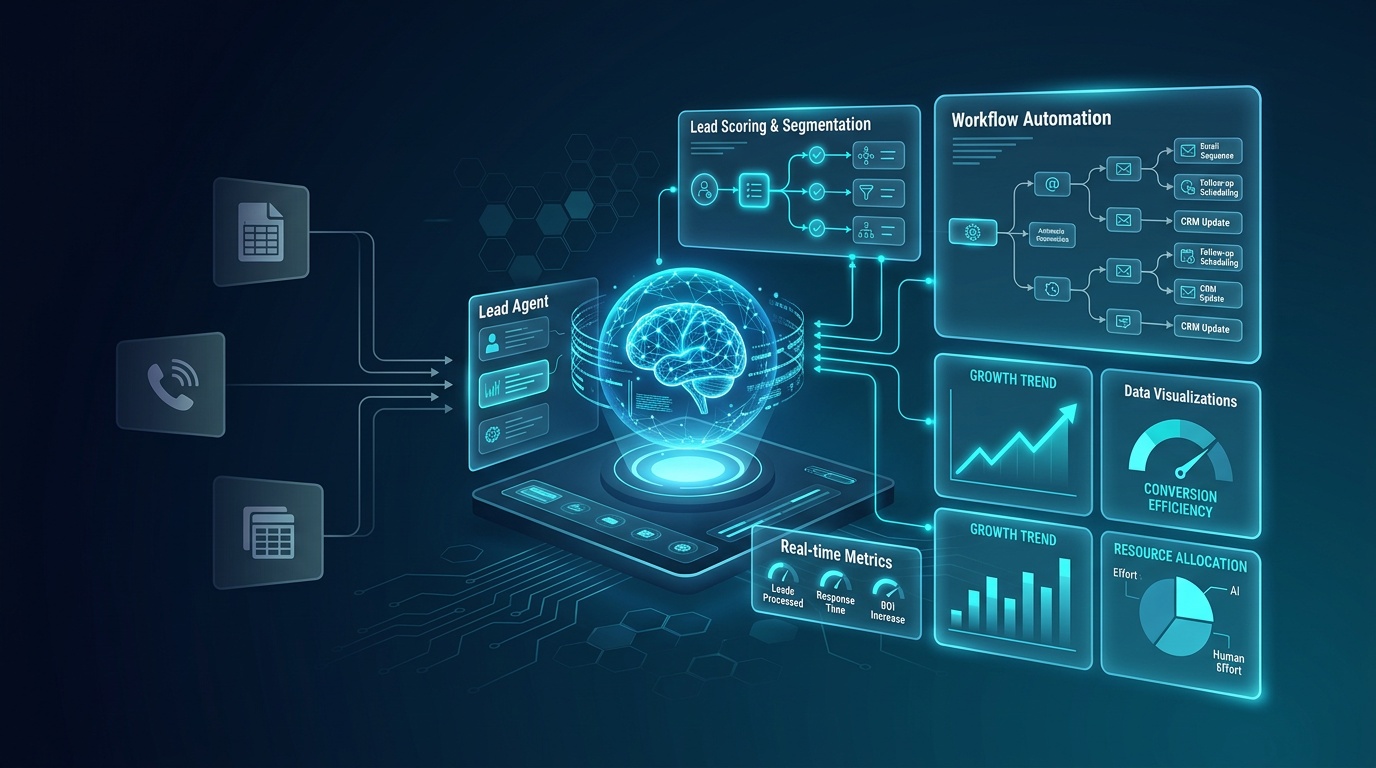
AI agents shift lead management from reactive to proactive. They operate continuously, engaging prospects quickly across multiple communication channels while maintaining personalized interactions. They improve over time by learning from real conversations and updating qualification logic without additional headcount.
How AI Agents Perform Lead Agent Functions with Superior Efficiency
AI systems support lead qualification through natural language processing that identifies intent, budget parameters, and timeline requirements early in conversations. They integrate with CRM platforms, update prospect records, and trigger follow-up sequences based on outcomes. This automation reduces manual data entry and prevents qualified prospects from being lost due to handoff gaps.
Comparing Human Lead Agents, Agencies, and AI Agents for Business
| Feature | Human Lead Agents | Lead Generation Agency | AI Agents |
|---|---|---|---|
| Operating Hours | 8-10 hours daily | Business hours only | Availability based on client-defined hours |
| Response Time | Minutes to hours | Hours to days | Fast responses within operating hours |
| Monthly Capacity | 500-800 prospects | 1,000-2,000 prospects | High concurrency (volume depends on configuration) |
| Consistency | Variable performance | Team-dependent quality | Consistent messaging based on rules and training |
| Scalability | Requires hiring | Contract renegotiation | Scales without adding staff |
Vynta AI Agents for Hospitality demonstrate what this transformation looks like in practice: bespoke automation that responds to guest inquiries with natural timing patterns and integrates with reservation systems such as SevenRooms. They support multilingual communication across WhatsApp, SMS, Instagram, and email, helping venues maintain consistent brand representation and increase average guest spend by up to 25% through brand-safe upsell suggestions.
Industry-Specific AI Lead Agents: Outcomes for Real Estate, Recruitment, Fundraising, and Hospitality
Real Estate: Automating Property Inquiries and Client Matching
Real estate agencies use AI agents to qualify property inquiries by budget, location preferences, and timeline requirements. They schedule viewings, send property recommendations based on stated criteria, and maintain engagement through personalized follow-up. AI agents handle multiple inquiries simultaneously while capturing buyer details that teams can miss during peak periods.
Recruitment: Streamlining Candidate Identification and Initial Screening
Recruitment firms deploy AI agents to run preliminary candidate screens through structured conversations that assess experience levels, salary expectations, and availability. Automated interactions identify qualified candidates before recruiters invest time in deeper interviews. The system keeps candidate profiles updated, enabling faster matching when new roles open.
Fundraising: Optimizing Investor Outreach and Donor Engagement
Fundraising organizations deploy AI agents to support donor stewardship through personalized communication that reflects giving history and engagement preferences. They determine optimal outreach timing, tailor messaging by donor segment, and track engagement patterns to inform future campaign planning.
Hospitality: Personalizing Guest Experiences and Managing Reservations
Hospitality venues use AI agents to manage reservation inquiries across multiple channels while providing fast responses that match brand voice and service standards. Vynta AI Agents for Hospitality respond to guest inquiries with natural timing patterns. They integrate with CRMs such as SevenRooms, updating guest profiles and preferences while supporting multilingual communication across WhatsApp, SMS, Instagram, and email.
Industry Impact: Hospitality venues using specialized AI agents report higher booking conversion rates and up to 25% increased average guest spend through upsell suggestions tailored to guest profiles.
Beyond Leads: How AI Agents Scale Revenue and Reduce Operational Costs
The ROI of AI Lead Generation: More Than New Contacts
AI agents deliver value beyond initial lead capture by keeping prospects engaged throughout longer sales cycles. They nurture relationships through relevant content, appointment reminders, and follow-up messages that keep prospects active until decisions occur. This sustained engagement improves lifetime value while lowering acquisition costs compared to manual prospecting.
Automating Sales Processes for Scalable Revenue Growth
Revenue growth becomes easier to sustain when AI agents handle routine sales tasks like appointment scheduling, document collection, and basic objection handling. Sales teams focus on negotiations and relationship building that influence closing rates. Companies report faster sales cycles after removing administrative bottlenecks.
Cutting Operational Expenses: The Cost-Saving Power of AI Agents
Cost reduction comes from automating repetitive customer interactions. AI agents operate without salaries, benefits, or recurring training ramp time while maintaining consistent performance. Vynta AI Agents for Hospitality can reduce operational costs by 30% while ensuring VIP guests receive human attention through escalation rules that route complex inquiries to appropriate staff members.
Addressing Common Concerns: Implementing AI Automation with Confidence
Some leaders worry about losing the personal touch with automation. AI agents address this concern with brand-specific tone controls, business rules, and escalation paths to humans when needed. Manual review and takeover options let staff intervene quickly, protecting the guest or buyer experience while capturing automation benefits.
Frequently Asked Questions
What is a lead agent?
As Operations Director at Vynta AI, I see lead agents as specialized professionals or automated systems. Their role is to identify, engage, and qualify potential customers. They prepare these prospects before passing them to sales teams, making the sales process more efficient and targeted.
How have lead agents evolved in business?
Historically, lead agents were human professionals focused on the early stages of customer acquisition. Today, AI-powered lead agents automate much of this work, operating continuously and handling hundreds of prospects simultaneously. This shift allows for greater scalability and efficiency in lead management.
Why are effective lead generation strategies important for businesses?
Without a systematic approach, businesses often rely on unpredictable referrals, which limits growth. Structured lead agent processes create a predictable customer pipeline and lead to higher conversion rates. This ensures prospects receive immediate, relevant responses when their interest is highest.
What are the core functions a lead agent performs?
Lead agents perform three primary functions: prospecting, engagement, and qualification. They research potential customers, initiate personalized contact, and assess readiness through strategic questions. This ensures sales teams receive high-quality opportunities with genuine purchase intent.
How do AI agents improve lead generation compared to traditional methods?
AI agents offer continuous operation and fast responses, engaging prospects across multiple channels with personalization. Unlike traditional methods with fixed schedules and limited volumes, AI agents scale without adding staff. For example, Vynta AI Agents can increase booking conversions by 50% and reduce operational costs by 30%.
Can AI agents be tailored for specific industries?
Absolutely, AI agents are highly adaptable for different industries. For real estate, they qualify inquiries and schedule viewings; for recruitment, they screen candidates. Vynta AI Agents for hospitality, for example, handle guest inquiries, integrate with reservation systems, and support multilingual communication to increase guest spend.