
quantizing
Quantizing is the process of converting continuous data or signals into discrete, finite units. In business automation, it’s what allows AI systems to turn messy, unstructured inputs into structured, actionable outputs–faster and at a fraction of the cost of traditional approaches.
Key Takeaways
- Quantizing converts continuous data into discrete units, a fundamental step for AI processing.
- This process enables AI systems to transform unstructured business inputs into structured, actionable outputs.
- Businesses achieve faster processing and reduced costs by applying quantizing within AI automation solutions.
Understanding ‘Quantizing’: Shifting from Continuous to Discrete
Quantizing transforms infinite variations into specific, manageable steps. The concept appears in physics, music production, and the AI models powering modern business automation–and in each case, the underlying logic is the same: take something fluid and give it defined structure so a system can act on it reliably.
The Core Idea: From Smooth to Steps
Think of a ramp versus a staircase. A ramp allows for infinite height positions. A staircase offers only fixed levels. Quantizing maps the ramp to the nearest stair. In large language models, this technique reduces the precision of numbers the model uses–converting high-precision floating-point values into lower-bit integers–which cuts memory requirements and boosts processing speed without gutting accuracy.
Why Discrete Matters: Precision and Efficiency
Discrete data structures let systems process massive volumes of information without lag. For real estate and recruitment teams, that means AI agents can categorize leads or match candidates against role requirements in seconds–freeing human staff to focus on relationship-building and closing, not manual sorting.
A Simple Analogy: Volume Knobs vs. Click Wheels
A traditional analog volume knob rotates smoothly through infinite levels. A digital click wheel steps through fixed increments. Quantizing snaps the smooth rotation to the nearest increment. That simplification is what lets a digital system interpret input reliably at speed–and it’s exactly what happens inside a quantized AI model processing a stack of inbound leads or guest reservation requests.
Key Insight
Quantizing makes AI practical for business. By collapsing data complexity into discrete units, teams get faster processing and lower infrastructure costs–without sacrificing the accuracy that high-stakes decisions require.
Quantization’s Journey: From Physics to Everyday Applications
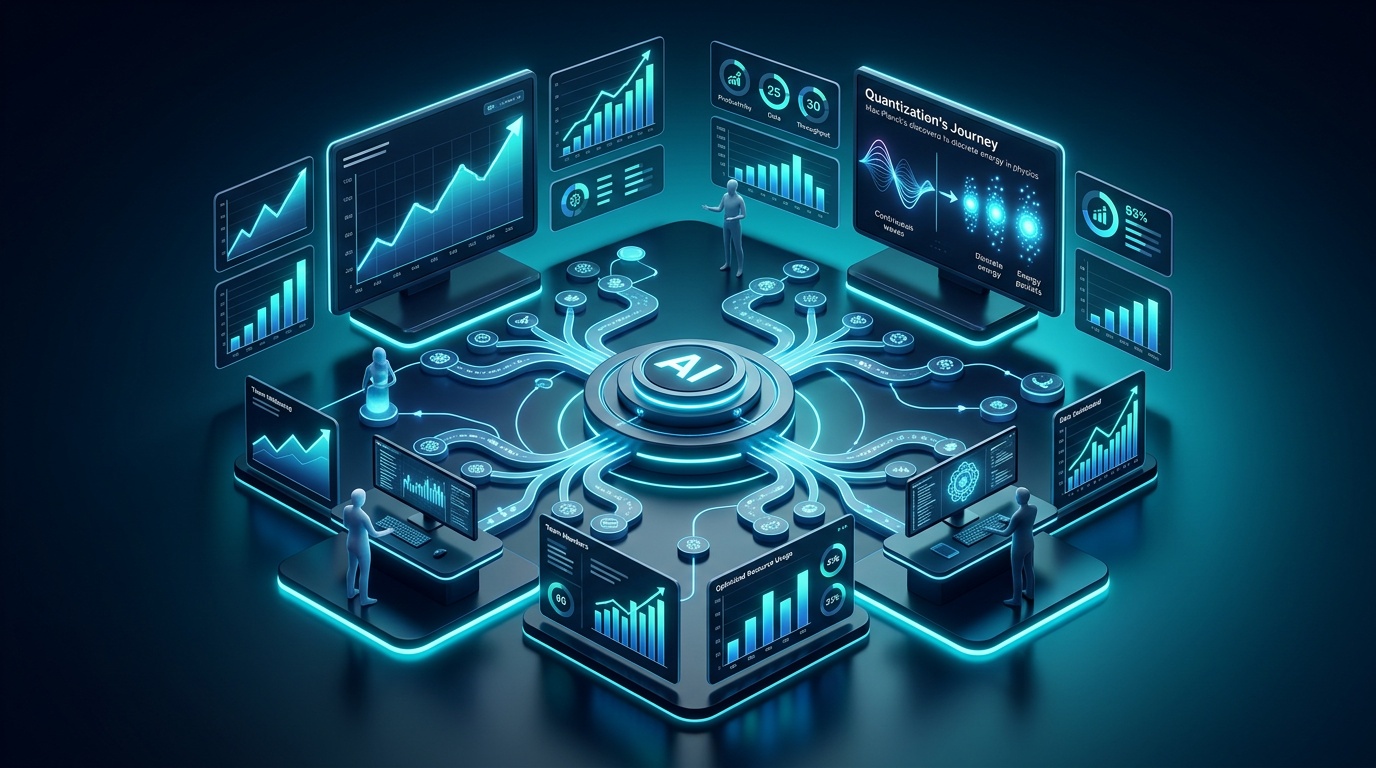
The quantization meaning in physics traces back to Max Planck, who proved that energy exists in discrete packets rather than continuous waves. That finding didn’t stay in the lab. In audio production, quantizing music means snapping recorded notes to a precise rhythmic grid–correcting timing errors and locking performances to a tempo. Same principle, different domain. What ties them together is the insight that converting continuous signals into discrete steps produces consistency and predictability that pure analog systems can’t match.
Quantization in Machine Learning: Fueling AI Practicality
Quantizing LLM models is where the concept moves from interesting to genuinely transformative for mid-market businesses. By reducing floating-point precision to lower-bit integers, the model’s memory footprint shrinks and inference speed increases–often dramatically. I’ve seen clients run sophisticated AI automation on standard cloud hardware that would have required enterprise-grade servers two years ago. That’s the direct business case: advanced AI without the infrastructure spend that used to price out smaller organizations.
How Quantization Powers Business Automation Across Verticals
Where this gets concrete is in the four verticals we work in daily. In real estate, quantization converts unstructured property descriptions into searchable, comparable data points–making lead-to-property matching far more precise. Recruitment teams use the same principle to score candidates against role requirements at volume, cutting time-to-shortlist without sacrificing match quality. For fundraising directors, discrete engagement scoring means outreach prioritization is based on data, not gut feel. And in hospitality, structured guest preference signals let AI agents build profiles that support personalized service at a scale no front-desk team could manage manually.
Each of these use cases works because the underlying model operates on structured, compressed data rather than raw, unprocessed noise. Quantizing is what makes that possible.
Strategic Verdict and Future Outlook
For operations leaders, the decision to adopt quantized AI models isn’t really a question of if–it’s a question of when and with whom. The cost and speed improvements are measurable and repeatable. Across fundraising and hospitality clients, we consistently see faster query response times, lower per-interaction costs, and better throughput on standard infrastructure.
Looking ahead, the stakes only rise. As edge computing and real-time responsiveness become table stakes, efficient data processing is either your bottleneck or your competitive edge. Quantized models keep high-level intelligence accessible without requiring server farms. That’s what lets a boutique hotel compete with a chain, or a 15-person recruitment firm punch above its weight against larger competitors with bigger tech budgets.
One word of caution: not all quantization is equal. Aggressive compression can erode accuracy on specialized tasks. The goal isn’t the smallest possible model–it’s the most efficient one that still delivers the precision your operations demand. Vet your AI partner on this point directly. Ask how they validate output quality post-compression. The answer will tell you a lot.
Evaluating Quantized AI for Business
Pros
- Reduces infrastructure costs
- Enables near-real-time responses for guest and client queries
- Makes advanced AI accessible on standard hardware
Cons
- Requires expert implementation to prevent accuracy loss
- May require fine-tuning for highly specialized tasks
Frequently Asked Questions
What is quantizing?
As an operations director focused on practical AI, I see quantizing as a fundamental process. It’s about converting continuous, infinite data into discrete, finite units. Think of it as turning a smooth ramp into a series of steps, which allows AI systems to process complex information much more efficiently, making it actionable for businesses.
How does quantizing apply to AI and business automation?
At Vynta AI, we see this as key to making AI practical for our clients. In AI, especially with large language models, quantizing reduces the precision of numbers used by the model. This significantly lowers computational resource requirements, improving processing speed and making advanced AI accessible on standard hardware, transforming messy inputs into structured outputs.
Why is quantizing important for AI systems in business?
For mid-market SMEs, the efficiency gains from quantizing are transformative. It makes AI practical and cost-effective for business operations by simplifying data complexity into discrete units. This enables faster processing and reduces operational costs without sacrificing the accuracy needed for critical decisions, allowing teams to focus on high-value tasks.
Can you explain quantizing with a simple analogy?
I always find analogies help clarify these technical concepts for business leaders. Imagine a traditional analog volume knob that rotates smoothly, offering infinite levels. Now compare that to a digital click wheel that adjusts volume in fixed increments. Quantizing is like snapping that smooth analog rotation to the nearest digital increment, simplifying input for reliable digital system interpretation.
What does quantizing mean in music production?
While my focus is business AI, it’s interesting to see how this principle applies across fields. In audio production, quantizing music involves snapping notes to a precise rhythmic grid. This process corrects timing errors, ensuring consistency and predictability in musical performances, by converting continuous signals, like a musician’s timing, into discrete, perfect steps.
How does quantizing help businesses use AI more effectively?
This is where the rubber meets the road for our Vynta AI clients. Quantizing bridges the gap between raw, complex data and actionable business intelligence. It allows AI agents to quickly categorize leads, match candidates, or structure guest profiles with precision. This speed and accuracy mean businesses can run sophisticated AI automation services on affordable hardware, making advanced solutions accessible.
What are the main advantages of using quantized AI models for operations?
From an operations perspective, the benefits are clear and measurable. Quantized AI models significantly reduce infrastructure costs and enable near real-time responses for client queries. They make advanced AI accessible on standard hardware, allowing mid-market SMEs to compete with larger entities. This approach simplifies data complexity, leading to faster processing and lower operational costs without sacrificing accuracy.