

workflow automation platform
Understanding Workflow Automation Platforms: The Foundation for Smarter Business Operations
A workflow automation platform connects your business processes, eliminates manual handoffs, and executes repeatable tasks automatically. AI-native platforms go further: they learn, adapt, and make decisions, turning static workflows into intelligent operations that drive measurable revenue outcomes.
What Exactly is a Workflow Automation Platform?
A workflow automation platform is software that orchestrates multi-step business processes without manual intervention. It triggers actions based on defined rules. When a new lead enters your CRM, the platform qualifies it, assigns it, and schedules follow-up automatically. The result is consistent execution at scale, freeing your team for high-value work.
Beyond Basic Automation: The AI-Native Advantage
Traditional automation follows rigid if-then logic. An AI workflow automation platform introduces pattern recognition, predictive scoring, and natural language processing. It doesn’t just execute a process–it evaluates context and selects the optimal path. That distinction separates tools that save hours from tools that generate revenue.
Key Benefits for Mid-Market SMEs: Driving Growth, Not Just Efficiency
Mid-market SMEs typically lack dedicated AI teams but compete against organizations that do. A purpose-built workflow automation platform closes that gap by embedding intelligence directly into sales, operations, and customer engagement. Measurable outcomes include faster lead-to-close cycles, reduced cost-per-hire, higher donor retention rates, and improved guest satisfaction scores.
The Power of AI in Automating Workflows: From Tasks to Intelligent Agents

How AI Transforms Standard Automation: Predictive Power and Complex Decision-Making
Standard automation executes. AI automation anticipates. An AI workflow automation platform analyzes historical data to predict which leads will convert, which candidates will accept offers, and which guests are likely to cancel reservations. These predictions enable proactive action rather than reactive responses, shifting your team from firefighting to strategy.
Agentic Workflows: Mimicking Human Judgment for Enterprise-Level Tasks
Agentic workflows deploy AI agents that handle multi-step tasks with contextual judgment. An agent managing investor outreach doesn’t just send emails–it reads responses, adjusts messaging tone, schedules calls, and updates pipeline status, all while keeping your team informed and in control. This mirrors what a skilled human coordinator does, operating continuously across hundreds of simultaneous interactions.
Real-World AI Automation: Practical Examples Across Key Business Functions
Consider a recruitment firm processing 400 applications weekly. An AI agent screens resumes against role criteria, scores candidates, sends personalized status updates, and books interviews directly into calendars. The team reviews a shortlist rather than a pile. Time-to-shortlist drops significantly, with placement quality improving because human judgment focuses where it matters most.
Transforming Industry-Specific Operations with AI Workflow Automation
Real Estate: Streamlining Lead Qualification and Property Matching for Faster Closings
Real estate agencies lose revenue when agents spend time on unqualified leads. An AI workflow automation platform scores inbound inquiries against buyer-intent signals, budget range, and timeline, then routes only sales-ready leads to agents. Automated property matching delivers personalized listings before prospects ask, accelerating the path to closing. See how our Agentic Systems for Real Estate drive faster closings.
Recruitment: Accelerating Candidate Screening and Interview Scheduling for Quality Hires
Recruitment firms using AI workflow automation report significant reductions in administrative overhead. Candidate sourcing agents scan multiple channels simultaneously, apply fit scoring, and initiate personalized outreach. Interview scheduling automation eliminates the back-and-forth that delays placements and frustrates candidates, protecting your agency’s reputation for responsiveness. See what Agentic Systems for Recruitment can do for your hiring pipeline.
Fundraising: Automating Investor Outreach and Donor Management for Campaign Success
The AI-Powered Fundraising Platform from Vynta AI automates investor identification, personalized outreach sequencing, and donor relationship nurturing at scale. Organizations using systematic AI outreach maintain consistent communication across their entire prospect base–not just the top tier. Engagement signals are tracked continuously, surfacing the right moment to request a commitment and improving conversion rates across campaigns.
Hospitality: Optimizing Guest Experience and Reservation Management for Higher Satisfaction
For hospitality managers, AI workflow automation handles reservation confirmations, pre-arrival personalization, upsell sequencing, and post-stay follow-up automatically–all within the operating hours and brand rules you define. Reducing no-shows through intelligent reminder workflows directly protects revenue, while automated upsell triggers increase average spend per guest without adding staff pressure. Vynta AI Agents for Hospitality are built specifically for this challenge.
Selection Deep Dive: What to Validate Before You Sign
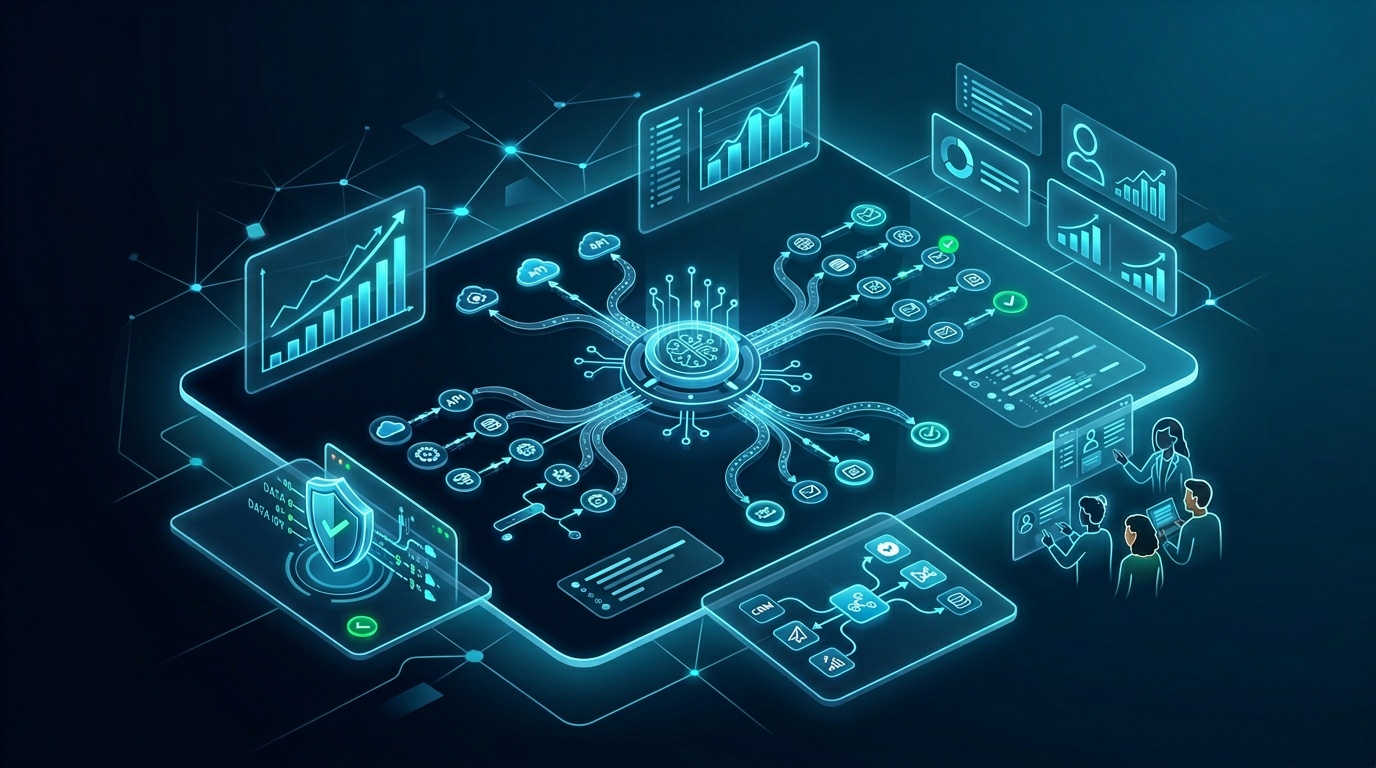
Three Non-Negotiables: Scalability, Security, and Integration
Evaluate any workflow automation platform against three hard criteria: native integration with your existing CRM and communication tools, enterprise-grade data security with clear compliance documentation, and architecture that scales with your transaction volume without requiring a costly rebuild. Platforms that demand re-implementation as your business grows are liabilities, not assets. Prioritize solutions with documented API connectivity and audit trails your compliance team can actually review.
Human-AI Collaboration: Augmenting Your Team, Not Replacing It
The right platform amplifies your team’s expertise. AI handles volume and consistency; your people handle relationships and judgment calls. A hospitality manager still owns the guest relationship–the AI handles reservation confirmations, upsell sequencing, and post-stay follow-up, freeing attention for the moments that define guest loyalty. That division of labor produces better outcomes than either approach alone, and it directly addresses the most common concern about AI adoption in service-oriented industries.
Why a Strategic Partner Matters: Complexity, Context, and Measurable ROI
A technology vendor sells software. A strategic partner configures workflows to your specific industry processes, trains your team, and measures outcomes against agreed benchmarks. For mid-market SMEs without internal AI resources, that distinction determines whether automation delivers projected ROI or becomes an expensive experiment. The AI-Powered Fundraising Platform illustrates this clearly: it’s not a generic email tool dropped into your stack. It’s a configured system aligned to your donor pipeline, outreach cadence, and campaign goals–built to deliver conversion improvements because the underlying workflow reflects how your organization actually raises capital.
Understanding Implementation: Transparency and Practical Steps
Honest implementation planning covers data readiness, integration timelines, and a phased rollout that delivers early wins without disrupting active operations. Expect an initial configuration period, a supervised learning phase, and ongoing optimization as your AI agents process real business interactions and refine their performance. Organizations that treat implementation as a one-time event consistently underperform those that treat their workflow automation platform as a living system. Build internal ownership from day one by assigning a process lead who collaborates directly with your automation partner throughout every phase.
Putting It Together: Your Path to Intelligent Operations
A workflow automation platform delivers compounding returns when selected and implemented with clear business intent. Organizations seeing the strongest outcomes share one characteristic: they treat automation as a strategic capability, not a cost-cutting exercise.
Across real estate, recruitment, fundraising, and hospitality, the pattern holds. AI workflow automation produces its greatest impact when it handles volume and consistency while human expertise handles relationships and complex judgment. Neither element works as well in isolation.
Matching Your Starting Point to the Right Entry Workflow
Start where manual effort is highest and the process is most repeatable. For recruitment firms, that’s typically candidate screening. For hospitality operators, that’s reservation follow-up and upsell sequencing. For fundraising organizations, investor outreach cadences offer immediate, measurable returns. Choose a single workflow, establish a performance baseline, and measure improvement before expanding scope.
The AI-Powered Fundraising Platform exemplifies this focused entry approach: it targets the workflow where fundraising organizations often lose momentum–consistent outreach across a large prospect base–and automates it with industry-specific intelligence rather than generic messaging logic.
What Evolving AI Capabilities Mean for Your Business
Agentic AI capabilities are advancing rapidly. Platforms deploying autonomous agents today are building toward systems that coordinate multiple agents across entire business functions–not just individual workflows. Mid-market SMEs that establish AI automation foundations now will hold a structural advantage as these capabilities mature, because their data, processes, and team familiarity with AI-augmented work will already be in place.
Open-source workflow automation options continue to expand, but they require internal technical resources to configure and maintain. For SMEs without dedicated engineering teams, purpose-built platforms with industry-specific configuration and strategic partner support consistently outperform self-managed open-source deployments on business outcomes.
Three Questions That Clarify the Right Platform Choice
Before committing to any platform, answer three questions honestly. First, does the platform have documented success in your specific industry vertical? Generic automation tools built for horizontal use cases rarely match the depth of industry-specific solutions. Second, does the vendor provide implementation support tied to performance benchmarks, or do they hand over software and step back? Third, can the platform grow with your transaction volume without a costly rebuild at the eighteen-month mark?
Vynta AI’s solutions across real estate, recruitment, fundraising, and hospitality are built to answer all three affirmatively. The goal is consistent: measurable business outcomes, delivered through AI that works alongside your team rather than around it.
Frequently Asked Questions
How do AI-native workflow automation platforms differ from traditional automation tools?
Traditional automation platforms follow rigid, predefined rules, executing tasks based on simple if-then logic. AI-native workflow automation platforms go further, using pattern recognition and predictive scoring to evaluate context and select the optimal path for a process. This allows them to learn, adapt, and continuously improve, turning static workflows into intelligent operations that drive measurable revenue outcomes.
What specific benefits do mid-market SMEs gain from using an AI workflow automation platform?
Mid-market SMEs gain a significant competitive edge by embedding intelligence directly into sales, operations, and customer engagement. These platforms deliver measurable outcomes such as faster lead-to-close cycles, reduced cost-per-hire, and improved guest satisfaction scores. They empower SMEs to drive growth without needing dedicated AI teams.
What are agentic workflows and how do they work in practice?
Agentic workflows involve deploying AI agents that can handle multi-step tasks with contextual judgment, mimicking human decision-making. For example, an agent managing investor outreach can read responses, adjust messaging tone, schedule calls, and update pipeline status automatically. This allows for continuous operation across hundreds of simultaneous interactions, freeing your team for strategic work.
Can you provide an example of AI workflow automation in a specific industry, like hospitality?
In hospitality, AI workflow automation can manage reservation confirmations, pre-arrival personalization, and post-stay follow-up automatically. For instance, Vynta AI Agents can increase booking conversion by 50% and reduce customer inquiry abandonment by 60%. They can also increase average guest spend by up to 25% through brand-safe upselling, all while ensuring VIP guests receive human care via escalation.
What should businesses prioritize when selecting an AI workflow automation platform?
When selecting an AI workflow automation platform, businesses should prioritize native integration with their existing CRM and communication tools. Enterprise-grade data security is non-negotiable to protect sensitive business information. Additionally, evaluate the platform’s scalability to ensure it can grow and adapt with your business needs.
How does AI help a workflow automation platform make decisions and adapt?
AI helps a workflow automation platform make decisions by analyzing historical data to identify patterns and predict future outcomes. This predictive power allows the platform to anticipate needs, such as which leads are most likely to convert or which guests might cancel. By evaluating context and continuously learning, the platform can adapt its actions proactively, shifting teams from reactive responses to strategic planning.
How does a workflow automation platform help businesses scale operations?
A workflow automation platform helps businesses scale by orchestrating multi-step processes without manual intervention, ensuring consistent execution across all operations. It automates repeatable tasks, freeing your team to focus on high-value work that drives growth. This allows businesses to handle increased volumes of interactions and transactions efficiently, supporting expansion without proportionally increasing headcount.