

shopify agent
Understanding the Shopify Agent: Beyond Traditional Chatbots
A Shopify agent is an AI system that takes autonomous action inside your store, qualifying leads, completing transactions, and managing customer journeys without waiting for human input at every step.
What Exactly Is a Shopify Agent?
Think of it this way: a traditional chatbot is a vending machine. A Shopify AI agent is an experienced sales associate who knows your entire inventory, remembers past purchases, and closes the sale without escalating every question to a manager.
The Core Difference: Agentic Action vs. Conversational Response
Standard chatbots match keywords to pre-written answers. A Shopify agent reasons through context, selects tools, executes multi-step tasks, and adapts mid-conversation. It doesn’t just respond — it acts. That distinction separates a revenue-generating asset from a glorified FAQ page.
How Shopify’s Vision Enables Agentic Commerce
Shopify’s investment in Shopify agentic commerce reflects a clear directional bet: buyers will increasingly shop through AI interfaces rather than traditional storefronts. Shopify is building the infrastructure — catalog APIs, checkout protocols, and data standards — so that merchants who prepare now will capture sales through every AI-powered channel that emerges next. That’s not a distant forecast. It’s already underway.
How AI Agents Drive Conversational Commerce on Shopify
From Browsing to Buying: The AI-Powered Purchase Journey
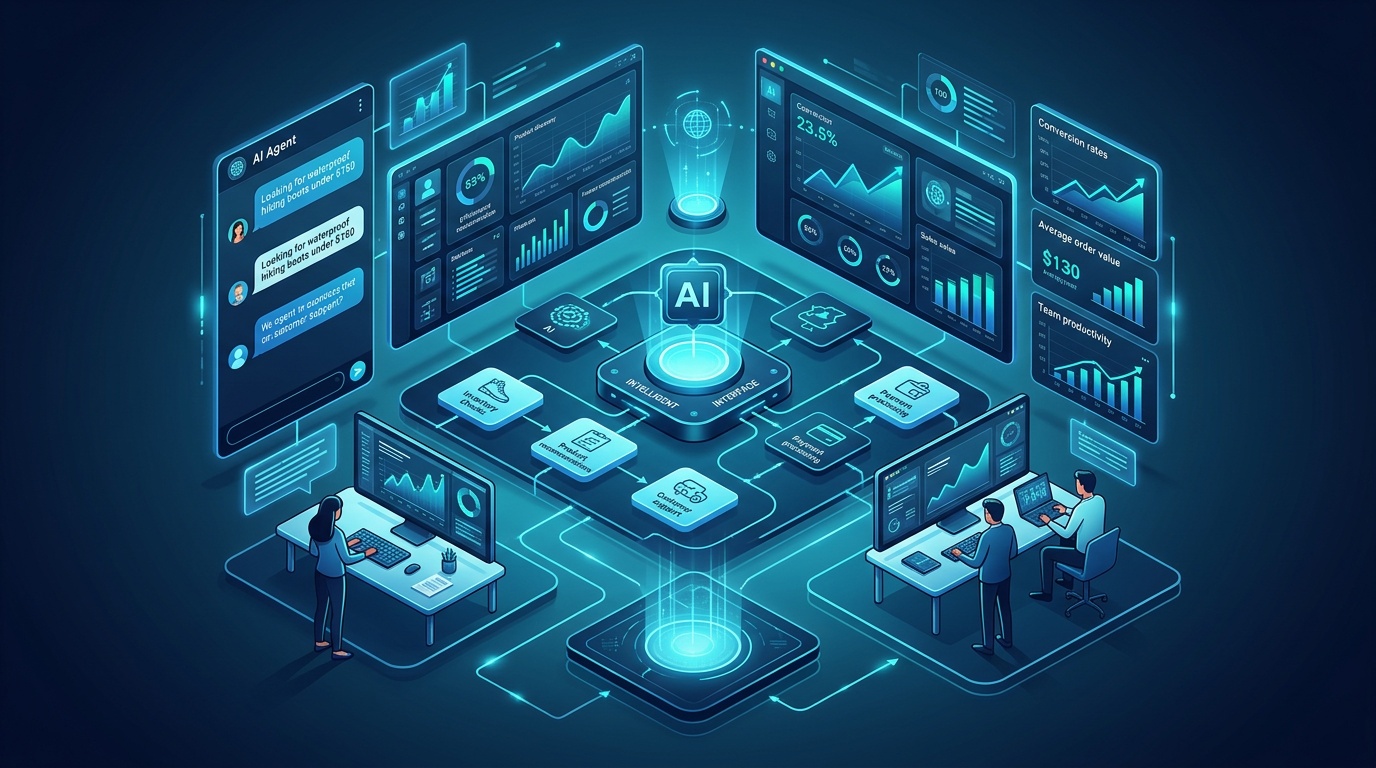
A shopper asks an AI assistant for a waterproof hiking boot under $150. A connected Shopify agent queries your live catalog, surfaces three matching products, handles size questions, and routes the buyer directly to a pre-filled checkout — all within a single conversation thread. No redirects. No abandoned tabs. One conversation, one completed sale.
The Universal Commerce Protocol (UCP) and Its Role
Shopify’s Universal Commerce Protocol is the technical bridge that lets external AI agents read your catalog, check inventory, and initiate purchases on your behalf. Merchants who enable UCP compatibility make their stores discoverable and transactable inside any AI-powered interface that adopts the standard — expanding reach without additional ad spend.
Practical Implementation: Enabling Your Shopify Store for AI Conversations
- Audit your product data: clean titles, accurate descriptions, and structured attributes are non-negotiable for AI readability.
- Activate Shopify’s catalog API permissions so external agents can query real-time inventory.
- Enable Shopify agent chat through your storefront settings or a compatible third-party integration.
- Define escalation rules so complex or high-value queries reach a human team member.
Measuring Success: Key Metrics for Conversational Sales
Track conversation-to-purchase rate, average order value from agent-assisted sessions, and cart abandonment reduction. Merchants using Shopify AI tools with proper catalog structuring typically report measurable lifts in conversion within the first 60 days of deployment. For tailored AI solutions that strengthen sales interactions, consider exploring our AI Automation Services.
Vynta AI’s Edge: Enterprise-Grade AI Agents for Scaled Shopify Success
Why Generic Bots Fall Short for Mid-Market SMEs
Off-the-shelf automation tools answer questions. They don’t understand your brand voice, your upsell logic, or your customer segments. For a mid-market merchant, that gap costs revenue daily — through missed upsells, inconsistent responses, and zero CRM synchronization. You’re paying for automation that isn’t actually working for your business.
The Vynta AI Difference: Specialization and Measurable Outcomes
| Capability | Generic Bot | Vynta AI Agent |
|---|---|---|
| Brand voice customization | Template-based | Fully bespoke |
| CRM integration | Limited or manual | Real-time synchronization |
| Upselling logic | Rule-based scripts | Customer profile-driven |
| Escalation control | Basic keyword triggers | Configurable VIP routing |
| Operating hours | Always-on | Client-defined windows |
Applying Vynta AI’s Expertise to Your Shopify Operations
Hospitality merchants selling experiences, event packages, or premium products through Shopify benefit directly from Vynta AI Agents for Hospitality, which can drive up to a 50% increase in booking conversion and a 60% reduction in inquiry abandonment. The same outcome-focused architecture applies across retail, recruitment, and real estate verticals — the industry changes, the results-first approach doesn’t.
The ROI of Sophisticated AI Agents
Vynta AI Agents for Hospitality clients report up to a 25% increase in average guest spend through brand-safe upselling and up to a 30% reduction in operational costs — without sacrificing the personal service that premium customers expect. These aren’t projections. They’re outcomes from live deployments.
The Future of AI Agents in Online Retail
Addressing Common Concerns: AI Adoption in Traditional Retail
Most merchant hesitation centers on three fears: losing brand control, alienating loyal customers, and deploying technology that misfires publicly. All three are configuration problems, not AI problems. Properly built agents operate within strict content rules, defined hours, and escalation protocols that keep humans in control of every sensitive interaction.
Human-AI Collaboration: Supporting Your Team, Not Replacing It
Your team’s expertise in relationships, judgment, and creative problem-solving isn’t something an algorithm replicates. A Shopify agent handles volume: repetitive inquiries, routine order updates, and initial qualification. Your staff focuses on the conversations that actually require human insight — making every working hour more productive and every customer interaction more deliberate.
Preparing Your Business for the Agentic Commerce Shift
Start with clean data. Structured product catalogs, accurate customer records, and documented brand guidelines are the foundation on which any AI agent performs reliably. Merchants who invest in data quality now will deploy faster and see returns sooner when Shopify agentic storefronts become the standard expectation — and that shift is closer than most retailers think.
The Strategic Advantage: Proactive AI Integration
Early adopters of agentic commerce aren’t just gaining efficiency. They’re training their AI systems on real customer behavior while competitors are still evaluating proposals. That behavioral data compounds in value over time, creating a performance gap that becomes very difficult to close. Every month of delay is a month of training data your competitors are accumulating instead of you.
Beyond the Basics: Advanced Strategies for Shopify Agentic Commerce

Shopify’s Catalog MCP Server and Data Orchestration
Shopify’s Model Context Protocol (MCP) server functions as a structured data layer that AI models query to retrieve accurate, real-time product information. In business terms, it makes sure the Shopify agent doesn’t quote outdated pricing or recommend out-of-stock items — protecting your brand credibility at every touchpoint. That’s operational hygiene with direct revenue implications.
Personalization at Scale: Hyper-Targeted Offers
When a returning customer initiates a conversation, a sophisticated Shopify AI agent cross-references purchase history, browsing behavior, and stated preferences to surface offers with genuine relevance. Personalization at this level, delivered consistently across thousands of simultaneous conversations, is operationally impossible for human teams alone. That’s not a limitation — it’s the point.
Integrating AI Agents With Existing CRM and Operations
Vynta AI Agents for Hospitality integrate in real time with CRM platforms, synchronizing guest data, reservation tags, and conversation history automatically. Applied to Shopify merchants, every agent interaction enriches your customer database rather than creating a separate, siloed data stream. Your systems get smarter with every conversation.
Future-Proofing Your Shopify Store: The Long-Term Vision
The merchants who’ll own their categories in five years are building AI-ready infrastructure today: structured data, CRM integration, defined escalation rules, and a clear brand voice encoded into every agent interaction. Vynta AI Agents for Hospitality demonstrate what this looks like in practice — multilingual support, channel-specific personalization across WhatsApp, SMS, Instagram, and email, and full operator control through a live conversation dashboard. That same architectural discipline applies directly to any Shopify merchant serious about Shopify agentic commerce.
The Shopify agent isn’t a feature to add later. It’s the foundation on which your next growth phase runs. Merchants who treat AI integration as a strategic priority will compound their data advantage, their conversion rates, and their customer relationships simultaneously. The window to build that foundation before it becomes table stakes is open now — and it won’t stay open indefinitely.
Frequently Asked Questions
What is a Shopify agent?
A Shopify agent is an AI system connected to your store’s data and tools, designed to take autonomous action. Unlike simple chatbots, it can qualify leads, complete transactions, and manage customer journeys without constant human intervention. It acts as an experienced sales associate, understanding your inventory and customer history to close sales directly.
How do Shopify AI agents differ from traditional chatbots?
The core difference lies in their capabilities: traditional chatbots match keywords to pre-written answers. A Shopify AI agent, however, reasons through context, selects tools, and executes multi-step tasks, adapting mid-conversation. This distinction means it does not just respond, it acts to generate revenue.
How do shoppers interact with a Shopify AI agent?
Shoppers interact with a Shopify AI agent through conversational interfaces, asking questions about products or seeking recommendations. The agent queries your live catalog, handles inquiries like sizing, and can route the buyer directly to a pre-filled checkout, all within a single conversation. This creates a seamless purchase journey without redirects or abandoned tabs.
What is the Universal Commerce Protocol (UCP) for Shopify?
Shopify’s Universal Commerce Protocol (UCP) is a technical bridge that allows external AI agents to read your store’s catalog, check inventory, and initiate purchases on your behalf. By enabling UCP compatibility, merchants make their stores discoverable and transactable within any AI-powered interface that adopts this standard. This expands your reach without needing additional ad spend.
How can merchants prepare their Shopify store for AI agents?
To prepare your Shopify store, first audit your product data to ensure clean titles, accurate descriptions, and structured attributes for AI readability. Next, activate Shopify’s catalog API permissions so external agents can query real-time inventory. Finally, enable Shopify agent chat through your storefront settings or a compatible third-party integration, and define escalation rules for complex queries.
What benefits can businesses expect from using Shopify AI agents?
Businesses can expect measurable lifts in conversion, often within 60 days of deployment, by tracking conversation-to-purchase rates and average order value from agent-assisted sessions. For specialized solutions like Vynta AI Agents, hospitality clients report up to a 50% increase in booking conversion and a 60% reduction in inquiry abandonment. These agents can also increase average guest spend by up to 25% through brand-safe upselling and reduce operational costs by 30%.
How does Vynta AI specialize in Shopify AI agents for businesses?
At Vynta AI, we develop bespoke AI agents tailored to specific business needs, going beyond generic automation tools. Our agents offer fully customized brand voice, real-time CRM synchronization, and guest profile-driven upselling logic. We focus on delivering measurable outcomes, such as increasing booking conversions and reducing operational costs for mid-market SMEs.