
Pricing details for AI agents in nightclubs.
Pricing details for AI agents in nightclubs typically range from $300 to $3,000+ per month, depending on the pricing model, functional scope, and venue size. Most nightclub operators see positive ROI within 60 to 90 days when AI handles reservations, upselling, and guest communications.
Breaking Down AI Agent Costs for Nightclubs: What to Expect
The Three Pricing Models: Usage, Task, and User-Based
Three models dominate AI agent pricing for nightclubs. Usage-based pricing charges per interaction or API call–ideal for venues with unpredictable traffic. Task-based pricing bills per completed action (a confirmed reservation, an upsell conversion), aligning cost directly with output. User-based pricing charges a flat monthly fee per seat or system integration, offering predictable budgeting.
| Model | Best For | Typical Monthly Range | Predictability |
|---|---|---|---|
| Usage-Based | Seasonal venues | $300-$1,200 | Variable |
| Task-Based | Revenue-focused operators | $500-$2,000 | Moderate |
| User/Flat-Rate | High-volume venues | $800-$3,000+ | High |
Beyond the Sticker Price: What’s Actually Included?
Published rates rarely reflect total investment. Onboarding, system integration with your POS or reservation platform, staff training, and ongoing model optimization all carry cost implications. Reputable providers bundle these items into transparent tiers; others itemize them separately. Always request a full scope breakdown before signing.
The Nightclub AI Agent Stack: Pricing for Key Functions
A complete AI stack for nightlife venues covers four functions: guest inquiry handling, reservation management, upselling automation, and post-visit follow-up. Each layer adds monthly cost–and measurable revenue impact. Entry-level deployments often start with inquiry and reservation agents; mature operations add dynamic upselling and loyalty workflows as data accumulates.
Calculating the True ROI of AI Agents in Your Nightclub
Quantifying Savings: Labor Costs and Operational Inefficiencies
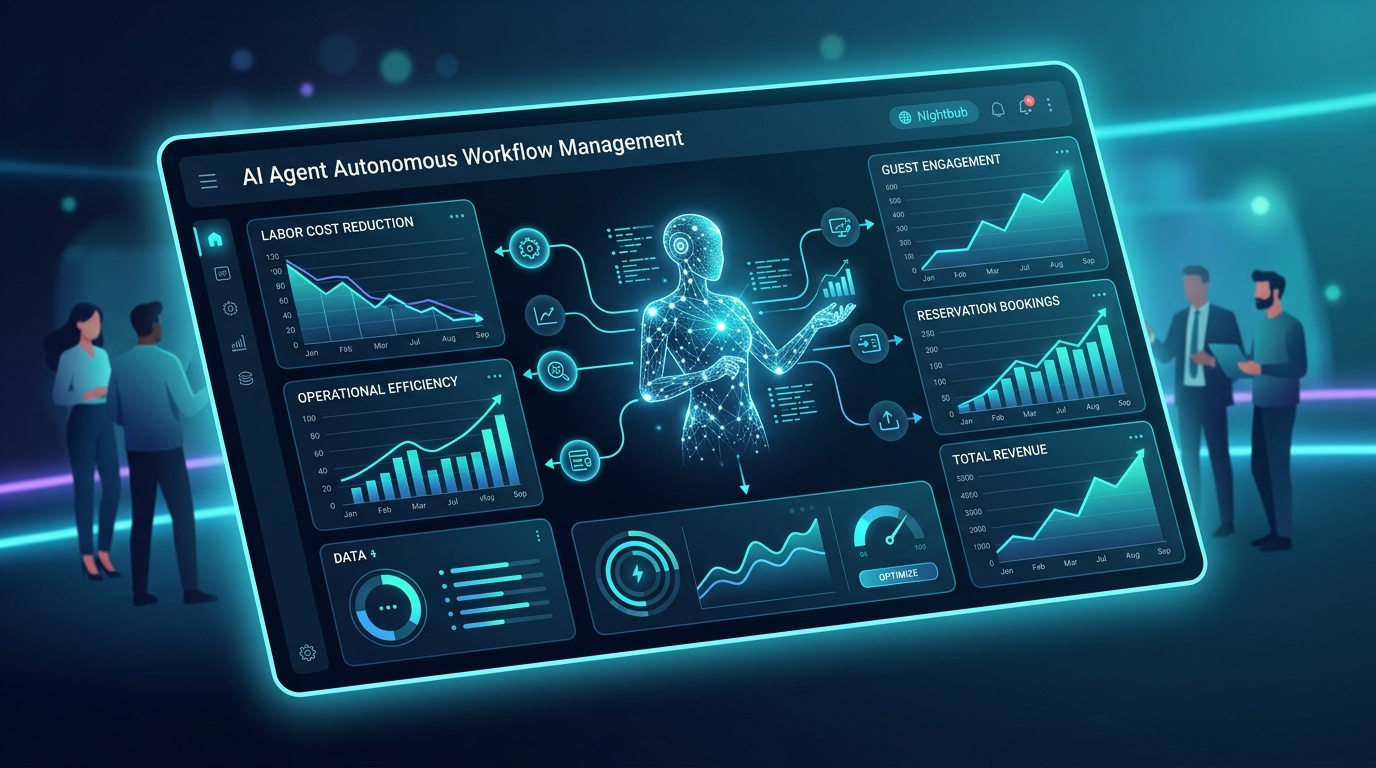
A nightclub spending $4,000 monthly on reservation staff and guest communications can realistically redirect 60-70% of that budget when AI agents absorb routine inquiry handling, booking confirmations, and waitlist management. The savings extend beyond salary: reduced training cycles, fewer shift coverage gaps, and consistent after-hours responsiveness all contribute to measurable gains. AI agents don’t call in sick on a Saturday night.
Boosting Revenue: AI-Driven Upselling and Dynamic Pricing
Cost reduction is only half the equation. AI agents trained on your venue’s booking history and guest profiles can trigger personalized upsell offers at precisely the right moment–VIP table upgrades during the reservation flow, bottle service additions via pre-event SMS, loyalty incentives post-visit. Venues using automated upselling consistently report 15-25% increases in revenue per guest. Dynamic pricing automation captures peak-night demand without manual intervention.
A Practical ROI Framework Before You Commit
Use this framework to build your business case before committing to any pricing tier:
(Labor cost reduction + Upsell revenue gained + No-show reduction value) minus monthly AI agent cost = net monthly ROI
Example: $2,400 labor savings + $1,800 upsell revenue + $600 no-show recovery, minus $900 AI agent subscription = $3,900 net monthly gain
Tracking these three input categories gives operators a clear picture of where AI delivers and where adjustments are needed. Most venues reach break-even within the first 30 days when upselling automation is active from day one.
The Pay-for-Performance Model: Aligning AI Costs With Nightclub Revenue
How It Works
Performance-based pricing ties your monthly cost directly to outcomes the AI agent produces. Rather than paying a flat subscription regardless of results, you pay a base platform fee plus a percentage of confirmed bookings, upsell conversions, or recovered no-show revenue the agent generates. This structure eliminates the fear of underperformance and aligns provider incentives with your business goals.
Arrangements structured this way typically involve a lower base fee ($200-500 per month) plus 3-8% of AI-attributed revenue. For a venue generating $15,000 monthly in AI-driven bookings and upsells, that’s $450-1,200 in variable fees on top of the base–total cost scales only as revenue scales.
Metrics That Make or Break This Model
Performance-based pricing works best when measured against clearly defined metrics: reservation conversion rate, upsell attachment rate, no-show reduction percentage, and post-visit rebooking rate. Establish baseline figures before deployment so attribution is unambiguous. Without clean baselines, disputes about what the AI actually caused become a recurring friction point.
Benefits of Performance-Aligned AI Costs
Pros
- Cost scales with revenue, protecting cash flow during slow periods
- Provider is financially motivated to optimize agent performance
- Easier internal approval when cost is self-funding
Cons
- Attribution tracking requires clean CRM and booking data
- High-revenue months increase costs proportionally
- Not all providers offer this structure
AI Agents vs. Human Staff: A Cost and Value Comparison for Nightlife Venues
Direct Cost Comparisons
| Function | Human Staff (Monthly) | AI Agent (Monthly) | AI Advantage |
|---|---|---|---|
| Reservation Management | $2,800-$3,500 | $300-$700 | 24/7 availability |
| Guest Inquiry Handling | $2,400-$3,200 | $200-$500 | Instant response, zero hold time |
| Upselling Outreach | $1,800-$2,600 | $400-$900 | Personalized at scale |
Beyond Salary: The Real Cost of Human Employees
Base salary represents roughly 70% of true employee cost. Payroll taxes, benefits, overtime on peak nights, recruitment fees, and turnover replacement–often estimated at 1.5 times annual salary in hospitality–push the real figure substantially higher. Direct salary comparisons that ignore these compounding variables consistently overstate the case for human staffing.
Where AI Outperforms Human Limitations
AI agents handle simultaneous conversations without any degradation in quality. A human reservation agent managing three calls at 11 p.m. on a Friday will make errors. An AI agent handles hundreds of concurrent inquiries with consistent accuracy. For nightclubs where peak demand is compressed into a few weekly hours, that scalability is a primary value driver–not just a cost story.
Partnering for Success: Vynta AI’s Approach to Implementation and Pricing
Our Commitment to Transparency: No Hidden Fees
AI agent pricing should never come with surprises. At Vynta AI, every proposal includes full scope documentation covering onboarding, integration, training, and ongoing optimization. No line item gets added after signature.
Tailored Solutions for Hospitality: Starting With Your Needs
Our hospitality deployments are built on deep vertical expertise–the same outcome-specific design philosophy we apply across every industry we serve. We assess your reservation system, guest communication workflows, and revenue targets before recommending any configuration. The goal is always a fit that matches your operational reality, not a generic product repackaged for nightlife.
Strategic Partnership for Long-Term Growth
We measure success by your revenue growth and guest satisfaction scores, not by contract length. Our team provides quarterly performance reviews, agent retraining as your venue evolves, and direct access to implementation specialists who understand nightlife operations from the ground up.
Choosing the Right AI Agent Pricing Structure for Your Nightclub
The right pricing model depends on your operational reality. Seasonal venues with unpredictable traffic benefit from usage-based structures. Revenue-focused operators who want provider accountability should explore performance-based arrangements. High-volume clubs with consistent demand often get the most value from flat-rate subscriptions that scale without variable billing surprises.
The comparison data is clear: AI agents deliver equivalent or superior output to human staff in reservation management, inquiry handling, and upselling outreach–at 20 to 30 percent of the monthly cost. That gap widens when you factor in benefits, overtime, and turnover replacement costs that never appear on an AI invoice.
Three priorities should guide your vendor selection process. First, demand full scope pricing before signing–including onboarding, integration, and ongoing optimization. Second, establish clean performance baselines so ROI attribution is unambiguous from day one. Third, prioritize providers with genuine hospitality expertise, not generic automation tools dressed up with nightlife terminology.
Start with reservation management and guest inquiry agents in month one. Add upselling automation in month two once baseline data is established. Deploy post-visit follow-up and loyalty workflows in month three. This phased approach generates positive ROI before each subsequent investment is made.
AI agent costs are only meaningful when evaluated against the revenue they generate and the operational costs they eliminate. With the right stack, the right pricing model, and a provider who genuinely understands nightlife operations, most venues achieve full break-even within 60 days–and sustained net gains well beyond that.
Frequently Asked Questions
What is the typical monthly cost for AI agents in nightclubs?
As Operations Director at Vynta AI, I see that pricing details for AI agents in nightclubs generally fall between $300 and $3,000+ per month. This range depends on the specific pricing model chosen, the functional scope of the AI, and the size of your venue. Our goal is always to provide solutions that deliver clear business outcomes.
How do pricing models for AI agents in nightclubs differ?
There are three primary pricing models for AI agents in nightclubs: usage-based, task-based, and user-based. Usage-based charges per interaction, fitting venues with variable traffic. Task-based bills per completed action, like a confirmed reservation, directly aligning cost with output. User-based pricing offers a predictable flat monthly fee per system integration.
What additional costs should nightclubs consider beyond the initial AI agent price?
Beyond the base subscription, nightclubs should account for onboarding, system integration with existing platforms like CRMs, and staff training. Ongoing model optimization is also a factor. At Vynta AI, we believe reputable providers bundle these items into transparent tiers, ensuring you understand the full scope of your investment upfront.
How do AI agents generate a return on investment for nightclubs?
AI agents drive ROI by significantly reducing operational costs, such as front-of-house labor hours, and by boosting revenue. They automate routine inquiries, reservation management, and post-visit follow-ups, freeing up human staff. Additionally, AI-driven upselling can increase average guest spend by up to 25% through personalized offers.
Can AI agents handle all guest interactions in a nightclub?
AI agents excel at handling routine guest inquiries, reservation management, and automated upselling, providing instant responses. For VIP guests or complex queries, clients can set strict escalation rules to route these directly to human staff, ensuring personalized care. This allows AI to manage high-volume tasks while humans focus on high-value interactions.
What is performance-based pricing for nightclub AI agents, and how does it work?
Performance-based pricing ties your monthly AI agent cost directly to the outcomes it produces. You pay a lower base platform fee plus a percentage of confirmed bookings, upsell conversions, or recovered no-show revenue the agent generates. This model aligns provider incentives with your business goals, ensuring costs scale only as your revenue scales.
How quickly can a nightclub expect to see ROI after deploying AI agents?
Nightclub operators often see a positive return on investment from AI agents within 60 to 90 days, especially when AI handles reservations, upselling, and guest communications. Many venues even reach break-even within the first 30 days when upselling automation is active from day one. This rapid ROI demonstrates the efficiency and revenue-generating power of AI.