
Best AI agent integrations for premium hospitality.
Best AI Agent Integrations for Premium Hospitality: Platform Comparison
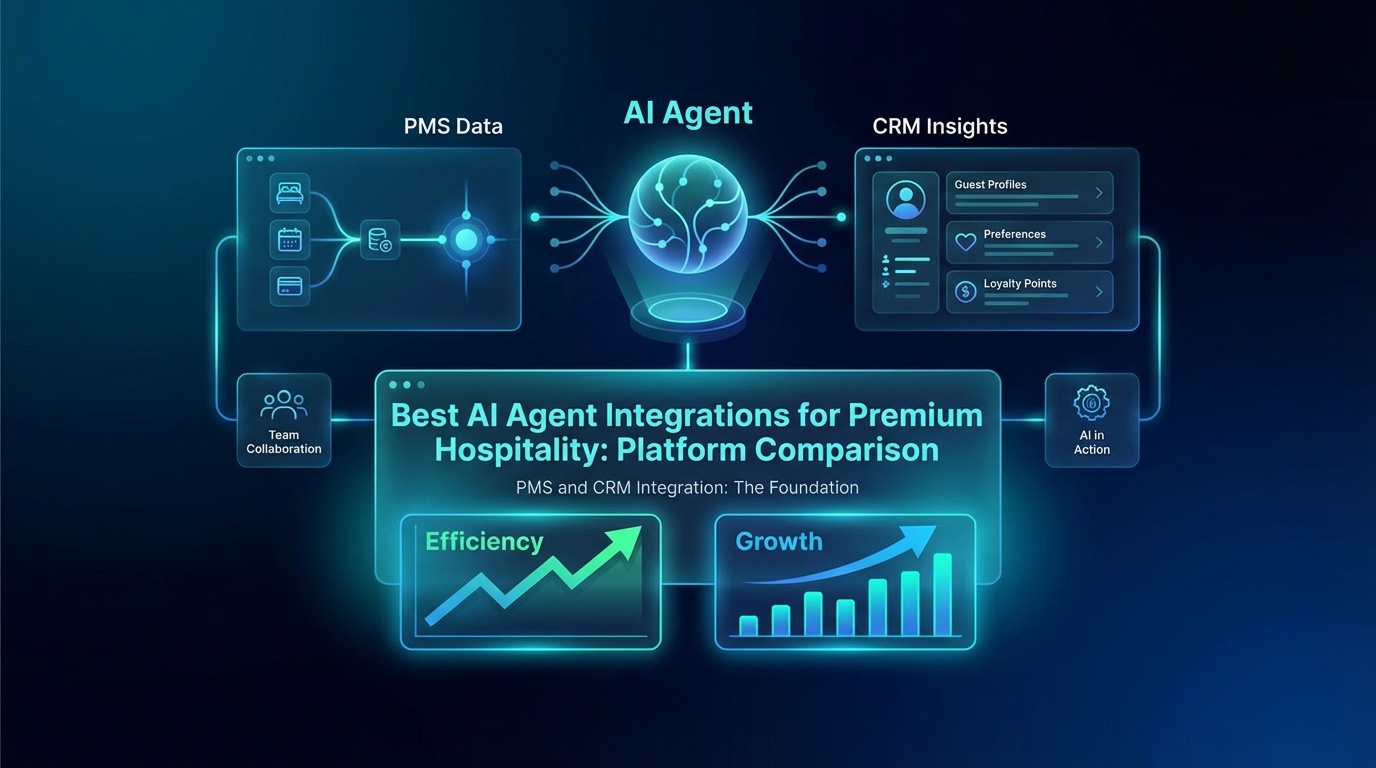
PMS and CRM Integration: The Foundation
Your PMS holds operational data; your CRM holds relationship data. Without integration, your AI agent operates blindly. Platforms like Vynta AI connect these systems so that when a returning guest books, the agent already knows the preferred floor, dining restrictions, and most recent complaint. Oracle OPERA and Salesforce Hospitality Cloud offer API-level integration points that enterprise-grade agents can access in real time.
Omnichannel Booking and Reservation Systems
Effective AI integrations must cover every booking channel simultaneously: OTAs, direct website, phone, WhatsApp, and email. Platforms including Chatlyn and Mindsay connect to central reservation systems (CRS) and respond across channels with consistent pricing and availability. The practical outcome is telling: a guest messaging via WhatsApp at 11 PM receives an accurate room confirmation, not a “we will get back to you” holding response.
Guest Communication and Concierge Platforms
Concierge AI platforms like Whisker AI and Supervity integrate with ticketing systems, restaurant reservation tools, and local activity APIs. Rather than a static FAQ bot, guests interact with an agent that books the spa, arranges airport transfers, and confirms dinner reservations inside a single conversation thread. Staff receive only the requests that genuinely require human judgment.
Dynamic Pricing and Revenue Optimization Tools
Revenue management systems such as IDeaS and Duetto generate pricing signals that AI agents can act on autonomously. When occupancy drops below a threshold, the agent proactively contacts qualified prospects from your CRM with targeted offers. When demand spikes, upsell logic activates across all active guest conversations. This closes the loop between pricing strategy and guest-facing execution — something no standalone tool can do.
Multi-Property Management and Cross-System Intelligence
For groups managing multiple properties, cross-system intelligence becomes the real differentiator. An AI agent that recognizes a guest’s stay history across three properties and applies group-level loyalty benefits creates the kind of recognition that independent properties can’t replicate manually. Vynta AI’s architecture supports multi-property data unification without requiring a full platform replacement.
Note: The same agentic architecture powering hospitality integrations also drives Vynta AI’s AI-Powered Fundraising Platform, applying the same multi-system orchestration logic to investor outreach and donor relationship management.
From Intent to Confirmation: How Agentic AI Automates the Full Guest Journey
Pre-Arrival Personalization: Predictive Guest Preferences
Integrated AI agents begin working before a guest arrives. By pulling stay history from your PMS and preference data from your CRM, the agent generates a pre-arrival profile: preferred room temperature, dietary restrictions, pillow type, and even preferred check-in time. That profile triggers automated pre-arrival messaging with personalized room upgrade offers timed to maximize acceptance rates. Hotels using predictive personalization at this stage report upsell conversion rates 30% above industry averages — because the offer is relevant rather than generic.
Reservation Optimization: Real-Time Upselling and Cross-Selling
When a guest modifies a reservation, most systems simply update the record. An integrated AI agent treats that moment as a revenue opportunity. Occupancy data from the revenue management system, dining availability from the restaurant platform, and spa capacity from the scheduling tool combine into a single, contextually appropriate offer presented inside the same conversation. A guest extending a stay by one night receives an automatic dinner reservation suggestion for the newly added evening — not a generic confirmation email.
In-Stay Service Delivery: Proactive Issue Resolution
IoT sensor data integrated with your AI agent layer shifts service from reactive to proactive. A room temperature reading outside the guest’s stated preference triggers an automatic check-in message before the guest picks up the phone to complain. Maintenance requests submitted via in-room tablets route directly to the relevant department with priority scoring based on guest tier. Staff handle the resolution; the AI agent handles the communication, status updates, and satisfaction follow-up. The human touch stays exactly where it matters most.
Post-Stay Reputation Management and Repeat Booking Automation
The guest journey doesn’t end at checkout. Integrated agents monitor review platforms, flag negative sentiment within hours of posting, and trigger recovery workflows: a personalized response from the general manager’s account, a targeted offer for a return visit, and a CRM tag that ensures the next stay addresses the specific issue raised. Properties using automated post-stay workflows report 18% higher repeat booking rates compared with those relying on manual follow-up. The AI handles the volume; your team handles the relationships that require genuine human judgment. For more on this, see this detailed analysis of AI agents in hospitality.
Integration Architecture for Mid-Market Hospitality: What You Actually Need
Evaluating Your Current Tech Stack: Assessment Framework
Before selecting any integration platform, map your existing systems against four criteria: API availability, data quality, system age, and staff technical readiness. Most mid-market properties run a PMS that is five to ten years old with limited native API support. That gap doesn’t disqualify AI integration — it determines the implementation path. Properties with modern cloud-based PMS platforms (Opera Cloud, Mews, Cloudbeds) can achieve core integrations in weeks. Legacy on-premises systems require middleware layers that add complexity but remain achievable within a phased approach.
API and System Integration Requirements
Effective AI agent integration requires bidirectional API connections, not one-way data feeds. Your AI agent must read guest profiles and write booking confirmations, update reservation records, and log service requests in real time. Evaluate each platform vendor on three technical points: REST API documentation quality, webhook support for real-time event triggers, and rate limits that accommodate peak booking periods. Vynta AI’s integration layer handles API authentication and data normalization across systems, removing that technical burden from your operations team.
Data Unification Across Guest Touchpoints
The single greatest obstacle to effective AI integration is fragmented guest data. A guest record in your PMS rarely matches the contact record in your email marketing platform or your loyalty program database. Data unification — creating a single guest identity across all systems — is the prerequisite for personalization at scale. It requires a one-time data audit and deduplication effort. The payoff: every AI agent interaction draws from a complete, accurate guest profile rather than a partial record. For more on AI’s transformative role in hospitality, see this resource from EHL Hospitality Insights.
Common Integration Pitfalls in Premium Hotels
Three mistakes consistently derail hospitality AI projects. First, poor data migration: importing duplicate or incomplete guest records creates a flawed foundation that no AI system can correct. Second, insufficient staff training: front desk teams who don’t understand what the AI agent handles will override it unnecessarily, wiping out efficiency gains. Third, over-automating high-touch moments — AI should never manage a complaint from a VIP guest without human review. Define clear escalation rules before go-live, or the automation will damage the service reputation it was deployed to protect.
The Verdict: Selecting the Right AI Integration Path for Premium Hospitality
Which Properties Should Act Now
AI agent integrations deliver compounding returns — properties that move earlier accumulate more guest data, more refined personalization models, and stronger direct booking channels than those that wait. If your property runs a modern cloud PMS, processes more than 40% of bookings through OTAs, and has front desk staff spending significant time on routine inquiries, the ROI case is already closed.
Properties on legacy on-premises systems shouldn’t treat that as a disqualifier. A phased approach starting with CRM connection and omnichannel booking automation delivers measurable returns before any PMS migration becomes necessary.
Prioritizing Your Integration Sequence
Not all integrations deliver equal value at equal cost. Sequence matters. Start with the connection between your PMS and booking channels: this single integration eliminates booking errors, captures direct reservations, and funds the next phase. Add concierge and service request routing in Phase 2, where staff time savings are most visible. Reserve revenue optimization and predictive personalization for Phase 3, once clean guest data flows consistently across your unified profile layer.
Preserving the Human Element at Scale
The competitive advantage of premium hospitality has never been technology. It’s the quality of human attention at moments that matter. Integrated AI agents protect that advantage by absorbing the operational volume that currently dilutes it. When your front desk team stops answering the same check-in questions 40 times a day, they become available for the guest interaction that earns a five-star review and a repeat booking. That reallocation of human attention is the actual product these integrations deliver.
Vynta AI’s approach across hospitality and our AI-Powered Fundraising Platform reflects the same operating principle: AI handles systematic, high-volume processes; humans handle relationships that require genuine judgment. The architecture scales. The service standard doesn’t have to be sacrificed to achieve it.
What Comes Next in Agentic Hospitality
The next evolution moves beyond reactive automation into genuinely predictive operations. AI agents that forecast staffing needs based on booking patterns, pre-position inventory based on guest preference clusters, and negotiate group rates autonomously within defined parameters are already in development across enterprise platforms. Mid-market properties that build integrated data foundations now will access these capabilities as they mature — without rebuilding from scratch. Those that delay will face a larger gap against both chain competitors and AI-native boutique brands entering the premium segment.
This isn’t a technology investment. It’s an operational model shift that determines whether your property competes on service quality or concedes ground to brands with deeper automation infrastructure. The window for first-mover advantage in the mid-market premium segment remains open — but not indefinitely.
Frequently Asked Questions
How do AI agent integrations specifically close the guest experience gap in premium hospitality?
Integrated AI agents connect disparate hotel systems like PMS, CRM, and communication channels. This ensures all guest data, from booking to dietary needs, is coordinated across every touchpoint. The result is a seamless, personalized experience where guests feel truly recognized, eliminating fragmented interactions that can make a guest feel like a transaction.
What are the key systems AI agents connect with to deliver a unified hospitality experience?
AI agents integrate with core hotel systems such as Property Management Systems (PMS) and Customer Relationship Management (CRM) to access operational and relationship data. They also connect with omnichannel booking platforms, guest communication tools, and dynamic pricing systems. This creates a single source of truth for guest information and operational needs.
How do AI agents contribute to increasing hotel revenue?
AI agents significantly boost revenue by reducing booking errors and growing direct bookings through frictionless reservation processes. They also enable real-time upselling and cross-selling, presenting relevant offers based on guest profiles and current occupancy. Vynta AI Agents, for example, can increase booking conversion by 50% and average guest spend by up to 25%.
Can AI agents manage complex guest requests or VIP interactions effectively?
Yes, AI agents are designed to manage a wide range of guest requests, from booking modifications to concierge services. For VIP guests or particularly complex inquiries, clients can set strict escalation rules. This ensures these interactions are seamlessly routed to human staff, guaranteeing personalized care while automating routine tasks.
How do integrated AI agents personalize the guest journey from pre-arrival to in-stay?
Integrated AI agents use guest history from PMS and preferences from CRM to create a pre-arrival profile, enabling personalized offers and messages. During a stay, they combine real-time data from various systems to present contextually appropriate upsell opportunities, like dinner reservations for an extended stay. This ensures every interaction feels tailored and relevant.
What are the specific advantages for multi-property hotel groups using AI agent integrations?
For multi-property groups, AI agents unify guest stay history and loyalty benefits across all properties. This creates a consistent, recognized experience for guests, which is difficult to achieve manually across multiple locations. It allows for group-level loyalty benefits and a cohesive brand experience that independent properties cannot match manually.
How do Vynta AI Agents ensure brand consistency and operational control?
Vynta AI Agents are fully customizable to a brand’s tone, business rules, and content controls. Clients define operating hours, and the AI supports multilingual capabilities and channel-specific personalization. Furthermore, clients can manually view, pause, and take over live conversations through a dashboard, maintaining full operational oversight.