
artificial intelligence enterprise
Why Artificial Intelligence Drives Revenue Growth for Mid-Market Enterprises
Artificial intelligence enterprise adoption in 2026 centers on one outcome: measurable revenue impact. Mid-market SMEs deploying industry-specific AI agents report 30-45% reductions in manual processing time and conversion rate improvements averaging 25% within the first two quarters of deployment. The difference between AI that delivers and AI that disappoints is vertical specialization.
Key Differences Between Enterprise and Consumer AI
| Dimension | Consumer AI | Enterprise AI |
|---|---|---|
| Data Security | Shared cloud models | Private deployment, governance controls |
| Customization | Generic outputs | Workflow-specific agents |
| Integration | Standalone tools | CRM, ATS, and PMS connectivity |
| Accountability | No audit trails | Compliance-ready logging |
| ROI Measurement | Qualitative only | KPI-tracked performance dashboards |
Enterprise AI platforms connect directly to existing business systems, execute multi-step workflows autonomously, and produce outputs tied to specific KPIs. Consumer tools generate content; enterprise agents drive decisions.
Adoption Statistics and Proven ROI Metrics in 2026
Mid-market firms adopting AI Automation Services see the fastest payback cycles when deployment targets high-frequency, repetitive workflows: lead qualification, candidate screening, investor follow-up, and reservation management. Organizations in these four verticals report cost-per-acquisition reductions of 20-35% within six months when AI agents replace manual outreach sequences.
Pros
- Scales outreach without adding headcount
- Delivers consistent follow-up cadences across thousands of contacts
- Generates predictive analytics that inform pipeline decisions
- Integrates with legacy CRM and ATS systems through custom APIs
Cons
- Requires a structured discovery phase before deployment
- ROI projections are estimates until live data calibrates the model
- Human oversight remains necessary during initial optimization cycles
Business Outcomes: Cost Savings and Headcount Efficiency
The strongest artificial intelligence enterprise case is operational efficiency: doing more with the same team. A recruitment firm processing 500 applications weekly can redirect two full-time coordinators from screening to relationship-building when AI agents handle initial candidate qualification. A boutique hotel that eliminates manual upsell follow-ups recovers 15+ staff hours weekly while increasing ancillary revenue per guest. AI Automation Services deliver this through workflow automation that includes exception handling–so human staff engage only when judgment genuinely matters.
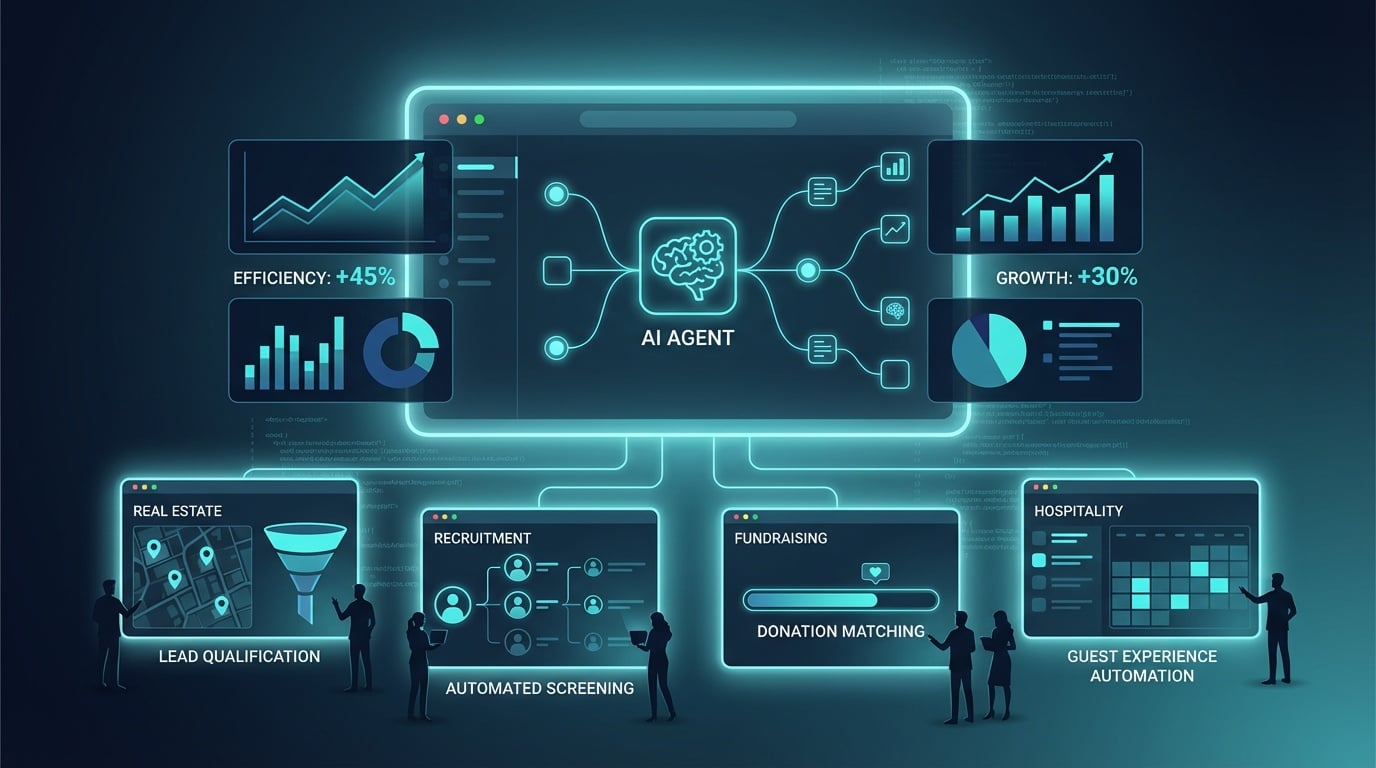
AI Agents in Action: Industry-Specific Automation for Real Estate, Recruitment, Fundraising, and Hospitality
Real Estate: Automating Lead Qualification and Property Matching
Real estate agencies lose revenue not from a lack of leads but from slow qualification. AI agents integrated with CRM systems score inbound inquiries against property criteria, buyer intent signals, and budget indicators in real time, routing only sales-ready prospects to agents. Teams report 30-40% improvements in contact-to-showing conversion rates when qualification latency drops from hours to minutes. Agents spend their time on relationships, not data entry. See how Vynta’s Agentic Systems for Real Estate are built specifically for these workflows.
Recruitment: Streamlining Candidate Screening and ATS Integration
Recruitment firms processing high application volumes face a consistent bottleneck: manual resume review consumes coordinator capacity that belongs in client and candidate relationships. AI agents connected to ATS platforms parse applications against role requirements, rank candidates by fit score, and trigger personalized outreach sequences automatically. Time-to-shortlist drops by 50-60%, and placement rates improve because coordinators focus on quality conversations rather than administrative sorting. Learn more about our Agentic Systems for Recruitment.
Fundraising: Optimizing Investor Outreach and Campaign Management
Fundraising organizations operate on relationship cadence. Miss a follow-up with a warm prospect and you’ve lost capital–often permanently. AI agents track investor engagement signals, prioritize outreach sequences based on interaction history, and generate personalized communication content aligned with each prospect’s stated interests. Campaign managers gain a clear pipeline view with predictive trend analysis that identifies which prospects are most likely to convert, freeing human relationship managers to focus attention where it matters most. Vynta’s AI-Powered Fundraising Platform is built specifically for this purpose.
Hospitality: Boosting Guest Satisfaction and Upsell Revenue
Boutique hotels and upscale restaurants using AI-driven communication automation report 18-25% increases in ancillary revenue per guest through pre-arrival upsell sequences delivered via SMS and WhatsApp. Personalized content generation, not generic broadcast messaging, drives these results.
Maria’s challenge at her boutique property is universal in hospitality: delivering personalized service at scale without proportional staffing increases. AI agents handle pre-arrival preference capture, automated upsell offers for room upgrades and dining reservations, and post-stay follow-up sequences. Reservation no-show rates fall when AI agents send timely, personalized confirmation reminders. Staff redirect recovered hours toward the high-touch interactions that define guest experience quality. See how Vynta AI Agents for Hospitality solve these challenges.
Overcoming Enterprise AI Challenges: Security, Integration, and Cost Control
Addressing Security, Governance, and Compliance Needs
Artificial intelligence enterprise deployments in regulated industries require governance frameworks, not just functionality. Real estate transactions, recruitment data, investor communications, and guest records each carry distinct compliance obligations. Enterprise AI agents must operate with audit-ready logging, role-based access controls, and data-handling policies that satisfy legal requirements. Vynta AI builds compliance checkpoints into every workflow rather than treating governance as a post-deployment addition.
Integrating AI with Legacy CRM and ATS Systems
The most common adoption barrier for mid-market SMEs is integration complexity. Most organizations already have CRM, ATS, or property management systems embedded in daily operations–and they’re not going to rip them out. Custom API development and data transformation services connect AI agents to these existing platforms, eliminating data silos and enabling real-time synchronization without requiring system replacement. The goal is augmentation of current infrastructure, not disruption of it.
Managing Inference Costs Without Sacrificing Performance
Cost Control Considerations
Managed Effectively
- Phased deployment limits initial compute costs to the highest-ROI workflows
- Exception-handling logic reduces unnecessary AI processing on simple tasks
- Performance Intelligence dashboards identify cost per outcome in real time
Risks Without Governance
- Unmonitored agents can accumulate inference costs on low-value tasks
- Over-automation without human checkpoints increases error-correction costs
How Vynta AI Delivers Enterprise AI Automation Tailored for Mid-Market SMEs
Custom AI Agents That Support Sales, Marketing, and Operations Teams
AI Automation Services from Vynta AI follow a structured process: discovery and assessment, expert implementation within weeks, and continuous monitoring with optimization reviews. Each engagement starts by mapping the highest-friction workflows in your vertical, then deploying agents that execute those workflows autonomously while flagging exceptions for human review.
Implementation Steps: From Assessment to Measurable Results
Deployment follows three phases. Assessment identifies the workflows carrying the highest time cost and conversion impact–this is where I’ve seen most SMEs leave the most money on the table. Implementation connects AI agents to existing systems through custom APIs and configures workflow automation with decision logic specific to your operations. The monitoring phase tracks KPIs including lead conversion rates, time-to-hire, donor retention, and revenue per guest, calibrating agent behavior against live performance data. These aren’t technical installations. They’re outcome-oriented deployments.
Steps to Select and Deploy Artificial Intelligence for Your Enterprise Operations
Evaluate Tools Based on Vertical Fit and Scalability
Generic automation tools lack the industry-specific logic that drives real outcomes in property sales, talent acquisition, donor relations, and guest services. Prioritize artificial intelligence enterprise solutions that demonstrate deep vertical knowledge, integrate with your existing systems, and scale without requiring proportional increases in technical staff. If a vendor can’t speak your industry’s language in the sales conversation, they won’t speak it in the product either.
Measure Success with KPIs Like Placement Rates and Donor Retention
Define success metrics before deployment–not after. Contact-to-showing conversion for real estate, time-to-shortlist and placement rate for recruitment, investor response rate and donor retention for fundraising, revenue per guest for hospitality. KPI-tracked performance dashboards make optimization continuous rather than reactive, and they give you the data to justify ongoing investment.
Next Steps: Partnering for Long-Term Business Transformation
Sustainable artificial intelligence enterprise adoption requires a strategic partner, not a software vendor. Vynta AI’s AI Automation Services begin with your specific operational challenges and build toward a deployment roadmap with projected outcomes. The path from assessment to measurable results is shorter than most mid-market SMEs expect–and far less disruptive than they fear.
Frequently Asked Questions
What is an AI enterprise?
An AI enterprise refers to the adoption of artificial intelligence by mid-market businesses, specifically for achieving measurable revenue impact. Unlike generic consumer tools, enterprise AI platforms connect directly to existing business systems and execute multi-step workflows autonomously. They are designed to drive decisions and operational efficiency, not just generate content.
Does AI really make businesses money?
Absolutely, AI demonstrably drives revenue growth for mid-market enterprises. Firms deploying industry-specific AI agents report significant reductions in manual processing time and conversion rate improvements, averaging 25% within the first two quarters. This translates to faster payback cycles and improved cost-per-acquisition metrics.
How is enterprise AI different from consumer AI?
Enterprise AI differs from consumer AI in several key areas. It prioritizes private data deployment with governance controls, offers workflow-specific agents for customization, and integrates deeply with business systems like CRM or ATS. Enterprise solutions also provide compliance-ready logging and KPI-tracked performance dashboards, unlike consumer tools which often have shared cloud models and qualitative ROI measurement.
What are common business outcomes from deploying enterprise AI?
The primary business outcomes from enterprise AI deployment are operational efficiency, cost savings, and improved headcount efficiency. By automating high-frequency, repetitive workflows such as lead qualification or candidate screening, businesses can redirect staff to higher-value tasks. This allows teams to accomplish more with the same resources, directly impacting the bottom line.
Which industries benefit most from AI automation services?
Industries with high-frequency, repetitive workflows see the fastest payback cycles from AI automation services. This includes real estate for lead qualification, recruitment for candidate screening, fundraising for investor outreach, and hospitality for reservation management and upsell revenue. Our Vynta AI Agents specialize in these vertical-specific automations.
What should businesses consider when adopting enterprise AI?
Businesses adopting enterprise AI should consider security, governance, and compliance needs, especially in regulated industries. A structured discovery phase is also necessary before deployment to ensure ROI projections are accurate and the model is calibrated with live data. Human oversight remains important during initial optimization cycles to ensure successful integration.