

workflow optimization
What Is Workflow Optimization and Why It Matters for Growing Businesses
Workflow optimization is the systematic process of analyzing, redesigning, and automating business processes to eliminate waste, reduce cycle time, and increase output without proportional headcount growth. For mid-market SMEs, it’s the difference between scaling revenue and scaling chaos.
Definition and Core Concept
At its core, workflow optimization identifies where time, money, and effort disappear inside your operations, then rebuilds those processes around measurable efficiency targets. This applies whether you’re qualifying real estate leads, screening recruitment candidates, managing donor outreach, or handling hospitality reservations.
Why Mid-Market SMEs Need Workflow Optimization Now
Mid-market businesses face a specific pressure: enterprise-level complexity with SME-level resources. Manual processes that worked at 20 employees collapse at 80. According to Harvard Business Review research, organizations that systematically optimize workflows recapture up to 30% of productive time previously lost to redundant tasks and approval bottlenecks.
The Cost of Inefficient Workflows
| Process Area | Manual Workflow | Optimized Workflow |
|---|---|---|
| Lead qualification (real estate) | 2-3 days per lead | Under 4 hours |
| Candidate screening (recruitment) | 5-7 days per role | 24-48 hours |
| Donor outreach (fundraising) | Weekly batch sends | Real-time personalized sequences |
| Guest inquiry response (hospitality) | 4-12 hours | Prompt, around the clock |
Slow workflows carry a direct revenue cost. In hospitality, a guest inquiry unanswered within two hours converts at a fraction of the rate of a prompt response. In recruitment, a five-day screening cycle loses top candidates to faster competitors. Inefficiency isn’t an operational inconvenience–it’s a measurable revenue leak that compounds as your business grows.
Workflow optimization isn’t a one-time project. It’s a continuous operational discipline, and businesses that treat it as such consistently outpace competitors who rely on headcount to solve process problems. Vynta AI Agents for Hospitality are built on exactly this principle: close the inquiry-to-booking gap that costs venues real revenue every single day.
The Real Business Impact: Measurable Outcomes Across Your Operations

Productivity Gains and Time Recapture
Optimized workflows return hours to your team that manual processes consume invisibly. Recruitment firms using automated candidate screening report time-to-hire reductions of 40-60%, freeing consultants to focus on relationship-building rather than resume sorting. Real estate agencies that automate lead qualification move prospects from inquiry to appointment in under four hours, compared to the industry average of two days. See how Agentic Systems for Real Estate accelerate lead qualification with AI-driven automation.
Cost Reduction Through Process Elimination
Every redundant approval step, manual data entry task, and duplicated communication carries a labor cost. Workflow optimization identifies and eliminates these without reducing output quality. Hospitality operations using AI-powered reservation management reduce operational costs by 30% while simultaneously improving guest response times. Cost reduction and service improvement. At the same time.
Error Reduction and Compliance Confidence
Manual processes introduce human error at every handoff point. Automated workflows execute consistently, applying the same rules to every transaction. For fundraising organizations managing donor data and regulatory compliance, that consistency isn’t optional–it’s the baseline. Systematic workflow optimization reduces data entry errors, missed follow-ups, and compliance gaps that create liability. Learn more about our AI-Powered Fundraising Platform designed to sharpen donor outreach with precision.
Revenue Acceleration and Scalability
Workflow optimization directly accelerates revenue by shortening every conversion cycle. In hospitality, Vynta AI Agents for Hospitality increase booking conversion by 50% and reduce inquiry abandonment by 60%, translating directly to revenue per available room or cover. Donor outreach sequences that respond in real time rather than weekly batches produce measurably higher response rates. Speed of process equals speed of revenue. For a broader perspective on breaking productivity ceilings by rethinking how work gets done, this McKinsey analysis is worth your time.
Employee Satisfaction and Retention
Staff turnover in service industries is expensive–and a significant driver is repetitive, low-value administrative work that burns out capable people. When workflow optimization removes that burden, employees redirect energy toward work requiring judgment, creativity, and relationship skills. Recruitment agencies report higher consultant satisfaction scores after automating screening workflows. Hospitality teams perform better when AI handles inquiry volume and staff focus on the guest in front of them. Keeping the people who deliver your competitive advantage is itself a measurable business outcome. This connection between structured work design and employee engagement is well-documented in recent organizational research.
How AI Automation Transforms Workflow Optimization
Beyond Traditional Automation: Intelligent Workflows
Traditional workflow tools follow fixed rules: if X happens, do Y. AI-powered workflows make contextual decisions based on data patterns, guest history, candidate profiles, or investor behavior. Think of it like the difference between a switchboard operator routing every call to the same extension and a senior account manager who instantly recognizes a high-value client and responds accordingly. One applies rules. The other applies judgment.
| Capability | Traditional Workflow Tools | AI-Powered Workflow Agents |
|---|---|---|
| Decision logic | Fixed rules only | Contextual, data-driven routing |
| Personalization | Template-based | Profile-specific responses |
| Learning | Static | Improves with each interaction |
| Escalation | Manual triggers | Automatic VIP and complexity routing |
| Industry fit | Generic | Vertical-specific logic built in |
Human-AI Collaboration, Not Replacement
AI handles the high volume of interactions that follow predictable patterns: standard inquiries, qualification questions, scheduling, and follow-up sequences. Human teams handle interactions requiring judgment, negotiation, and relationship depth. Vynta AI Agents for Hospitality operationalize this split precisely, with configurable escalation rules ensuring VIP guests and complex queries always reach a human staff member. The result is a team that operates with greater capacity and speed, without sacrificing the personal service that defines premium hospitality.
Practical Workflow Optimization Strategies for Your Industry
Step 1: Map and Analyze Your Current Workflows
Start by documenting every step in your highest-volume processes. For real estate agencies, that means lead intake to appointment. For recruitment firms, it means application receipt to shortlist delivery. Identify who touches each step, how long each handoff takes, and where tasks sit waiting for human action. You can’t optimize what you haven’t measured.
Step 2: Identify Bottlenecks and Waste
Bottlenecks reveal themselves through three signals: tasks that accumulate in queues, processes requiring repeated manual intervention, and handoffs where information gets lost or re-entered. In hospitality, the inquiry-to-reservation gap is the most common revenue bottleneck. In fundraising, donor follow-up sequences that depend on individual staff memory represent systematic risk. Workflow optimization skills begin with recognizing these patterns before designing solutions.
Step 3: Standardize and Automate High-Volume Tasks
Standardization precedes automation. Define the rules governing each decision before assigning them to a system. Once standardized, high-volume repetitive tasks are strong candidates for automation: lead qualification scoring, candidate pre-screening questionnaires, donor outreach sequences, and guest inquiry responses. Vynta AI Agents for Hospitality execute this step across WhatsApp, SMS, Instagram, and email–with channel-specific personalization and multilingual support built in.
Step 4: Implement Monitoring and Continuous Improvement
Workflow optimization isn’t a deployment event. Track conversion rates, cycle times, error rates, and cost per transaction weekly. Set threshold alerts when metrics drift. Recruitment firms should monitor time-to-hire and offer acceptance rates. Hospitality managers should track booking conversion, no-show rates, and average guest spend. The data tells you where the next optimization opportunity is hiding.
Industry Implementation Paths
Each vertical applies these steps differently. Real estate agencies prioritize lead routing and appointment scheduling automation first. Recruitment firms gain the fastest ROI from automated pre-screening and candidate status communications. Fundraising organizations benefit most from sequenced donor outreach tied to behavioral triggers. Hospitality businesses see immediate revenue impact from automating inquiry response and upselling–Vynta AI Agents for Hospitality increase average guest spend by up to 25% through profile-specific upselling.
From Implementation to ROI: Building Your Workflow Optimization Roadmap
Quick Wins vs. Strategic Transformation
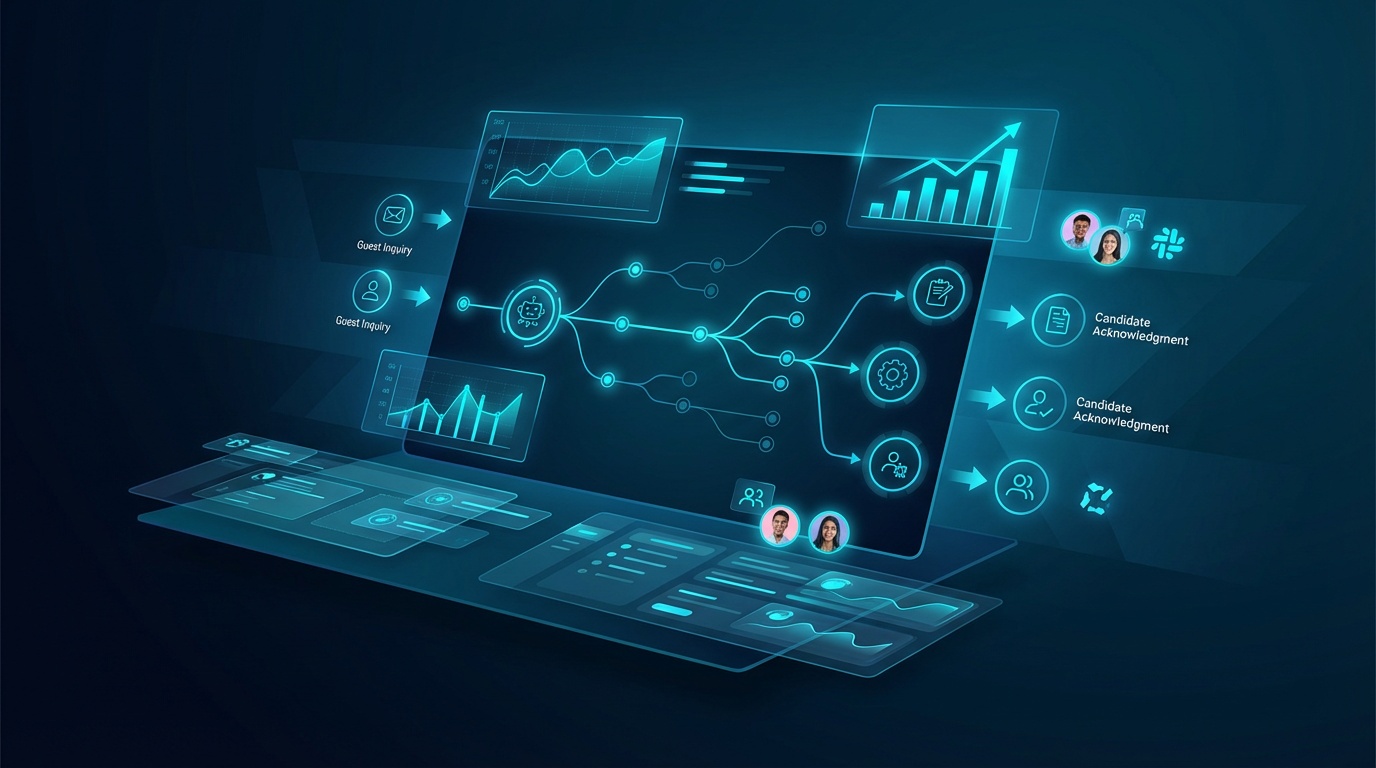
Start with one high-volume, low-complexity process. Automate guest inquiry responses or candidate acknowledgment emails before rebuilding your entire CRM workflow. Early wins build internal confidence and generate the data that informs larger decisions. I’ve seen teams derail solid optimization programs by trying to boil the ocean in month one. Don’t.
Setting Realistic Timelines and Measuring Success
A practical roadmap runs in 30/60/90-day phases. Days 1-30: map workflows, identify your top three bottlenecks, and launch one automation. Days 31-60: measure results, refine the rules, and expand to two additional processes. Days 61-90: assess ROI against baseline KPIs and plan the next optimization cycle. Expect meaningful metric movement by day 60, not day seven.
Common Adoption Barriers and Solutions
The most common resistance in service industries is the fear that automation will damage client relationships. The evidence points the other way: faster responses and consistent follow-up improve satisfaction scores. Address this by starting with back-office processes invisible to clients, then expanding to client-facing automation once internal confidence builds. Transparent escalation rules–like those built into Vynta AI Agents for Hospitality–reassure teams that VIP relationships stay in human hands.
Scaling Workflows as Your Business Grows
Workflows built on configurable AI agents scale without proportional cost increases. Adding 200 new leads, candidates, donors, or guest inquiries doesn’t require two additional staff members when the underlying workflow is automated. That’s the core economic argument for workflow optimization at the mid-market level: capacity scales, headcount doesn’t.
Frequently Asked Questions
What is process flow optimization?
Workflow optimization is the systematic approach to analyzing, redesigning, and automating business processes. Its goal is to eliminate waste, reduce cycle time, and increase output without needing to grow your team proportionally. For mid-market SMEs, this means transforming operations to achieve measurable efficiency targets and scale effectively.
How to optimize workflow performance?
To optimize workflow performance, you systematically analyze existing processes to identify inefficiencies, then redesign them to eliminate waste and bottlenecks. Automating repetitive tasks, especially with AI, is key to recapturing productive time and reducing errors. This approach allows businesses to accelerate revenue and improve team satisfaction.
What are the four types of workflows?
While workflows aren’t typically categorized into specific ‘four types,’ optimization efforts often focus on delivering measurable outcomes across key operational areas. These include driving significant productivity gains and time recapture, achieving cost reduction through process elimination, reducing errors for improved compliance, and accelerating revenue and scalability.
Is workflow optimization a skill?
Workflow optimization is more than just a skill; it’s a continuous operational discipline and a strategic mindset for business growth. It involves the ability to analyze processes, identify inefficiencies, and strategically implement solutions, often using AI automation. Mastering this discipline allows businesses to consistently outpace competitors and scale effectively.
What is an example of workflow optimization?
A clear example is in real estate, where Agentic Systems for Real Estate transform lead qualification. Instead of manual processes taking days, AI-driven automation enables instant engagement and qualification, converting inquiries into viewings in under four hours. This maximizes agent productivity by automating 80% of tasks, leading to over 30% more deals closed.
Why is workflow optimization important for growing businesses?
Workflow optimization is critical for growing businesses, especially mid-market SMEs, because it prevents manual processes from collapsing under increased demand. It transforms potential chaos into structured growth, ensuring that scaling revenue doesn’t mean scaling operational problems. This discipline directly addresses measurable revenue leaks and allows businesses to expand efficiently.