
Best AI agents for luxury venue revenue optimization.
Best AI Agents for Luxury Venue Revenue Optimization
Why Luxury Venues Need AI Agents for Revenue Growth
Boutique hotels and upscale restaurants face a persistent challenge: delivering personalized service while maximizing revenue per guest. Manual pricing strategies leave money on the table during demand surges. Limited staff can’t identify every upselling opportunity. AI agents solve these problems by automating pricing decisions and guest interactions without sacrificing the personal touch that defines premium hospitality.
The Revenue Challenges Facing Boutique Hotels and Upscale Restaurants
A 20-room boutique hotel or 60-seat restaurant can’t afford dedicated revenue management teams, yet they compete against properties with sophisticated pricing algorithms. Manual rate adjustments miss micro-opportunities: weekend surges, local events, weather patterns, competitor moves. Front desk staff juggle reservations and guest requests. They miss chances to recommend premium rooms or wine pairings during peak moments.
No-shows compound these losses. A single unreported cancellation at a fully booked property represents pure revenue loss. Traditional reservation systems lack predictive intelligence to flag high-risk bookings or automatically trigger waitlist notifications.
How AI Agents Deliver Measurable Gains in Occupancy and Guest Spend
AI agents monitor hundreds of variables simultaneously: booking pace, competitor rates, local demand signals, guest behavior patterns. They adjust room rates multiple times daily to capture maximum revenue without deterring bookings. For restaurants, AI analyzes reservation patterns to optimize table assignments and suggest targeted upsells based on guest preferences and ordering history.
Key Insight: AI-powered revenue management doesn’t replace human judgment. It augments your team’s capabilities by handling data-intensive tasks, freeing managers to focus on guest relationships and strategic decisions that require emotional intelligence.
The automation extends beyond pricing. AI sends personalized pre-arrival messages offering room upgrades, spa packages, or dining reservations. It predicts no-show probability and proactively manages waitlists. Post-stay, it triggers review requests and loyalty incentives timed for maximum response rates.
Real Metrics from AI Deployments in Hospitality
Properties implementing AI revenue optimization report average daily rate increases of 12-34% within the first year. A 45-room boutique hotel in Charleston saw occupancy rise from 68% to 83% after deploying dynamic pricing, generating an additional $280,000 in annual room revenue. An upscale restaurant group added $340,000 in food and beverage sales through AI-driven upselling that recommended wine pairings and premium menu items based on guest profiles.
AI agents reduce no-show rates by 15-25% through predictive modeling and automated confirmation workflows. They also cut reservation management time by 40%, allowing staff to redirect hours toward guest experience improvements that drive repeat bookings and positive reviews.
Top AI Agents for Luxury Venue Revenue Optimization
Selecting the right AI platform depends on your venue’s specific revenue challenges and technical resources. Enterprise-grade systems offer comprehensive features but require dedicated IT support and six-figure budgets. Mid-market solutions prioritize quick deployment and measurable ROI without extensive integration projects.
Duetto Revenue Strategy Platform: Real-Time Pricing Precision
Duetto specializes in dynamic pricing for hotels with 50+ rooms, analyzing demand patterns across distribution channels to recommend optimal rates. The platform excels at group booking optimization and event-based pricing adjustments. Properties using Duetto report average revenue per available room increases of 8-15%. The system requires integration with existing property management systems and typically costs $1,500-$3,000 monthly, making it better suited for multi-property operators than single boutique venues.
SuperAGI Revenue Intelligence: Demand Forecasting and Yield Management
SuperAGI focuses on predictive analytics for both lodging and food service operations. Its machine learning models forecast demand up to 90 days ahead, enabling proactive inventory management and staffing decisions. Restaurants benefit from table yield optimization that maximizes revenue per seating period. The platform’s strength lies in cross-venue analytics for small chains, though single-location operators may find the feature set exceeds their immediate needs. Implementation timelines run 8-12 weeks, with pricing starting at $2,000 monthly.
Vynta AI Hospitality Agents: Guest Upselling and Reservation Automation
Vynta AI delivers industry-specific AI agents designed for mid-market luxury venues without internal AI resources. The platform automates guest communication workflows–from pre-arrival upsell offers to post-stay review requests–while maintaining the personalized tone that defines premium hospitality. Unlike enterprise systems focused solely on pricing, Vynta AI’s agents optimize the entire guest journey: reservation confirmations, upgrade recommendations, dining reservations, no-show prevention.
A 28-room boutique property in Napa Valley deployed Vynta AI’s upselling agent and increased ancillary revenue by $42,000 in the first quarter through automated spa package offers and room upgrade prompts. The system integrates with existing reservation platforms in days rather than months, with transparent pricing that scales with venue size. Mid-market managers value Vynta AI’s human-AI collaboration approach, where agents handle repetitive outreach while staff focus on in-person guest experiences.
Other Key Players: Flyr and SiteMinder for Channel Optimization
Flyr applies airline-style yield management to hospitality, optimizing rates across OTA channels and direct bookings. The platform suits properties heavily dependent on online travel agencies. SiteMinder focuses on channel management and distribution, ensuring rate parity across booking platforms while maximizing visibility. Both serve specific operational needs but lack the comprehensive guest interaction automation that drives upselling revenue.
| Platform | Best For | Key Strength | Implementation Time | Typical Investment |
|---|---|---|---|---|
| Duetto | 50+ room properties | Group booking optimization | 10-16 weeks | $1,500-$3,000/month |
| SuperAGI | Multi-location chains | 90-day demand forecasting | 8-12 weeks | $2,000+/month |
| Vynta AI | Boutique venues with 15-60 rooms | Guest journey automation | 1-2 weeks | Scales with property size |
| Flyr | OTA-dependent properties | Channel yield management | 6-10 weeks | $1,200-$2,500/month |
How AI Agents Optimize Pricing and Occupancy in Luxury Settings
AI agents continuously monitor market conditions that human managers can’t track in real time. They process competitor rate changes, local event calendars, weather forecasts, and historical booking patterns to identify the price point that maximizes revenue without deterring bookings.
Dynamic Pricing That Captures Demand Surges Without Losing Guests
Traditional revenue management relies on weekly rate adjustments based on occupancy forecasts. AI agents make micro-adjustments multiple times daily, responding to booking velocity and competitive moves. When a conference is announced nearby, the system detects increased search activity and gradually raises rates to capture willingness to pay. If booking pace slows three weeks before arrival, the agent triggers targeted promotions for specific guest segments rather than blanket discounts that erode margins.
This granular approach prevents holding rates too high and missing bookings–or dropping prices too early and leaving revenue uncaptured. A 35-room property in Savannah increased average daily rate by 23% while maintaining 81% occupancy by letting AI handle rate optimization during the city’s peak festival season.
Forecasting Tools to Maximize Revenue Per Available Room
Predictive models analyze years of booking data to identify patterns invisible to manual analysis. They recognize that business travelers booking Tuesday-Thursday stays typically reserve 8-12 days ahead and show low price sensitivity, while leisure guests booking weekend stays reserve 30-45 days out and respond to rate promotions. Armed with these insights, AI adjusts pricing strategies by segment and booking window.
Restaurant applications forecast covers by day-part, enabling dynamic menu pricing and staffing optimization. An upscale steakhouse in Austin uses AI forecasting to adjust reservation availability, holding prime 7:30 p.m. slots for higher-spending guests while releasing earlier times to price-sensitive diners. For more on optimizing dining operations, see event management in restaurants.
Case Study: $340K in Added Food and Beverage Revenue
Case Study: A three-location restaurant group implemented AI-powered upselling agents that analyzed guest ordering history and preferences. The system sent personalized wine pairing recommendations and premium menu suggestions via pre-arrival emails and table-side prompts. Within 12 months, the group generated $340,000 in incremental food and beverage revenue, with average check size increasing 18% among guests who received AI-generated recommendations.
The key to this success? Maintaining authentic hospitality while automating outreach. Servers received guest preference summaries on their tablets, enabling natural conversations about wine selections rather than generic upselling scripts. Guests perceived the recommendations as attentive service, not algorithmic manipulation.
AI-Powered Upselling and Guest Experience for Higher Revenue
Revenue optimization extends beyond pricing to every guest interaction. AI agents identify upselling opportunities throughout the guest journey while preserving the personalized service that justifies premium rates.
Personalized Recommendations That Boost Average Guest Spend
AI agents analyze guest profiles, past stays, and booking patterns to suggest relevant upgrades and add-ons. A couple celebrating an anniversary receives automated offers for champagne packages and late checkout. Business travelers get workspace upgrades and express breakfast options. These targeted recommendations convert at 3-5 times the rate of generic upsell attempts because they align with actual guest needs.
Timing matters as much as relevance. AI determines optimal moments for each offer: room upgrades 48 hours before arrival when guests are planning their trip, spa appointments 24 hours ahead when schedules firm up, and dining reservations immediately after booking confirmation. This sequenced approach prevents overwhelming guests while maximizing conversion opportunities.
Reducing No-Shows and Cart Abandonment with Smart Automation
Predictive models identify high-risk reservations based on booking source, lead time, and guest history. AI agents send targeted confirmation requests to at-risk bookings while avoiding unnecessary contact with reliable guests. Properties reduce no-show rates by 15-25% through this intelligent intervention, protecting revenue during high-demand periods. For more on this applied science, see AI revenue optimization in luxury venues.
Abandoned booking recovery follows similar logic. When guests start but don’t complete online reservations, AI triggers personalized follow-up messages that address common obstacles: rate concerns, room availability questions, policy clarifications. A boutique hotel in Charleston recovered 12% of abandoned bookings through automated follow-up sequences, adding $68,000 in annual revenue.
Implementation Steps for Mid-Market Venues
Deploying AI agents doesn’t require massive IT overhauls or months of downtime. Mid-market properties achieve quick wins by following a phased approach:
- Audit current revenue leakage: Identify where manual processes miss opportunities. Track no-show rates, measure time spent on reservation confirmations, and estimate lost upsell revenue tied to missed guest interactions.
- Start with guest communication automation: Deploy AI agents for pre-arrival messaging and upselling before tackling complex pricing algorithms. This delivers fast ROI while building team confidence.
- Integrate with existing systems: Choose platforms that connect with your current property management or reservation system. API-based integrations take days, not months, and preserve operational workflows. Learn more about our AI automation services that make integration seamless.
- Train staff on human-AI collaboration: Position AI as a tool that handles data-intensive tasks so your team can focus on face-to-face guest experiences. Share early wins to build buy-in.
- Measure and iterate: Track metrics like average daily rate, ancillary revenue per guest, and no-show rates. Use the data to refine AI agent behavior and expand automation gradually. For foundational concepts, browse scholarship on AI revenue management.
Properties following this roadmap typically see measurable revenue gains within 90 days, with full implementation taking three to six months depending on venue complexity.
Getting Started with AI Agents: Vynta AI for Hospitality Managers
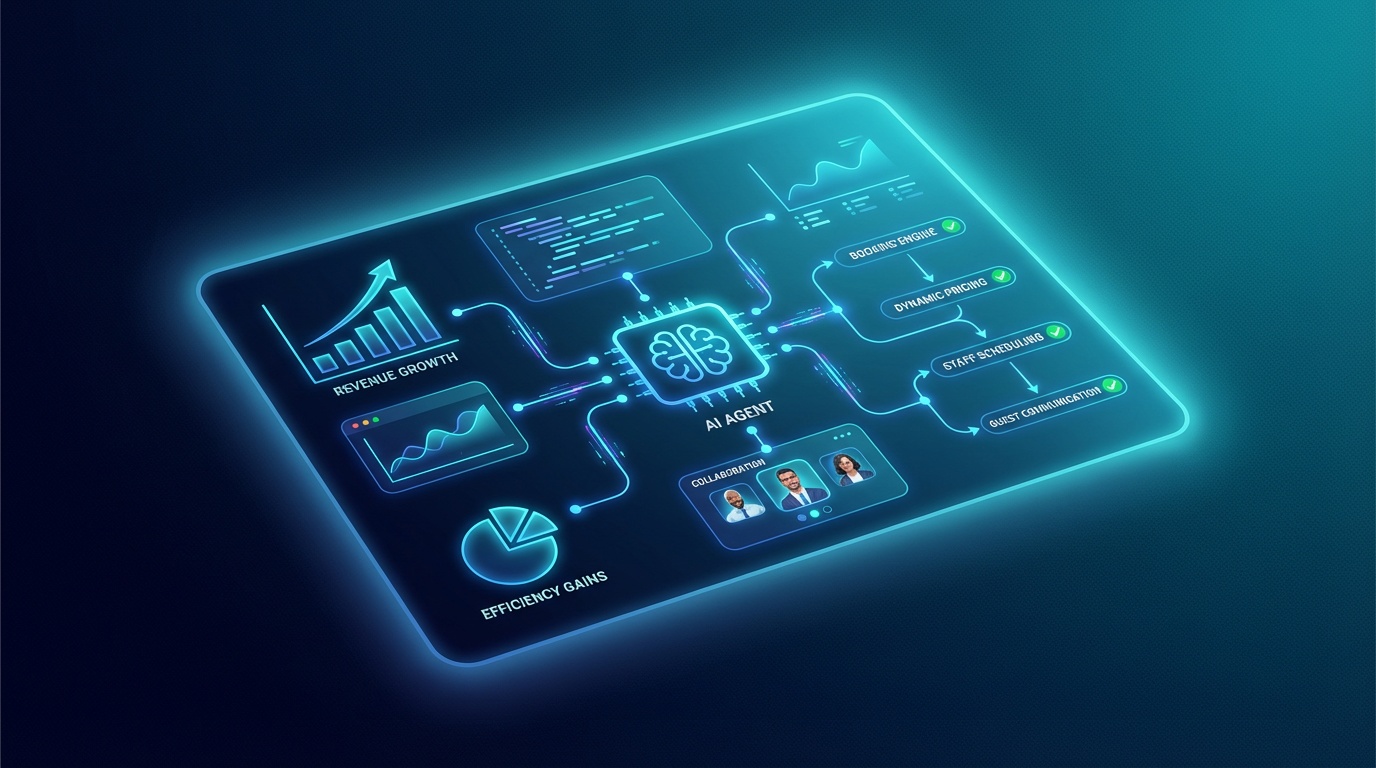
Mid-market luxury venues need AI solutions built for their operational reality: limited IT resources, tight budgets, and the imperative to maintain personalized guest experiences. Vynta AI addresses these constraints with hospitality-specific agents that deploy quickly and deliver transparent ROI.
Why Mid-Market Venues Choose Vynta AI Over Enterprise Tools
Enterprise revenue management platforms were designed for large hotel chains with dedicated revenue teams and six-figure software budgets. They offer comprehensive features but require extensive customization, lengthy implementations, and ongoing technical support. A 25-room boutique property doesn’t need airline-style yield management across 50 distribution channels. It needs automated guest communication that drives upsells without sounding robotic.
Vynta AI focuses on the highest-impact revenue opportunities for boutique venues: personalized pre-arrival offers, intelligent upgrade recommendations, no-show prevention, and post-stay engagement. The platform integrates with existing reservation systems in one to two weeks and requires no dedicated IT staff to maintain. Pricing scales with property size, making sophisticated AI accessible to venues that can’t justify enterprise software costs.
Strategic Advantage: Vynta AI’s agents maintain your venue’s unique voice and service standards. Unlike generic chatbots, the system learns your brand tone and guest preferences, ensuring each automated message feels like a natural extension of your hospitality team.
| Factor | Enterprise Platforms | Vynta AI |
|---|---|---|
| Ideal Property Size | 100+ rooms, multi-location | 15-60 rooms, independent or small chains |
| Implementation Timeline | 8-16 weeks | 1-2 weeks |
| Technical Requirements | Dedicated IT support | Standard reservation system integration |
| Primary Focus | Channel management and pricing algorithms | Guest journey automation and upselling |
| Customization | Extensive but complex | Industry-specific templates ready to deploy |
Quick Wins: 3-Month Roadmap to Revenue Gains
Month 1: Foundation and Quick Wins
Deploy automated pre-arrival messaging with room upgrade offers. Implement no-show prediction and confirmation workflows. Track baseline metrics: current average guest spend, no-show rate, and staff time spent on reservation management. Most properties see 10-15% reductions in no-shows immediately.
Month 2: Upselling Expansion
Add personalized recommendations for dining reservations, spa services, and local experiences based on guest profiles. Implement post-stay review requests timed for maximum response rates. Properties typically generate $8,000-$15,000 in incremental ancillary revenue during this phase.
Month 3: Optimization and Scaling
Analyze which messages and offers convert best. Refine AI agent behavior based on guest response patterns. Expand automation to additional guest touchpoints. By month three, venues report 20-30% increases in ancillary revenue and 40% reductions in reservation management time.
Overcoming Common Implementation Hurdles
The most common concern? Maintaining authentic hospitality while automating guest interactions. AI agents solve this by augmenting rather than replacing human judgment. Staff can review AI-generated messages before deployment, ensuring the tone matches brand standards. Agents handle repetitive tasks like confirmation reminders and standard upgrade offers, freeing your team for high-value interactions that require emotional intelligence.
Data integration worries often prove unfounded. Modern AI platforms connect via standard APIs to existing property management systems, pulling guest history and reservation data without manual exports. Setup takes hours, not weeks, and doesn’t disrupt daily operations.
Cost justification becomes straightforward when framed as revenue generation rather than expense. A $1,500 monthly investment that produces $8,000 in additional ancillary revenue delivers a 5:1 ROI before accounting for time savings and improved guest satisfaction. For more background, see revenue management concepts.
Luxury hospitality succeeds through personalized service and strategic revenue management. AI agents don’t replace the human touch that defines premium experiences. They automate data-intensive tasks so your team can focus on creating memorable moments that drive repeat bookings and positive reviews. For boutique hotels and upscale restaurants ready to scale revenue without scaling headcount, purpose-built AI platforms offer a clear path from implementation to measurable results.
Frequently Asked Questions
What are some leading AI agents for revenue optimization in luxury hospitality?
As Operations Director at Vynta AI, I understand that selecting the right AI agent depends on a venue’s specific needs. Leading platforms like Duetto specialize in dynamic pricing for larger hotels, while SuperAGI offers strong demand forecasting for both lodging and food service. For mid-market luxury venues seeking to optimize the entire guest journey, Vynta AI provides industry-specific agents that automate communication and upselling. Each platform offers distinct advantages depending on your operational scale and revenue challenges.
How do AI agents help luxury venues grow revenue?
AI agents significantly boost revenue by automating pricing decisions and guest interactions. They monitor hundreds of variables, adjusting rates multiple times daily to capture maximum revenue, and identify upselling opportunities based on guest preferences. This data-intensive work frees your team to focus on guest relationships, driving measurable gains in occupancy and guest spend.
What measurable results can luxury venues expect from AI revenue optimization?
Properties using AI revenue optimization often see significant improvements. For example, average daily rates can increase by 12-34% within the first year, and occupancy can rise substantially. AI also helps reduce no-show rates by 15-25% and can add hundreds of thousands in annual room or food and beverage revenue through dynamic pricing and targeted upselling.
How do AI agents assist with no-shows and reservation management?
AI agents play a key role in preventing revenue loss from no-shows by predicting high-risk bookings and proactively managing waitlists. They can send personalized pre-arrival messages and automated confirmation workflows. This automation also cuts reservation management time by around 40%, allowing staff to focus more on guest experience.
What makes Vynta AI a suitable option for mid-market luxury venues?
Vynta AI is designed for mid-market luxury venues that may not have internal AI resources. Our agents automate guest communication, from pre-arrival offers to post-stay review requests, while maintaining a personalized tone. We focus on optimizing the entire guest journey, including reservation confirmations, upgrade recommendations, and no-show prevention, with quick integration into existing platforms.
Do AI agents replace human staff in luxury hospitality?
No, AI agents do not replace human judgment or the personal touch essential to luxury hospitality. Instead, they augment your team’s capabilities by handling data-intensive tasks and automating routine interactions. This allows your staff to focus on strategic decisions, guest relationships, and delivering exceptional service that requires emotional intelligence.