

top 10 Agentic Systems for Recruitment
What Agentic Systems Mean for Recruitment Agencies
Agentic systems are autonomous AI agents that execute complete recruitment workflows without manual oversight. Unlike basic automation tools that follow rigid scripts, these systems make decisions, adapt to context, and handle multi-step processes from candidate sourcing through interview scheduling. For recruitment agencies, this can mean processing over 100,000 CVs per day and screening candidates in under 10 seconds, while your consultants focus on building client relationships and closing placements.
Core Capabilities That Drive Hiring Efficiency
The top 10 Agentic Systems for Recruitment share three foundational capabilities. First, they collect and process applications from multiple job boards, including CV Library, Indeed, Reed, TotalJobs, and LinkedIn, without manual data entry. Second, they conduct intelligent candidate screening with up to 85% matching accuracy, learning your qualification criteria from past successful placements. Third, they maintain 24/7 automated engagement through the WhatsApp Business API and other channels, keeping candidates warm throughout the hiring pipeline. These systems can save about two hours per hire and cut the hiring cycle by over 60%. Explore how Agentic Systems for Recruitment can enhance your hiring efficiency.
Why Mid-Market Firms Gain Most from Autonomous AI Agents
Mid-market recruitment agencies face a unique challenge: enterprise-level client demands without enterprise-level resources. Agentic systems level the playing field by automating administrative tasks that typically consume 70% of consultant time. A team of five can operate with the throughput of fifteen, processing hundreds of applications daily while maintaining personalized candidate communication. This scalability happens without expanding headcount or increasing overhead costs.
Real-World Outcomes in Candidate Sourcing and Screening
Recruitment firms implementing agentic systems often see placements increase by over 50% within the first quarter. The dormant ATS database reactivation rate can reach 18%, bringing previously overlooked candidates back into active pipelines. Administrative tasks tied to reactivation can drop by 33%. Interview coordination can become fully automated, with the system scheduling interviews, sending confirmations and reminders, and providing preparation materials to candidates. The system can also generate branded candidate profiles and go-to-market documents for client submissions, removing hours of manual documentation work from each placement cycle.
Measurable Impact: Agentic Systems for Recruitment help recruitment firms screen more candidates, schedule more interviews, and place more candidates without expanding the team or increasing administrative costs.
Top 10 Agentic Systems for Recruitment Ranked by ROI
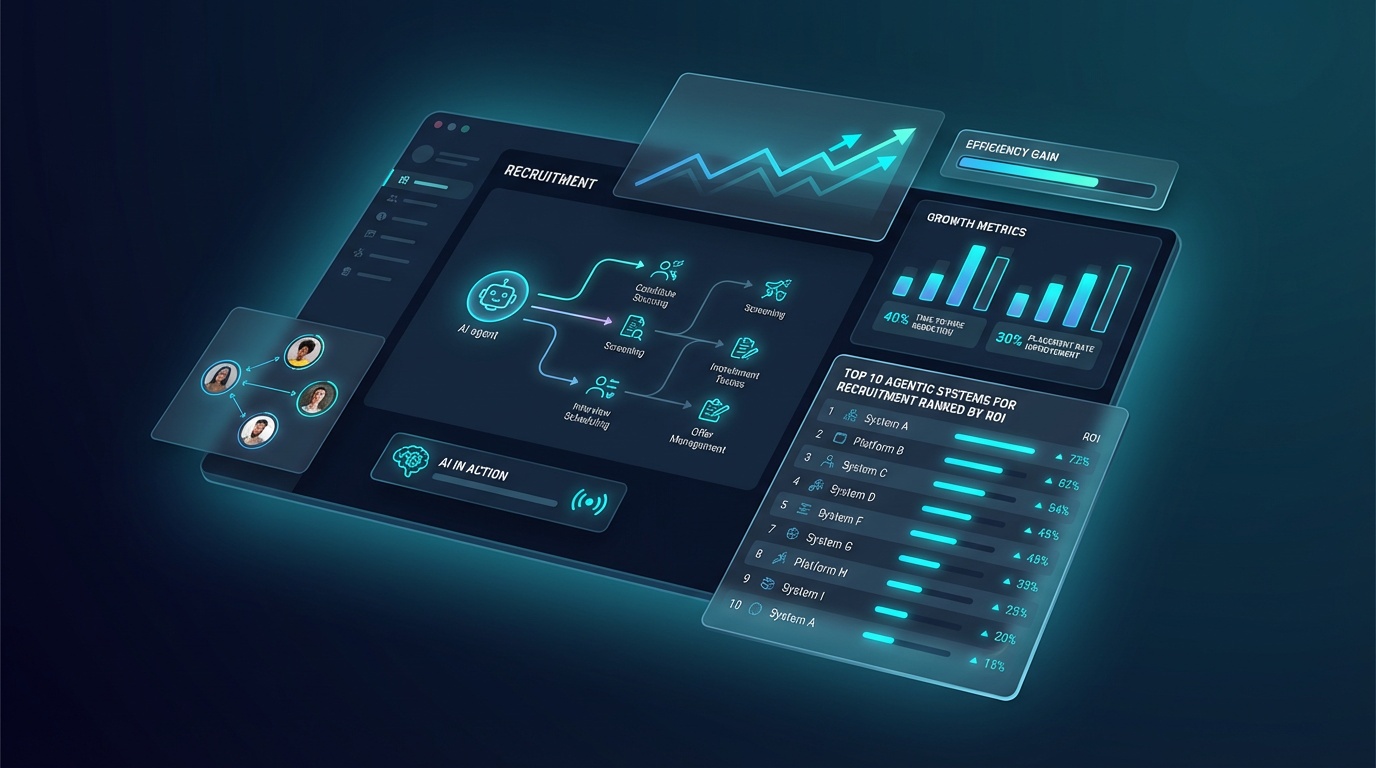
This ranking evaluates platforms based on time-to-hire reduction, placement rate improvement, and cost per successful hire. Each system offers distinct strengths for different agency sizes and hiring volumes.
1-3: Leaders in End-to-End Screening and ATS Integration
1. Vynta AI delivers complete recruitment automation with native integration across major UK and US job boards. The platform processes applications, screens candidates with up to 85% accuracy, and manages full engagement cycles through the WhatsApp Business API. Mid-market agencies can achieve 50%+ placement increases and 60% shorter hiring cycles. Custom agent configuration adapts to specialized roles within days. Discover more about how Vynta AI's Agentic Systems for Recruitment can transform your agency.
2. Teammates.ai excels at high-volume screening with advanced natural language processing for technical role requirements. Strong ATS compatibility with Bullhorn and Vincere makes it suitable for agencies managing 500+ placements annually. Pricing starts at $899 per month for core features.
3. Paradox (Olivia) specializes in candidate experience optimization with conversational AI that handles initial screening and scheduling. Works well for agencies prioritizing candidate engagement metrics. Enterprise pricing requires custom quotes.
4-7: Strong Performers for Sourcing and Scheduling
4. Greenhouse combines recruitment marketing with intelligent sourcing. Best for agencies building talent communities for repeat client needs. Starts at $6,500 annually, with add-on costs for AI features. For other vertical industries leveraging autonomous AI, see our Agentic Systems for Real Estate solutions.
5. MokaHR offers collaborative hiring workflows with AI-assisted candidate ranking. Suitable for boutique agencies handling specialized placements where consultant input remains central. Mid-tier pricing is $400 to $600 per month.
6. Fetcher automates passive candidate sourcing from LinkedIn and GitHub. Strong for tech recruitment agencies that need continuous pipeline development. Subscription model pricing is about $750 per month per recruiter.
7. Eightfold.ai uses talent intelligence for skills-based matching. Better for agencies with large historical placement data for model training. Enterprise-only pricing.
8-10: Solid Options for High-Volume and SMB Needs
8. HireVue focuses on video interview automation with assessment scoring. Useful for agencies conducting structured interviews at scale. Starts at $35,000 annually.
9. Textio optimizes job descriptions using language analysis to improve application rates. This is a complementary tool, not a full agentic system. Pricing typically ranges from $6,000 to $12,000 per year.
10. Pymetrics applies behavioral assessments for culture-fit screening. Niche application for agencies prioritizing soft-skills matching. Custom enterprise pricing.
| Platform | Best For | ATS Integration | Avg. Time Savings |
|---|---|---|---|
| Vynta AI | Mid-market full automation | Native multi-board | 2 hours per hire |
| Teammates.ai | High-volume technical | Bullhorn, Vincere | 1.5 hours per hire |
| Paradox | Candidate experience | Major ATS platforms | 1 hour per hire |
| Greenhouse | Talent community building | Native ecosystem | 45 minutes per hire |
How Agentic Systems Integrate with Your ATS and Workflows
Integration begins with API connections to your existing applicant tracking system and job board accounts. The agentic system authenticates with platforms such as Bullhorn, Vincere, JobAdder, CV Library, Indeed, Reed, TotalJobs, and LinkedIn through secure OAuth protocols. Configuration often takes three to five business days: you define role requirements, qualification criteria, and communication templates while the AI reviews historical placement data to learn matching patterns. Once live, the system monitors all connected sources continuously, ingests applications, and updates candidate records in your ATS without duplicate entries or data conflicts.
Step-by-Step Setup for LinkedIn, Indeed, and Core ATS Platforms
Start by granting read and write permissions to your ATS and job board accounts through the platform’s integration dashboard. Map data fields between systems so candidate information flows correctly: contact details, work history, qualifications, and application status must align with your existing database structure. Configure screening parameters by uploading job descriptions and examples of successful placements. The AI analyzes these samples to build matching algorithms tailored to your client requirements. Set communication preferences, including response timing, channel selection (email, SMS, WhatsApp), and escalation rules when human intervention becomes necessary. Test the workflow with a small batch of applications before full deployment to identify any field-mapping issues or screening-threshold adjustments that may be needed.
Multi-Agent Collaboration for Full Recruitment Pipelines
Advanced implementations deploy specialized agents across different pipeline stages. One agent handles initial sourcing and screening, passing qualified candidates to a scheduling agent that coordinates interviews with both candidates and clients. A third agent manages post-interview follow-up, reference checks, and offer negotiations. These agents share context through your ATS, ensuring seamless handoffs without information loss. When a candidate’s status changes, all relevant agents receive updates and adjust their actions accordingly. This orchestration reduces the 33% of administrative tasks typically consumed by status tracking and inter-team communication.
Case Example: Reactivating Dormant Databases for More Placements
A mid-market recruitment agency deployed an agentic system to mine its 12,000-candidate ATS database that had accumulated over five years. The AI identified 2,160 previously qualified candidates whose profiles matched current open roles but had gone cold due to timing mismatches. The system automatically sent personalized reactivation messages through WhatsApp and email, adjusted for each candidate’s last interaction date and original application context. Within 30 days, 389 candidates (an 18% reactivation rate) re-engaged, resulting in 47 successful placements that generated incremental revenue without new sourcing costs. The entire reactivation campaign required zero consultant hours beyond initial approval of message templates. Learn about best practices in following up leads to optimize these results.
Key Challenges and Proven Fixes for Agentic AI Deployment
Recruitment agencies face three primary barriers when adopting agentic systems: upfront investment concerns, data security requirements, and scaling complexity. Understanding these obstacles and the available solutions determines implementation success.
Top Barriers: Cost, Security, and Scaling Without Headcount Growth
Initial costs range from about $400 per month for basic platforms to $35,000 annually for enterprise solutions, which can create budget anxiety for agencies operating on thin margins. Calculate ROI by measuring current cost per placement (consultant hours multiplied by hourly rate, plus advertising spend) against projected costs with automation. Most mid-market firms reach breakeven within four to six months as placement volume increases while administrative overhead remains flat. Security concerns center on candidate data protection and GDPR compliance. Choose systems with SOC 2 Type II certification, end-to-end encryption, and granular access controls. Ensure contracts specify data ownership and deletion procedures. Scaling challenges can emerge when automation outpaces your ability to manage increased client demand. Address this with staged deployment: automate screening first, add scheduling after three months, then implement full pipeline automation once consultant capacity becomes available.
2026 OWASP Risks and Simple Mitigation Steps
The OWASP Top 10 for Large Language Models identifies prompt injection, insecure output handling, and excessive agency as primary risks in agentic systems. Mitigate prompt injection by implementing input validation that removes suspicious commands from candidate communications before AI processing. Address insecure output handling through automated review queues in which consultants approve AI-generated client communications before sending. Control excessive agency by defining strict permission boundaries: the system can screen and schedule, but it cannot make final hiring decisions or negotiate rates without human approval. Regular audits of AI actions and decision logs help identify unusual patterns that may indicate security issues.
Vynta AI Approach: Custom Agents That Deliver Cost Savings
Vynta AI builds recruitment-specific agentic systems designed for mid-market agencies that lack internal AI resources. Custom agent configuration adapts to your specialized verticals, whether you place health care professionals, IT contractors, or executive roles. The platform delivers cost savings compared to expanding your team to handle equivalent placement volume. Implementation includes consultant training, workflow optimization, and ongoing performance monitoring so the AI learns from your best placements. This consultative approach positions the technology as a strategic partner rather than a vendor transaction, with success measured by placement rates and client retention metrics.
Implementation Reality: Successful agentic system deployment often requires 90 days to reach full operational efficiency as the AI learns your qualification standards and consultants adapt workflows to focus on relationship-building over administrative tasks.
Pick the Right Agentic System and Scale Your Agency
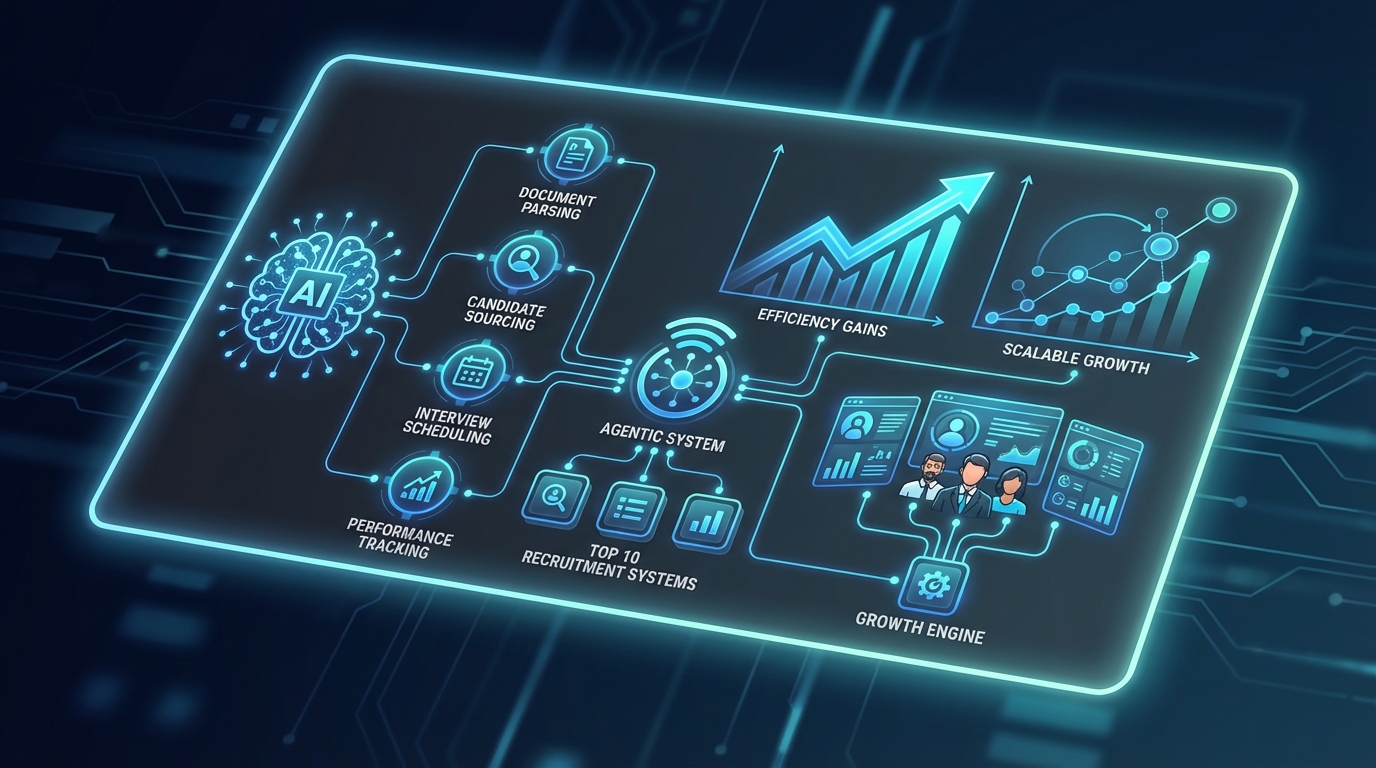
Selecting from the top 10 Agentic Systems for Recruitment depends on three factors: current placement volume, client specialization, and growth trajectory. Agencies placing fewer than 50 candidates annually benefit most from focused tools such as Textio or Pymetrics that optimize specific workflow bottlenecks. Mid-market firms handling 100 to 500 placements need comprehensive platforms such as Vynta AI or Teammates.ai that automate end-to-end processes while integrating with existing ATS infrastructure. High-volume agencies exceeding 500 placements may require enterprise solutions such as Eightfold.ai or Greenhouse that scale across multiple consultant teams and client verticals.
Decision Framework: Match Tools to Your Hiring Volume and Goals
Evaluate platforms using four criteria. First, measure ATS compatibility: does the system connect natively to your existing Bullhorn, Vincere, or JobAdder instance without custom development costs? Second, assess screening accuracy by requesting pilot tests with 50 to 100 real applications from your database. Third, calculate total cost of ownership, including subscription fees, implementation services, and consultant training time. Fourth, verify scalability by confirming the platform handles your projected placement volume three years forward without pricing-tier jumps or performance degradation. Request case studies from agencies that match your size and vertical specialization before committing to annual contracts.
Next Steps: Quick Wins and Long-Term Transformation with Vynta AI
Begin with dormant database reactivation to generate immediate ROI while your team learns the system. Configure screening parameters for your three highest-volume roles to build AI matching confidence before expanding to specialized positions. Schedule weekly performance reviews during the first 90 days to refine communication templates and qualification thresholds based on candidate feedback and client acceptance rates. Vynta AI supports mid-market recruitment agencies through implementation with custom agent configuration, consultant training, and ongoing optimization. The platform adapts to specialized verticals, whether you place health care professionals, IT contractors, finance executives, or skilled trades, learning from successful placements to improve matching accuracy over time.
Expected ROI: 2-3x Faster Hires at Lower Cost
Recruitment agencies implementing agentic systems can reduce time-to-hire from an industry average of 42 days to 14 to 18 days while cutting cost per placement by about 30%. Consultants can shift from spending 70% of their time on administrative tasks to spending 70% on client relationship development and candidate coaching. This capacity reallocation supports the 50%+ placement increases observed across many mid-market firms. The technology frees consultants from repetitive screening and scheduling work, allowing a stronger focus on the advisory services that differentiate an agency and support premium fees. Agentic systems amplify human expertise rather than replace it, positioning your firm to compete with larger agencies while maintaining personalized service that wins client loyalty.
Strategic Advantage: The top 10 Agentic Systems for Recruitment can transform mid-market agencies into high-volume placement teams without expanding headcount. A five-person team can operate with the throughput of fifteen, processing hundreds of applications daily while maintaining the relationship focus that drives repeat business and referrals.
| Agency Size | Annual Placements | Recommended System | Expected Time Savings |
|---|---|---|---|
| Boutique | Under 50 | Textio, Pymetrics | 45 minutes per hire |
| Mid-Market | 100-500 | Vynta AI, Teammates.ai | 2 hours per hire |
| Enterprise | 500+ | Eightfold.ai, Greenhouse | 1.5 hours per hire |
The recruitment market rewards agencies that adopt intelligent automation early. Competitors are already deploying these systems to capture market share through faster response times and higher placement volumes. The question is not whether to implement agentic AI, but which platform aligns with your growth strategy and client specialization. Start with a focused pilot on your highest-volume roles, measure results against current performance, and scale systematically as your team builds confidence in the technology. Vynta AI delivers recruitment-specific automation designed for mid-market agencies ready to scale placements without proportional cost increases.
The recruitment market rewards agencies that adopt intelligent automation early. Competitors are already deploying these systems to capture market share through faster response times and higher placement volumes. The question is not whether to implement agentic AI, but which platform aligns with your growth strategy and client specialization. Start with a focused pilot on your highest-volume roles, measure results against current performance, and scale systematically as your team builds confidence in the technology. Vynta AI delivers recruitment-specific automation designed for mid-market agencies ready to scale placements without proportional cost increases. Learn more about the concept of autonomous AI agents to understand their foundations.
Frequently Asked Questions
What are agentic systems in recruitment?
As someone deeply involved in AI automation, I see agentic systems as autonomous AI agents that manage complete recruitment workflows without manual oversight. Unlike basic tools, these systems make decisions, adapt to context, and handle multi-step processes from sourcing to scheduling. They allow your consultants to focus on building client relationships and closing placements.
How do agentic systems help recruitment agencies?
Agentic systems significantly boost efficiency by automating administrative tasks that often consume up to 70% of a consultant’s time. This means agencies can process hundreds of thousands of CVs daily and screen candidates in seconds. The result is a faster hiring cycle and more placements without expanding your team.
What core functions do agentic systems perform in hiring?
The most effective agentic systems collect and process applications from various job boards, eliminating manual data entry. They conduct intelligent candidate screening with high matching accuracy, learning your specific qualification criteria. Additionally, they maintain 24/7 automated engagement with candidates, keeping them warm throughout the hiring pipeline.
Why are mid-market recruitment firms a good fit for agentic systems?
Mid-market firms often face enterprise-level client demands with limited resources. Agentic systems level the playing field by automating high-volume administrative tasks, allowing a smaller team to operate with the throughput of a much larger one. This provides scalability without increasing headcount or overhead costs.
What kind of real-world results can agencies expect from agentic systems?
We’ve seen firms achieve impressive outcomes, including placement increases of over 50% within the first quarter. These systems can reactivate dormant ATS databases, bringing overlooked candidates back into active pipelines. They also fully automate interview coordination, sending confirmations and preparation materials to candidates.
How does Vynta AI stand out among agentic recruitment solutions?
At Vynta AI, our focus is on delivering complete recruitment automation with native integration across major UK and US job boards. Our platform processes applications, screens candidates with up to 85% accuracy, and manages full engagement cycles. Mid-market agencies using Vynta AI can achieve significant placement increases and shorter hiring cycles, with custom agent configuration adapting to specialized roles within days.
What should an agency consider when selecting an agentic system?
When advising agencies, I always emphasize evaluating platforms based on their ability to reduce time-to-hire, improve placement rates, and lower cost per successful hire. Consider your specific needs, whether it’s high-volume screening, candidate experience optimization, or specialized sourcing. Each system offers distinct strengths for different agency sizes and hiring volumes.