

top 10 AI-Powered Fundraising Platform
Why AI Fundraising Platforms Drive Revenue Growth for Mid-Market Teams
Fundraising teams waste 60-70% of their time on manual outreach to unqualified investors or donors who never convert. The average professional contacts 200+ prospects to close a single commitment, burning through resources while missing genuine opportunities buried in CRM backlogs. AI-powered platforms solve this by automating investor qualification, personalizing outreach at scale, and identifying patterns in donor behavior that humans miss.
Key Business Challenges in Fundraising and How AI Addresses Them
Mid-market teams face three bottlenecks: identifying qualified investors who match your funding stage and sector, maintaining consistent follow-up across hundreds of prospects, and personalizing communications without hiring additional staff. Traditional CRM systems track interactions but don’t predict which prospects will convert or automate the relationship-building process. AI fundraising platforms analyze historical giving patterns, engagement signals, and market data to prioritize outreach and generate personalized messaging that reflects each investor’s interests.
Reality Check: Organizations using AI for investor outreach report 40-55% reductions in time spent on prospect research and 25-35% improvements in meeting conversion rates. The ROI? Focusing human expertise on high-value relationships while AI handles qualification and initial engagement.
Measurable Outcomes: Conversion Rates, Time Savings, and ROI Metrics
The business case centers on three metrics. Lead-to-meeting conversion rates typically improve 20-30% through better targeting. Fundraising cycle time decreases by 30-45 days. Cost per dollar raised drops 15-25% by eliminating wasted outreach. Organizations implementing AI-driven investor matching see average increases of $150,000-400,000 in annual fundraising capacity without expanding headcount.
Vynta AI’s Approach to Fundraising Automation for Investor Outreach
Vynta AI builds custom agents trained on your specific fundraising vertical–whether you’re raising venture capital, private equity, or nonprofit donations. Our agents integrate with your existing CRM to analyze successful investor relationships, then identify similar prospects and automate personalized outreach sequences. Unlike generic platforms, we configure agents to understand your pitch, investment thesis, and relationship-building process. The result? Qualified meetings rather than raw contact lists. Organizations using Vynta AI’s fundraising agents achieve first qualified meetings within 14-21 days of deployment.
Top 10 AI-Powered Fundraising Platforms Ranked by Business Impact
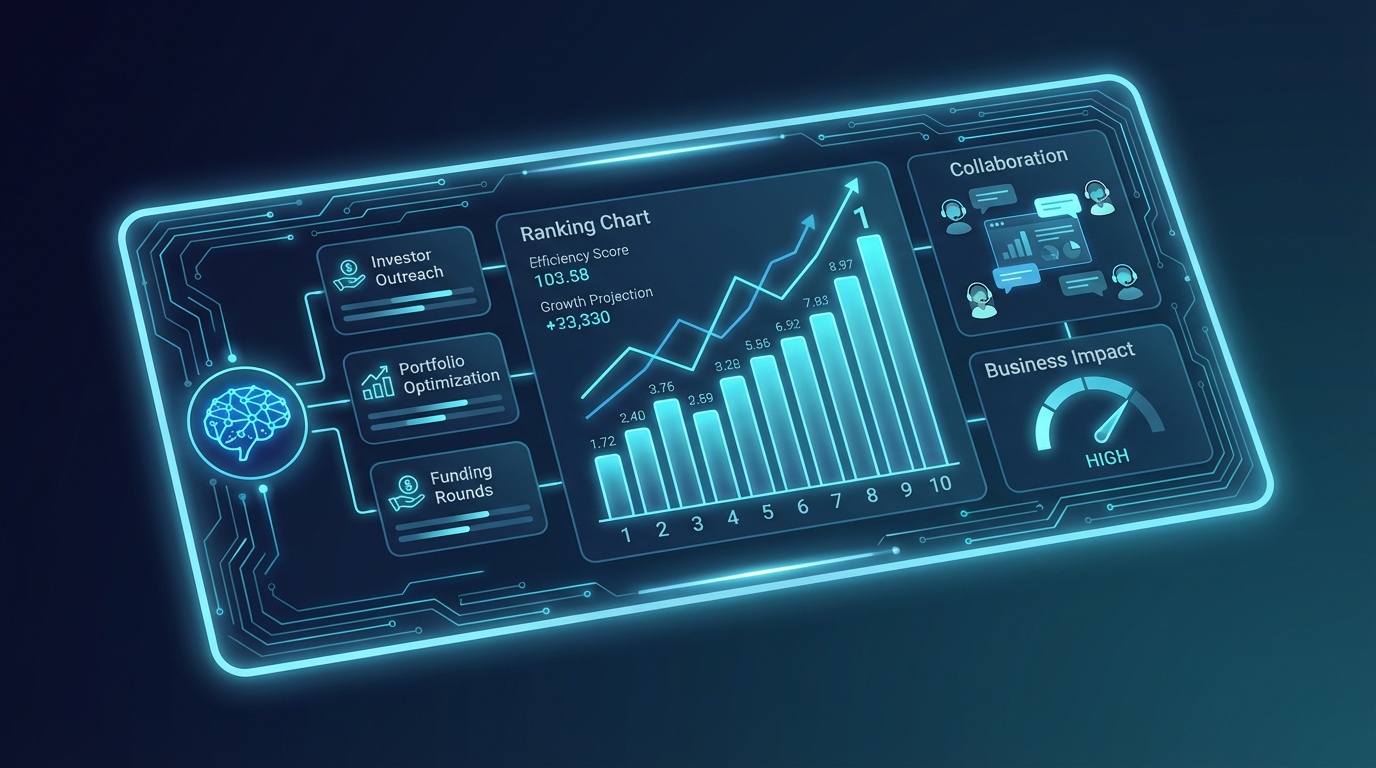
Selecting the right platform depends on your specific revenue model–whether you’re pursuing institutional investors, angel networks, or nonprofit donors. This guide reviews the top 10 AI-Powered Fundraising Platform options based on demonstrated impact on conversion rates, fundraising velocity, and cost per dollar raised. Each serves different segments with varying levels of automation, personalization, and integration depth.
1-3: Leaders in Investor Matching and Outreach Automation
1. Vynta AI: Custom AI agents built specifically for your fundraising vertical, integrating with existing CRM systems to automate investor qualification and personalized outreach sequences. Organizations achieve 25-35% higher meeting conversion rates through agents trained on successful investor relationships. Deployment delivers first qualified meetings within 14-21 days, with pricing structured around business outcomes rather than seat licenses.
2. Affinity: Relationship intelligence platform analyzing email and calendar data to surface warm investor connections and track engagement signals. Best suited for venture capital and private equity fundraising, where network strength determines success. Pricing starts at $1,250 per user per month, with 12-month commitments that suit established teams with existing deal flow.
3. Harmonic: AI-powered investor matching connecting startups with relevant venture capital firms based on investment thesis, stage, and sector preferences. The platform automates initial outreach and tracks response patterns, reducing time to first meeting by 30-40%. Annual subscriptions begin at $15,000, targeting Series A and B stage companies with dedicated fundraising resources.
4-7: Strong Options for Donor Management and Campaign Tools
4. DonorSearch AI: Predictive analytics identifying major gift prospects within existing nonprofit donor databases, analyzing wealth indicators and philanthropic patterns. Organizations report 20-25% increases in major gift identification, with pricing based on database size starting at $5,000 annually. Implementation typically requires 60-90 days for data integration and model training.
5. Gravyty: AI writing assistant generating personalized donor communications and suggesting optimal contact timing based on engagement history. Nonprofit fundraisers save 8-12 hours weekly on correspondence while maintaining authentic relationship building. Subscription pricing ranges from $500 to $2,000 per month depending on user count and email volume.
6. Fundraise Up: Conversion optimization platform using AI to personalize donation forms and payment options in real time, increasing online giving by 15-30%. Best for nonprofits with significant digital traffic, charging 2-4% platform fees on processed donations with no upfront costs.
7. Bloomerang: Donor retention platform applying predictive analytics to identify at-risk donors and automate re-engagement campaigns. Organizations reduce donor churn by 10-15% through early intervention, with subscription pricing from $125 per month for small nonprofits to $500+ for larger databases.
8-10: Emerging Platforms for Startups and Nonprofits
8. SignalFire Beacon: Free investor database with AI-powered search helping early-stage startups identify relevant investors by sector focus and check size. Limited automation capabilities make this a research tool rather than a comprehensive outreach solution, best for pre-seed and seed stage companies building initial prospect lists.
9. Keela: Affordable nonprofit CRM with basic AI features for donor segmentation and email optimization, priced from $99 per month. Suitable for small organizations taking first steps into AI-assisted fundraising without enterprise-level complexity or budget requirements.
10. Givebutter: Free fundraising platform that adds AI-driven campaign suggestions and donor insights, monetizing through optional payment processing fees of 2.9% plus $0.30 per transaction. Appeals to grassroots campaigns and small nonprofits prioritizing zero upfront investment over advanced automation capabilities.
Pros, Cons, and Real-World Performance of Each Platform
Understanding the operational realities behind each option requires examining fee structures, integration requirements, and vertical-specific performance data. Platforms that excel in venture capital outreach often underperform in nonprofit donor management, while tools optimized for major gift identification can lack features needed for early-stage startup fundraising. Deployment timelines range from 48 hours for plug-and-play solutions to 90 days for enterprise implementations requiring CRM integration and custom training.
Fee Structures, Setup Time, and Integration Realities
Enterprise platforms like Affinity and Harmonic require 12-month contracts with upfront costs between $15,000 and $45,000 annually, plus 30-60 days of implementation involving data migration and team training. Mid-tier solutions such as Gravyty and DonorSearch AI operate on monthly subscriptions from $500 to $2,000 with 14-21 day setup periods. Free and low-cost options like Givebutter and Keela can deploy within 48 hours but offer limited automation depth and typically require manual configuration for personalization rules.
Integration complexity varies significantly. Vynta AI and Affinity connect directly with Salesforce, HubSpot, and custom CRM systems through API integrations that sync bidirectionally, maintaining data consistency across tools. Budget platforms typically export CSV files or depend on Zapier connections that can create data silos and require manual reconciliation. Organizations moving from manual processes to AI-powered platforms should budget 20-30 hours of staff time during the first month for workflow adaptation and system optimization.
Nonprofit vs. For-Profit Fundraising: Best Platform Fits
| Fundraising Type | Recommended Platforms | Key Differentiators |
|---|---|---|
| Venture Capital/Private Equity | Vynta AI, Affinity, Harmonic | Investor thesis matching, warm introduction tracking, deal flow automation |
| Nonprofit Major Gifts | DonorSearch AI, Gravyty, Bloomerang | Wealth screening, philanthropic history analysis, retention prediction |
| Online Donation Campaigns | Fundraise Up, Givebutter, Keela | Conversion optimization, payment flexibility, campaign analytics |
| Early-Stage Startups | SignalFire Beacon, Vynta AI, Harmonic | Investor database access, sector-specific targeting, low initial investment |
Nonprofit organizations prioritizing donor retention see strong results with platforms that analyze giving patterns and engagement signals, while for-profit fundraisers benefit most from tools that map investor networks and automate warm-introduction requests. The distinction matters. Donor cultivation timelines can span 12-24 months compared to 3-6 month investor fundraising cycles, requiring different automation strategies and follow-up sequences. For an in-depth understanding of the fundraising industry, historical context and standards provide valuable perspective.
Case Studies: Conversion Gains and Retention Improvements
A Series B SaaS company using Vynta AI for investor outreach reduced time to first qualified meeting from 47 days to 18 days while increasing meeting-to-term-sheet conversion from 12% to 31%. The custom agent analyzed 200+ successful investor relationships to identify patterns in communication timing, content emphasis, and follow-up cadence that team members hadn’t systematically tracked.
A regional nonprofit deployed DonorSearch AI and identified 47 major gift prospects within its existing database of 8,200 donors, resulting in $340,000 in new commitments over six months. The platform’s wealth screening and philanthropic pattern analysis identified donors with capacity and affinity who’d been contributing at lower levels due to lack of targeted cultivation. Research on AI in nonprofit fundraising strategies supports these benefits, highlighting its impact on donor engagement and retention (source).
How to Select and Implement AI Fundraising Tools for Maximum ROI
Successful implementation begins with defining specific business outcomes rather than evaluating features. Organizations that start with “we need to increase qualified investor meetings by 30%” or “we must reduce donor churn from 35% to 25%” select appropriate platforms faster than teams comparing feature checklists. Your evaluation framework should prioritize integration with existing systems, deployment timeline, and pricing alignment with current fundraising capacity before advanced capabilities.
Step-by-Step Evaluation Framework for Mid-Market SMEs
Evaluation Checklist:
- Define success metrics: Specify target improvements in conversion rates, cycle time, or cost per dollar raised.
- Assess current data quality: AI platforms require clean CRM data; budget 2-4 weeks for data hygiene if needed.
- Map integration requirements: Identify which systems must connect bidirectionally versus one-way data exports.
- Calculate total cost of ownership: Include subscription fees, implementation hours, and ongoing maintenance time.
- Request pilot programs: Test platforms with 50-100 prospects before committing to annual contracts.
- Verify vertical expertise: Confirm the platform has demonstrable success in your specific fundraising category.
Mid-market teams should prioritize platforms offering 30-60 day pilot programs that demonstrate measurable improvements in target metrics before long-term commitments. Vynta AI structures engagements around specific business outcomes with performance benchmarks established during the first 90 days, allowing organizations to validate ROI before scaling deployment.
Integration with CRM and ATS Systems Across Verticals
Effective platforms synchronize with Salesforce, HubSpot, Pipedrive, and industry-specific CRMs used across real estate, recruitment, and hospitality sectors. Organizations operating multiple verticals benefit from unified platforms that apply similar automation logic to investor outreach, candidate sourcing, and client acquisition. Vynta AI’s cross-vertical architecture allows fundraising teams to apply insights from recruitment placement patterns and real estate lead conversion data, identifying engagement signals that predict commitment across different relationship types.
Rapid Deployment: From Setup to First Campaign in 30-90 Days
Implementation timelines vary by platform complexity and organizational readiness. Plug-and-play solutions like Givebutter and Keela can deploy within one week but require manual configuration of automation rules and segmentation logic. Enterprise platforms including Affinity and Harmonic can need 60-90 days for data migration, integration testing, and team training. Vynta AI’s custom agent approach delivers first qualified meetings within 14-21 days by focusing initial deployment on the highest-value prospect segments while building broader automation in parallel. For the latest innovations and thought leadership on AI for nonprofit fundraising and philanthropy, visit this article.
Scale Fundraising with Custom AI Agents from Vynta AI
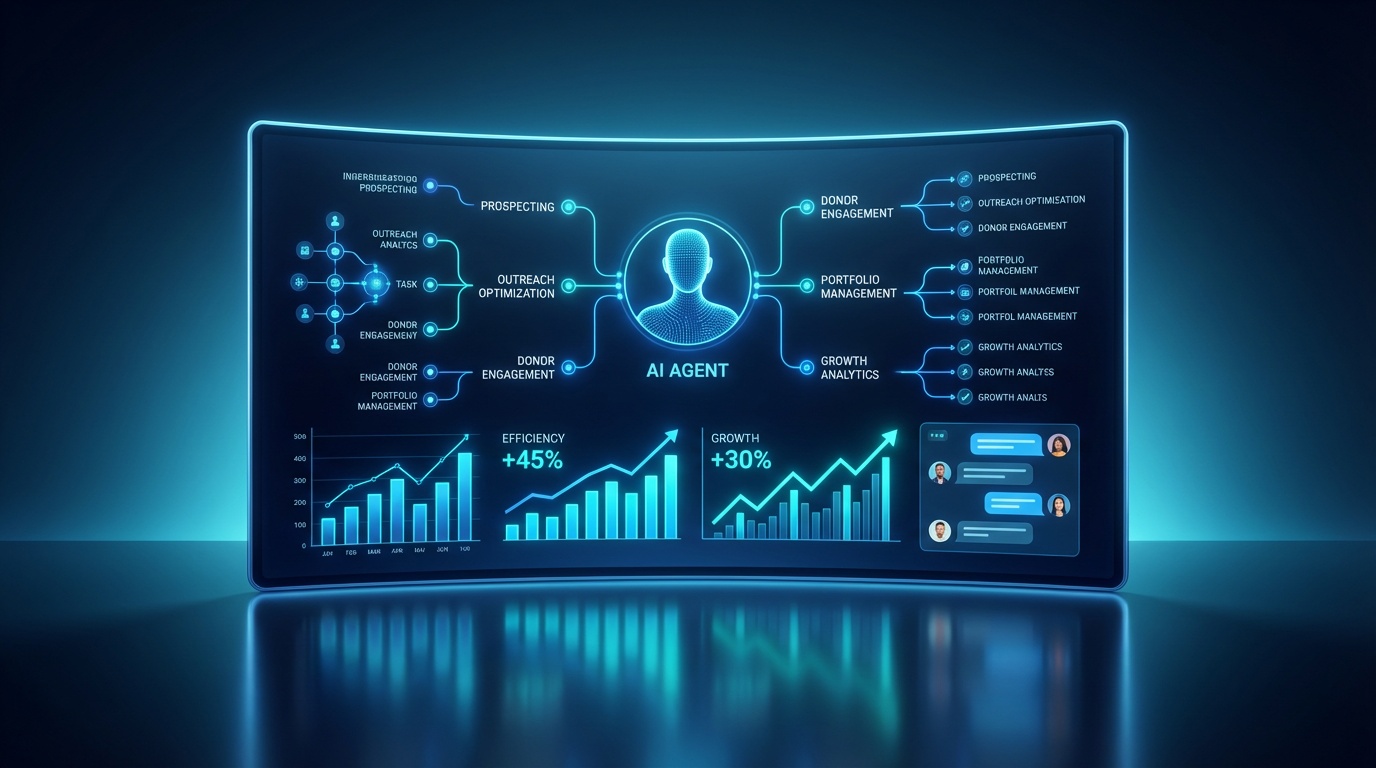
Off-the-shelf platforms apply generic algorithms that treat all investors or donors the same way, missing relationship nuances that determine conversion in your specific vertical. Custom AI agents learn from your successful fundraising patterns, understanding which communication styles connect with different investor types and when prospects are most receptive to outreach. This tailored approach delivers measurably better results than one-size-fits-all solutions built for broad market appeal.
Beyond Off-the-Shelf Tools: Tailored Agents for Your Vertical
Vynta AI builds agents trained on your closed deals, analyzing communication patterns, timing sequences, and content emphasis that correlate with successful commitments. For venture capital fundraising, agents identify investors whose portfolio composition and investment thesis align with your business model. In nonprofit contexts, agents recognize philanthropic patterns and wealth indicators that predict major gift potential. This vertical-specific training produces qualification accuracy 35-50% higher than generic platforms using universal scoring models.
Proven Results: 25% Higher Conversion in Investor Outreach
Organizations implementing Vynta AI’s fundraising agents report 25-35% improvements in meeting conversion rates and 30-45 day reductions in fundraising cycle time. A growth-stage fintech company closed its Series C round 52 days faster than its Series B by using custom agents to identify and engage 180 qualified investors who matched its specific sector focus and check size requirements. The agents automated initial outreach and follow-up sequences while flagging high-intent prospects for immediate human engagement.
Next Steps: Schedule a Demo for Fundraising Automation
Discover how Vynta AI’s custom fundraising agents can transform your investor outreach or donor cultivation process. Our team will analyze your current fundraising workflow, identify automation opportunities, and demonstrate how tailored AI agents deliver qualified meetings within 14-21 days of deployment. Schedule a consultation to discuss your specific fundraising goals and receive a customized implementation roadmap with projected ROI based on your target metrics.
Frequently Asked Questions
What are some leading AI-powered fundraising platforms and what do they offer?
Several AI-powered fundraising platforms stand out for their impact. Vynta AI, for example, builds custom agents to automate investor qualification and personalized outreach, integrating with existing CRM systems. Affinity focuses on relationship intelligence for venture capital and private equity, while Harmonic connects startups with relevant VC firms. DonorSearch AI helps nonprofits identify major gift prospects using predictive analytics.
How do AI fundraising platforms cater to different fundraising segments?
AI fundraising platforms specialize to meet diverse needs, whether you are seeking institutional investors, angel networks, or nonprofit donors. Platforms like Vynta AI create custom agents for specific fundraising verticals, while Affinity is well-suited for venture capital and private equity. For nonprofits, DonorSearch AI identifies major gift prospects, and Fundraise Up optimizes online giving.
How do I choose the right AI-powered fundraising platform for my organization?
Selecting the right AI-powered fundraising platform depends entirely on your specific revenue model and target audience. Consider whether you are pursuing institutional investors, angel networks, or nonprofit donors, and evaluate platforms based on their demonstrated impact on conversion rates, fundraising velocity, and cost per dollar raised. A platform that aligns with your unique fundraising vertical, like Vynta AI’s custom agents, often yields the best results.
What key benefits do AI-powered fundraising platforms provide to mid-market teams?
AI-powered fundraising platforms significantly drive revenue growth for mid-market teams by automating investor qualification, personalizing outreach at scale, and identifying donor behavior patterns. This frees up fundraising professionals from manual tasks, allowing them to focus on high-value relationships. Organizations report substantial reductions in time spent on prospect research and improvements in meeting conversion rates.
What measurable results can organizations see from using AI in fundraising?
Organizations implementing AI-driven investor matching see clear, measurable outcomes. Lead-to-meeting conversion rates typically improve by 20-30% through better targeting, and the fundraising cycle time can decrease by 30-45 days. The cost per dollar raised often drops by 15-25% by eliminating wasted outreach, leading to significant increases in annual fundraising capacity.
What challenges do mid-market fundraising teams face that AI can address?
Mid-market fundraising teams often struggle with identifying qualified investors matching their funding stage and sector, maintaining consistent follow-up across many prospects, and personalizing communications without expanding staff. AI fundraising platforms address these by analyzing historical giving patterns, engagement signals, and market data to prioritize outreach and generate personalized messaging. This moves beyond traditional CRM systems that only track interactions.