
Vynta AI Agents for Hospitality alternatives
Why Hospitality Managers Seek Alternatives to Vynta AI Agents
Hospitality managers face a universal challenge: scaling personalized guest service without proportionally increasing staff costs. Boutique hotels, upscale restaurants, nightclubs, and beach clubs must respond instantly to inquiries across WhatsApp, Instagram, SMS, and email while maintaining brand voice and upselling appropriately. Manual handling leads to abandoned inquiries, missed revenue, and staff burnout. This drives the search for Vynta AI Agents for Hospitality alternatives that automate guest interactions without sacrificing the personal touch that defines premium service.
Common Pain Points in Guest Experience and Operations
Mid-market hospitality venues lose revenue when guests abandon inquiries after slow responses, when staff lack time to upsell upgrades or special experiences, and when VIP guests receive generic treatment. No-shows drain profitability, and multilingual support stretches small teams thin. Managers need systems that respond instantly during operating hours, escalate complex requests to humans, and integrate with existing reservation platforms like SevenRooms without requiring technical expertise.
How Vynta AI Agents Address Hospitality Needs
Vynta AI Agents for Hospitality are bespoke AI agents designed specifically for luxury hospitality venues such as restaurants, premium bars, nightclubs, and beach clubs. The system can increase booking conversion by 50% and reduce customer inquiry abandonment by 60% through instant, human-like responses with natural pauses across all channels. The AI agents can increase average guest spend by up to 25% through brand-safe upselling tailored to guest profiles and channel specifics, while operational costs can be reduced by 30%. Vynta AI agents integrate in real time with CRMs like SevenRooms, synchronizing guest data, reservations, tags, and updates automatically. Clients set strict escalation rules so VIPs or complex queries are routed to human staff, and the AI operates only during hours defined by the customer with full manual override through a dashboard.
Gaps That Drive the Search for Other Options
Some managers seek alternatives when they need simpler task automation rather than full guest conversation handling, when budget constraints favor generic chatbots over custom agents, or when they operate outside the luxury hospitality segment. Others want platforms with prebuilt templates for faster deployment, or they require features Vynta prioritizes differently, such as post-stay review management or broader PMS compatibility beyond SevenRooms.
Pros
- Bespoke design for luxury hospitality with brand-safe upselling
- 50% booking conversion increase and 60% reduction in abandoned inquiries
- Real-time SevenRooms integration with automatic guest data sync
- Multilingual support with channel-specific personalization
- Strict escalation rules ensure VIP guests receive human care
- Full control over operating hours, tone, and live conversation takeover
Considerations
- Custom build requires a longer implementation than template solutions
- Optimized for the luxury segment rather than budget hospitality
- Primary CRM integration focuses on SevenRooms
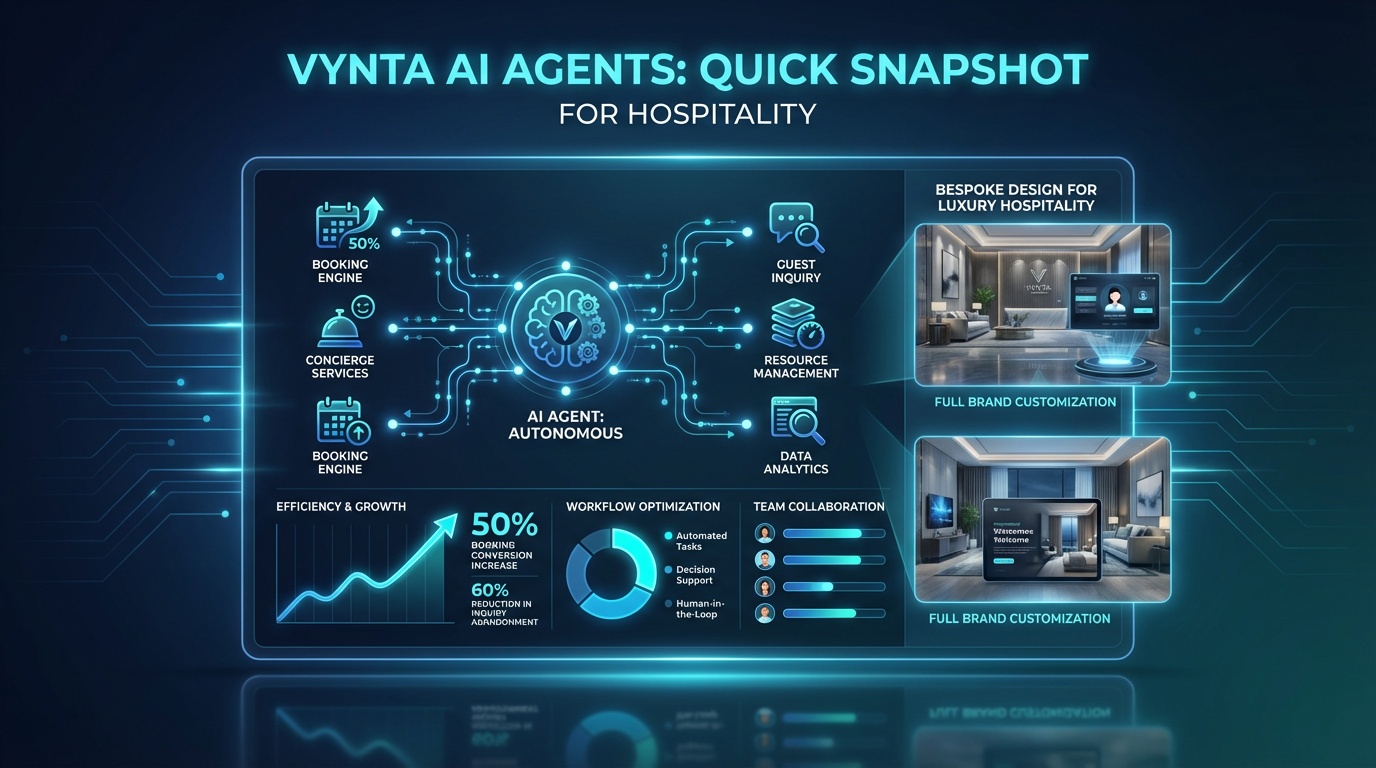
Vynta AI Agents: Quick Snapshot
Pros
- Bespoke design for luxury hospitality venues with full brand customization
- 50% booking conversion increase and 60% reduction in inquiry abandonment
- Real-time SevenRooms integration with automatic guest data synchronization
- Up to a 25% increase in average guest spend through brand-safe, profile-tailored upselling
- Multilingual support with channel-specific personalization across WhatsApp, SMS, Instagram, and email
- Manual override dashboard with live conversation takeover capability
Limitations
- Custom development timeline is longer than template-based solutions
- Premium pricing reflects bespoke agent architecture
- Primary focus on the luxury segment may exceed the needs of casual dining venues
Top Alternatives to Vynta AI Agents for Hospitality Operations
Managers evaluating Vynta AI Agents for Hospitality alternatives typically seek solutions that balance automation sophistication with implementation speed and budget. The market offers platforms ranging from generic chatbots to specialized hospitality AI, each with distinct strengths in reservation management, guest inquiry handling, and revenue optimization. The right choice depends on venue type, guest journey complexity, and team resources available to oversee AI interactions.
Supervity AI: Task Automation Across Hotel Systems
Best for: Hotels needing workflow automation beyond guest conversations, such as housekeeping coordination and maintenance requests.
Supervity focuses on operational task management across property management systems, automating internal processes like room status updates and staff scheduling. The platform offers prebuilt templates that reduce setup time compared to custom agents. Its strength lies in back-of-house efficiency rather than front-facing guest interactions, making it suitable for venues prioritizing internal operations over personalized guest communication. The system integrates with multiple PMS platforms but lacks the conversational sophistication and channel-specific personalization that Vynta provides for guest-facing interactions.
Pros
- Broad PMS compatibility across multiple hotel systems
- Quick deployment with prebuilt workflow templates
- Strong back-of-house operational automation
Cons
- Limited guest-facing conversational capabilities
- Generic responses lack brand voice customization
- No specialized upselling logic for hospitality revenue optimization
10xDS: Real-Time Guest Inquiry Handling
Best for: Venues requiring basic inquiry response automation with standard integration capabilities.
10xDS delivers real-time responses to guest inquiries across common channels, focusing on speed and availability. The platform handles routine questions about hours, locations, and basic reservation details with acceptable accuracy. Its pricing model suits mid-market venues with straightforward guest interaction patterns. The system lacks advanced features like natural response timing with human-like pauses, sophisticated escalation rules for VIP guests, or the deep CRM synchronization that enables personalized upselling based on guest history and preferences.
Pros
- Competitive pricing for basic inquiry automation
- Fast response times across standard channels
- Simple setup process with minimal technical requirements
Cons
- Robotic response patterns without natural timing
- Limited upselling capabilities and revenue optimization
- Basic escalation logic cannot distinguish VIP treatment protocols
TrustYou: Personalized Hotel Guest Support
Best for: Hotels emphasizing post-stay review management and reputation monitoring alongside guest communication.
TrustYou combines guest messaging with comprehensive review aggregation and sentiment analysis. The platform excels at collecting and responding to post-stay feedback across multiple review sites, providing reputation insights that inform service improvements. Its guest communication features handle standard inquiries with acceptable personalization. The system prioritizes review management over the real-time reservation optimization and brand-safe upselling that drive immediate revenue. TrustYou serves hotels where reputation management holds equal or greater priority than conversion rate optimization during the booking journey.
Pros
- Comprehensive review aggregation from multiple platforms
- Sentiment analysis informs service improvement strategies
- Integrated guest messaging and reputation management
Cons
- Guest communication is secondary to the review-management focus
- Limited real-time CRM integration for personalized upselling
- Not specialized for luxury restaurant, nightclub, or beach club segments
Ema and Other Emerging Players
Best for: Organizations exploring general-purpose AI agents across multiple business functions beyond hospitality.
Ema and similar emerging platforms offer broad AI automation capabilities across various industries and use cases. These tools provide flexibility to customize agents for different departments, from customer service to internal operations. Their generalist approach means hospitality-specific features like reservation management, no-show prevention, and guest spend optimization require significant configuration. Venues seeking deep hospitality expertise with proven metrics like 50% booking conversion increases and 25% guest spend growth may benefit more from specialized solutions. Teams comparing Vynta AI Agents for Hospitality alternatives should validate how each platform handles real reservation workflows, guest data, and escalation requirements.
| Platform | Primary Strength | CRM Integration Depth | Upselling Capability | VIP Escalation | Best Venue Type |
|---|---|---|---|---|---|
| Vynta AI Agents | Bespoke luxury hospitality with brand-safe upselling | Real-time SevenRooms sync with guest profiles | Up to a 25% spend increase through tailored suggestions | Custom rules with manual takeover | Premium restaurants, nightclubs, beach clubs |
| Supervity AI | Back-of-house operational workflows | Multiple PMS connections, limited guest data | Basic task automation, minimal revenue focus | Standard priority routing | Hotels prioritizing internal operations |
| 10xDS | Fast inquiry response at competitive pricing | Standard API connections | Limited personalization logic | Basic escalation without VIP distinction | Mid-market venues with routine inquiries |
| TrustYou | Review management and reputation monitoring | Moderate integration for feedback collection | Post-stay focus rather than booking optimization | Standard guest service routing | Hotels emphasizing online reputation |
| Ema | General-purpose AI across business functions | Configurable but requires custom setup | Generic automation without hospitality logic | Customizable but not hospitality-specific | Multi-department organizations |
Key Features to Compare in Hospitality AI Agents
Selecting the right AI agent requires evaluating capabilities that directly impact guest satisfaction and revenue. Managers should prioritize features that align with their venue’s guest journey, existing technology stack, and service standards. The criteria below separate generic automation from hospitality-specific solutions.
Reservation Management and No-Show Prevention
Effective AI agents must handle the complete reservation lifecycle: confirming bookings, sending automated reminders, managing modifications, and reducing no-shows through timely guest communication. Vynta AI Agents achieve 50% booking conversion increases by responding instantly during defined operating hours with natural pauses that mimic human interaction patterns. Systems lacking sophisticated timing controls often send robotic rapid-fire responses that diminish brand perception. The best solutions integrate directly with reservation platforms to update availability in real time, preventing double bookings and ensuring staff always work from accurate data.
Upselling and Revenue Optimization
Revenue growth depends on intelligent upselling that feels personalized rather than pushy. Top-tier AI agents analyze guest profiles, booking history, and channel context to recommend appropriate upgrades, premium experiences, or add-ons. Vynta AI Agents for Hospitality increase average guest spend by up to 25% through brand-safe upselling tailored to individual preferences and communication channels. Generic chatbots often cannot distinguish between a first-time Instagram inquiry and a returning VIP guest on WhatsApp, which can lead to irrelevant offers that damage relationships. Effective systems also know when not to upsell, preserving the premium service experience that defines luxury hospitality.
PMS/CRM Integrations and Escalation Rules
Seamless integration with property management systems and customer relationship management platforms eliminates manual data entry and keeps guest records consistent. Vynta AI agents integrate in real time with CRMs like SevenRooms, synchronizing guest data, reservations, tags, and updates automatically. This supports personalized service based on complete guest history. Equally important are escalation protocols that route VIP guests and complex queries to human staff immediately. Clients can set strict escalation rules so VIPs or complex queries are routed to human staff, ensuring high-value relationships receive appropriate attention while routine inquiries remain automated.
Human Oversight for Brand-Safe Interactions
Premium hospitality venues cannot afford AI mistakes that compromise brand reputation. The best systems provide manual override capabilities, allowing staff to view, pause, and take over live conversations through a dashboard. Vynta customers maintain full control over operating hours, tone, content restrictions, and conversation flow. The AI operates only during hours defined by the customer with complete transparency into all interactions. This human-AI collaboration model delivers efficiency without sacrificing the judgment required for exceptional guest experiences, a balance that separates strategic partners from vendors selling generic automation tools.
| Feature | Vynta AI Agents | Supervity AI | 10xDS | TrustYou |
|---|---|---|---|---|
| Natural Response Timing | Human-like pauses and delays | Standard automated timing | Rapid-fire responses | Standard automated timing |
| Real-Time CRM Integration | SevenRooms full synchronization | Multiple PMS connections | Basic integration capabilities | Limited real-time sync |
| Personalized Upselling | Profile- and channel-specific recommendations | Not specialized for guest revenue | Basic upselling prompts | Limited revenue optimization |
| VIP Escalation Rules | Customizable protocols with instant routing | Standard escalation logic | Basic escalation capabilities | Standard escalation logic |
| Manual Conversation Takeover | Live dashboard with full control | Limited override options | Not available | Limited override options |
| Brand Voice Customization | Fully bespoke agent design | Template-based customization | Minimal customization | Standard customization options |
Real ROI Outcomes and Implementation Costs Across Options
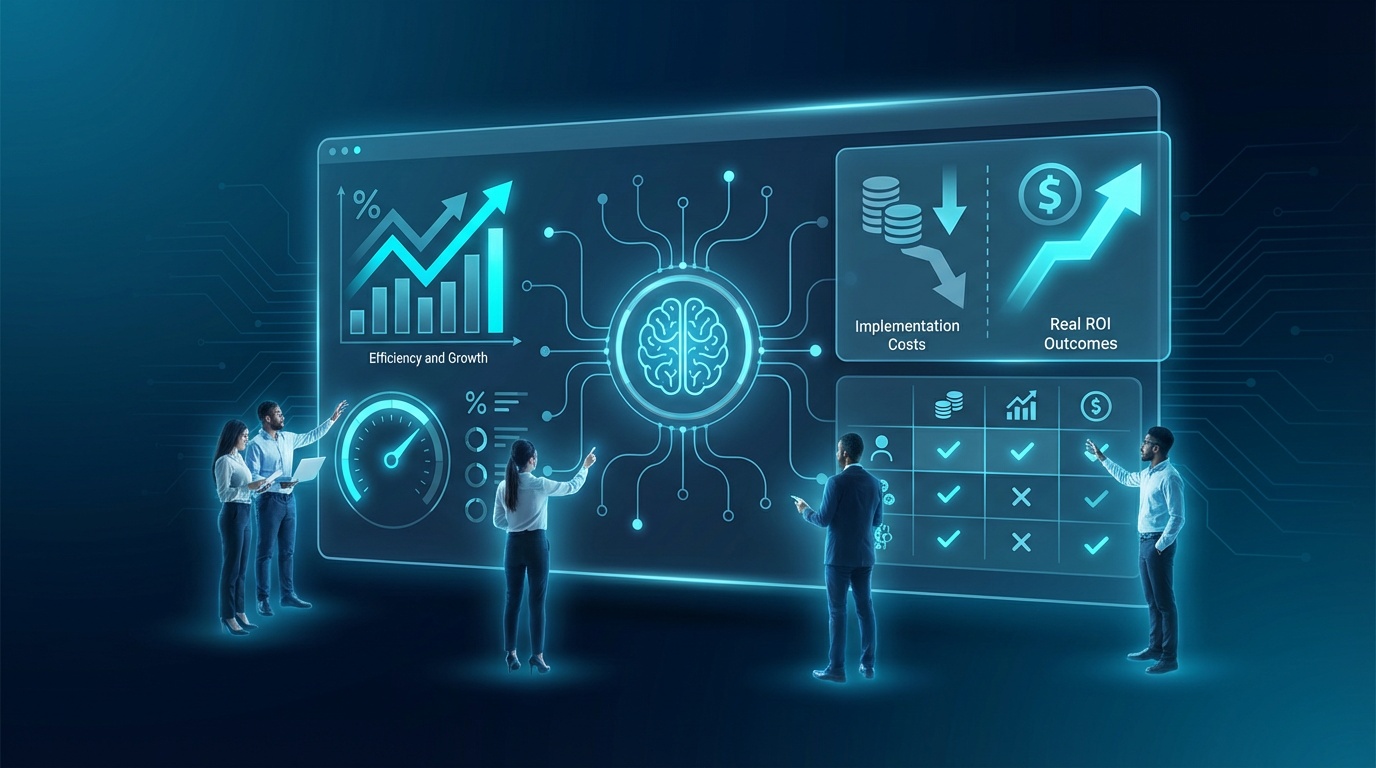
Business decisions require transparent cost-benefit analysis. Hospitality AI agents justify investment through measurable improvements in conversion rates, guest spend, and operational efficiency. Understanding expected returns and implementation requirements helps managers select solutions aligned with their venue’s financial reality and growth objectives.
Expected Gains: From 60% Fewer Abandoned Inquiries to Higher Guest Spend
Vynta AI Agents deliver documented outcomes: 50% booking conversion increases, 60% reductions in customer inquiry abandonment, 25% average guest spend growth, and 30% operational cost reductions. These metrics reflect the combined effect of instant responses, intelligent upselling, and staff time shifting to high-value interactions. Generic alternatives typically achieve 15% to 30% conversion improvements with minimal upselling impact due to limited personalization capabilities. The performance gap widens in luxury segments where guest expectations for personalized service are highest and where misaligned automation can harm brand perception more than in casual dining contexts.
Cost Breakdown and Break-Even Analysis for Mid-Market Venues
Implementation costs vary significantly across solutions. Template-based platforms like Supervity and 10xDS offer monthly subscriptions starting around $500 to $1,500 with quick deployment but limited customization. TrustYou pricing reflects its dual focus on messaging and review management, typically ranging from $1,000 to $3,000 monthly depending on property size. Bespoke solutions like Vynta AI Agents require a higher initial investment for custom development but can deliver stronger ROI through revenue optimization that generic tools often cannot match. A boutique hotel capturing just five additional high-value bookings monthly at $300 average spend can recover typical AI agent costs while freeing staff for guest experience improvements that drive repeat business.
Case Studies from Hotels, Nightclubs, and Restaurants
A premium beach club implemented Vynta AI Agents to handle WhatsApp and Instagram inquiries during peak season, reducing abandoned conversations from 40% to 15% while increasing average party spend through personalized bottle service recommendations. A boutique hotel automated routine reservation modifications and pre-arrival communications, allowing concierge staff to focus on in-person VIP services. An upscale restaurant deployed AI for reservation confirmations and special-occasion upselling, achieving 22% higher per-table revenue through strategic wine pairing and private dining room suggestions. These outcomes reflect the strategic advantage of hospitality-specific AI over generic automation: a practical understanding of guest expectations, revenue moments, and service standards that define premium experiences.
How to Choose and Implement the Right AI Agent for Your Venue
Strategic selection requires matching AI capabilities to your guest journey, team structure, and growth objectives. The framework below guides managers through evaluation and deployment while avoiding common implementation pitfalls that undermine ROI.
Match Tools to Your Guest Journey and Team Size
Map your current guest interaction flow from initial inquiry through post-visit follow-up. Venues with complex upselling opportunities, VIP guest segments, and multichannel communication benefit most from sophisticated agents like Vynta that handle nuanced conversations. Properties with straightforward reservation processes and limited upselling may find sufficient value in simpler solutions. Consider team capacity: smaller staffs gain more from comprehensive automation, while larger teams might prioritize tools that support rather than replace human touchpoints. Luxury positioning demands AI that maintains brand voice consistency, making bespoke development worthwhile despite longer implementation timelines.
Steps for Testing Integrations and Measuring Results
Begin with pilot programs on high-volume, low-complexity channels before expanding to VIP communications. Establish baseline metrics: current conversion rates, average response times, inquiry abandonment percentages, and per-guest revenue. Test CRM integration thoroughly to confirm data synchronization accuracy. Define clear escalation triggers and monitor AI decisions during the first 30 days, refining rules based on real guest interactions. Track automation rates and quality indicators like guest satisfaction scores and staff feedback on workload reduction. Successful implementations show measurable improvement within 60 days across conversion, revenue, and operational efficiency.
Why Custom Vynta-Style Agents Outperform Off-the-Shelf for SMEs
Mid-market hospitality venues often lack the internal AI resources that enterprise hotel chains deploy, yet they compete on personalized service that generic chatbots can undermine. Custom agents designed for luxury hospitality reflect the revenue dynamics, guest expectations, and brand constraints that separate premium from budget experiences. Agentic Systems for Real Estate show how industry-specific AI frameworks outperform generic ones, a principle equally true in hospitality. Vynta AI Agents are bespoke AI agents designed specifically for luxury hospitality venues such as restaurants, premium bars, nightclubs, and beach clubs, delivering outcomes that template solutions often cannot match. This partnership model supports ongoing optimization as guest preferences evolve and seasonal patterns shift, keeping the AI aligned with business goals instead of becoming outdated software that needs replacement.
If you are comparing Vynta AI Agents for Hospitality alternatives, prioritize two checks during evaluation: whether the agent can reliably sync guest data and reservations in real time, and whether escalation rules and manual takeover work cleanly during service hours.
Frequently Asked Questions
What AI agent solutions are available for hospitality operations?
As an Operations Director at Vynta AI, I see a range of AI solutions for hospitality, from bespoke conversational agents like Vynta AI, designed for luxury venues, to platforms focused on back-of-house automation like Supervity AI. The right choice depends on a venue’s specific needs, whether it is guest communication, internal workflows, or a blend of both. Our goal at Vynta AI is to deliver measurable business outcomes by automating guest interactions.
What is an AI platform for hospitality and how does it help managers?
An AI platform for hospitality automates guest interactions and operational tasks, helping managers scale personalized service without increasing staff costs. These systems respond instantly to inquiries across channels, upsell services, and integrate with existing reservation platforms. This frees up human staff to focus on complex requests and VIP guest experiences, directly impacting revenue and guest satisfaction.
Can AI agents completely replace human staff in hospitality?
From my perspective at Vynta AI, AI agents are powerful tools that complement human staff, not replace them. Our Vynta AI agents handle routine inquiries and upselling, allowing human teams to dedicate their expertise to complex guest needs and personalized service. We build systems with strict escalation rules, ensuring VIPs and complex queries always receive human attention.
Why do hospitality managers look for alternatives to Vynta AI Agents?
Managers seek alternatives when their needs are simpler than full conversational handling, if budget constraints favor generic chatbots, or if they operate outside the luxury segment. Some also prioritize features like broader PMS compatibility beyond SevenRooms or faster deployment with prebuilt templates. We understand that different venues have different requirements for their AI solutions.
How do Vynta AI Agents differ from other hospitality AI solutions?
Vynta AI Agents are custom-built for luxury hospitality, focusing on human-like guest conversations, brand-safe upselling, and real-time SevenRooms integration. Alternatives like Supervity AI often prioritize back-of-house workflow automation and broad PMS compatibility, while 10xDS offers basic real-time inquiry responses. Our strength lies in delivering bespoke, guest-facing automation with measurable revenue impact.
What business outcomes can hospitality venues expect from implementing AI agents?
Implementing AI agents can lead to significant business outcomes, such as increasing booking conversion by 50% and reducing customer inquiry abandonment by 60%. Venues can also see an increase in average guest spend by up to 25% through tailored upselling. These systems also help reduce operational costs and ensure instant, consistent guest communication.