
Alternatives to manual booking for beach clubs using AI agents.
The Manual Booking Problem: Why Beach Clubs Lose Revenue and Guest Satisfaction
Beach clubs operate in a high-stakes environment in which every missed inquiry translates directly to lost revenue. When your staff juggles phone calls, walk-ins, and online messages during peak hours, response times stretch from minutes to hours. Industry data shows that response delays beyond five minutes reduce conversion rates by 400%. For beach clubs competing in saturated coastal markets, that lag means guests book elsewhere.
Key Takeaways
- Missed inquiries directly cause lost revenue for beach clubs.
- Manual booking processes overwhelm staff during peak times, leading to slow response rates.
- Response delays exceeding five minutes decrease conversion rates by 400%.
- Slow response times cause potential guests to book with competitors in crowded markets.
Peak hour bottlenecks drain staff and lose bookings
Friday afternoon inquiries pile up as your team manages on-site guest services. A party of eight waits 90 minutes for a cabana quote while your receptionist handles three simultaneous phone calls. By the time staff responds, that group has already reserved at your competitor. Manual processes create artificial scarcity in your availability, not because you lack inventory but because you lack bandwidth.
High OTA commissions erode direct booking margins
Reliance on third-party platforms costs beach clubs 15-25% per reservation in commissions. When direct booking channels require manual monitoring and slow response times, guests default to OTA convenience despite your higher margins on direct sales. The commission drain compounds monthly, reducing profitability on every sunbed and cabana rental.
Missed inquiries outside business hours cost revenue
Your beach club closes at sunset, but booking inquiries arrive at 10 PM when guests plan weekend trips. Without 24/7 responsiveness, you lose bookings to competitors with always-on systems. Late-night and early-morning inquiries represent 30-40% of total booking volume for coastal hospitality operators, yet most beach clubs abandon this revenue window entirely.
Revenue Reality Check: A 50-capacity beach club missing just three bookings daily due to slow response times loses $180,000+ annually at average day-pass rates of $120 per guest.
Inconsistent personalization reduces average booking value
Manual booking workflows rarely capture guest preferences or past behavior. Staff miss upselling opportunities because they lack instant access to guest history during inquiry conversations. A returning VIP receives the same generic quote as a first-time visitor, eliminating chances to suggest bottle service, premium cabanas, or event upgrades that increase transaction value by 35-60%.
| Workflow Aspect | Manual Process | AI-Assisted Process |
|---|---|---|
| Average Response Time | 45-120 minutes | Under 30 seconds |
| After-Hours Coverage | None (voicemail only) | Full 24/7 availability |
| Upsell Consistency | Staff-dependent (20-40%) | Systematic (75-85%) |
| Cost Per Booking | $18-25 (staff time) | $3-6 (automation) |
| Conversion Rate | 12-18% | 28-35% |
How AI Agents Replace Manual Booking: The Complete Workflow
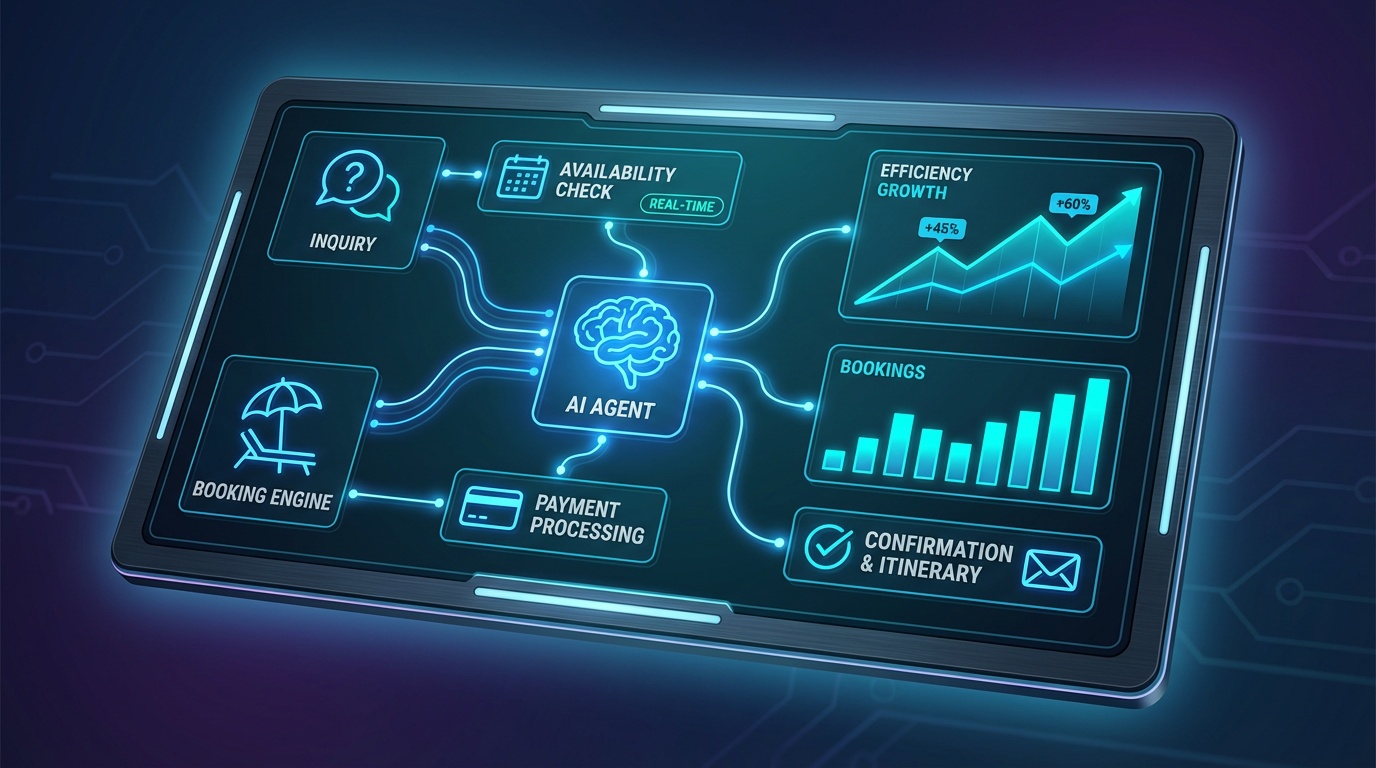
Alternatives to manual booking for beach clubs using AI agents transform every stage of the reservation journey. When a guest inquires about weekend availability, the AI agent instantly accesses your property management system, checks real-time inventory across sunbeds, cabanas, and VIP sections, then delivers accurate pricing within seconds. This eliminates the back-and-forth that characterizes manual processes.
Real-time availability checks and instant quoting
AI agents query your booking system continuously, maintaining synchronized inventory across all channels. When a party of six requests Saturday cabana availability, the agent evaluates capacity, applies dynamic pricing rules based on demand, and presents options with add-on suggestions. The entire availability check completes in under three seconds, matching guest expectations formed by consumer booking experiences in other industries.
End-to-end reservation completion with payment processing
Once guests select their preferred option, AI agents guide them through reservation completion without staff intervention. The system collects guest details, processes deposits or full payments through integrated gateways, sends confirmation emails with arrival instructions, and updates your calendar automatically. Payment security meets PCI compliance standards while maintaining the conversational flow guests expect from hospitality brands.
Personalized upselling based on guest profiles and party size
AI agents analyze booking patterns to suggest relevant upgrades. A couple booking a standard sunbed receives offers for beachfront positioning or lunch reservations. A group of eight triggers automatic cabana suggestions with bottle service packages. Returning guests see personalized options based on previous visits, such as their preferred section or beverage choices, increasing average order value without pushy sales tactics.
Upsell Example: A party of eight arriving Friday evening automatically receives a cabana recommendation plus a bottle service suggestion, increasing transaction value from $960 (standard day passes) to $1,850 (cabana package with beverages).
24/7 responsiveness without staff escalation
AI agents handle inquiries at 2 AM with the same efficiency as 2 PM. Guests planning trips from different time zones receive immediate responses regardless of your local business hours. The system maintains conversation context across multiple exchanges, answering follow-up questions about amenities, cancellation policies, or group discounts without human intervention. Staff only engage when guests request special accommodations that require judgment calls.
System Integrations That Make AI Agents Work for Beach Clubs
AI booking automation requires technical connections to your existing hospitality infrastructure. These integrations determine whether your AI agent functions as a reliable booking channel or creates operational headaches through data inconsistencies and manual workarounds.
PMS and CRS connections for real-time inventory
Your property management system holds authoritative data on availability, pricing, and guest records. AI agents must connect directly to this system through APIs to access real-time information. Without live integration, agents provide outdated availability that leads to double bookings or missed revenue opportunities. Modern PMS platforms like Mews, Cloudbeds, and Opera offer API access that enables seamless synchronization. Explore our Vynta AI Agents for Hospitality to see integrations in action.
Payment gateway integration for secure transactions
Completing reservations requires secure payment processing. AI agents integrate with gateways like Stripe, Adyen, or your existing merchant services to handle deposits and full payments within the booking conversation. This integration maintains PCI compliance while removing friction from the purchase process. Guests complete transactions without leaving the conversation or navigating separate payment portals.
Calendar and capacity management across all revenue streams
Beach clubs generate revenue through multiple channels: day passes, cabana rentals, event bookings, membership programs, and food and beverage services. AI agents need unified visibility across these streams to prevent overbooking and optimize yield. Integration with capacity management tools ensures that accepting a large event booking automatically adjusts day-pass availability for that date.
Channel synchronization to reduce OTA dependency
Many beach clubs distribute inventory through OTAs, their website, social media, and direct channels. AI agents synchronize availability across these touchpoints, updating inventory in real time as bookings occur. This prevents overselling that damages guest relationships while reducing reliance on high-commission OTA platforms by making direct booking channels equally convenient.
Integration Priority: Real-time availability synchronization prevents double bookings and lost revenue. A beach club processing 50 daily bookings across four channels without live synchronization loses an average of 8-12 bookings weekly to inventory conflicts.
| Integration Approach | Capabilities | Tradeoffs |
|---|---|---|
| Full PMS + Payment Integration | Real-time synchronization, autonomous booking completion, zero manual intervention | Higher initial setup cost, 2-3 week implementation timeline |
| Limited Integration (inquiry capture only) | Lead collection, basic qualification, manual booking completion by staff | Lower cost, faster deployment, but requires ongoing staff involvement |
Quantifiable Revenue Impact: What Beach Clubs Can Expect
Alternatives to manual booking for beach clubs using AI agents deliver measurable financial returns within 60-90 days of deployment. The revenue impact stems from four distinct mechanisms: conversion improvement, channel shift economics, transaction value growth, and operational cost reduction.
Conversion lift from instant response and reduced friction
Response time directly affects booking conversion. Beach clubs using AI agents see inquiry-to-booking rates increase from 12-18% to 28-35% because guests receive immediate answers during their decision window. Eliminating multi-step processes, in which guests must email, wait for responses, and then complete separate payment steps, removes abandonment points that cost manual operations 40-60% of potential bookings.
Direct booking growth by reducing OTA commission dependency
When direct channels match OTA convenience through instant availability and payment processing, guests shift booking behavior. Beach clubs report 18-25% increases in direct bookings within three months of AI agent deployment, translating to $15,000-$40,000 in monthly savings from reduced OTA commissions for mid-market operations processing 300-500 monthly reservations.
Average order value increase through intelligent upselling
Systematic upselling outperforms staff-dependent approaches. AI agents suggest relevant upgrades to 75-85% of bookings versus 20-40% in manual workflows, increasing average transaction values by $45-$120 per reservation. A beach club processing 400 monthly bookings gains $18,000-$48,000 in additional monthly revenue from consistent upgrade suggestions alone.
Operational cost savings from staff time reallocation
Automating routine bookings reduces staff hours dedicated to reservation management by 60-75%. A beach club paying two staff members $18 per hour for 40 combined weekly booking hours saves $2,800 monthly in labor costs. Staff redirect time to high-value activities like VIP relationship management and on-site guest services that generate additional revenue and improve satisfaction scores.
Real-world case metrics from hospitality operators
Urban beach club operators implementing AI booking agents report 18% direct booking increases combined with 22% reductions in cost per reservation. Coastal resort properties document 60% decreases in late-night call volume alongside 3.4% monthly revenue lifts from captured after-hours inquiries. These outcomes reflect typical mid-market deployments with standard PMS integrations and payment gateway connections.
Combined Impact: A 50-capacity beach club implementing AI booking automation typically sees $8,000-$15,000 in monthly revenue increases from conversion improvements, $12,000-$25,000 in additional upsell revenue, and $2,500-$4,000 in labor cost savings, delivering 4-7 month payback periods on implementation investment.
| Metric | Before AI Agents | After AI Agents | Impact |
|---|---|---|---|
| Average Response Time | 45-120 minutes | Under 30 seconds | 98% reduction |
| Inquiry Conversion Rate | 12-18% | 28-35% | +133% improvement |
| Cost Per Booking | $18-25 | $3-6 | 75% decrease |
| After-Hours Bookings | 0-5% of total | 30-40% of total | 700% increase |
| Average Transaction Value | $120-150 | $165-270 | +38-80% |
Custom AI Agents for Beach Club Scenarios: Events, VIP Services, and Membership Automation
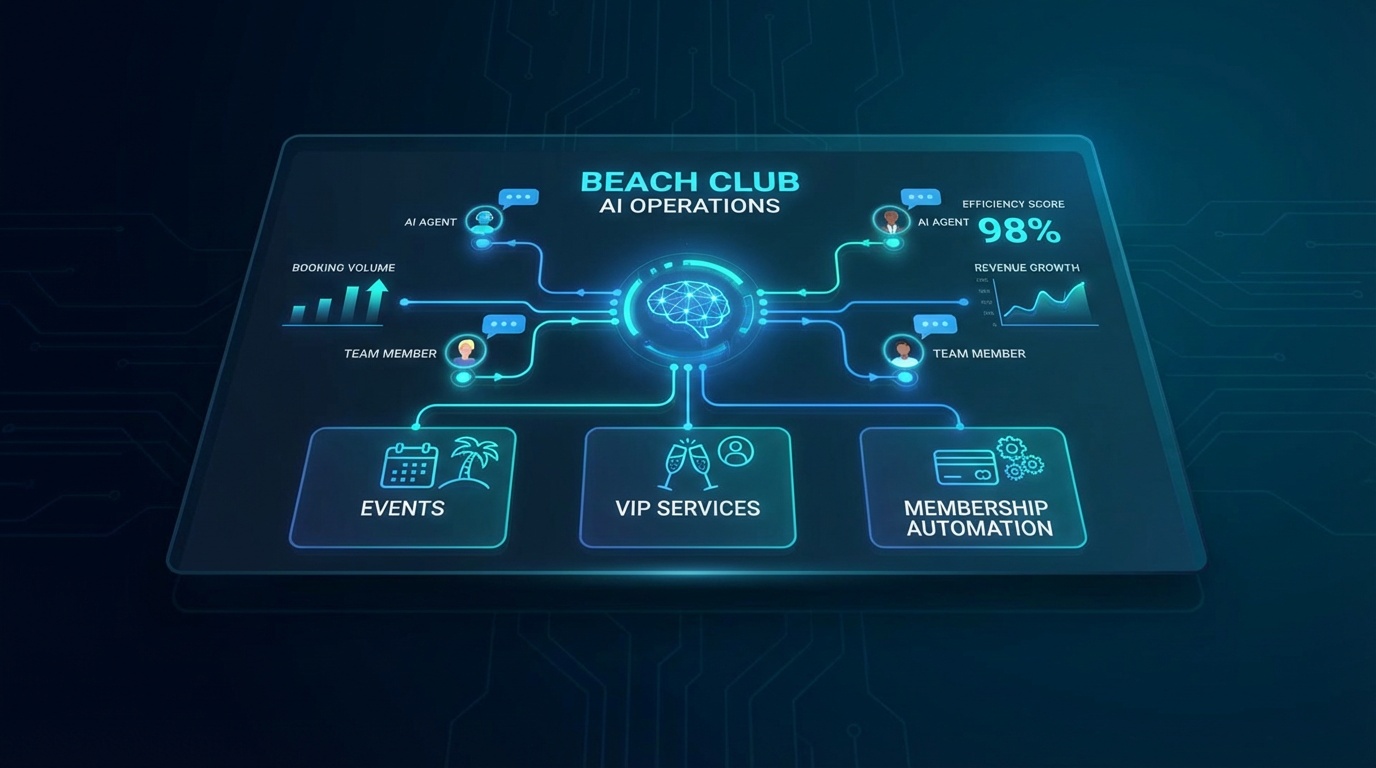
Generic chatbots fail in beach club environments because they lack context for hospitality complexity. Custom AI agents built specifically for alternatives to manual booking for beach clubs using AI agents handle event workflows, VIP recognition, and membership program details that differentiate premium operations from commodity day-pass vendors.
Event-based booking workflows for DJ nights and sunset parties
Beach club events require different booking logic than standard day passes. AI agents recognize event inquiries and apply appropriate pricing tiers, minimum spend requirements, and table assignment rules. When guests book for Saturday night DJ events, the system automatically suggests bottle service packages, applies group minimums, and coordinates table reservations that align with your floor plan and service capacity.
VIP table assignment and seasonal membership program management
Returning VIP guests and members expect recognition and preferential treatment. Custom AI agents access guest history to identify high-value customers, automatically offer best-available table positions, and suggest complimentary upgrades that strengthen relationships. Membership inquiries trigger specialized workflows that explain program benefits, calculate seasonal pricing, and process enrollment without staff involvement.
VIP Recognition Example: A returning guest who spent $3,200 across four previous visits automatically receives a best-table offer plus a complimentary champagne upgrade suggestion, increasing the likelihood of a fifth booking and reinforcing premium positioning.
Smart personalization using guest history and preferences
AI agents analyze past bookings to customize recommendations. A couple who previously booked beachfront sunbeds with lunch service receives similar suggestions for a future visit. Groups that added bottle service see those options highlighted automatically. This personalization increases conversion because suggestions align with demonstrated preferences rather than generic upselling scripts.
Group Composition Intelligence: A 10-person party booking for the weekend receives an AI-generated suggestion for a premium cabana, two bottle service options matched to party size, and lounge seating add-ons, increasing the average transaction from $1,200 to $2,400.
Escalation rules that preserve the human touch for complex requests
Custom AI agents recognize when situations require human judgment. Requests for corporate events, wedding celebrations, or special dietary accommodations trigger automatic handoffs to staff with full conversation context. The AI handles qualification and information gathering, then transfers the request to your team for relationship-building and customization that justify premium pricing.
AI Agents vs. Manual Booking: Feature Comparison and When to Escalate
Understanding AI capability boundaries helps beach club managers set realistic expectations and design effective human-AI collaboration models. Most operations find that AI agents autonomously handle 70-85% of booking inquiries while staff focus on relationship-driven interactions that command higher margins.
What AI agents handle autonomously (70%+ of inquiries)
Standard booking requests, availability checks, pricing quotes, payment processing, confirmation delivery, and systematic upselling operate without human involvement. AI agents manage routine group bookings, membership renewals, event ticket sales, and modification requests that follow predictable patterns. After-hours inquiries, multilingual support, and FAQ responses complete autonomously, freeing staff for on-site guest services.
When human agents take over (VIP requests, special accommodations)
Corporate event planning, wedding celebrations, influencer partnerships, and custom catering arrangements require human expertise. VIP guests expecting personal relationships with management trigger staff notifications for direct outreach. Unusual requests like accessibility accommodations, pet policies, or off-menu services escalate automatically because they involve judgment calls that affect brand reputation and guest satisfaction.
Handoff workflows that maintain service quality
Effective AI-to-human transitions preserve conversation context and guest information. When escalation occurs, staff receive complete inquiry history, guest profile data, and AI-suggested options, eliminating repetitive questions that frustrate customers. The handoff appears seamless from the guest perspective, maintaining the premium service expectations that justify beach club pricing.
Operational Rule: AI handles routine bookings that follow standard patterns; humans handle relationships and exceptions that require creativity, negotiation, or brand judgment. This division maximizes both efficiency and guest satisfaction.
Choosing the Right AI Agent Provider for Your Beach Club Size
Beach club operations vary dramatically in complexity and scale. A 30-capacity urban rooftop beach club has different automation needs than a 200-capacity coastal resort property. Generic chatbot platforms like Intercom or Drift capture leads but lack hospitality-specific logic for table assignment, capacity management, and revenue optimization. Specialized solutions like Profitroom AI offer hotel-focused features but miss beach club nuances around day-pass inventory, event workflows, and outdoor seating dynamics.
Custom AI agents built specifically for beach club operations deliver the highest ROI for mid-market properties processing 200-800 monthly bookings. These solutions integrate with your existing PMS, apply your specific pricing rules, and handle the event-based booking complexity that distinguishes beach clubs from traditional hospitality venues. Properties below 200 monthly bookings may find implementation costs exceed short-term returns, while operations above 800 monthly bookings justify enterprise platforms with dedicated support teams. Learn about our Vynta AI Agents for Hospitality designed for these needs.
| Solution Type | Best For | Strengths | Limitations |
|---|---|---|---|
| Generic Chatbots (Intercom, Drift) | Lead capture only | Low cost, fast deployment, familiar interfaces | No PMS integration, no payment processing, no hospitality logic |
| Hotel-Focused AI (Profitroom) | Traditional lodging properties | Room inventory management, multi-night bookings | Limited event workflows, weak day-pass logic, lacks beach club customization |
| Custom Beach Club Agents (Vynta AI) | Mid-market beach clubs (200-800 monthly bookings) | Event workflows, capacity optimization, VIP recognition, full PMS integration | Higher initial investment, requires a technical integration phase |
Implementation Strategy: Moving from Manual to AI-Powered Bookings
Successful AI adoption follows a phased approach that minimizes operational disruption while building confidence in automation reliability. Beach club managers who attempt full-scale deployment without testing workflows risk guest experience failures that damage brand reputation. Strategic implementation balances speed with validation.
Audit your current booking workflows and pain points
Document where manual processes fail most frequently. Track response times during peak hours, measure after-hours inquiry volume, identify common upselling misses, and calculate current cost per booking. This baseline establishes clear improvement targets and helps prioritize which workflows to automate first. Most beach clubs discover that 60-70% of inquiries follow predictable patterns suitable for immediate automation.
Select integrations based on your PMS and payment infrastructure
Confirm that your property management system offers API access for real-time availability synchronization. Verify payment gateway compatibility with your merchant services provider. Beach clubs using modern platforms like Mews, Cloudbeds, or Sevenrooms typically complete integration in 10-15 business days. Legacy systems may require middleware solutions that add 2-3 weeks to deployment timelines but remain technically feasible.
Pilot with a single revenue stream (e.g., day-pass bookings)
Begin automation with your highest-volume, lowest-complexity booking type. Day-pass reservations provide an ideal testing ground because they follow standardized pricing, require minimal customization, and generate sufficient transaction volume for meaningful performance measurement. Run the pilot for 30 days while maintaining manual backup processes, allowing staff to validate AI accuracy before expanding scope.
Quick Win Strategy: Deploy AI agents for off-hours inquiries first. Measure response time improvement and conversion lift before a full rollout. This approach delivers immediate ROI without disrupting peak-hour operations, during which staff already manage workload effectively.
Measure baseline metrics and set realistic improvement targets
Track inquiry-to-booking conversion rates, average response times, cost per reservation, and transaction values throughout the pilot phase. Compare AI-handled bookings against manual benchmarks to quantify performance gains. Realistic targets for the first 60 days include 15-25% conversion improvements, 90%+ response time reductions, and 20-35% increases in upsell attachment rates.
Scale to event bookings, VIP reservations, and membership programs
Once day-pass automation proves reliable, expand to event workflows that require table assignment logic and minimum spend enforcement. Add VIP recognition rules that trigger personalized offers based on guest history. Implement membership program automation last because these workflows involve longer sales cycles and relationship-building that benefit from refined AI training. Full deployment typically completes within 90-120 days from the initial pilot launch.
Alternatives to manual booking for beach clubs using AI agents represent operational transformation, not technology installation. Beach club managers who approach implementation as process redesign rather than software deployment achieve faster adoption and higher returns. The goal is not eliminating human expertise but redirecting it toward high-value interactions that justify premium positioning and drive guest loyalty.
Strategic Recommendations for Beach Club Operators
Mid-market beach clubs face a decision point. Manual booking processes that functioned adequately five years ago now cost 20-30% of potential revenue through slow response times, missed after-hours inquiries, and inconsistent upselling. Competitors deploying AI automation gain compounding advantages in direct booking share, operational efficiency, and guest satisfaction scores.
Properties processing 200-800 monthly bookings represent the optimal fit for custom AI agent deployment. Operations below this threshold may find manual processes adequate until growth justifies automation investment. Properties exceeding 800 monthly bookings should prioritize AI implementation immediately because revenue leakage scales with transaction volume, costing $15,000-$40,000 monthly in missed opportunities.
The competitive moat widens quarterly. Beach clubs implementing alternatives to manual booking for beach clubs using AI agents in 2025 capture market share from slower-moving competitors while building guest databases enriched with preference data that powers increasingly sophisticated personalization. Delaying adoption means ceding direct booking volume to OTAs and losing high-value guests to competitors offering superior convenience.
Start with off-hours automation to prove ROI without operational risk. Measure results for 60 days, then expand to peak-hour workflows and complex booking scenarios. This phased approach delivers quick wins that fund broader deployment while building organizational confidence in AI reliability. Beach clubs that wait for perfect conditions never implement, while early adopters compound advantages that become insurmountable over 18-24 month horizons.
Many beach clubs distribute inventory through Reservation system channels that include OTAs, their website, social media, and direct channels, synchronizing availability in real time and reducing overbooking risks.
Complementing these channels with capacity management and dynamic pricing principles from Revenue management optimizes yield while maintaining guest satisfaction and operational efficiency.
AI agents operate based on continuous communication with your booking system, ensuring accurate real-time availability and seamless guest interactions across all revenue streams.
Frequently Asked Questions
How can AI agents assist with beach club bookings?
As Operations Director at Vynta AI, I see how AI agents transform the booking journey for beach clubs. They instantly access your property management system, check real-time inventory, and deliver accurate pricing within seconds. This eliminates the manual back-and-forth, allowing for end-to-end reservation completion and personalized upsells.
What distinguishes an AI-powered booking system from a standard automated system?
An AI-powered booking system goes beyond basic automation by understanding context and personalizing interactions. It integrates with your property management system for real-time data, offering dynamic pricing and tailored upsell suggestions that a simple automated system cannot. This intelligence helps capture more bookings and improve guest satisfaction.
How do AI agents personalize guest experiences for beach club reservations?
AI agents analyze guest profiles, booking patterns, and party size to suggest relevant upgrades, such as beachfront sunbeds or bottle service packages. For returning guests, they can offer options based on previous visits, like their preferred section or beverage choices. This systematic personalization increases average order value without pushy sales tactics.
What problems do beach clubs face with manual booking processes?
Manual booking leads to significant revenue loss due to missed inquiries, slow response times, and lost bookings, especially during peak hours or outside business hours. It also creates artificial scarcity in availability and results in inconsistent personalization. This often forces reliance on third-party platforms, eroding direct booking margins.
What integrations are needed for AI agents to work effectively for beach clubs?
For AI agents to function as reliable booking channels, they require direct connections to your existing hospitality infrastructure. This includes property management systems (PMS) and central reservation systems (CRS) to access real-time inventory, pricing, and guest records. These integrations ensure data consistency and smooth operations.
How do AI agents improve conversion rates for beach club bookings?
AI agents provide instant responses and real-time availability checks, addressing inquiries within seconds, which significantly improves conversion rates. By offering 24/7 responsiveness and personalized options, they capture bookings that would otherwise be lost to delays or competitors. This ensures your beach club never misses a booking opportunity.