

AI-Powered Fundraising Platform tutorial
What is an AI-Powered Fundraising Platform tutorial?
An AI-Powered Fundraising Platform tutorial teaches fundraising organizations how to implement intelligent automation systems that identify, qualify, and engage potential donors at scale. You’ll learn to set up AI agents that analyze donor behavior patterns, personalize outreach sequences, and automate follow-up communications while maintaining the authentic relationships that drive successful fundraising.
The training focuses on configuring machine learning models to score donor prospects, predict giving capacity, and optimize communication timing. You’ll train AI systems on your organization’s historical fundraising data to identify which prospects warrant human attention and which can be nurtured through automated workflows. The curriculum covers integration with existing donor management systems, email platforms, and analytics tools to create a unified operation.
Expect to deploy AI agents that automate donor research, qualification, and initial outreach while your team focuses on relationship-building and closing major gifts. Most organizations complete platform setup, workflow configuration, and performance optimization in 2–4 weeks.
Benefits of an AI-Powered Fundraising Platform tutorial
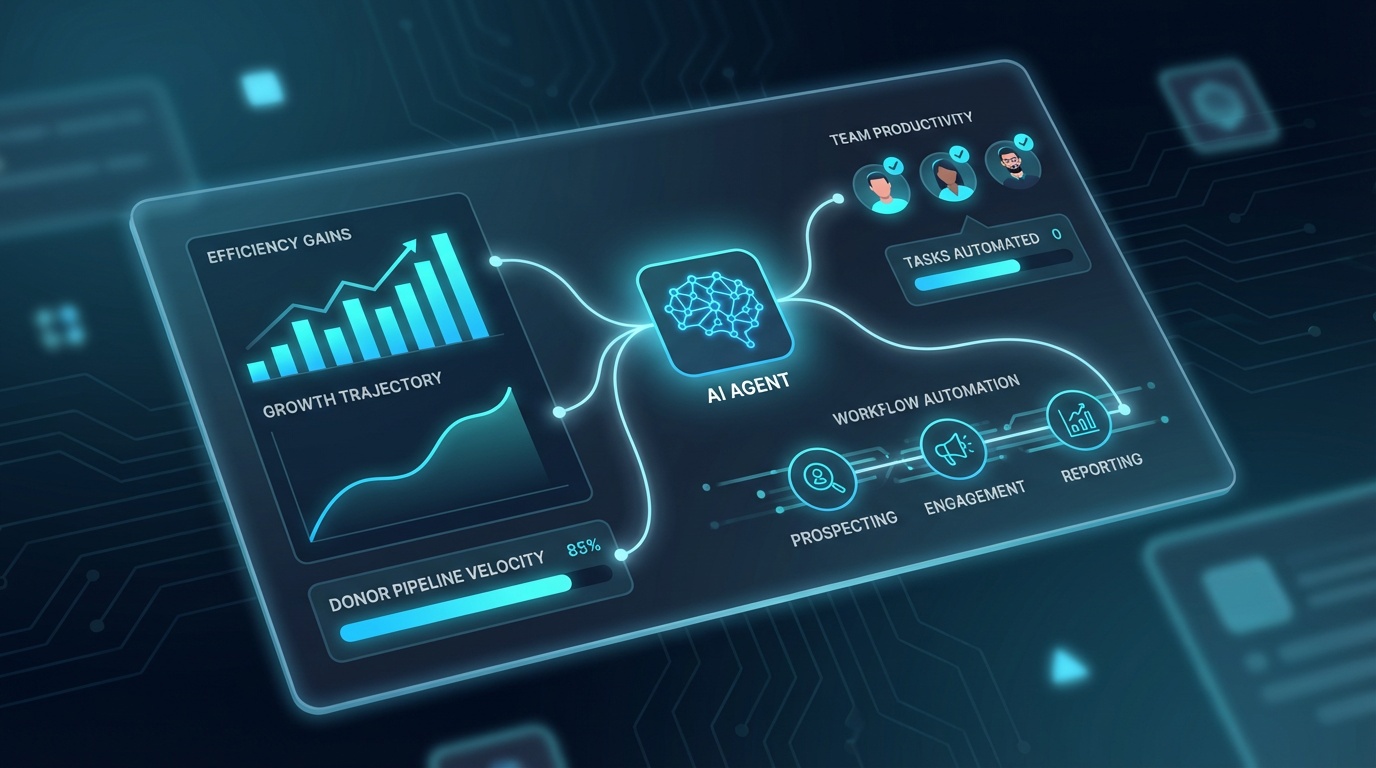
Organizations that complete AI fundraising automation training typically reduce manual prospect research time by 15–20 hours per week, allowing development officers to focus on relationship management. AI agents process large volumes of donor profiles and surface qualified prospects that human teams often miss.
The financial impact is measurable. Automated qualification and personalized outreach sequences generate 40–60% higher response rates compared to generic email campaigns. Your team maintains consistent communication with 3–5x more prospects simultaneously, eliminating cold leads due to bandwidth constraints. AI-driven donor scoring highlights giving-capacity signals and routes higher-potential prospects to your strongest closers.
Day-to-day operations transform. I’ve seen teams eliminate repetitive data entry, follow-up scheduling, and manual list segmentation that previously consumed 10+ hours weekly. Real-time analytics dashboards provide visibility into pipeline health, campaign performance, and AI agent effectiveness—supporting data-informed adjustments that improve ROI across your donor acquisition program.
How to choose an AI-Powered Fundraising Platform tutorial
Select training that matches your fundraising motion and donor database size. Foundation grant-focused teams need different configurations than individual donor programs or corporate sponsorship teams. Strong tutorials include workflow templates aligned to your specific use case.
Prioritize hands-on implementation guidance over high-level overviews. Look for step-by-step configuration instructions, sample prompt frameworks for donor communications, and troubleshooting steps for common integration challenges. The best resources share realistic performance benchmarks from similar organizations—not just aspirational case studies.
Evaluate technical requirements carefully. Effective tutorials specify required integrations with your donor management system, email platform, and data sources. They explain data preparation, including how to clean historical fundraising records for model training. Skip tutorials that require extensive coding unless your team has developer resources.
Implementation support determines success. Choose tutorials backed by expert access for configuration questions tied to your donor segments. Post-launch optimization guidance matters too—helping you refine performance based on real campaign results rather than treating setup as a one-time task.
Advanced implementation strategies
Configure donor segmentation rules that align automation with your giving tiers and prospect categories. Major gift prospects ($100K+) need a different nurture path than mid-level donors ($5K–$25K) or first-time contributors. Set up conditional workflows that route high-capacity prospects to senior development officers while AI agents manage high-volume communication for lower-tier segments.
Train your AI agents on successful past communications. Use historical emails that generated meetings, call notes that led to commitments, and case statements that connected with specific donor profiles. The platform learns your organization’s voice and adapts messaging to match proven patterns. I’ve found that A/B testing automated sequences reveals which subject lines, calls to action, and story angles drive the strongest response across segments.
Integrate wealth screening data and philanthropic databases to strengthen prospect research. Connect your platform to public records, foundation databases, and business intelligence sources that indicate giving capacity. AI agents cross-reference that data with engagement signals—website visits, event attendance, email interactions—to generate composite donor scores. This multi-factor analysis surfaces prospects with both capacity and genuine interest in your mission.
Establish benchmarks and optimization cycles from day one. Track metrics like prospect-to-meeting conversion rate (target: 8–12%), average response time (target: under 24 hours), and cost per qualified donor across automated versus manual processes. Schedule monthly reviews to refine prompts, adjust scoring rules, and update nurture sequences based on results.
Common implementation challenges
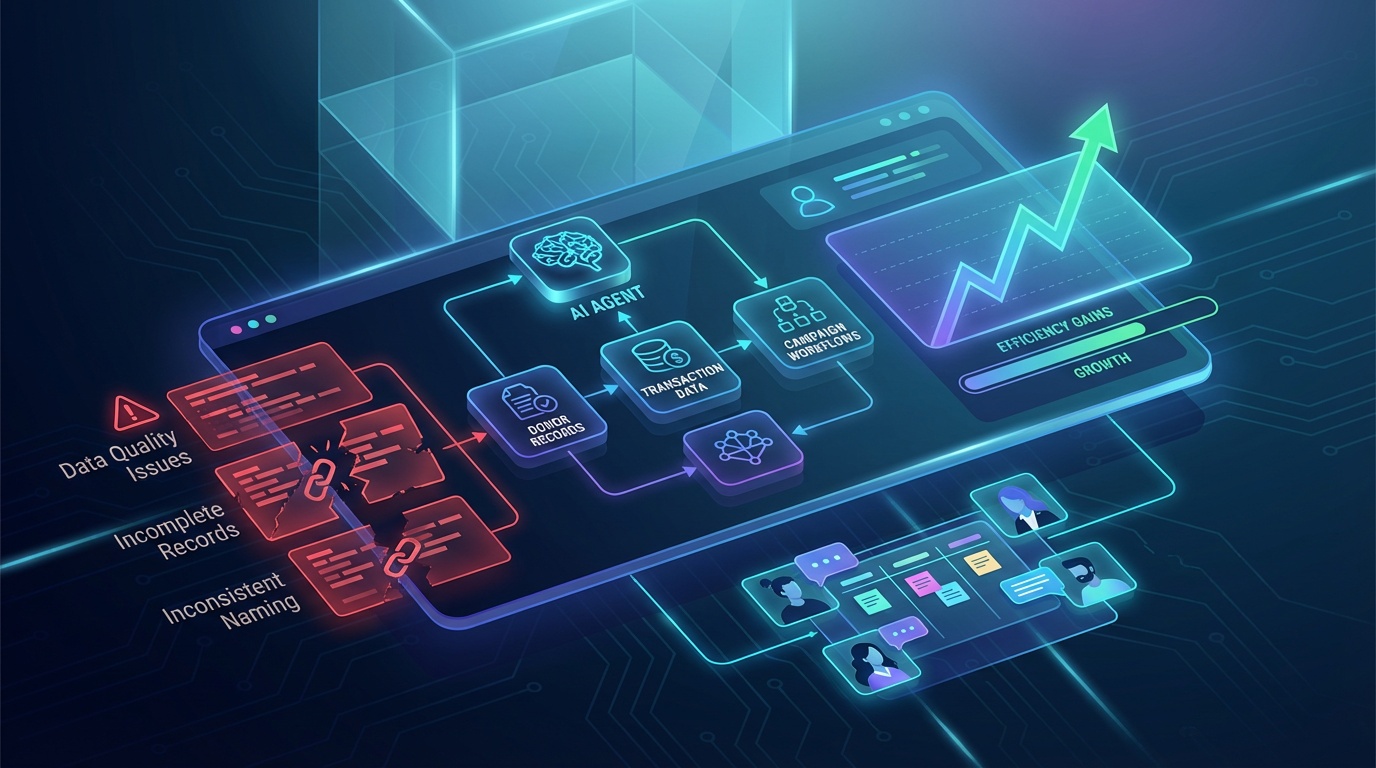
Data quality issues derail many implementations before they start. Incomplete donor records, inconsistent naming conventions, and outdated contact information tank AI accuracy. Dedicate 2–3 weeks to data cleanup before activation: standardize fields, remove duplicates, validate email deliverability. Skipping preparation leads to poor performance and wasted time troubleshooting problems rooted in data hygiene.
Team resistance to automation is real. Development officers used to manual prospecting may see AI agents as threats rather than tools. Address this with clear communication about how automation reduces admin work while keeping relationship-building with humans. Involve the team in workflow design. Show early wins—like 15 hours saved on research—and resistance fades quickly.
Maintaining an authentic tone at scale is tricky. Generic AI-generated messages damage trust and reduce response rates. Invest time in prompt guidance that reflects your mission, voice, and donor etiquette. Review early outputs closely and iterate. Reserve sensitive communications—donor grievances, major gift solicitations, board interactions—for people while automating routine follow-ups and information requests.
Integration with existing systems
Successful implementation depends on tight connections between your donor management system, communication tools, and the AI automation layer. Start by mapping your stack: where does contact information live? Giving history? Engagement data? Communication logs? Most platforms integrate with popular donor CRMs via API connections that sync data both ways, so AI agents work from current records and update the CRM after each interaction.
Email platform integration affects outreach scale and deliverability. Connect your system to an email service that protects sender reputation and provides engagement analytics. Configure triggers that notify AI agents when donors open emails, click links, or reply. These signals feed scoring rules that adjust priority and follow-up timing automatically.
Calendar and meeting scheduling tools complete the loop. After a positive reply, AI agents can propose times, send invitations, and add preparation notes to a development officer’s calendar. This eliminates back-and-forth and helps the team focus on meeting prep instead of coordination logistics.
Integration priority: Start with donor CRM connectivity, then email, then calendars. Each layer builds on the previous one to support automated prospect-to-meeting workflows.
Measuring ROI and performance
Track time savings as a primary efficiency metric during the first 90 days. Calculate hours previously spent on research, list building, email drafting, and follow-up scheduling—then compare that to the time required to supervise and refine automated flows. Most teams free up 12–20 hours weekly for higher-value work like donor meetings, proposal writing, and stewardship.
Pipeline velocity shows impact on outcomes. Measure time from prospect identification to first meaningful engagement, then track movement through qualification to a scheduled meeting. Compare stage conversion rates for AI-sourced prospects versus traditionally sourced prospects to confirm quality holds while volume increases. We’ve seen fundraising teams reduce qualification time from 3–4 weeks to 5–7 days.
Revenue attribution ties activity to results. Tag AI-initiated relationships in your CRM and track them through cultivation to commitment. Compare acquisition cost and total dollars raised by campaign type to decide where automation pays off and where the process needs adjustment. One client reduced cost-per-acquired-donor from $485 to $127 while doubling outreach volume.
Scaling your AI fundraising operations
Expand AI agent responsibilities in phases as the team gains confidence and workflows stabilize. Start with research and initial outreach, then add scoring, meeting scheduling, and post-event follow-up. Run each phase for 4–6 weeks with monitoring before adding complexity. Rushing this causes confusion and undermines trust.
Once core workflows perform well, scale across segments. Reuse proven campaign templates to run parallel initiatives by region, demographic, giving category, or program area. AI agents absorb volume without a matching increase in headcount. Monitor results by segment and shift attention to where performance is strongest. If corporate sponsorships convert at 14% but foundation grants convert at 6%, double down on the corporate workflows.
More advanced capabilities become useful once the platform accumulates performance data. Predictive giving models improve with completed campaigns. Language generation becomes more personalized when trained on your actual communications and donor responses. Ongoing optimization turns an initial deployment into a repeatable growth system.
At Vynta AI, we pair platform adoption with practical operations support: a clear owner, a measurement plan, and a monthly optimization cadence. That structure keeps automation aligned to your fundraising strategy and your team’s capacity. Learn about our comprehensive AI Automation Services to enhance your fundraising operations.
For deeper insights into AI fundraising and how machine learning is transforming donor engagement, explore specialized learning paths offered by industry leaders.
Mastering storytelling techniques is critical for success. Consider courses on AI-powered digital storytelling for fundraising tools to craft compelling narratives that connect donors authentically to your mission.
Frequently Asked Questions
How can AI be used for fundraising?
AI-powered fundraising platforms help organizations identify, qualify, and engage potential donors at scale. They automate tasks like donor research, personalizing outreach sequences, and managing follow-up communications. This allows your team to focus on building authentic relationships and securing major gifts.
What should I expect to learn from an AI-powered fundraising platform tutorial?
A tutorial guides you through configuring machine learning models to score donor prospects, predict giving capacity, and optimize communication timing. You’ll learn to train AI systems on your historical data and integrate them with existing donor management and email platforms. The focus is on platform setup, workflow configuration, and performance optimization.
How long does it typically take to implement an AI fundraising platform?
From my experience, organizations can expect to complete the platform setup, workflow configuration, and initial performance optimization within 2–4 weeks of starting a dedicated tutorial. This timeframe allows for proper training and integration with your existing systems.
How do I choose the right AI fundraising platform tutorial for my organization?
It’s important to select a tutorial that aligns with your specific fundraising motion and donor database size. Look for hands-on implementation guidance, step-by-step configuration instructions, and realistic performance benchmarks. Also, ensure the tutorial specifies technical requirements and offers expert implementation support.
What are some advanced ways to use AI in fundraising?
Advanced strategies include configuring donor segmentation rules to create tiered nurture paths for different prospect categories. You can train AI agents on your successful past communications to replicate your organization’s voice and messaging. Integrating wealth screening data and philanthropic databases also strengthens prospect research, allowing AI to generate composite donor scores.
What benefits can an AI fundraising tutorial bring to my team?
Mastering AI fundraising automation can significantly improve donor pipeline velocity and team productivity. It reduces manual prospect research time, allowing development officers to focus on relationship management. Your team can maintain consistent communication with more prospects, reducing the risk of promising leads going cold due to bandwidth constraints.