

top Agentic Systems for Recruitment 2026
Why Agentic Systems Are Transforming Recruitment in 2026
Recruitment firms face an impossible equation. Candidates expect responses within hours. Clients demand faster placements. And administrative work? It’s consuming 60–70% of recruiter time.
The top agentic systems for recruitment 2026 solve this by moving beyond simple task automation. They handle entire processes autonomously—from CV collection through interview scheduling—without waiting for approval at every decision point.
The Shift From Task Automation to Autonomous Workflows
Traditional recruiting tools require constant human input at every decision point. An application comes in. You review it. You decide to screen. You initiate contact. You schedule. Repeat 50 times per day.
Agentic systems break this pattern. They make independent decisions based on learned criteria, processing applications across multiple job boards and initiating engagement without waiting for recruiter approval.
Think of it like the difference between a dishwasher and a cleaning service. One handles the task when you load it. The other manages the entire kitchen independently.
Speed, Cost, and Quality: The Business Case
A bad hire costs between $15,000 and $25,000. That’s recruitment expenses, training, and lost productivity combined.
Agentic systems cut hiring cycles by over 60% while maintaining 85% candidate matching accuracy. Recruitment firms I’ve worked with report placement increases exceeding 50% within months of implementation. Consultants reclaim roughly 2 hours per hire—time previously lost to administrative coordination.
Cost Reality: A single bad hire costs $15K–$25K. Agentic systems reduce time-to-hire by over 60% while improving match quality through systematic assessment that reduces gut-feel decisions.
What Makes Agentic AI Different
Your ATS stores data. Automation tools execute predefined sequences.
Agentic systems? They operate autonomously across the full recruitment lifecycle. Processing over 100,000 CVs daily. Screening candidates in under 10 seconds. Engaging prospects through WhatsApp 24/7. Coordinating interview logistics with minimal human intervention.
The difference is operational independence. You get scale without headcount.
Top Agentic Systems for Recruitment: Platform Comparison
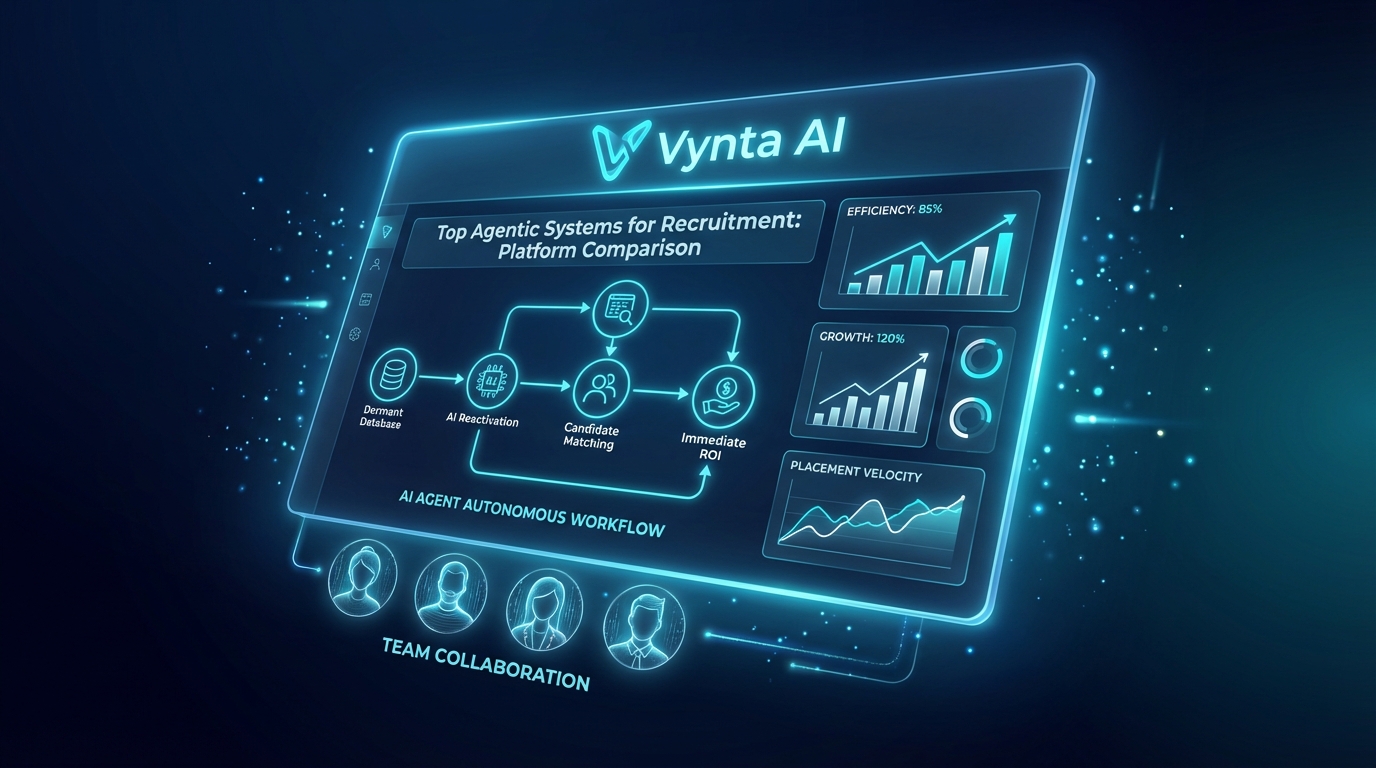
Vynta AI: Purpose-Built for Mid-Market Recruitment Firms
Best for: Recruitment agencies seeking immediate ROI through dormant database reactivation and multichannel candidate sourcing.
Vynta AI delivers measurable outcomes for recruitment firms without enterprise budgets or internal AI teams. We integrate with existing ATS platforms to automate CV processing from CV Library, Indeed, Reed, TotalJobs, and LinkedIn.
What separates us? The 18% dormant database reactivation rate. We’re recovering previously unusable candidate data and converting it into placements. Firms report a 33% reduction in administrative tasks and placement increases exceeding 50% within months.
Our platform handles end-to-end workflows:
- Automated CV collection and processing
- Candidate screening in under 10 seconds
- 24/7 engagement through WhatsApp Business API
- Automated interview scheduling with confirmations and reminders
- Branded candidate profile generation for client submissions
Consultants shift from administrative coordination to relationship building. Higher-quality placement decisions. Real strategic work.
Paradox: High-Volume Hiring at Scale
Best for: Enterprise organizations with thousands of monthly hires across standardized roles.
Paradox specializes in conversational AI for candidate screening and interview coordination at massive scale. It performs well in retail, hospitality, and logistics sectors where hiring volume prioritizes speed over deep customization.
Pros
- Handles thousands of simultaneous candidate conversations
- Strong integration with enterprise HRIS systems
- Proven track record with Fortune 500 clients
Cons
- Enterprise pricing can be prohibitive for mid-market firms
- Limited customization for specialized recruitment needs
- Requires significant implementation resources
Moonhub: Lean Teams Scaling Without Headcount
Best for: Startups and tech companies prioritizing specialized talent acquisition with minimal recruiting staff.
Moonhub focuses on proactive sourcing for technical and executive roles. AI identifies passive candidates and initiates personalized outreach campaigns automatically.
What to Prioritize When Selecting Your Platform
Match platform capabilities to your hiring volume and specialization.
High-volume generalist hiring? Conversational screening at scale.
Specialized recruitment? You need multichannel sourcing, database reactivation, and branded candidate presentation.
Mid-market agencies should prioritize rapid ROI through immediate productivity gains. Not long-term infrastructure buildouts that delay value.
Core Capabilities That Deliver ROI in Recruitment
Autonomous Talent Sourcing Across Multiple Channels
Stop checking multiple job boards daily. Agentic systems automatically collect and process applications from CV Library, Indeed, Reed, TotalJobs, and LinkedIn simultaneously.
They process over 100,000 CVs per day, identifying qualified candidates while you focus on client relationships. Database reactivation recovers 18% of previously unusable ATS data—converting forgotten candidates into active placements without added sourcing costs.
Intelligent Screening With Bias Detection
Manual CV screening takes 15–20 minutes per candidate. Agentic systems complete this in under 10 seconds while maintaining 85% matching accuracy.
They learn qualification criteria from successful placements, applying consistent evaluation standards that reduce unconscious bias. This improves quality-of-hire metrics while cutting time spent on unqualified applications.
Speed Matters: 52% of candidates abandon application processes that take longer than 48 hours to respond. Agentic systems engage qualified prospects within minutes.
Dynamic Candidate Engagement and Personalization
Automated engagement through WhatsApp Business API keeps candidates warm. Systems send personalized updates, answer common questions, and nurture prospects through the pipeline.
Continuous touchpoints reduce the abandonment that occurs when communication delays exceed 48 hours.
Interview Scheduling and Coordination
Coordinating interviews consumes hours of back-and-forth emails. Agentic platforms handle complete scheduling workflows: checking availability across multiple calendars, sending confirmations, delivering automated reminders, and providing preparation materials.
This saves roughly 2 hours per hire while creating a professional candidate experience.
Onboarding Automation and Retention Prediction
The administrative burden doesn’t end at placement. Leading systems generate branded candidate profiles and go-to-market documents for client submissions, removing hours of manual formatting work.
Standardized documentation keeps quality consistent across placements while freeing consultants for client advisory work instead of document production.
Implementation Reality: Getting Agentic Systems Live
Integration Requirements: ATS, HRIS, and Existing Tools
Agentic systems work through integration with your existing ATS—not as a replacement. The connection enables automated CV processing, candidate data synchronization, and workflow triggers without disrupting established processes.
Mid-market firms should prioritize platforms offering prebuilt integrations with common ATS providers. Custom development projects delay time-to-value.
Phased Rollout Approach for Mid-Market Teams
Start with one high-volume role or client. Demonstrate ROI before full deployment.
This contained pilot helps recruiters build confidence with AI-driven workflows while proving measurable improvements. Firms typically expand system usage across roles within three to six months after early success.
Shifting Recruiter Roles From Administrator to Strategist
Administrative tasks drop by 33%. How consultants spend their time changes completely.
Instead of processing CVs and coordinating schedules, recruiters focus on client relationship development, market intelligence, and candidate consultation. This role shift improves job satisfaction while driving revenue through higher-value work that AI supports—not replaces.
Role Transformation: Recruiters shift from spending 60–70% of time on administration to strategic activities that directly impact placement quality and client retention.
Measuring ROI: KPIs That Matter
Track time-to-hire, cost-per-hire, quality-of-hire, candidate satisfaction scores, and placement retention rates.
Hiring cycles drop by over 60%. You save roughly 2 hours per hire. This translates to capacity increases without headcount expansion.
Monitor dormant database reactivation rates and administrative time allocation to quantify efficiency gains beyond placement volume.
The Competitive Advantage: What Agentic Recruitment Means for Your Business
Speed as a Differentiator in Talent Wars
The best candidates receive multiple offers within days.
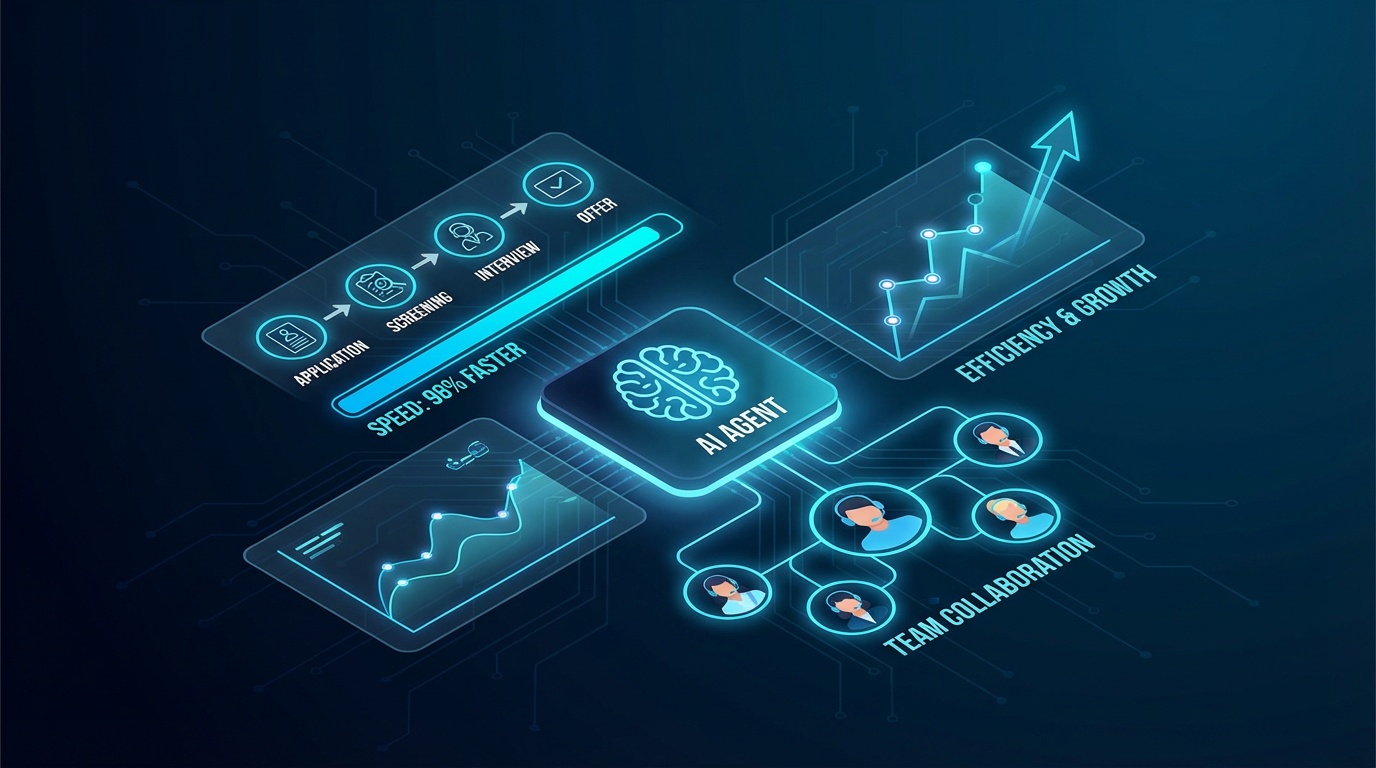
Firms using agentic systems respond to applications within minutes. Screen within hours. Present to clients the same day.
You win placements that competitors miss while candidates are still waiting for initial contact from slower agencies.
Quality Improvements Through Systematic Assessment
Consistent screening criteria reduce the variability of manual CV review. The 85% matching accuracy comes from systematic evaluation against proven success patterns—not subjective decisions that vary by recruiter workload.
This consistency improves client satisfaction and reduces placement failures that damage agency reputation.
Cost Reduction Without Sacrificing Candidate Experience
Automation reduces cost-per-hire while improving candidate communication frequency and responsiveness.
The 24/7 engagement capability and automated interview coordination create a premium candidate experience. Your employer brand strengthens. Offer acceptance rates increase.
Building a Proactive Talent Pipeline vs. Reactive Hiring
The best agentic recruitment platforms enable continuous talent pool development. You’re not scrambling for candidates when requisitions arrive.
By 2026, 70% of enterprises will be scaling agentic systems across operations. Recruitment firms that adopt now build competitive moats through proprietary candidate databases and AI-optimized processes that reactive competitors can’t quickly replicate.
Growth Potential: Organizations implementing advanced AI capabilities achieve 3x revenue growth compared to competitors relying on manual processes.
Making the Platform Decision: Strategic Selection Framework
Align Platform Capabilities With Your Hiring Model
Your selection should match operational reality. Not aspirational features.
Agencies placing 20–100 candidates monthly across diverse roles? You need multichannel sourcing, database reactivation, and rapid ROI. Vynta AI delivers these outcomes specifically for mid-market recruitment firms—placement increases exceeding 50% and measurable time savings of 2 hours per hire.
Enterprise platforms designed for Fortune 500 hiring volumes introduce unnecessary complexity and cost for agencies at this scale.
High-volume organizations hiring thousands of standardized roles monthly benefit from conversational screening infrastructure. Specialized technical recruiters prioritize passive candidate identification and personalized outreach sequences.
Match platform architecture to your actual hiring patterns.
Integration Depth and Speed to Value
Prebuilt ATS integrations determine how quickly you see results. Platforms requiring custom development delay the productivity gains that justify investment.
Leading agentic systems connect to existing tools within days. Not months. You get immediate workflow automation without disrupting current placements.
Mid-market firms without dedicated IT resources? You need turnkey solutions with vendor-managed integrations. The hiring cycle reduction and administrative task reduction only materialize when systems operate autonomously—not when they create new technical dependencies.
Total Cost of Ownership Beyond Licensing
Platform fees represent one component of true cost. Factor in implementation resources, training time, ongoing customization needs, and the opportunity cost of delayed deployment.
Vynta AI’s rapid implementation and immediate database reactivation deliver ROI within the first billing cycle. We recover previously dormant candidates at an 18% reactivation rate—generating placements without additional sourcing investment.
Enterprise platforms with extensive feature sets often require consultants, change management programs, and months of configuration before delivering value.
Calculate time-to-first-placement improvement. Not just annual licensing costs.
Vendor Partnership Model and Support Structure
Agentic systems require strategic partnership. Not transactional software licensing.
Evaluate vendor commitment to recruitment industry expertise versus generic AI automation. Firms achieving over 50% placement increases work with vendors who understand candidate engagement dynamics, client presentation requirements, and compliance considerations specific to recruitment operations.
Support structure matters during scaling. As you expand from pilot roles to full deployment, vendor responsiveness and recruitment-specific guidance determine rollout speed.
Generic automation vendors lack the industry context to tune workflows for placement quality and candidate experience simultaneously.
The Future Recruitment Market: Positioning for 2026 and Beyond
Consolidation Toward Specialist Platforms
The agentic systems market is splitting. Enterprise-scale infrastructure on one side. Industry-specialist solutions on the other.
By 2026, successful mid-market agencies will run specialist platforms built for recruitment workflows. Not adapted generic automation tools.
The 70% of enterprises scaling agentic systems create competitive pressure that makes AI adoption mandatory for survival. Not optional for differentiation.
Generalist platforms will serve high-volume standardized hiring. Specialist recruitment platforms will dominate agency and executive search markets where candidate quality and client presentation standards determine success.
The Emergence of AI-Native Recruitment Firms
New entrants are building agencies from inception around agentic capabilities. They operate with consultant-to-placement ratios that traditional firms can’t match without automation.
These AI-native competitors process thousands of candidates daily while maintaining personalized client service through strategic human intervention at high-value touchpoints.
Established firms must transform existing operations to compete. The 3x revenue growth potential from advanced AI implementation comes from operating advantage that AI-native firms achieve naturally.
Legacy agencies need deliberate transformation strategies. Not incremental automation add-ons.
Regulatory and Compliance Evolution
AI-driven hiring faces increasing scrutiny around bias detection, candidate privacy, and decision transparency.
The leading recruitment automation platforms build compliance capabilities into core workflows. Documenting screening criteria. Maintaining audit trails that support regulatory requirements. This proactive approach prevents disruption for firms using unaudited AI tools.
Candidate expectations around AI disclosure are shifting too. Transparent communication about AI involvement in screening and engagement builds trust. Not concern.
Firms that position AI as capability support—rather than pure cost cutting—maintain stronger employer brands and candidate relationships.
Strategic Positioning: Action Steps for Recruitment Leaders
Begin with measurement. Baseline your current time-to-hire, cost-per-hire, placement volume, and administrative time allocation. These metrics quantify improvement and support investment decisions.
Pilot with a contained scope. Select one high-volume role or client relationship where speed and administrative efficiency directly impact revenue. Demonstrate measurable improvement before expanding deployment.
I’ve seen firms report over 50% placement increases starting with focused pilots that prove ROI within 90 days.
Invest in consultant training around AI collaboration. The role shift from administrator to strategist requires skill growth in client advisory, market analysis, and relationship management.
Your competitive advantage comes from human consultants operating at their highest level. Backed by autonomous systems handling operational execution.
The recruitment industry is splitting. Firms that automate administrative workflows on one side. Those that keep manual processes on the other.
By 2026? The productivity gap will be impossible to close.
The top agentic systems for recruitment provide the operational foundation for sustained advantage in an increasingly AI-driven talent market.
Frequently Asked Questions
What exactly are agentic systems in recruitment?
Agentic systems go beyond simple task automation, creating autonomous workflows that manage entire recruitment processes from CV collection to interview scheduling. They make independent decisions based on learned criteria, freeing recruiters from administrative burdens. This allows consultants to focus on strategic placements and relationship building.
How do agentic systems help recruitment firms save time and money?
Agentic systems significantly reduce hiring cycles by over 60% and improve candidate matching accuracy to 85%. By automating 60-70% of administrative tasks, they allow consultants to reclaim approximately 2 hours per hire, leading to over 50% placement increases and avoiding the $15,000 to $25,000 cost of a bad hire.
What makes agentic AI different from regular automation tools for recruiters?
Unlike traditional automation that executes predefined sequences, agentic AI operates autonomously across the full recruitment lifecycle. It makes independent decisions, processes vast numbers of CVs daily, and engages prospects without constant human input. This provides operational independence and scalability without needing more headcount.
Can agentic systems really improve candidate matching accuracy?
Absolutely. Agentic systems achieve an 85% candidate matching accuracy by learning qualification criteria from successful placements. They apply consistent evaluation standards, which helps reduce unconscious bias in early screening and ultimately improves the quality of hire.
How do agentic systems handle sourcing candidates from various job boards?
Agentic systems autonomously source talent across multiple channels, collecting and processing applications from platforms like CV Library, Indeed, Reed, TotalJobs, and LinkedIn simultaneously. This eliminates manual checking, processing over 100,000 CVs daily, and ensures recruiters focus on qualified candidates.
Which agentic system is best for a mid-market recruitment agency?
For mid-market recruitment agencies, I recommend prioritizing platforms that offer rapid ROI and integrate seamlessly with existing ATS. Vynta AI, for example, is purpose-built for this segment, delivering measurable outcomes through dormant database reactivation and multichannel candidate sourcing without requiring enterprise budgets.
How do agentic systems address the issue of dormant candidate databases?
Agentic systems excel at reactivating dormant candidate databases. Platforms like Vynta AI can recover an 18% dormant database reactivation rate, converting previously unusable candidate data into active placements. This generates new opportunities without additional sourcing costs, maximizing the value of existing assets.