

top 10 Agentic Systems for Real Estate
What Are Agentic Systems and Why Real Estate Needs Them
Agentic systems represent a fundamental shift from reactive automation to autonomous decision-making. Unlike chatbots that follow scripts or CRM tools that wait for human input, these AI agents independently execute multi-step workflows: qualifying leads, matching properties, scheduling viewings, and nurturing prospects through personalized follow-ups. For real estate agencies drowning in inquiries while watching conversion rates stagnate, this technology turns bottlenecks into revenue engines.
Defining Agentic Systems in Business Terms
An agentic system acts like a tireless team member who works 24/7 across WhatsApp, SMS, email, and website chat. It captures property inquiries, asks qualification questions, analyzes responses against your inventory, suggests relevant listings with virtual tours, coordinates viewing schedules, sends reminders to reduce no-shows, and collects feedback to refine future recommendations. The system responds in under 60 seconds and automates 80% of repetitive tasks that typically consume over 20 hours per agent per week.
Key Differences from Traditional AI Tools
Traditional automation requires constant human oversight. A standard CRM sends templated emails when you click a button. Marketing automation triggers pre-written sequences based on simple rules.
Agentic systems? They make contextual decisions.
They determine which properties match a buyer’s stated preferences, recognize when a lead needs immediate human attention, adjust communication tone based on engagement patterns, and prioritize hot prospects over tire-kickers. This autonomous judgment separates agents from tools—one anticipates needs, the other waits for commands.
Real Estate Challenges These Systems Solve
Mid-market agencies face three major pain points. First, response speed: 78% of buyers choose the agent who replies first, yet most agencies take hours to respond during business hours and go dark evenings and weekends. Second, qualification inefficiency: agents waste time on unqualified leads while hot prospects slip through the cracks. Third, follow-up inconsistency: without systematic nurture, 65% of potential deals die from neglect.
Agentic systems address all three by delivering instant engagement, intelligent qualification, and automated personalized follow-up that increases qualified pipeline by 3x.
Business Impact: Agencies using top 10 Agentic Systems for Real Estate report higher agent productivity, stronger client retention, and meaningful revenue lift when these systems are implemented with clean data, defined processes, and ongoing optimization.
Top 10 Agentic Systems for Real Estate Operations
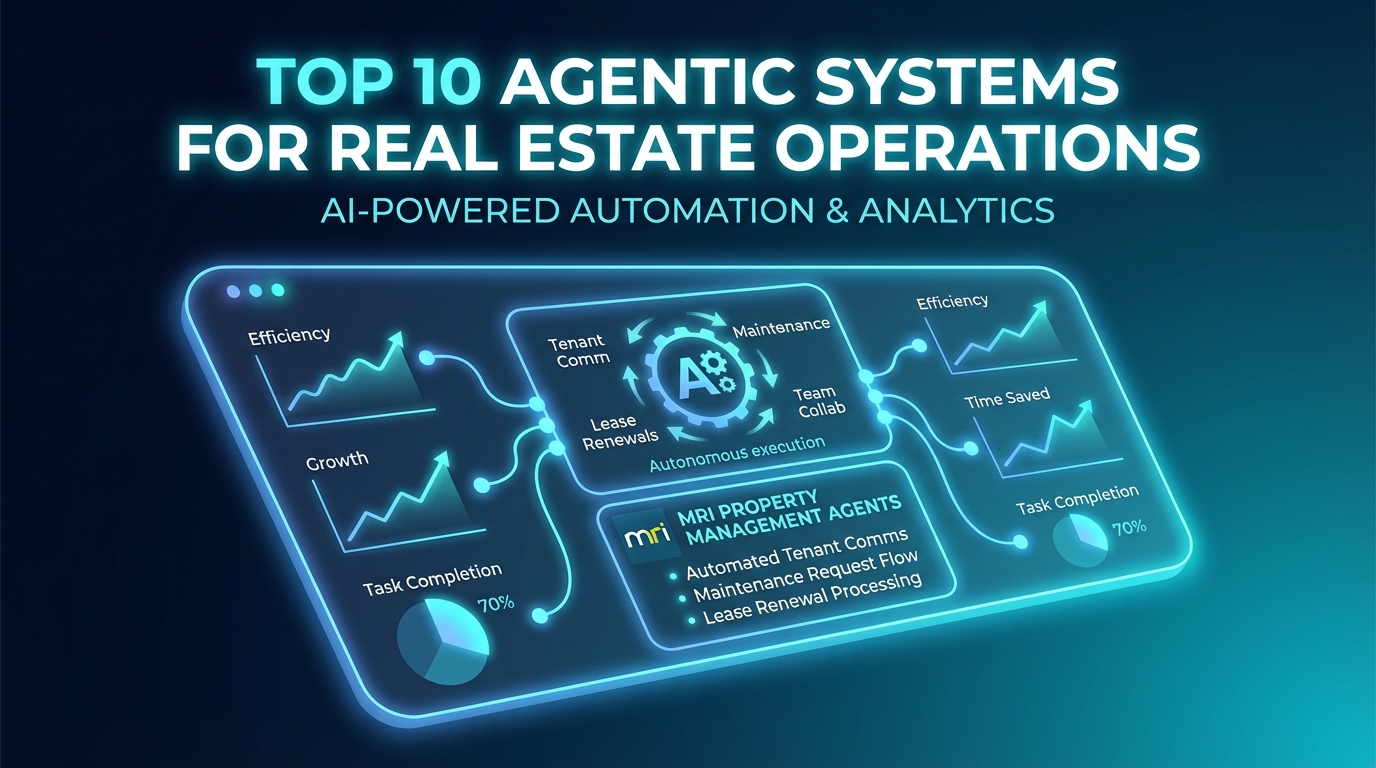
1. MRI Property Management Agents
MRI Software’s agentic layer automates tenant communications, maintenance requests, and lease renewals for property managers handling large portfolios. The system triages service tickets, schedules vendors, and updates tenants automatically. Best for commercial property management firms needing operational efficiency at scale.
2. ProptechOS Workflow Automation
ProptechOS connects building systems with business workflows, enabling agents that monitor IoT sensors, predict maintenance needs, and optimize energy costs. Ideal for agencies managing smart buildings where operational data supports the property’s value story.
3. Ascendix Lead Conversion Agents
Built specifically for real estate CRM integration, Ascendix agents capture leads from multiple sources, score them based on behavior patterns, and route hot prospects to the right agents while nurturing colder leads with property suggestions. A strong choice for agencies with established CRM infrastructure seeking better lead management.
4. LeewayHertz Property Matching Systems
Custom-built agentic solutions from LeewayHertz use advanced matching algorithms to analyze buyer preferences against inventory, considering factors beyond basic filters like neighborhood trends, school ratings, and investment potential. These projects require development investment but can deliver highly personalized property recommendations that speed up decisions.
5. NurtureBoss Leasing Agents
Focused on residential leasing, NurtureBoss agents qualify renters, schedule property tours, send application reminders, and coordinate move-in logistics. The system reduces vacancy time by maintaining consistent engagement with prospective tenants. Purpose-built for property management companies with high-volume rental operations.
6. Charter Global Portfolio Optimizers
These agents analyze portfolio performance data, identify underperforming assets, and recommend pricing adjustments or marketing strategy changes. Designed for investment firms and agencies managing multiple properties where data-driven optimization drives profitability.
7. ZBrain Client Outreach Tools
ZBrain’s generative AI agents create personalized email campaigns, social media content, and property descriptions tailored to specific buyer segments. The system learns from engagement metrics to refine messaging. Useful for agencies prioritizing marketing automation alongside operational efficiency.
8. Custom Vynta AI Lead Qualification Agents
At Vynta AI, we’ve built industry-specific agentic workflows that integrate with your existing CRM and property platforms. Our agents provide 24/7 engagement across channels, qualify leads through structured conversations, match properties using your inventory data, coordinate viewing calendars with automated reminders, and deliver personalized follow-ups.
Implementation includes discovery, strategy design, and phased deployment with clear human-in-the-loop checkpoints. We don’t hand you technology and disappear—we stay involved through optimization to ensure you’re actually seeing conversion gains.
9. IoT-Integrated Smart Building Agents
These systems connect with sensors and building management platforms to monitor occupancy patterns, environmental conditions, and security systems. Agents automatically adjust climate controls, alert managers to anomalies like water leaks or unauthorized access, and generate operational reports. Best suited for commercial real estate firms managing Class A office buildings or luxury residential properties where smart infrastructure creates differentiation.
10. Compliance and Anomaly Detection Systems
Specialized agents monitor transaction documents, flag regulatory compliance issues, and detect unusual patterns in financial data or tenant behavior. The system can review lease agreements for missing clauses, verify insurance documentation, and alert managers to late payments or potential fraud indicators. A fit for agencies operating in heavily regulated markets or managing high-value portfolios where compliance failures can carry significant financial risk.
| System | Primary Use Case | Best For | Integration Complexity |
|---|---|---|---|
| MRI Property Management | Tenant operations automation | Commercial property managers | Medium |
| ProptechOS | Smart building optimization | Tech-forward agencies | High |
| Ascendix | Lead scoring and routing | CRM-dependent agencies | Low |
| Vynta AI | End-to-end lead conversion | Mid-market agencies seeking growth | Medium |
| Compliance Agents | Regulatory monitoring | High-value portfolio managers | Medium |
Real-World Results: Metrics from Agentic Systems in Action
Lead Qualification and Conversion Gains
Agencies deploying agentic lead qualification report qualified pipeline increases of 3x within 90 days. Conversion rates rise significantly when prospects receive responses in under 60 seconds compared to slower follow-up methods. The combination of instant engagement and intelligent property matching shortens sales cycles by reducing days of back-and-forth that often characterizes buyer-agent interactions. For more on AI applications in real estate, see Artificial intelligence in real estate.
Portfolio Monitoring and Anomaly Fixes
Property managers using IoT-integrated agents reduce emergency maintenance costs through predictive issue detection. Systems identify HVAC inefficiencies, plumbing leaks, and security vulnerabilities before they escalate into expensive repairs or tenant complaints.
One commercial firm managing 47 office buildings reported saving $340,000 annually by addressing anomalies flagged by monitoring agents within hours instead of weeks. That’s real money saved—not projected, not theoretical.
Tenant and Client Service Improvements
Client satisfaction scores improve when agentic systems manage routine communications, viewing coordination, and feedback collection. Automated calendar reminders cut no-show rates for property tours by up to 40%, allowing agents to focus on qualified appointments. Consistent follow-up also reduces the chance prospects ghost or switch to a competitor that responds faster.
Cost Savings and Time Reductions
Across many agencies, a practical benchmark is time saved: teams often reclaim 15-20 hours per agent per week by automating repetitive tasks like initial replies, scheduling, reminders, and data entry. That capacity shift translates into more deals closed per agent without hiring additional staff, especially when the system’s tuned to the team’s qualification criteria and inventory reality. Learn more about emerging trends in AI and technology integration at Gartner’s artificial intelligence insights.
How Vynta AI Builds Custom Agentic Systems for Real Estate
Integration with CRM and Property Platforms
Vynta AI agents connect directly to your existing CRM, property management software, and communication channels. We map your current workflows, identify automation opportunities, and build custom integrations that preserve your data structure while adding autonomous capabilities. The system pulls inventory data in real time, updates contact records automatically, and syncs viewing schedules with agent calendars to reduce manual data entry.
Step-by-Step Implementation Process
Implementation begins with discovery sessions where we document your lead sources, qualification criteria, and sales processes. Strategy design follows, creating agentic workflows tailored to your business model and team structure.
Phased deployment starts with a pilot program on one lead channel or property type, allowing your team to adapt before a full rollout. Training focuses on human-AI collaboration, showing your team when to let agents work autonomously and when to step in for high-value interactions.
Human-AI Teamwork in Daily Operations
Our systems support your agents rather than replace them. The AI manages initial inquiry response, qualification conversations, property matching, and routine follow-ups. Human agents get notifications when prospects request viewings, ask complex questions, or show high purchase intent.
This division keeps experienced agents focused on relationships and negotiation while reducing administrative bottlenecks that limit transaction volume. I’ve seen teams double their monthly closings without adding headcount—purely by shifting time allocation.
Strategic Partnership: Vynta AI focuses on real estate workflows, including the operational details that generic automation platforms often miss.
Steps to Select and Deploy Agentic Systems That Deliver ROI

Evaluate Systems Against Your Workflows
Map your current bottlenecks before selecting technology. If lead response time’s killing conversions, prioritize instant engagement capabilities. If agents waste time on unqualified prospects, focus on qualification features. Match system strengths to your specific pain points rather than choosing based on broad feature lists that don’t address revenue constraints.
Measure Success with Key Metrics
Track response time to inquiries, qualified lead percentage, viewing-to-offer conversion rate, and agent hours saved weekly. Establish baselines before deployment and measure monthly improvements. Strong implementations show measurable gains within 60 days: faster response times, higher qualification rates, and more deals per agent.
Scale from Pilot to Full Operations
Start with one lead source or property category. Validate that the system handles your inventory and buyer profiles effectively before expanding. A gradual rollout reduces risk and gives the team time to adjust without disrupting active deals.
Common Pitfalls and How to Avoid Them
Agencies struggle when they expect instant perfection or deploy without training. Agentic systems learn from your data and feedback. Plan time for refinement, correct mis-qualification early, and maintain human oversight during the first 90 days.
Partner with vendors who provide ongoing optimization rather than one-time setup. For academic and technical research on agentic AI in real estate, consult agentic AI real estate research.
Choosing the Right Agentic System for Your Agency
Match Technology to Your Business Model
Residential sales agencies need different capabilities than commercial property managers or investment firms. If your revenue depends on high-volume lead conversion, prioritize systems like Vynta AI or Ascendix that excel at instant engagement and qualification. Commercial managers with maintenance-heavy portfolios often benefit more from MRI or IoT-integrated agents that automate operational workflows. Investment-focused firms should evaluate portfolio optimization tools from Charter Global or compliance monitoring systems that protect high-value transactions.
Your existing technology stack matters. Agencies already invested in specific CRM platforms should favor systems offering native integrations to avoid data silos. Teams comfortable with technology can manage higher implementation complexity for custom solutions, while smaller agencies may prefer turnkey options with simpler deployment paths.
Calculate True ROI Beyond Software Costs
Implementation expenses include software licensing, integration work, and team training time. Calculate payback period by dividing total costs by monthly revenue gains from increased conversions. Many teams evaluating the top 10 Agentic Systems for Real Estate focus on the same drivers: faster response, more qualified conversations, and more closed deals per agent.
Factor in hidden costs: Does the system require ongoing developer support? Will you need additional staff to manage the technology? Compare these against quantifiable benefits like hours saved weekly per agent, which frees capacity for revenue-generating activities rather than administrative work.
Vendor Partnership Considerations
Evaluate vendors on industry expertise, not just technical capabilities. Generic AI platforms may not understand real estate sales cycles, buyer behavior, and compliance constraints that shape effective automation.
Ask potential partners about their experience with property matching approaches, qualification criteria for real estate, and integration with MLS systems or property management platforms. Have they actually deployed in your market? Can they show metrics from similar agencies?
Ongoing support determines long-term success. Agentic systems improve through continuous refinement based on your data and feedback. Choose vendors offering optimization services, regular performance reviews, and updates that adapt to changing market conditions or business strategies.
| Selection Criteria | High Priority For | Key Questions to Ask |
|---|---|---|
| Lead conversion focus | Residential sales agencies | What’s the typical response time? How does qualification work? |
| Operational automation | Property managers | Which maintenance workflows are automated? What tenant communication’s included? |
| CRM integration depth | Established agencies | Which native connectors are available? How often does data sync? |
| Industry specialization | All agency types | Which real estate clients have you served? What vertical-specific features exist? |
| Implementation support | Small to mid-market firms | Is training included? What does ongoing optimization look like? |
The Future of Agentic Systems in Real Estate
Predictive Market Intelligence
Next-generation agents will analyze market trends, pricing patterns, and demographic shifts to recommend listing strategies before properties hit the market. These systems will predict which neighborhoods may appreciate, identify emerging buyer segments, and suggest property improvements that maximize ROI. Agencies that adopt early gain an edge through data-driven insights that guide acquisition and pricing decisions.
Multimodal Property Experiences
Emerging agentic systems will generate personalized virtual tours, create custom property videos highlighting features tied to buyer preferences, and produce interactive 3D models that prospects can explore independently. AI agents will narrate walkthroughs, answer questions about property details in real time, and simulate renovation possibilities based on buyer input. This technology reduces the need for physical showings while maintaining engagement quality.
Autonomous Transaction Coordination
Future agents will manage transaction workflows: ordering inspections, coordinating appraisals, tracking document signatures, monitoring financing milestones, and alerting relevant parties to delays or issues. The system will maintain communication with stakeholders so deals progress from offer acceptance to closing without agents manually tracking dozens of moving parts.
Regulatory Adaptation and Compliance
As real estate regulations evolve, agentic systems will update workflows to align with new disclosure requirements, fair housing laws, and data privacy rules. Agents will monitor legislative changes, adjust document templates, and flag potential violations before they occur. This compliance management reduces legal risk while keeping agencies current across jurisdictions.
Final Recommendations for Agency Owners

The top 10 Agentic Systems for Real Estate share common strengths: instant engagement that captures leads competitors miss, qualification that focuses agent time on high-intent prospects, and follow-up that reduces the number of deals lost to slow responses. The right choice depends on your bottlenecks and business model.
Start by auditing current workflows. Where do leads drop? Which repetitive tasks consume the most agent time? What percentage of inquiries get a response within 60 seconds? Use those answers to prioritize system capabilities tied to revenue.
For mid-market agencies seeking lead-to-close automation with real estate expertise built in, Vynta AI delivers custom agentic workflows that integrate with existing platforms while keeping the human touch that defines strong client relationships.
The agencies thriving in 2026 will be those that deployed agentic systems in 2024 and 2025, giving their teams time to adapt and their systems time to learn. The question isn’t whether to implement agentic automation, but which system matches your agency’s growth trajectory and how quickly you can begin capturing productivity gains.
Action Step: Schedule discovery calls with three vendors from this list whose capabilities align with your priority workflows. Compare real estate expertise, implementation approach, and ongoing support before making a selection.
Frequently Asked Questions
What is an example of an agentic system in real estate?
An agentic system acts like a tireless team member, working 24/7 to automate key real estate workflows. For instance, a Vynta AI agent can instantly capture property inquiries, ask qualification questions, suggest relevant listings with virtual tours, and coordinate viewing schedules. This frees up human agents to focus on high-value interactions and client relationships.
How do agentic systems differ from traditional CRM tools for realtors?
Traditional CRMs primarily store data and require human input to trigger actions like sending templated emails. Agentic systems, by contrast, make autonomous, contextual decisions, such as determining which properties best match a buyer’s preferences or recognizing when a lead needs immediate human attention. They proactively execute multi-step workflows across channels like WhatsApp, SMS, email, and website chat, automating 80% of repetitive tasks.
How can agentic systems help realtors with the 80/20 rule?
The 80/20 rule suggests that 80% of results come from 20% of efforts. Agentic systems help realtors focus on that critical 20% by automating 80% of repetitive tasks, like initial lead qualification and consistent follow-ups. This allows agents to dedicate their time to building relationships and closing deals, leading to over 30% more deals closed and a 3x increase in qualified pipeline.
What is the 3-3-3 rule in real estate and how do agentic systems assist with it?
The 3-3-3 rule often refers to consistent follow-up, such as contacting a lead within 3 minutes, 3 days, and 3 weeks. Agentic systems excel at this by providing instant responses in under 60 seconds and delivering consistent, personalized follow-ups across multiple channels. This systematic nurture prevents deals from dying due to neglect, improving client retention by 85%.
What business impact do agentic systems have on real estate agencies?
Agentic systems deliver significant business impact by improving agent productivity, client retention, and revenue generation. Agencies report higher agent productivity, an 85% improvement in client retention, and over $100k in additional revenue per agent per year. These systems help convert more leads and close more deals without expanding the team or increasing admin costs.
How do agentic systems improve lead qualification and conversion rates?
Agentic systems provide instant, 24/7 engagement to capture leads and then intelligently qualify them through structured conversations. They analyze responses against inventory to suggest relevant properties, which significantly improves the quality of the pipeline. This leads to a 3x increase in qualified pipeline and an 85% conversion rate for inquiries into viewings and sales.
Can agentic systems help reduce no-shows for property viewings?
Yes, agentic systems are designed to reduce no-shows by automating calendar coordination and sending timely reminders for viewings. After an agentic system schedules a viewing, it ensures prospects receive consistent communication leading up to the appointment. This proactive approach helps maintain engagement and ensures higher attendance rates.