

abm ai
If you’re a mid-market business owner in real estate, recruitment, fundraising, or hospitality, you’ve probably heard about ABM AI but aren’t sure whether it’s another tech buzzword or something that can actually move your revenue needle. Here’s what matters: account-based marketing powered by AI automation lets you target your best-fit accounts with precision, automate the grunt work, and close deals faster without hiring more salespeople. This guide shows you exactly how abm ai works in practice and why it’s become essential for SMEs competing against larger players.
ABM AI combines account-based marketing strategy with artificial intelligence to identify high-value prospects, personalize outreach at scale, and automate repetitive tasks across sales and marketing. For mid-market businesses in specialized industries, it delivers measurable ROI through improved conversion rates and better resource allocation without requiring internal AI expertise or enterprise-level budgets.
What Account-Based Marketing with AI Means for Mid-Market Businesses
Account-Based Marketing Defined in Simple Terms
Account-based marketing flips traditional lead generation on its head. Instead of casting a wide net and hoping for bites, you identify specific high-value accounts that match your ideal customer profile, then coordinate marketing and sales efforts to win those accounts. Think of it as fishing with a spear instead of a net. For a recruitment agency, this means targeting specific companies known for high hiring volumes rather than blasting job postings everywhere. For hospitality businesses, it’s focusing on corporate clients who book repeatedly rather than one-off travelers.
How AI Changes Traditional ABM Approaches
Traditional ABM requires massive manual effort: researching accounts, personalizing messages, tracking engagement, and coordinating follow-ups. AI automation transforms this by analyzing thousands of data points to score accounts, generating personalized outreach at scale, and triggering next-best actions based on prospect behavior. A real estate agency using abm ai can automatically qualify leads based on property preferences and financial signals, then route hot prospects to agents with relevant listings. The AI handles pattern recognition and repetitive tasks while your team focuses on relationship building. Explore our Agentic Systems for Real Estate to see this in action.
Why Mid-Market SMEs Need ABM AI Now
Mid-market businesses face a squeeze: you’re competing against enterprises with bigger budgets and specialized teams, but you lack their resources. abm ai levels the playing field by giving you enterprise-grade targeting and personalization without the enterprise price tag or complexity. Your competitors are already adopting these tools. A fundraising organization using AI-powered donor outreach can identify and engage potential major donors with the same sophistication as large nonprofits, but with a three-person team instead of thirty. Check out our AI-Powered Fundraising Platform to maximize donor engagement with less overhead.
Key Benefits of ABM AI Across Sales and Marketing

Improved Conversion Rates from Precise Targeting
When you focus resources on accounts that actually fit your business, conversion rates improve. AI analyzes historical data to identify patterns in your best customers, then finds similar prospects. Recruitment firms often see improved placement rates when AI pre-screens candidates against client requirements before human recruiters invest interview time. Learn how our Agentic Systems for Recruitment streamline candidate screening effectively.
Time Savings Through Automation of Repetitive Tasks
Your team spends hours on data entry, lead research, follow-up scheduling, and status updates. AI agents can handle these tasks continuously. A hospitality manager using automated guest communication systems can save weekly time on reservation confirmations, upsell messaging, and feedback collection, redirecting that time to in-person service. Discover how Vynta AI Agents for Hospitality can transform guest interactions.
Stronger Sales and Marketing Team Alignment
ABM requires tight coordination between marketing and sales. AI provides a single source of truth: shared account scoring, synchronized messaging, and transparent pipeline visibility. When your real estate marketing team generates property inquiries, AI can enrich lead data and assign prospects to agents based on specialization and availability.
Measurable ROI with Data-Driven Decisions
Every action generates data. AI tracks which messages drive responses, which accounts show buying signals, and which channels deliver results. You stop guessing and start optimizing based on evidence. Fundraising teams using AI-powered investor outreach can attribute donations to specific touchpoints, then prioritize what works.
ABM AI in Action: Industry Examples from Vynta AI Verticals
Real Estate: Automating Lead Qualification and Property Matching
Real estate agencies waste countless hours chasing unqualified leads. AI agents can analyze inquiry data to score prospects based on budget signals, timeline indicators, and property preferences, then match them with relevant listings automatically. When a prospect submits a contact form, the AI can cross-reference their requirements against your inventory, enrich their profile with public data, and route qualified leads to the right agent within minutes.
Recruitment: Streamlining Candidate Screening and ATS Integration
Recruitment firms drown in resumes. AI-powered candidate screening can integrate with your ATS to parse applications, match skills against job requirements, and rank candidates by fit score before human recruiters review anyone. The system can flag potential issues and highlight standout qualifications, then schedule initial screening calls automatically. Recruiters can focus on top-tier candidates and client relationship management instead of reading hundreds of resumes.
Fundraising: Optimizing Investor Outreach and Donor Management
Fundraising organizations struggle to identify and engage potential major donors systematically. AI can analyze giving patterns, wealth indicators, and engagement history to score prospects, then personalize outreach sequences based on donor interests and communication preferences. The system tracks interactions, sends timely follow-ups, and alerts your team when a prospect shows intent signals like downloading your impact report or attending multiple events.
Hospitality: Boosting Guest Experiences and Upsell Opportunities
Hospitality businesses need to deliver personalized service at scale without ballooning labor costs. AI agents can manage reservation confirmations, send pre-arrival preference surveys, recommend room upgrades based on guest history, and trigger post-stay feedback requests automatically. When a repeat guest books, the system can recognize past preferences for late checkout or specific amenities and offer relevant add-ons.
How Vynta AI Delivers ABM AI Without the Complexity
Enterprise-Grade Agents Tailored for Mid-Market Needs
Many enterprise AI platforms require large budgets, technical teams, and months of implementation. Generic automation tools often lack the industry-specific intelligence to handle nuanced workflows in real estate transactions, recruitment placements, or donor cultivation. Vynta AI bridges this gap with pre-configured AI agents built for your vertical. You get sophisticated account scoring, personalized outreach automation, and CRM integration without hiring data scientists or overhauling your tech stack. Explore our broad range of AI Automation Services designed to fit your industry needs.
Implementation Steps for Quick Wins
Start with one high-impact workflow: lead qualification for real estate, candidate pre-screening for recruitment, donor outreach for fundraising, or reservation management for hospitality. Connect your existing systems through standard integrations, configure your ideal customer profile criteria, and let the AI learn from your historical data. Most clients see measurable improvements as the agents handle repetitive tasks while your team maintains control over strategic decisions and relationship moments.
Addressing Common Concerns in Traditional Industries
Service businesses often worry that automation feels impersonal or replaces human relationships. When implemented well, AI handles data processing and routine communication, freeing your team to spend more time on consultative conversations and relationship building. A recruitment director spends less time sorting resumes and more time advising clients on hiring strategy. A hospitality manager focuses on in-person guest interactions instead of email confirmations. The technology supports human work rather than replacing it.
Real Results: Metrics from Our Clients
Clients across verticals report increases in qualified pipeline, reductions in time spent on administrative tasks, and improvements in conversion rates. A real estate team can close more transactions monthly with the same agent headcount. A recruitment firm can reduce time-to-placement. A fundraising organization can increase major donor meetings without adding development staff. These outcomes come from focusing human effort where it creates the most value.
Next Steps to Scale Revenue with ABM AI
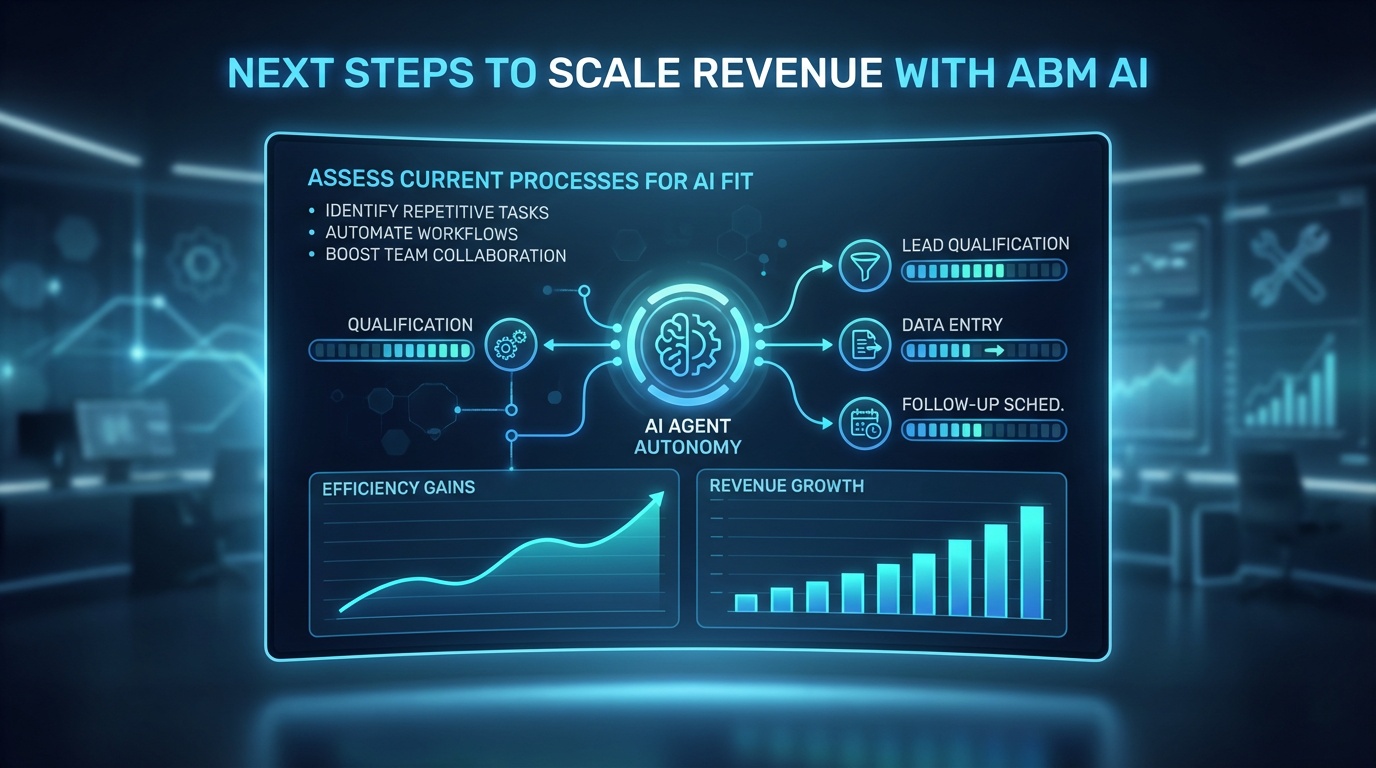
Assess Your Current Processes for AI Fit
Identify workflows where your team performs repetitive tasks: lead qualification, data entry, follow-up scheduling, and initial screening. Calculate hours spent weekly on these activities and conversion rates at each pipeline stage. The biggest ROI often comes from automating high-volume, lower-complexity tasks that currently consume skilled staff time.
Choose the Right Partner for Your Vertical
Generic tools can require extensive customization. Enterprise platforms can demand technical resources you don’t have. Look for solutions built for your industry with results in similar businesses. Implementation speed, integration with your existing systems, and ongoing support matter more than long feature lists.
Measure Success with Clear KPIs
Define success metrics before implementation: qualified leads per week, time-to-close, placement rates, donor retention, guest satisfaction scores, or revenue per account. Track these monthly to validate ROI and identify optimization opportunities. The data will guide where to expand automation next and where human touchpoints create the most value.
Your 90-Day ABM AI Implementation Roadmap
Month One: Foundation and Quick Wins
Start with an audit and integration. Document your current lead-to-close process, noting where prospects drop off and where staff time disappears into administrative tasks. Connect your CRM and communication platforms to your AI system, then configure one high-impact workflow. Real estate agencies typically begin with lead qualification, recruitment firms with resume screening, fundraising teams with donor research automation, and hospitality businesses with reservation management. You’ll see early time savings as the AI takes over data entry and initial response handling.
Month Two: Optimization and Expansion
Analyze performance data from your initial workflow. Which accounts score highest? Which messages generate responses? Refine your ideal customer profile criteria based on actual conversion patterns, not assumptions. Add a second workflow that complements the first. If you automated lead qualification, add personalized follow-up sequences. If you started with candidate screening, integrate interview scheduling. The AI learns from growing data volume, improving accuracy over time.
Month Three: Full-Scale Deployment and Measurement
Expand across your pipeline. Your team now trusts the system because they’ve seen results. Calculate ROI using baseline metrics from before implementation: conversion rates, time-to-close, staff hours saved, and revenue per account. Many mid-market businesses reach positive ROI as efficiency gains compound.
Success Factor
The difference between successful adoption and abandoned implementations often comes down to change management, not technology. Involve your team early, celebrate small wins, and keep human oversight on strategic decisions while letting AI handle repetitive execution.
Where ABM AI Is Heading Next
Predictive Account Intelligence
Current AI identifies good-fit accounts based on historical patterns. Next-generation systems will predict which accounts may need your services before they start searching. Real estate agents may receive alerts when homeowners show early selling signals like property tax searches or renovation permit applications. Recruitment firms may spot hiring surges based on funding announcements and expansion indicators. This shifts you from reactive response to proactive outreach.
Seamless Multi-Channel Orchestration
Today’s tools are strong at email automation and CRM integration. Next platforms will coordinate touchpoints across email, social media, direct mail, and phone outreach with unified messaging and timing. A fundraising organization’s AI may recognize when a donor engages with LinkedIn content, trigger a personalized email referencing that interest, and schedule a phone call at an optimal time based on past response patterns.
Deeper Vertical-Specific Intelligence
Generic AI understands language and broad patterns. Specialized AI will incorporate your industry’s dynamics. Future systems for real estate may incorporate market trend data, property valuation models, and mortgage rate impacts. Recruitment AI may parse skills taxonomies and career progression patterns specific to different roles. Hospitality AI may integrate seasonal demand forecasting and pricing optimization.
Final Recommendations for Mid-Market Leaders

Account-based marketing powered by AI automation is one of the strongest competitive advantages available to mid-market businesses. You can deliver enterprise-level targeting and personalization without enterprise budgets or technical teams. The businesses winning in real estate, recruitment, fundraising, and hospitality aren’t the ones with the biggest teams; they’re the ones that pair human judgment with intelligent automation.
Start small with one workflow that consumes significant staff time and delivers measurable business outcomes. Prove ROI quickly, then expand systematically. Success also depends on choosing a partner who understands your industry’s workflows and constraints. Generic tools can force you to act as a systems integrator. Enterprise platforms can assume technical resources you don’t have. Industry-specific solutions like Vynta AI deliver results faster because the intelligence is pre-configured for how real estate agencies sell properties, how recruitment firms place candidates, how fundraising teams cultivate donors, and how hospitality businesses manage guest experiences.
Your competitors are already adopting these capabilities. The question isn’t whether to implement abm ai, but how quickly you can deploy it to protect and grow your market position. The mid-market businesses that thrive over the next five years will be those that move decisively now to scale revenue without proportionally scaling headcount.