
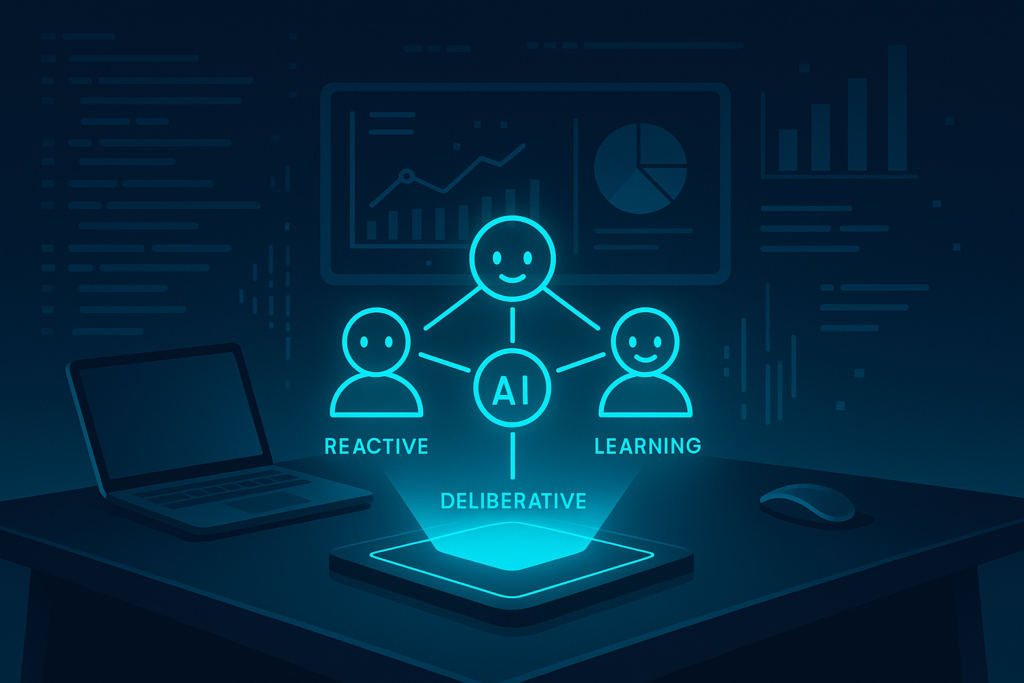
In real estate, recruitment, fundraising, and hospitality, types of AI agents automate repetitive tasks while augmenting human teams—handling 500+ concurrent interactions so your staff focuses on high-value relationships. Unlike generic chatbots, these agents perceive their environment via CRM/ATS integrations, make autonomous decisions through planning modules, and execute actions like booking reservations or scheduling interviews. For a comprehensive overview of how these solutions can transform your business, explore the Vynta AI homepage.
The five core types of AI agents range from simple reflex systems (rule-based responses) to sophisticated learning agents that adapt over time. Business law parallels exist with general versus special agents, providing compliance frameworks for agent deployments in regulated industries. If you’re interested in tailored automation for your industry, discover AI agent services designed for real estate, recruitment, and fundraising.
Key characteristics include autonomy (independent operation), reactivity (real-time responses), and goal-orientation (working toward specific business outcomes like lead qualification or guest upselling). Hospitality businesses report 35% higher upsell rates, while recruitment firms achieve 50% faster candidate screening through strategic agent deployment.
The 5 Core Types of AI Agents and Their Measurable Outcomes in Key Verticals

Simple Reflex Agents – Fast, Rule-Based Automation for Predictable Tasks
Simple reflex agents react to current inputs via if-then rules without memory, ideal for fully observable environments like reservation confirmations. They deliver 20-30% time savings on routine operations—hospitality businesses reduce no-show losses by 15% through automated alert systems.
Implementation requires three steps: map business rules (e.g., “if VIP guest, offer suite upgrade”), integrate with existing PMS systems (2-hour setup), and test on 100 bookings. These agents excel at predictable tasks like sending upsell offers to repeat wine enthusiasts or triggering maintenance alerts based on room status.
Model-Based Reflex Agents – Handling Partial Visibility in Dynamic Markets
Model-based agents maintain internal world models to infer unseen states, crucial for dynamic environments. Real estate agencies achieve 25% faster lead prioritization by tracking market dynamics and inferring buyer intent from incomplete CRM data—even when buyer queries are vague. For a deeper dive into the science behind intelligent agents, see this authoritative overview of intelligent agents.
These agents build models using 7-day historical data, update hourly via API connections, and require weekly drift monitoring. They excel when information is incomplete but patterns exist, such as matching properties based on partial buyer preferences or predicting candidate interest from limited interaction data.
Goal-Based Agents – Strategic Planning for Revenue Targets
Goal-based agents plan action sequences toward explicit objectives like “book 10 investor meetings weekly.” Fundraising organizations report 2x investor outreach volume with 40% higher meeting rates through strategic email and call sequencing based on response predictions.
Deployment involves defining specific goals (e.g., 20% conversion rate), implementing search algorithms (3-day setup), and daily re-planning based on results. These agents excel at complex workflows requiring multi-step coordination, such as nurturing leads through qualification stages or managing multi-touch donor cultivation campaigns.
Utility-Based Agents – Balancing Trade-Offs for Optimized Decisions
Utility-based agents maximize utility functions across multiple criteria, balancing competing priorities like cost versus revenue. Recruitment firms cut time-to-hire by 30% by optimizing candidate fit (0.7 weight), salary requirements (0.2 weight), and urgency (0.1 weight) simultaneously.
Setup requires scoring utility functions and quarterly A/B testing to refine weights. These agents handle complex trade-offs like balancing guest satisfaction against revenue optimization or weighing candidate quality against placement speed in high-volume recruitment scenarios.
Learning Agents – Adaptive Powerhouses That Evolve with Your Business
Learning agents improve through feedback via reinforcement or supervised learning, handling uncertainty and evolving business conditions. All verticals report 35% accuracy gains within 6 months, with hospitality showing particular strength in guest intent recognition and personalized journey optimization.
| Agent Type | Autonomy Level | Best Environment | 6-Month ROI | Hospitality Example |
|---|---|---|---|---|
| Simple Reflex | Low | Fully observable | 20% efficiency | No-show alerts |
| Model-Based | Medium | Partially observable | 25% speed gain | Dynamic pricing |
| Goal-Based | High | Goal-oriented | 40% conversions | Upsell sequences |
| Utility-Based | High | Multi-objective | 30% optimization | RevPAR balancing |
| Learning | Highest | Dynamic/uncertain | 35% accuracy lift | Personalized journeys |
For practical examples of how these agent types are applied in real-world business scenarios, you can review our about page for case studies and success stories.
**Types of Agents** in Business Law – Ensuring Compliant AI Deployments
Understanding legal types of agents prevents costly compliance issues when deploying AI automation. General agents possess broad authority (like learning AI managing full recruitment cycles), while special agents handle specific tasks (reflex agents sending lead alerts). This distinction protects SMEs from unauthorized AI actions that exceed intended scope.
Compliance ROI: Proper agent classification ensures 100% audit-ready operations, crucial for fundraising organizations managing investor relations. Real estate agencies avoid liability issues when AI agents operate within defined principal-agent agreements, maintaining professional standards while scaling automation. For more on how AI agents are transforming the fundraising sector, visit our fundraising solutions.
Critical Insight: AI agents inherit legal responsibilities from their classification. A hospitality AI with general agent authority can modify reservations autonomously, while special agents require human approval for changes exceeding $500 value.
Implementation Framework: Draft one-page principal-agent agreements defining scope, duration, and termination conditions. Appoint sub-agents for multi-department workflows, ensuring clear authority chains. Review quarterly to align AI capabilities with business growth and regulatory changes.
| Aspect | AI Simple Reflex (Special Agent) | AI Learning (General Agent) |
|---|---|---|
| Authority Scope | Narrow, task-specific | Broad, decision-making autonomy |
| Risk Level | Low (predictable outcomes) | Medium (requires oversight protocols) |
| Hospitality Application | Automated reservation confirmations | Complete guest experience management |
| Liability Considerations | Limited to defined rules | Requires comprehensive agreements |
For a scholarly perspective on agent theory and compliance, see this recent research on intelligent agents.
Single-Agent vs. Multi-Agent Systems – Scaling Automation Across Verticals
Single-agent systems excel for focused automation—one recruitment screening agent cuts processing time by 50% with straightforward one-week implementation. Multi-agent systems coordinate specialized roles, handling complex workflows where individual agents collaborate toward shared objectives.
Multi-Agent Advantage: Hospitality operations achieve 20% RevPAR improvements through coordinated reservation, upselling, and feedback agents. Real estate teams deploy lead qualification, property matching, and CRM updating agents that collectively process 10x more prospects than single-agent approaches.
Coordination Protocols: Multi-agent systems require shared memory modules and communication standards. Successful fundraising deployments use consensus protocols where outreach and due diligence agents coordinate investor touchpoints, preventing conflicting communications that damage relationships.
Multi-Agent Advantages:
- Handles 1000+ daily tasks vs. 100 for single agents
- 10% error reduction through cross-agent validation
- Scalable specialization across departments
- ROI positive within 3 months for SMEs
Implementation Considerations:
- Higher initial complexity requiring 2-week setup
- Coordination protocols need ongoing monitoring
- Integration across multiple business systems
Deployment Strategy: Start with role identification (2 days), define communication protocols, integrate existing systems without replacement, test coordination handling 10% failure scenarios through human oversight, then scale with performance monitoring. For more on the latest trends and strategies in AI agent deployment, check out our in-depth blog on AI-powered recruitment solutions.
Industry-Specific **Types of AI Agents** – Vertical Applications and Measurable Outcomes

Real Estate – Goal-Based Agents for 70% Faster Lead Qualification
Goal-based agents transform real estate operations by planning multi-step property matching sequences. They coordinate market analysis, buyer preference modeling, and timing optimization to achieve specific conversion targets while reactivating 25% of previously stale leads through strategic re-engagement campaigns. For a closer look at how AI is reshaping property sales, visit our real estate automation page.
Implementation Success: Agencies set utility weights balancing property match accuracy (60%) with buyer urgency (40%). Agents automatically prioritize high-intent prospects, schedule viewings during optimal timeframes, and coordinate follow-up sequences that maintain engagement without overwhelming potential buyers.
Recruitment – Learning Agents Halving Time-to-Hire
Learning agents revolutionize talent acquisition by continuously refining candidate screening algorithms based on placement success rates. They process CV databases, conduct initial assessments, and schedule interviews while improving accuracy through feedback from hiring outcomes and candidate performance data.
Capacity Multiplication: Recruitment agencies handle 2x application volume without additional headcount. Agents learn from successful placements to identify subtle candidate indicators, reducing false positives by 40% while maintaining quality standards that satisfy client requirements. For more insights, read our blog post on emerging AI recruitment trends.
Fundraising – Utility-Based Agents for Tripled Investor Touchpoints
Utility-based agents optimize fundraising campaigns by balancing personalization depth, outreach frequency, and response timing across investor portfolios. They maximize engagement probability while respecting relationship dynamics and investment cycle timing constraints.
Strategic Coordination: Agents achieve 40% higher meeting conversion rates through sophisticated trade-off decisions. They weigh investor preferences, market conditions, and timing to ensure optimal outreach. For a broader perspective on AI agent architectures, see our analysis of multi-agent system design best practices.
Frequently Asked Questions
What are the main types of AI agents and how do they differ in their decision-making processes?
The main types of AI agents are reflex, goal-based, utility, and learning agents. Reflex agents respond reactively using simple if-then rules, goal-based agents plan actions to achieve specific objectives, utility agents optimize decisions based on preferences or outcomes, and learning agents adapt over time by improving from experience.
How can implementing AI agents improve operational efficiency and ROI in industries like hospitality and recruitment?
AI agents automate repetitive tasks such as reservation management in hospitality or candidate screening in recruitment, enabling faster processing and reducing manual workload. This leads to measurable ROI improvements—like 35% higher upsell rates in hospitality and 50% faster candidate placements—by enhancing operational efficiency and allowing staff to focus on high-value interactions.
What steps are involved in deploying simple reflex agents for automating routine business tasks?
Deploying simple reflex agents involves identifying predictable, rule-based tasks, defining clear if-then conditions, integrating the agent with relevant systems like CRM or ATS, and monitoring performance to ensure consistent, real-time responses that free up human resources for more complex activities.
How do model-based reflex agents handle partial information to improve decision-making in dynamic markets such as real estate?
Model-based reflex agents maintain an internal state to track unobserved aspects of their environment, allowing them to make informed decisions despite incomplete data. In real estate, this means better lead qualification and property matching by considering market trends and client preferences even when some information is missing or delayed.
About The Author
Anas Moujahid is the chief contributing writer & Operations Director for the Vynta AI Blog, where he turns cutting-edge AI automation into measurable business outcomes for mid-market companies.
Vynta AI designs enterprise-grade AI agents that augment rather than replace people—freeing teams to focus on higher-value work while the bots handle the busywork.
We specialise in four service-heavy verticals where AI can move the revenue needle fast: real estate, recruitment, fundraising and hospitality.
Anas started his career architecting AI and automation systems; today he leads operations at Vynta AI, making sure every deployment lands real-world ROI—whether that’s more booked viewings for estate agents, faster placements for recruiters, warmer investor pipelines for fundraisers or happier guests for hotels and restaurants.
Vynta AI delivers results by:
- Building industry-specific agents pre-trained on real-world workflows—no generic chatbots here.
- Integrating seamlessly with existing CRMs, ATSs, PMSs and fundraising platforms—zero rip-and-replace.
- Measuring success in business KPIs (lead-to-close rates, time-to-hire, donor retention, RevPAR) not vanity metrics.
- Providing transparent implementation plans so clients know exactly what to expect, when and why.
- Pairing every AI agent with human-in-the-loop controls to keep quality, compliance and brand voice on point.
Since launch, Vynta AI has helped agencies slash lead qualification time by up to 70 %, recruitment firms cut screening hours in half, fundraising teams triple investor touchpoints and hospitality brands lift guest satisfaction scores by double digits—all while keeping human expertise firmly in the loop.
Anas writes with the same ethos that drives Vynta AI: outcome-focused, jargon-free and grounded in real business value. Expect data-backed insights, practical implementation guides and a clear-eyed view of what AI can—and can’t—do for your organisation.