

Key Takeaways
- Revenue teams that effectively use nurture campaigns achieve 20-40% higher conversion rates from lead to opportunity.
- Many organizations overlook nurturing, often relying on generic emails sent indiscriminately.
- Modern nurture campaigns are automated and behavior-driven to guide prospects through the sales funnel.
- Timing and content relevance are critical components of successful nurture campaigns.
Table of Contents
- What Is a Nurture Campaign? Clear Definition, Purpose & Where It Fits in Your Funnel
- Drip vs Nurture vs Lifecycle: Making Sense of the Campaign Types
- Mapping Nurture Campaigns to the Buyer’s Journey (and Lifecycle Stages)
- The Business Case: Why Nurture Campaigns Are a Revenue Engine, Not “Nice to Have”
- Measuring, Optimizing & Scaling Nurture Campaigns
- Common Nurture Campaign Problems & How to Fix Them
- AI-Powered Nurture: How Enterprise AI Agents Elevate Traditional Campaigns
Nurture Campaigns: The Practical Playbook for Revenue Teams (Not Just Email Marketers)
Revenue teams that master nurture campaigns see 20-40% higher conversion rates from lead to opportunity. Yet most organizations treat nurturing as an afterthought—a few generic emails sent to anyone who downloads a whitepaper. Modern nurture campaigns are automated, behavior-driven systems that move prospects through your sales funnel with precision timing and relevant content.
This playbook covers everything from basic definitions to industry-specific implementations across real estate, recruitment, fundraising, and hospitality. You’ll learn how to design campaigns that actually convert, measure what matters, and scale nurture programs that become genuine revenue engines.
For organizations focused on donor engagement, fundraising nurture campaigns can significantly increase average gift size and donor retention rates.
What Is a Nurture Campaign? Clear Definition, Purpose & Where It Fits in Your Funnel
Working Definition: What “Nurture Campaign” Really Means in 2025
A nurture campaign is an automated, multi-touch communication sequence that moves prospects from initial interest to purchase decision based on their behavior and stage in the buying journey. Unlike one-off email blasts or newsletters, nurture campaigns respond dynamically to prospect actions—sending different messages based on what someone clicks, downloads, or ignores.
These campaigns function as always-on infrastructure, not single email series. They trigger when specific conditions are met (form submission, page visit, inactivity period) and continue until the prospect converts, opts out, or meets an exit condition like booking a demo or making a purchase.
Lead Nurturing vs Nurture Marketing vs Generic Email
Lead nurturing specifically targets known contacts moving through defined stages (subscriber → lead → opportunity → customer). Nurture marketing encompasses broader relationship-building across the entire customer lifecycle, including retention and advocacy campaigns.
| Campaign Type | Primary Goal | Timing | Targeting | Key Measurement |
|---|---|---|---|---|
| Nurture Campaign | Convert leads to opportunities | Behavior-triggered | Segmented by stage/behavior | Conversion rate |
| Broadcast Email | Announce/inform | Fixed schedule | Entire list | Open/click rate |
| Newsletter | Maintain awareness | Regular intervals | Subscribers | Engagement rate |
The Core Purpose: From “More Emails” to Measurable Pipeline
Effective nurture campaigns deliver three measurable outcomes. First, they increase lead-to-opportunity conversion rates by 20-40% through consistent, relevant follow-up. Second, they shorten sales cycles by 10-30% by educating prospects and addressing objections before sales conversations. Third, they boost customer lifetime value through strategic upsell and cross-sell sequences.
The key difference between nurture campaigns and generic email marketing lies in measurement. Success isn’t measured by email opens or clicks, but by business metrics: booking rates, qualified leads generated, revenue attributed, and time-to-close reduction.
Drip vs Nurture vs Lifecycle: Making Sense of the Campaign Types
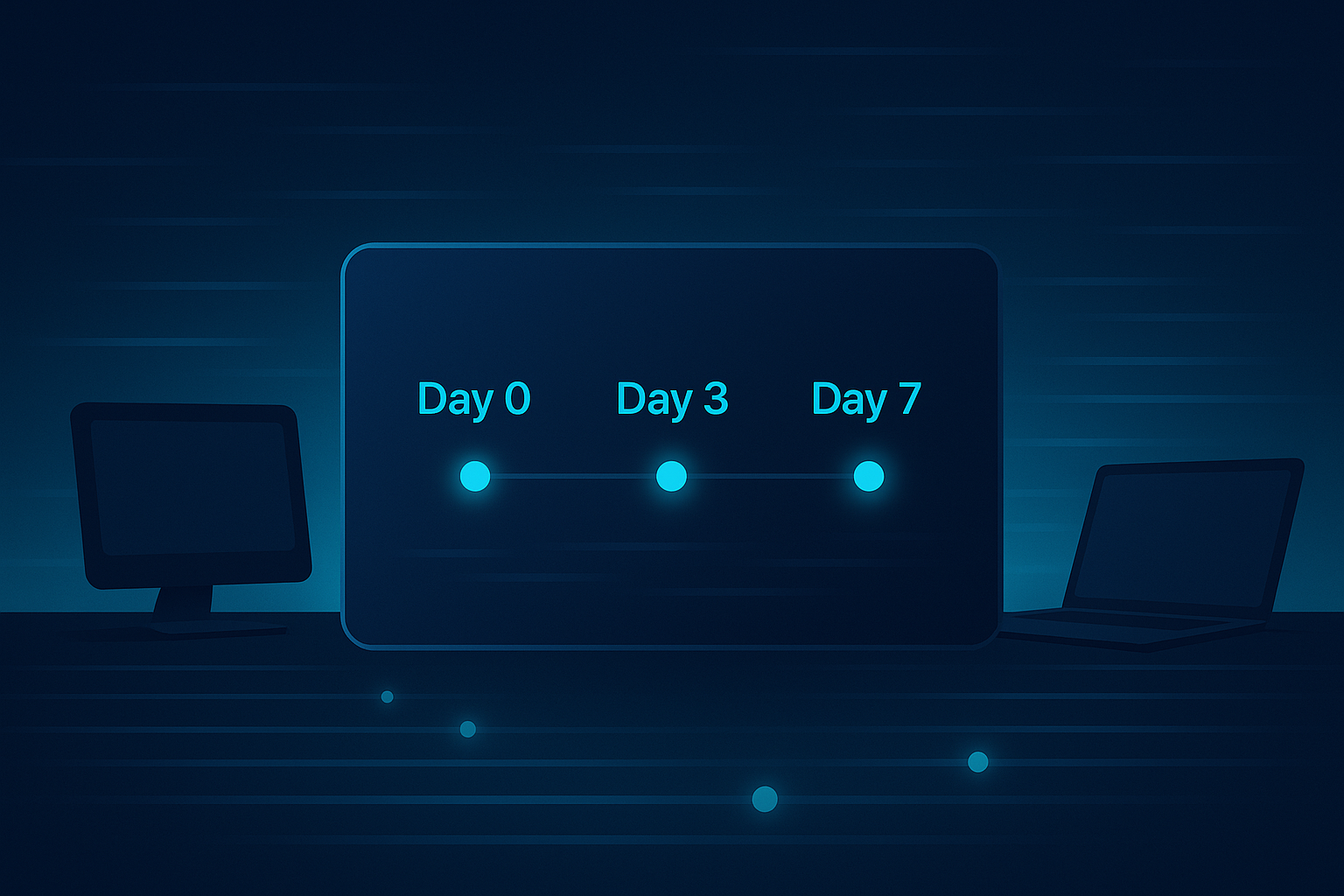
Drip Campaigns (Time-Based) vs Nurture Campaigns (Behavior-Based)
Drip campaigns follow fixed schedules—every new subscriber gets Email 1 on Day 0, Email 2 on Day 3, Email 3 on Day 7, regardless of their actions. They’re simple to set up but treat all prospects identically. A typical welcome drip might be: Day 0 (welcome + resources), Day 3 (case study), Day 7 (product demo), Day 14 (customer testimonial).
Nurture campaigns adapt based on behavior. If someone clicks a pricing link, they enter a different sequence than someone who downloads an educational guide. The timing adjusts too—highly engaged prospects might receive the next message in 24 hours, while less engaged ones wait 3-5 days.
Where Lifecycle Marketing Fits
Lifecycle marketing maps to customer stages: anonymous visitor → subscriber → lead → marketing qualified lead (MQL) → sales qualified lead (SQL) → customer → advocate. Nurture campaigns operate within this framework, moving people between stages based on their readiness to buy.
Think of lifecycle stages as the destination and nurture campaigns as the vehicle. A single customer might experience multiple nurture campaigns: initial lead nurture, post-demo follow-up, customer onboarding, and win-back sequences.
Decision Guide: Which Do You Need Right Now?
Use drip campaigns for straightforward onboarding sequences where everyone needs the same information in the same order—like new employee orientation or basic product education. Choose nurture campaigns when sales cycles exceed 14 days, involve multiple decision-makers, or when prospect behavior indicates varying levels of engagement and readiness. For complex buying journeys, nurture campaigns provide the flexibility and personalization required to move prospects efficiently through the funnel.
Mapping Nurture Campaigns to the Buyer’s Journey (and Lifecycle Stages)
The Three Core Journey Stages
Top-of-funnel (TOFU) prospects ask “Do I have a problem worth solving?” Your nurture campaigns should deliver educational content that frames their challenge and positions your solution category. Middle-of-funnel (MOFU) buyers evaluate “Which solution fits my specific needs?” Here, nurture sequences provide comparison guides, case studies, and ROI calculators. Bottom-of-funnel (BOFU) prospects wonder “Why you over the competition?” and require social proof, pricing information, and risk-reduction offers like trials or guarantees.
Each stage demands different content velocity and urgency. TOFU nurturing unfolds over weeks or months with educational touchpoints. MOFU sequences accelerate to weekly or bi-weekly contact as evaluation intensifies. BOFU campaigns often trigger daily follow-ups when prospects demonstrate high purchase intent through pricing page visits or demo requests.
Lifecycle Stages and “Readiness to Buy”
Lead status, behavioral score, and recent activity form the triad that determines nurture campaign assignment. A marketing-qualified lead (MQL) who downloads multiple resources but hasn’t engaged with sales content remains in educational nurture. The same lead becomes sales-qualified (SQL) when they visit pricing pages twice in 48 hours or request a demo, triggering immediate sales outreach.
The complete lifecycle progression flows: anonymous visitor → subscriber → lead → MQL → SQL → opportunity → customer → repeat customer → advocate. Each transition requires specific nurture triggers. For example, customers who haven’t purchased in 90 days enter win-back sequences, while high-value repeat customers receive VIP treatment and early access offers.
Content Mapping: Who Needs to Hear What, When
| Stage | Buyer Questions | Content Type | Typical CTA |
|---|---|---|---|
| New Lead | “Is this worth my time?” | Industry insights, problem identification | Download guide, subscribe |
| Evaluating Options | “What solutions exist?” | Comparison charts, feature demos | Watch demo, book consultation |
| Ready to Talk | “Why choose you?” | Case studies, testimonials, pricing | Schedule call, start trial |
| New Customer | “How do I succeed?” | Onboarding, best practices | Complete setup, attend training |
| At-Risk Customer | “Is this still working?” | Success stories, optimization tips | Book health check, upgrade |
| Loyal Customer | “What’s next?” | Advanced features, expansion opportunities | Explore add-ons, refer others |
Timing: How Long Should a Nurture Campaign Run?
Short sales cycles (≤14 days) require intensive 5-7 touch sequences over 10-21 days. Real estate viewings, restaurant reservations, and recruitment applications fall into this category. Longer cycles (30-90+ days) need 8-15 touches spread across 30-180 days, allowing prospects to research thoroughly without feeling pressured.
Industry benchmarks suggest B2B software sales require 6-8 touches over 60-90 days, while high-value services like fundraising consulting may nurture prospects for 6-12 months. The key is matching campaign duration to natural buying cycles rather than arbitrary timelines. Monitor engagement metrics to identify optimal sequence length—if opens drop below 15% after touch 6, your sequence is likely too long.
The Business Case: Why Nurture Campaigns Are a Revenue Engine, Not “Nice to Have”
Core Benefits and Expected Uplift
Well-executed nurture campaigns typically improve lead-to-opportunity conversion by 20-40% within 90 days of implementation. Marketing automation platforms report that nurtured leads produce 20% more sales opportunities compared to non-nurtured leads. In hospitality, automated post-stay sequences increase repeat booking rates by 15-25%, while recruitment firms see 30% faster time-to-fill when candidates receive consistent communication throughout the hiring process.
Average order value increases of 10-30% are common when nurture campaigns include educational content about premium services or add-ons. Real estate agents using property-specific nurture sequences report 25% higher commission values as educated buyers feel more confident making larger purchases. Fundraising organizations implementing donor nurture campaigns see 40% higher average gift sizes compared to one-off solicitation emails.
Cost & Efficiency: Doing More with the Team You Already Have
Automated nurture campaigns replace 60-80% of manual follow-up tasks while maintaining personalized communication. A typical sales development representative spends 4-6 hours daily on follow-up emails and calls. Nurture automation reduces this to 1-2 hours of high-value activities like handling warm responses and booking qualified meetings. This efficiency enables your existing team to focus on strategic conversations and closing deals, rather than repetitive outreach.
Measuring, Optimizing & Scaling Nurture Campaigns

Baseline Measurement: What to Track in the First 30 Days
Start with engagement metrics that predict revenue outcomes. Open rates (aim for 25-35% for B2B, 20-30% for B2C), click-through rates (3-8%), and response rates (2-5%) establish your baseline performance. More critically, track conversion metrics: meeting booking rate (10-20% of engaged leads), demo completion rate, and progression through your sales funnel.
Link these metrics directly to revenue outcomes within 60-90 days. In real estate, measure valuation-to-instruction ratios. Recruitment firms should track interview attendance and placement rates. Fundraising organizations need donor activation and average gift progression. Hospitality businesses must monitor booking conversion and guest satisfaction scores alongside traditional email metrics.
A/B Testing Roadmap
Test in order of impact: subject lines first (30-50% of open rate variance), then offers and CTAs (40-60% of click variance), followed by timing and cadence. Test one variable at minimum 500 recipients per variant, running for at least one complete campaign cycle before declaring winners.
Advanced testing includes message tone (formal vs conversational), content format (text vs image-heavy), and send frequency. Property managers might test “New listings in [Area]” against “3 homes perfect for your budget” subject lines. Recruitment agencies could compare immediate job alerts versus weekly digest formats.
Fixing Underperforming Nurture Campaigns
Low open rates indicate list hygiene issues or poor subject lines. Clean inactive subscribers after 90 days of non-engagement and A/B test subject line approaches. High opens with low clicks suggest misaligned expectations—your subject promises don’t match email content, or CTAs lack clarity and urgency.
Mid-sequence drop-off points to pacing problems. If leads disengage after email 3 of 7, content relevance has declined or you’re asking for too much commitment too early. High unsubscribe rates typically mean frequency mismatches or unclear value propositions in your initial opt-in process.
Scaling: From One Flow to a Full Nurture Ecosystem
Add segments methodically: VIP prospects first, then re-engagement campaigns for dormant leads, followed by customer expansion journeys. Each new flow should serve a distinct business objective with separate success metrics.
Operational scaling requires monthly content audits and quarterly performance reviews. Establish content refresh schedules—update market data quarterly, refresh case studies bi-annually, and retire underperforming assets. This systematic approach prevents nurture campaigns from becoming stale while maintaining consistent performance standards.
For more on optimizing your nurture ecosystem, explore our guide to nurture campaign services and how they can help you scale efficiently.
Common Nurture Campaign Problems & How to Fix Them
Strategy and Setup Challenges
Problem: “Do nurture campaigns replace my sales team?” Solution: Nurture campaigns amplify human capabilities, handling routine follow-ups so sales professionals focus on qualified conversations. A property consultant still conducts viewings—nurture ensures more prospects show up ready to buy.
Problem: “How often should I update content?” Solution: Update time-sensitive elements monthly (market data, pricing), refresh case studies quarterly, and overhaul messaging annually. Create a content calendar with clear ownership and review cycles.
Performance & Troubleshooting
Problem: “Campaigns aren’t converting to sales.” Solution: Check lead quality at entry point, review handoff timing to sales teams, and audit message-to-offer alignment. Often, the issue is premature or delayed sales engagement rather than campaign content.
Problem: “Sales says leads are over-nurtured.” Solution: Implement lead scoring thresholds that trigger immediate sales alerts. High-intent behaviors (pricing page visits, repeat property views) should bypass standard nurture timing for immediate human follow-up.
Tools & Operations
Problem: “Do I need full marketing automation?” Solution: Start with email tools that offer basic automation (HubSpot, Mailchimp, ConvertKit). Upgrade to advanced platforms when managing 3+ simultaneous nurture flows or complex lead scoring requirements.
Problem: “How do I prevent campaigns from going stale?” Solution: Build refresh triggers into your process—quarterly performance reviews, annual content audits, and continuous A/B testing of key elements. Assign clear ownership for ongoing optimization.
For a deeper dive into troubleshooting nurture campaign performance, see our article on marketing automation best practices.
AI-Powered Nurture: How Enterprise AI Agents Elevate Traditional Campaigns
From Static Workflows to Adaptive Journeys
Traditional nurture campaigns follow predetermined paths regardless of individual behavior. AI agents create dynamic experiences that adapt in real-time based on engagement patterns, content preferences, and buying signals. When a prospect repeatedly visits pricing pages, AI automatically adjusts subsequent messages to address budget concerns and ROI justification.
This adaptive approach increases conversion rates by 25-40% compared to static sequences. Instead of sending the same “Day 3” email to everyone, AI considers recency of engagement, content consumption patterns, and similar prospect behaviors to optimize timing and content selection for each individual.
Personalization at Scale without Burning Out Your Team
AI agents handle personalization beyond basic merge tags, incorporating property preferences, job requirements, donation history, and guest preferences to deliver relevant content at scale. For example, in real estate, AI can tailor property recommendations based on browsing behavior and budget. In recruitment, AI agents match candidates to roles based on skills and engagement signals. Fundraising organizations benefit from AI-driven donor segmentation, ensuring each outreach is timely and relevant. Hospitality managers can leverage AI to send personalized upsell offers based on guest history and preferences, increasing both satisfaction and revenue per guest.
By automating these complex personalization tasks, AI agents free your team to focus on high-value interactions—consultations, negotiations, and relationship-building—while ensuring every prospect and customer receives a tailored experience.
Frequently Asked Questions
What distinguishes a nurture campaign from generic email blasts or newsletters?
A nurture campaign is an automated, multi-touch communication sequence tailored to a prospect’s behavior and stage in the buying journey, unlike generic email blasts or newsletters that send the same message to broad audiences. Nurture campaigns dynamically respond to actions such as clicks or downloads, delivering relevant content with precise timing to guide prospects toward conversion.
How do behavior-driven nurture campaigns improve lead-to-opportunity conversion rates?
Behavior-driven nurture campaigns improve conversion rates by delivering personalized, timely content that aligns with a prospect’s interests and engagement signals. This targeted approach keeps prospects engaged, builds trust, and accelerates their progression through the sales funnel, resulting in 20-40% higher lead-to-opportunity conversion rates compared to generic outreach.
In what ways can nurture campaigns be mapped to different stages of the buyer’s journey?
Nurture campaigns can be strategically designed to align with each stage of the buyer’s journey—awareness, consideration, and decision—by delivering content that addresses specific needs and questions at each phase. For example, early-stage campaigns focus on education and awareness, mid-stage on solution evaluation, and late-stage on decision support and closing, ensuring prospects receive relevant messaging throughout their journey.
How can organizations measure and optimize the effectiveness of their nurture campaigns?
Organizations can measure nurture campaign effectiveness through key metrics like conversion rates, engagement levels, time-to-conversion, and revenue influenced. Optimization involves analyzing these metrics to refine content relevance, timing, and segmentation, as well as leveraging AI automation to continuously personalize interactions and scale campaigns for maximum ROI.
About The Author
Anas Moujahid is the chief contributing writer & Operations Director for the Vynta AI Blog, where he turns cutting-edge AI automation into measurable business outcomes for mid-market companies.
Vynta AI designs enterprise-grade AI agents that augment rather than replace people—freeing teams to focus on higher-value work while the bots handle the busywork.
We specialise in four service-heavy verticals where AI can move the revenue needle fast: real estate, recruitment, fundraising and hospitality.
Anas started his career architecting AI and automation systems; today he leads operations at Vynta AI, making sure every deployment lands real-world ROI—whether that’s more booked viewings for estate agents, faster placements for recruiters, warmer investor pipelines for fundraisers or happier guests for hotels and restaurants.
Vynta AI delivers results by:
- Building industry-specific agents pre-trained on real-world workflows—no generic chatbots here.
- Integrating seamlessly with existing CRMs, ATSs, PMSs and fundraising platforms—zero rip-and-replace.
- Measuring success in business KPIs (lead-to-close rates, time-to-hire, donor retention, RevPAR) not vanity metrics.
- Providing transparent implementation plans so clients know exactly what to expect, when and why.
- Pairing every AI agent with human-in-the-loop controls to keep quality, compliance and brand voice on point.
Since launch, Vynta AI has helped agencies slash lead qualification time by up to 70 %, recruitment firms cut screening hours in half, fundraising teams triple investor touchpoints and hospitality brands lift guest satisfaction scores by double digits—all while keeping human expertise firmly in the loop.
Anas writes with the same ethos that drives Vynta AI: outcome-focused, jargon-free and grounded in real business value. Expect data-backed insights, practical implementation guides and a clear-eyed view of what AI can—and can’t—do for your organisation.