
Key Takeaways
- The shift to business services online SSA tips offers significant opportunities for mid-market companies.
- Subscription Service Agreement models provide predictable revenue but face high failure rates due to manual process bottlenecks.
- Sixty percent of SSA businesses fail within three years because operational inefficiencies harm margins and client satisfaction.
- AI automation is a crucial competitive differentiator for SSA businesses aiming to scale successfully.
Table of Contents
- What Are Online Business Services and Why SSA Models Matter Today
- The Four Critical Operational Workflows That Break Online Business Services
- How AI Automation Transforms Online Business Service Delivery
- Real-World SSA Transformation: Industry-Specific Automation Wins
- Implementation Strategy: Deploying Automation Without Disrupting Your SSA Business
The shift to business services online ssa tips has created unprecedented opportunities for mid-market companies, but also exposed critical operational gaps. Subscription Service Agreement (SSA) models promise predictable revenue streams, yet 60% fail within three years due to manual process bottlenecks that erode margins and client satisfaction. AI automation isn’t just an efficiency play—it’s the competitive differentiator between thriving SSA businesses and those struggling to scale.
Whether you’re running a real estate agency qualifying 100+ leads weekly, a recruitment firm screening endless CVs, a fundraising organization managing investor relationships, or a hospitality business personalizing guest experiences, the same operational friction points kill SSA profitability. The solution lies in industry-specific AI automation that augments human expertise rather than replacing it.
What Are Online Business Services and Why SSA Models Matter Today
Defining Online Business Services in the Digital Economy
Online business services represent the evolution from traditional brick-and-mortar delivery to cloud-native, scalable service models. Unlike physical products, digital services can theoretically scale without proportional cost increases—but only if operational workflows are automated. Real estate agencies can manage 10x more leads through AI qualification systems, while recruitment firms can screen candidates 24/7 without expanding headcount.
Understanding SSA (Subscription Service Agreements) as a Business Model
SSA models generate predictable monthly recurring revenue through ongoing service delivery rather than one-time transactions. A fundraising consultancy might charge $5,000 monthly for investor relationship management, or a hospitality management company might earn $2,000 monthly per property for guest experience optimization. The challenge: SSA margins compress rapidly when manual processes dominate operational workflows, making client retention expensive and growth unsustainable.
The Operational Cost Problem SSA Models Face
Typical SSA businesses spend 30-40% of revenue on manual operations—lead qualification, scheduling coordination, follow-up sequences, and reporting. A recruitment firm earning $50,000 monthly might allocate $18,000 to manual CV screening and interview coordination alone. This operational overhead creates a scalability ceiling: adding clients requires proportional staff increases, eliminating the margin advantages that make SSA models attractive. Automation breaks this cost structure by handling repetitive judgment calls while humans focus on strategic relationship management.
The Four Critical Operational Workflows That Break Online Business Services

Lead Qualification and Client Onboarding Bottleneck
Real estate agencies manually qualifying 50+ leads weekly face 4-6 hour response delays that kill conversion rates. Manual property matching and buyer qualification creates information gaps where hot leads turn cold. Similarly, recruitment firms spending 15+ hours weekly on initial CV screening delay candidate pipeline velocity, causing client frustration and competitor advantages. The qualification bottleneck becomes exponentially worse as SSA client volume grows, creating a service delivery crisis that drives churn.
Service Delivery Coordination and Scheduling Chaos
Manual guest communication in hospitality creates 15-20% no-show rates, directly impacting revenue per available room. Recruitment firms face similar coordination failures: interview scheduling conflicts delay placements by weeks, reducing client satisfaction and extending time-to-hire metrics. Poor coordination compounds across SSA clients, creating operational chaos where human coordinators become overwhelmed and service quality deteriorates across the entire client base.
Follow-Up and Client Retention Gaps
Fundraising organizations lose capital opportunities through inconsistent investor touchpoints—manual relationship management can’t maintain the frequency required for deal momentum. Real estate agencies face parallel challenges: leads go cold between agent handoffs, and past clients don’t receive systematic nurture sequences for repeat business. These retention gaps directly impact SSA model sustainability, as acquiring new clients costs 5x more than retaining existing ones.
Billing, Reporting, and Success Metric Tracking Failures
Manual reporting delays ROI visibility across all verticals—clients can’t see value delivery in real-time, making SSA contract renewals vulnerable to competitor pitches. Hospitality clients need guest satisfaction trends, recruitment clients need time-to-hire improvements, fundraising clients need investor pipeline progress, and real estate clients need lead conversion analytics. Without automated KPI tracking, SSA relationships become transactional rather than strategic partnerships.
How AI Automation Transforms Online Business Service Delivery
Industry-Specific AI Agents: Why Generic Tools Fail for SSA Models
Generic automation platforms break down when applied to specialized workflows—real estate lead scoring requires property market knowledge, recruitment candidate matching needs role-specific skill assessment, fundraising investor profiling demands industry expertise, and hospitality guest preferences require service context. Off-the-shelf chatbots can’t distinguish between a serious property buyer and a casual browser, leading to misallocated human resources and frustrated prospects.
Vynta’s industry-specific AI agents come pre-built with vertical expertise: real estate agents understand property matching logic, recruitment agents recognize skill-role fit patterns, fundraising agents identify investor profile indicators, and hospitality agents interpret guest preference signals. This specialization delivers immediate value without months of custom configuration.
The Five-Stage Implementation Lifecycle: From Chaos to Measurable Results in 90 Days
Structured implementation delivers ROI in the first quarter versus enterprise platforms requiring 6-18 months of custom development. The five-stage approach maps Discovery → Solution Design → Pilot Build → Go-Live → Continuous Optimization, with each phase building measurable value. Week 1-2 focuses on workflow mapping and baseline KPIs, weeks 3-4 handle solution design and system integration, weeks 5-6 run pilot testing with real data, weeks 7-8 execute gradual go-live rollout, and ongoing optimization ensures sustained performance improvements.
This timeline advantage proves critical for SSA businesses where cash flow depends on immediate operational improvements. Real estate agencies can’t wait 18 months for lead qualification automation—they need results within 30 days to maintain competitive positioning and client satisfaction.
Human-in-the-Loop: Augmentation, Not Replacement
AI handles repetitive judgment calls—lead scoring, candidate matching, donor profiling, guest preference analysis—while humans retain strategic oversight and relationship management. A hospitality AI agent processes guest communication patterns and preferences, but the concierge makes final service recommendations and handles complex requests. This augmentation model improves employee satisfaction by eliminating tedious tasks and allowing focus on high-value client interactions that drive SSA renewals.
The human-in-the-loop approach addresses industry skepticism about automation in service businesses by preserving the personal touch that clients expect while accelerating operational efficiency behind the scenes.
Real-Time Integration with Existing Systems
Zero rip-and-replace implementation connects AI agents to existing CRMs, ATSs, property management systems, and fundraising platforms without disrupting current workflows. Real estate agencies keep their familiar CRM interface while AI agents work in the background to score leads and trigger follow-up sequences. Recruitment firms maintain their ATS while AI pre-screens candidates and updates pipeline status automatically.
This integration approach eliminates the operational disruption that kills SSA client satisfaction during implementation periods, ensuring service quality remains consistent throughout the automation rollout process.
| Approach | Time-to-ROI | Setup Model | Business KPI Focus | Integration Method |
|---|---|---|---|---|
| Generic Tools | 6+ months | Self-service configuration | Task completion metrics | API connections only |
| Industry-Specific AI | 30-90 days | Guided implementation | Revenue and retention KPIs | Native CRM/ATS integration |
| Enterprise Platforms | 12-18 months | Custom development | Operational efficiency | Complete system replacement |
Real-World SSA Transformation: Industry-Specific Automation Wins
Real Estate Agencies: From Manual Lead Qualification to 70% Faster Conversions
A mid-market real estate agency managing 100+ leads weekly faced 4-6 hour response delays that killed hot prospects. Manual lead routing required agents to review property preferences, budget qualifications, and timeline requirements before making contact, creating bottlenecks during peak inquiry periods. AI automation now qualifies property matches and buyer readiness in real-time, triggering immediate personalized responses based on listing inventory and client profiles.
Specific outcomes: lead response time reduced to under 15 minutes, qualified pipeline improved by 35%, and reactivated cold leads increased by 22%. The ROI mechanism works through faster lead-to-appointment conversion rates and higher closing percentages from better-qualified prospects. Agents now spend time on relationship building and negotiation rather than manual lead sorting, improving both job satisfaction and commission earnings.
Recruitment Firms: Automating Candidate Screening Without Losing Quality Matches
A recruitment team spending 20+ hours weekly on CV screening faced capacity constraints that delayed client placements and reduced market competitiveness. High application volumes created bottlenecks where quality candidates were lost to faster competitors, while manual screening inconsistencies led to poor role-fit matches that damaged client relationships. AI pre-screening now analyzes job descriptions against candidate profiles using role-specific skill matching and experience relevance scoring.
Screening capacity increased by 40% without additional headcount, candidate matching accuracy improved through consistent evaluation criteria, and time-to-hire reduced by 3 weeks on average. Human recruiters now focus on relationship building with top-tier candidates and strategic client consultation, while AI handles initial qualification and interview scheduling coordination. This division of labor improves placement quality and client satisfaction simultaneously.
Fundraising Organizations: Scaling Investor Outreach and Relationship Nurturing
A fundraising organization limited by manual investor prospecting could only maintain meaningful touchpoints with 50-60 potential investors quarterly, restricting deal flow and capital access. Inconsistent follow-up sequences lost momentum on promising opportunities, while research-intensive investor matching consumed 15+ hours weekly that could have been spent on relationship building. AI now identifies high-potential investors based on portfolio alignment and investment history, personalizing outreach sequences at scale while maintaining relationship authenticity.
Investor meetings increased by 45% through systematic outreach cadence, faster investor-opportunity matching reduced time-to-first-meeting, and higher funding success rates resulted from consistent relationship nurturing. The portfolio growth mechanism works through expanded investor network reach and improved deal closure rates. Development officers now focus on strategic relationship management and complex negotiations rather than manual prospect research and scheduling coordination.
Hospitality: Personalizing Guest Experience While Optimizing Operations
A boutique hotel and restaurant faced service inconsistencies from manual guest communication, error-prone reservation handling, and missed upselling opportunities that reduced revenue per available room. Guest preferences weren’t systematically tracked between visits, creating impersonal experiences that contradicted the boutique positioning. AI now profiles guest preferences from booking patterns and service history, automating personalized touchpoints while optimizing reservation management and identifying upselling opportunities based on guest spending patterns.
Guest satisfaction scores improved by 17 points through consistent personalized service, no-show rates reduced via automated confirmation sequences, and RevPAR increased through systematic upselling of room upgrades and restaurant reservations. The guest loyalty impact compounds through repeat bookings and referral generation. Staff now focus on delivering exceptional in-person experiences rather than manual booking administration and preference tracking.
Implementation Strategy: Deploying Automation Without Disrupting Your SSA Business
Phase 1 (Weeks 1-2): Discovery and Workflow Mapping
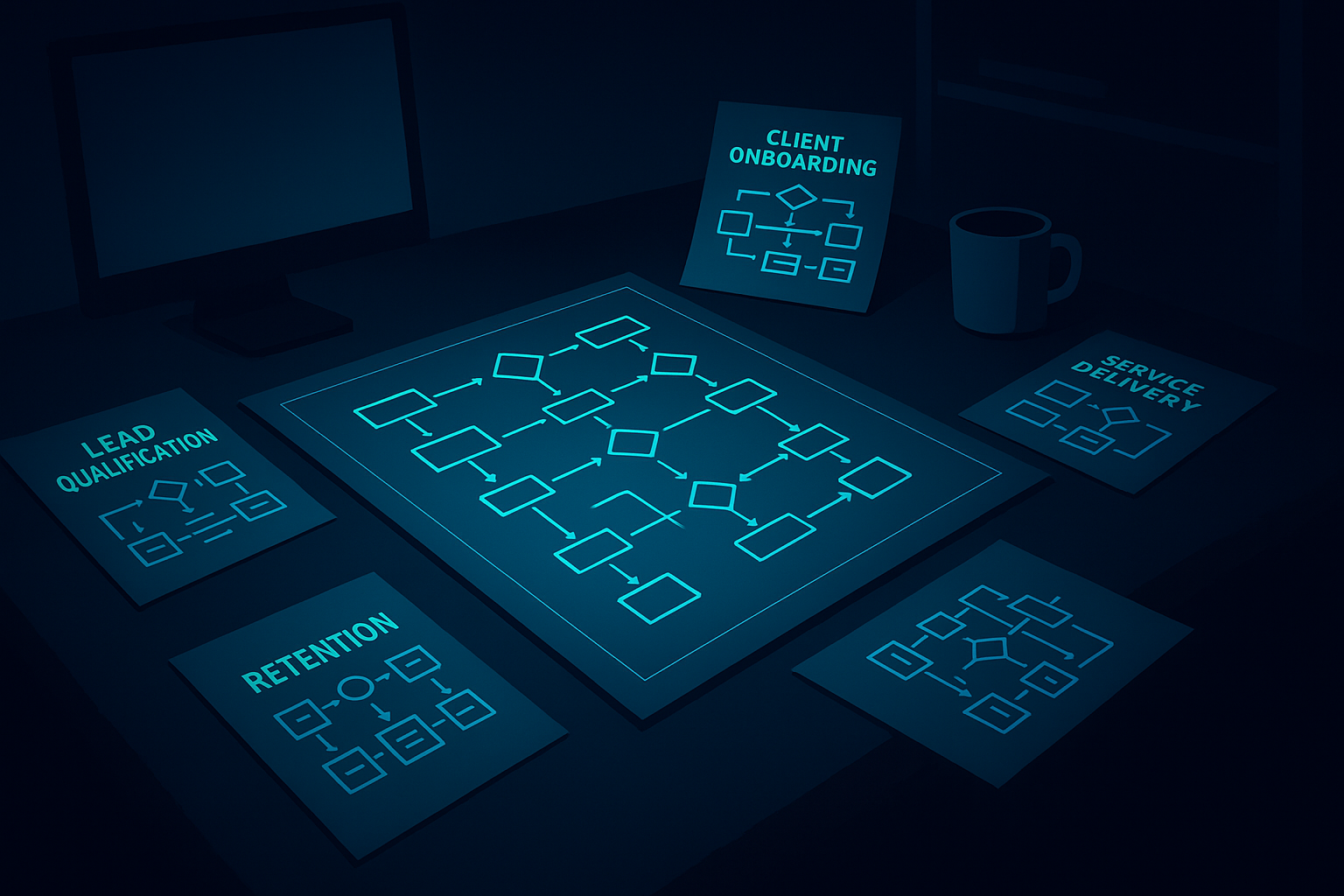
Conduct comprehensive impact assessment identifying highest-volume, revenue-critical processes across lead qualification, client onboarding, service delivery, and retention workflows. Map current operational sequences documenting decision points, handoff requirements, and exception handling procedures. Establish baseline KPIs measuring conversion rates, response times, and client satisfaction metrics that will demonstrate automation ROI. This discovery phase prevents expensive rework by ensuring AI agents address actual business bottlenecks rather than assumed pain points.
Dedicate process owners from each operational area to document workflows accurately and identify integration requirements with existing CRM, ATS, or property management systems. Week 1 focuses on process documentation, week 2 establishes measurement baselines and defines success criteria for automation implementation.
Phase 2 (Weeks 3-4): Solution Design and System Integration
Select highest-impact automation opportunities based on volume-revenue analysis from discovery phase, design AI agent logic matching your industry-specific requirements, and plan integrations with existing business systems without disrupting current operations. Establish success metrics in business terms—lead-to-close rates, time-to-hire improvements, guest satisfaction scores—rather than vanity metrics like task completion counts. Transparent design documentation prevents implementation surprises and ensures stakeholder alignment on expected outcomes.
Week 3 covers solution architecture and integration planning, week 4 finalizes AI agent configuration and establishes testing protocols for pilot phase validation.
Phase 3 (Weeks 5-6): Pilot Build and Internal Testing
Configure AI agents using real business data from representative workflows, run parallel testing alongside existing manual processes to validate accuracy and identify edge cases requiring human oversight. Gather user feedback from team members who will interact with automated systems daily, addressing usability concerns and workflow integration issues before full deployment. Pilot testing with live data prevents production failures that could disrupt client service or damage SSA renewal rates.
Week 5 handles agent configuration and initial testing, week 6 focuses on user acceptance testing and exception handling refinement to ensure smooth go-live transition.
Phase 4 (Weeks 7-8): Go-Live with Gradual Rollout
Execute soft launch covering subset of workflows—typically 20-30% of volume—while monitoring conversion rates and business KPIs in real-time to catch performance issues before they impact client satisfaction. Scale automation coverage based on demonstrated performance, maintaining manual backup processes until confidence builds in AI agent reliability. Progressive rollout prevents big-bang failures that could damage client relationships or create operational chaos during critical business periods.
Week 7 covers soft launch execution and monitoring, week 8 scales automation coverage based on performance validation and team confidence levels.
Phase 5 (Ongoing): Continuous Optimization and Scaling
Implement weekly conversion tracking, monthly operational audits, and automated alerts for performance deviations such as unusual no-show rates, processing delays, or qualification errors. For additional guidance on optimizing your SSA automation journey, you might find this resource on subscription business models helpful.
To learn more about the team behind these solutions, visit the Vynta About page for insights into their expertise and approach. For a comprehensive overview of available solutions, explore the services offered by Vynta.
Frequently Asked Questions
What are the main challenges that cause 60% of Subscription Service Agreement (SSA) businesses to fail within three years?
The primary challenges include manual process bottlenecks that lead to operational inefficiencies, eroding profit margins and harming client satisfaction. These inefficiencies often result in poor billing accuracy, delayed customer support, contract management issues, and high churn rates, which collectively undermine the scalability and sustainability of SSA businesses.
How does AI automation improve operational workflows in online business services using SSA models?
AI automation streamlines key workflows such as billing, customer support, contract management, and churn prediction by reducing manual effort and errors. This leads to faster service delivery, improved client retention, and more predictable revenue streams, enabling businesses to scale efficiently while maintaining high customer satisfaction.
Which specific operational workflows typically create bottlenecks in online business services, and how can they be addressed?
Billing processes, customer support interactions, contract lifecycle management, and churn monitoring are common bottlenecks. These can be addressed through AI-driven automation that ensures accurate invoicing, timely and personalized customer responses, seamless contract updates, and proactive identification of at-risk clients to reduce churn.
Why is automation considered a competitive differentiator for mid-market companies using SSA models?
Automation enables mid-market companies to deliver consistent, high-quality service at scale without proportionally increasing costs. By augmenting human expertise with AI, these businesses improve operational efficiency, enhance client experiences, and secure predictable revenue growth—advantages that are critical for standing out in competitive SSA markets.
About The Author
Anas Moujahid is the chief contributing writer & Operations Director for the Vynta AI Blog, where he turns cutting-edge AI automation into measurable business outcomes for mid-market companies.
Vynta AI designs enterprise-grade AI agents that augment rather than replace people—freeing teams to focus on higher-value work while the bots handle the busywork.
We specialise in four service-heavy verticals where AI can move the revenue needle fast: real estate, recruitment, fundraising and hospitality.
Anas started his career architecting AI and automation systems; today he leads operations at Vynta AI, making sure every deployment lands real-world ROI—whether that’s more booked viewings for estate agents, faster placements for recruiters, warmer investor pipelines for fundraisers or happier guests for hotels and restaurants.
Vynta AI delivers results by:
- Building industry-specific agents pre-trained on real-world workflows—no generic chatbots here.
- Integrating seamlessly with existing CRMs, ATSs, PMSs and fundraising platforms—zero rip-and-replace.
- Measuring success in business KPIs (lead-to-close rates, time-to-hire, donor retention, RevPAR) not vanity metrics.
- Providing transparent implementation plans so clients know exactly what to expect, when and why.
- Pairing every AI agent with human-in-the-loop controls to keep quality, compliance and brand voice on point.
Since launch, Vynta AI has helped agencies slash lead qualification time by up to 70 %, recruitment firms cut screening hours in half, fundraising teams triple investor touchpoints and hospitality brands lift guest satisfaction scores by double digits—all while keeping human expertise firmly in the loop.
Anas writes with the same ethos that drives Vynta AI: outcome-focused, jargon-free and grounded in real business value. Expect data-backed insights, practical implementation guides and a clear-eyed view of what AI can—and can’t—do for your organisation.