Beyond efficiency gains, AI enables nonprofits to demonstrate impact with unprecedented precision. Automated data collection and analysis generate compelling reports for board meetings, grant applications, and donor stewardship—transforming how organizations communicate their value to stakeholders.
Essential AI Technologies for Nonprofit Leaders

Machine Learning: Unlocking Donor Intelligence
Machine learning algorithms analyze donor behavior patterns to predict giving likelihood, optimal ask amounts, and preferred communication channels. This technology powers the donor scoring systems that help development teams prioritize outreach efforts and customize appeals for maximum effectiveness.
Natural Language Processing: Scaling Personal Touch
NLP technology drafts personalized thank-you letters, social media posts, and newsletter content at scale while maintaining authentic voice. Advanced systems analyze donor feedback sentiment, automatically categorize volunteer applications, and generate grant proposal drafts from program data.
| AI Technology |
Primary Nonprofit Application |
Typical Time Savings |
| Machine Learning |
Donor segmentation & prospect research |
5-10 hours/week |
| Natural Language Processing |
Content creation & communication |
8-15 hours/week |
| Predictive Analytics |
Campaign optimization & planning |
3-6 hours/week |
Predictive Analytics: Strategic Foresight
Predictive models forecast donation trends, volunteer availability, and program demand cycles. This intelligence enables proactive resource planning, optimized campaign timing, and evidence-based budget allocation that maximizes mission impact per dollar invested.
Selecting the Right AI Solution: A Strategic Framework
Vynta AI – Enterprise-Grade Fundraising Automation
Best for: Mid-market nonprofits seeking comprehensive donor engagement automation with measurable ROI tracking.
Vynta AI delivers purpose-built fundraising automation that integrates seamlessly with existing CRM systems. The platform combines donor research, personalized outreach sequencing, and real-time analytics in a unified solution designed specifically for nonprofit fundraising workflows. Organizations typically see 35-50% improvements in donor response rates within 90 days of implementation.
ChatGPT – Versatile Content Generation
Best for: Small nonprofits needing flexible writing assistance for grants, social media, and donor communications.
Pros:
- Low cost and immediate accessibility
- Versatile content creation capabilities
- No technical setup required
Cons:
- Requires prompt engineering for best results
- Manual integration with CRM and workflows
- Quality may vary without human review
ChatGPT provides accessible AI writing assistance for nonprofits with limited technical resources. The platform excels at generating grant proposals, social media content, and donor newsletters, though organizations must invest time in prompt engineering to achieve consistent quality. Integration requires manual workflows, making it ideal for smaller teams with flexible processes.
DonorSearch AI – Specialized Prospect Intelligence
Best for: Development teams focused primarily on major gift identification and wealth screening.
DonorSearch AI concentrates on prospect research and wealth screening capabilities, offering deep donor intelligence for major gift campaigns. The platform provides comprehensive donor profiles and giving capacity analysis, though it requires separate tools for campaign execution and donor communication management.
| Platform |
CRM Integration |
Automation Depth |
Nonprofit Specialization |
Implementation Speed |
| Vynta AI |
Native integration |
End-to-end workflows |
Purpose-built |
2-3 weeks |
| ChatGPT |
Manual export/import |
Content generation only |
General purpose |
Immediate |
| DonorSearch AI |
API connections |
Research-focused |
Fundraising-specific |
4-6 weeks |
Strategic Implementation Framework
Successful ai for nonprofits implementation begins with process audit and clear success metrics. Start by identifying the highest-impact, lowest-complexity automation opportunities—typically donor acknowledgment sequences or volunteer application processing. Establish baseline measurements for time investment, response rates, and staff satisfaction before deployment.
Pilot programs should run for 60-90 days with weekly performance reviews and staff feedback sessions. This approach allows for real-time optimization while building organizational confidence in AI capabilities. Organizations that follow structured implementation frameworks report 85% higher satisfaction rates and faster ROI achievement compared to ad-hoc adoption approaches.
Fundraising Revolution: From Research to Stewardship
AI-powered grant writing transforms proposal development from weeks-long projects to same-day deliverables. Automated research identifies relevant opportunities, generates compelling narratives from program data, and customizes applications for specific funder priorities. Mid-sized nonprofits report submitting 3x more grant applications with 40% higher success rates using AI research and writing tools.
Donor stewardship automation maintains meaningful relationships at scale through personalized communication sequences. AI analyzes giving history, engagement patterns, and communication preferences to deliver targeted messages that feel individually crafted. One children’s nonprofit increased donor retention 28% by implementing AI-driven thank-you sequences that referenced specific program impacts aligned with donor interests.
Marketing Excellence: Personalized Outreach at Scale
Content creation acceleration enables nonprofits to maintain consistent social media presence, email campaigns, and website updates without dedicated marketing staff. AI generates compelling stories from program data, creates graphics optimized for different platforms, and schedules content for maximum engagement timing.
Campaign personalization reaches new sophistication levels through AI-driven donor segmentation and message customization. Organizations can create dozens of campaign variations targeting specific donor demographics, interests, and giving capacity levels—work that previously required entire marketing departments.
Real-World Impact: Giving Tuesday Campaign
A mid-market food bank used AI to create personalized Giving Tuesday campaigns for five donor segments in under two hours. Results: 45% higher open rates, 60% more donations, and 25% increase in average gift size compared to their previous year’s generic campaign approach.
Operational Excellence: Administrative Automation
Program administration benefits significantly from AI automation in volunteer management, client intake processing, and impact reporting. Automated systems screen volunteer applications, schedule training sessions, and match volunteers with appropriate opportunities based on skills and availability patterns.
Impact measurement becomes real-time rather than retrospective through AI-powered data collection and analysis. Programs generate weekly board-ready reports showing client outcomes, resource utilization, and progress toward strategic goals—enabling data-driven decision making that optimizes mission impact per dollar invested.
Ethical AI Implementation: Maintaining Mission Integrity
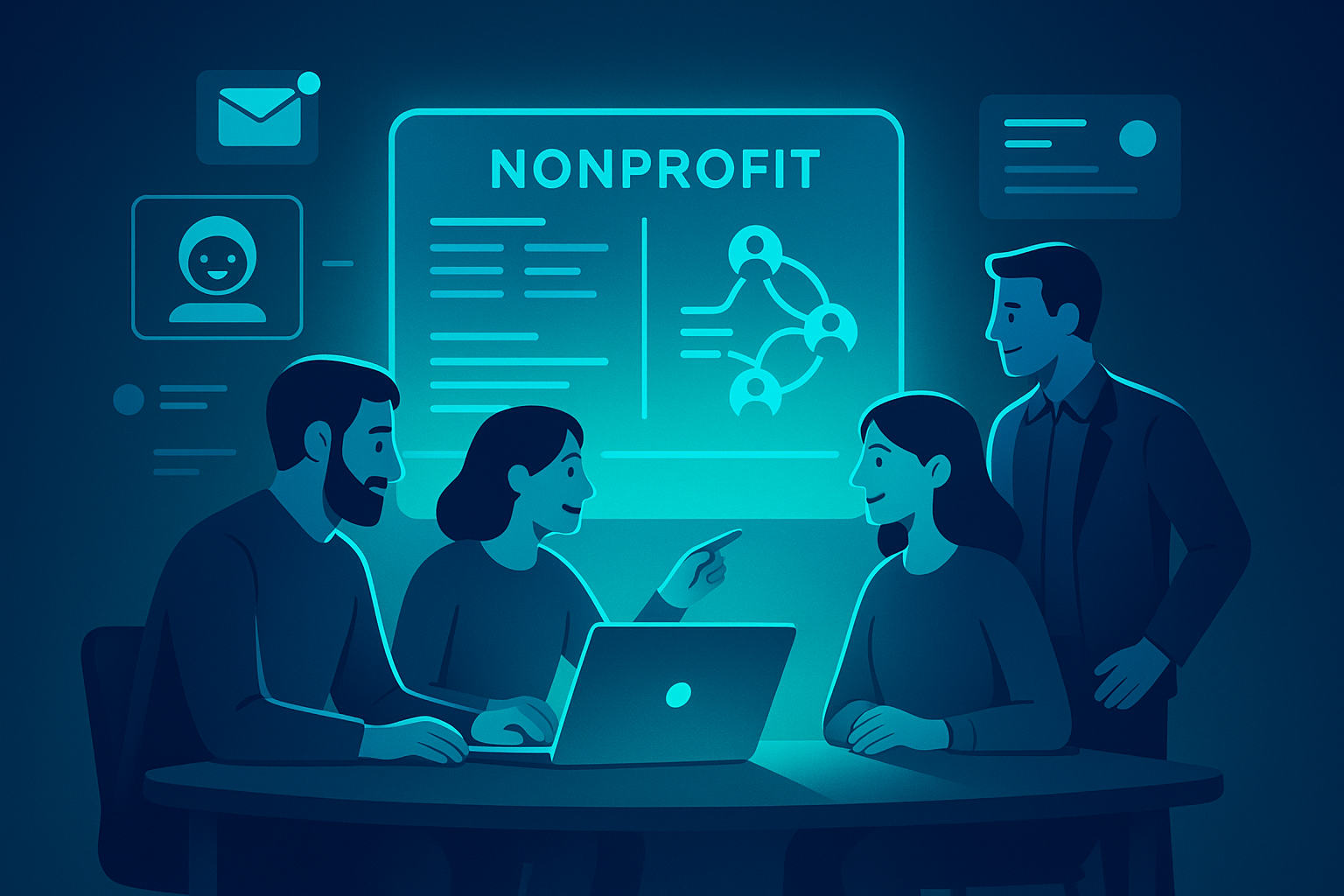
AI as Mission Amplifier, Not Replacement
Responsible ai for nonprofits implementation prioritizes augmenting human capabilities rather than replacing staff relationships with donors and clients. AI handles data processing, routine communications, and administrative tasks, freeing staff for strategic thinking, relationship building, and direct service delivery that requires human empathy and judgment.
Transparency protocols ensure stakeholders understand when and how AI supports organizational operations. Clear policies govern AI use in donor communications, data analysis, and decision-making processes, maintaining trust while leveraging technological advantages for greater mission impact.
Privacy-First Data Practices
Nonprofit AI implementations require robust data governance frameworks protecting constituent privacy while enabling operational efficiency. Organizations must establish clear protocols for data access, retention, and sharing that comply with applicable regulations while supporting AI functionality.
Privacy Protection Checklist
- Encrypt all donor data before AI processing
- Implement role-based access controls for AI outputs
- Establish data retention limits for AI-generated insights
- Create opt-out mechanisms for AI-driven communications
- Document AI decision-making processes for transparency
Data minimization principles limit AI processing to essential operational information, reducing privacy risks while maintaining functionality. Regular audits verify compliance with donor consent preferences and data protection requirements, ensuring AI systems support rather than compromise organizational values.
Organizational AI Competency Development
Staff training programs ensure teams understand AI capabilities and limitations, preventing over-reliance while maximizing productivity gains. Quarterly workshops covering prompt engineering, output evaluation, and ethical considerations build confidence and competence across all organizational levels.
Board education initiatives help leadership make informed decisions about AI investments and policies. Regular briefings on AI performance metrics, risk management, and strategic opportunities enable governance bodies to provide appropriate oversight while supporting innovation that advances mission objectives. For a deeper dive into the landscape of AI-powered nonprofits, see this comprehensive overview from Stanford Social Innovation Review.
The Future of Nonprofit Impact: Strategic AI Integration
Beyond Automation: AI as Strategic Partner
The evolution of ai for nonprofits moves beyond task automation toward strategic intelligence that informs program development, resource allocation, and impact measurement. Predictive analytics identify emerging community needs before they become crises, enabling proactive rather than reactive service delivery.
Human-AI collaboration models preserve the relationship-centered nature of nonprofit work while leveraging data insights for greater precision and effectiveness. Development teams combine AI-generated donor intelligence with personal knowledge to craft compelling solicitations that resonate on both analytical and emotional levels.
Sustainable AI Evolution Strategy
Organizations that treat AI implementation as an ongoing capability rather than a one-time project achieve superior long-term results. Annual strategy reviews assess emerging AI technologies against mission priorities, ensuring technology investments align with organizational growth and changing community needs. For additional insights on AI in the nonprofit sector, refer to this research from Tuck School of Business.
Measurement frameworks track both efficiency gains and mission impact metrics, providing comprehensive evaluation of AI contributions to organizational effectiveness. This dual focus prevents technology adoption for its own sake while maximizing the mission-advancing potential of AI investments.
Mission-Driven Market Leadership
Nonprofits implementing comprehensive AI strategies gain significant competitive advantages in donor acquisition, volunteer recruitment, and program effectiveness. Organizations demonstrate greater impact per dollar, faster response to community needs, and more sophisticated stakeholder engagement than peers relying solely on traditional approaches.
These capabilities translate directly into increased funding opportunities, as foundations and individual donors increasingly prioritize organizations demonstrating measurable impact and operational excellence. AI becomes not just an operational tool but a strategic differentiator that attracts resources and enhances mission sustainability.
The strategic implementation of ai for nonprofits represents more than technological advancement—it’s a fundamental shift toward data-driven mission delivery that amplifies human compassion with intelligent automation. Organizations that embrace AI thoughtfully and systematically position themselves for unprecedented impact scalability while maintaining the personal connections that define effective nonprofit work.
Success requires starting with clear business outcomes, implementing responsibly, and measuring consistently. Whether automating donor communications, streamlining volunteer management, or generating compelling grant proposals, AI serves as the force multiplier that transforms limited resources into unlimited potential for community impact. The future belongs to nonprofits that harness AI not as a replacement for human dedication, but as the strategic partner that makes every mission moment more effective.
Frequently Asked Questions
How can AI automation increase fundraising ROI and improve donor engagement for nonprofits?
AI automation boosts fundraising ROI by enabling personalized donor segmentation and targeted outreach, resulting in response rates up to 40% higher than traditional methods. It also automates follow-up communications, maintaining consistent engagement that triples donor interaction without adding workload to development teams.
What are the key AI technologies that nonprofit leaders should consider implementing?
Nonprofit leaders should focus on AI technologies like machine learning for predictive donor analytics, natural language processing for automated communications and grant writing, and data-driven segmentation tools that optimize outreach strategies and resource allocation for greater mission impact.
How can nonprofits integrate AI while preserving their human-centered values and mission integrity?
Nonprofits can preserve their human-centered values by using AI to augment—not replace—staff efforts, automating routine tasks to free up time for meaningful donor relationships and mission-driven work. Transparent AI implementation with ethical guidelines ensures technology supports compassion and mission alignment throughout the organization.
In what ways does AI help reduce administrative overhead and enhance program impact in nonprofit organizations?
AI reduces administrative overhead by automating time-consuming tasks like donor database management, grant research, and routine communications, saving 20-60% of staff time. This efficiency allows nonprofits to redirect resources toward program delivery and strategic initiatives, ultimately amplifying their mission impact and operational effectiveness.
About The Author
Anas Moujahid is the chief contributing writer & Operations Director for the Vynta AI Blog, where he turns cutting-edge AI automation into measurable business outcomes for mid-market companies.
Vynta AI designs enterprise-grade AI agents that augment rather than replace people—freeing teams to focus on higher-value work while the bots handle the busywork.
We specialise in four service-heavy verticals where AI can move the revenue needle fast: real estate, recruitment, fundraising and hospitality.
Anas started his career architecting AI and automation systems; today he leads operations at Vynta AI, making sure every deployment lands real-world ROI—whether that’s more booked viewings for estate agents, faster placements for recruiters, warmer investor pipelines for fundraisers or happier guests for hotels and restaurants.
Vynta AI delivers results by:
- Building industry-specific agents pre-trained on real-world workflows—no generic chatbots here.
- Integrating seamlessly with existing CRMs, ATSs, PMSs and fundraising platforms—zero rip-and-replace.
- Measuring success in business KPIs (lead-to-close rates, time-to-hire, donor retention, RevPAR) not vanity metrics.
- Providing transparent implementation plans so clients know exactly what to expect, when and why.
- Pairing every AI agent with human-in-the-loop controls to keep quality, compliance and brand voice on point.
Since launch, Vynta AI has helped agencies slash lead qualification time by up to 70 %, recruitment firms cut screening hours in half, fundraising teams triple investor touchpoints and hospitality brands lift guest satisfaction scores by double digits—all while keeping human expertise firmly in the loop.
Anas writes with the same ethos that drives Vynta AI: outcome-focused, jargon-free and grounded in real business value. Expect data-backed insights, practical implementation guides and a clear-eyed view of what AI can—and can’t—do for your organisation.