

Key Takeaways
- Managing help desk operations strategically is essential for driving business growth in mid-market SMEs.
- Exceptional customer service and operational efficiency are critical challenges for modern businesses.
- Help desk management impacts various industries, including hospitality, real estate, recruitment, and fundraising.
- Effective help desk operations contribute directly to improving bottom-line results.
Table of Contents
- Core Principles—What ‘Managing a Help Desk’ Really Means
- Setting Up a High-Performance Help Desk for Hospitality, Real Estate, Recruitment, and Fundraising
- Optimizing Help Desk Operations: Techniques for ROI and Efficiency
- Advanced AI & Automation in Help Desk Management
- Measuring Success—Help Desk KPIs that Matter
- Common Help Desk Challenges and Solutions
- Help Desk Management in Action—Real-World Scenarios Across Four Verticals
- How to Choose—and Continuously Upgrade—Your Help Desk Solution
The Strategic Role of Help Desk Management in Business Growth
Modern mid-market SMEs face a critical challenge: delivering exceptional customer service while maintaining operational efficiency. The ability to manage help desk operations strategically has evolved from a back-office function to a revenue-driving business imperative. For hospitality managers handling guest inquiries, real estate agencies managing property requests, recruitment firms processing candidate queries, and fundraising organizations coordinating investor communications, help desk management directly impacts bottom-line results.
A help desk serves as the centralized hub for customer service requests, technical support, and operational inquiries. Unlike a service desk—which encompasses broader IT service management including asset management and change control—a help desk focuses specifically on request resolution and customer interaction. This distinction matters significantly for service-heavy industries where customer experience drives retention and revenue.
For organizations seeking tailored solutions, robust platforms designed for hospitality, real estate, recruitment, and fundraising can provide the specialized features and integrations needed to optimize help desk performance and drive measurable business results.
Core Principles—What ‘Managing a Help Desk’ Really Means
Managing a help desk encompasses three critical components: people, processes, and technology. Effective management requires orchestrating skilled agents, standardized workflows, and robust platforms to deliver consistent outcomes. The scope extends beyond ticket handling to include strategic planning, performance optimization, and continuous improvement initiatives that drive measurable business results.
Core functions include request intake through multiple channels, intelligent ticket triage based on priority and complexity, SLA adherence monitoring, escalation management, and comprehensive resolution tracking. However, true help desk management focuses on outcomes: improving First Contact Resolution (FCR) rates, reducing Time-to-Resolution, and increasing Customer Satisfaction (CSAT) scores. These metrics directly correlate with revenue retention and growth across all service industries.
| Function | Help Desk Focus | Service Desk Focus | ITSM Focus |
|---|---|---|---|
| Primary Role | Customer service requests | IT service delivery | Enterprise IT governance |
| Scope | Issue resolution | Service management | Strategic IT alignment |
| Key Metrics | FCR, CSAT, response time | SLA compliance, availability | ROI, service quality |
| Industry Fit | Hospitality, real estate, recruitment | Technology companies | Large enterprises |
Industry-specific requirements shape help desk management approaches. Hospitality operations demand 24/7 availability with multilingual support capabilities. Real estate agencies require CRM integration for lead tracking and automated property matching. Recruitment firms need candidate database connectivity and interview scheduling automation. Fundraising organizations require donor management integration and compliance tracking. Understanding these unique needs determines platform selection, staffing models, and performance benchmarks.
Setting Up a High-Performance Help Desk for Hospitality, Real Estate, Recruitment, and Fundraising
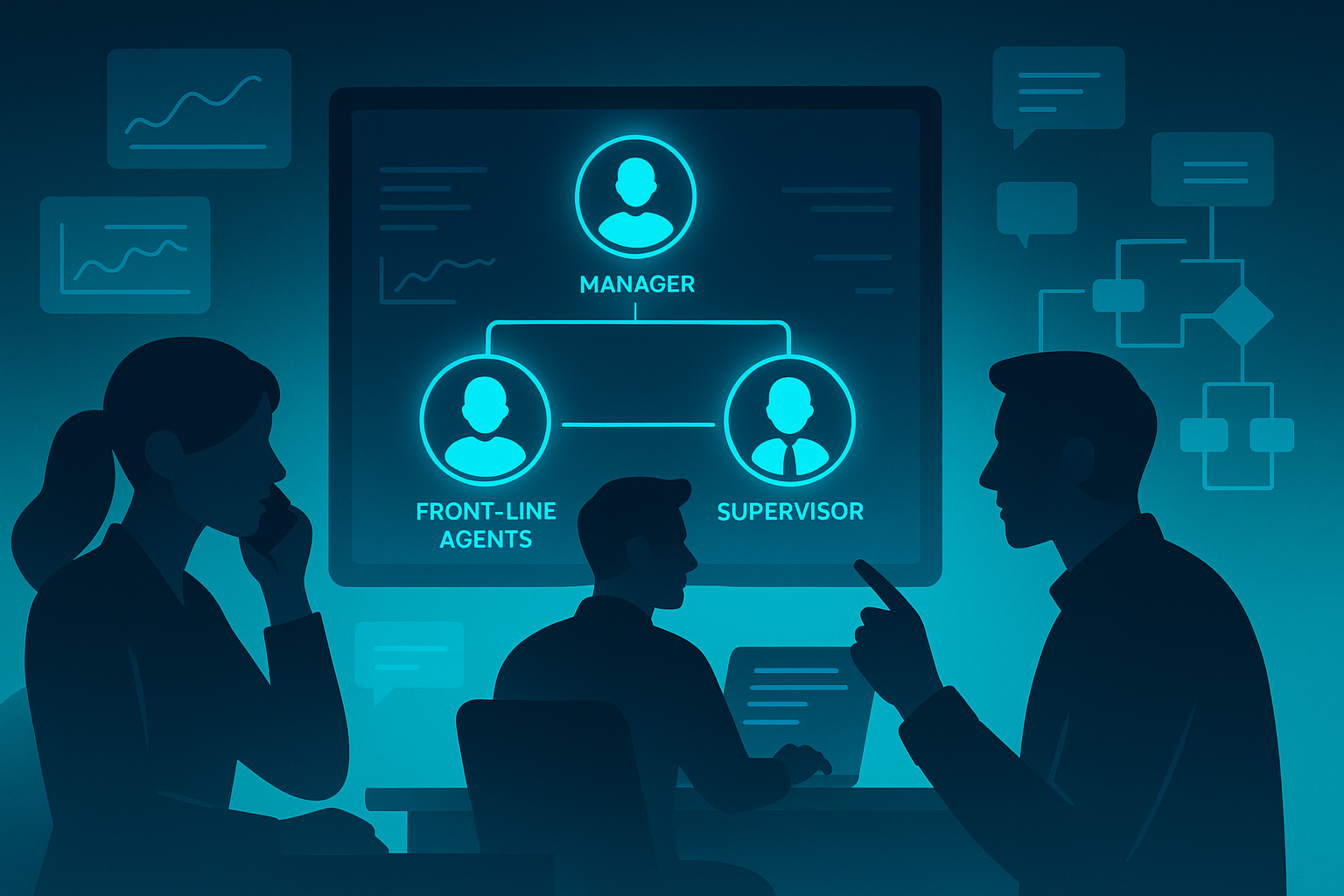
Defining Roles & Responsibilities
Successful help desk operations require a clearly defined organizational structure with specific accountability at each level. Front-line agents handle initial customer contact, perform basic troubleshooting, and escalate complex issues following predetermined criteria. Team leads monitor queue performance, provide real-time coaching, and manage escalations requiring supervisory intervention.
Industry-specific role specialization enhances service quality and efficiency. Hotels deploy guest services agents trained in reservation systems, billing inquiries, and concierge services. Real estate agencies utilize property specialists familiar with MLS systems, contract processes, and market data. Recruitment firms employ candidate coordinators skilled in ATS navigation, interview scheduling, and compliance requirements. This specialization reduces resolution times while improving customer satisfaction through expert-level support.
Selecting the Right Help Desk Platform—Key Features & Must-Have Integrations
Platform selection determines operational capabilities and scalability potential. Essential features include automated ticket routing based on content analysis, omnichannel communication support (email, chat, SMS, phone), comprehensive knowledge base functionality, and robust reporting capabilities. Advanced automation features like intelligent escalation, SLA monitoring, and customer sentiment analysis separate enterprise-grade platforms from basic ticketing systems.
Integration capabilities prove critical for mid-market SMEs operating multiple business systems. CRM connectivity enables agents to access customer history and preferences instantly. Calendar integration facilitates appointment scheduling and follow-up automation. Financial system connections provide billing information and payment processing capabilities. Communication platform integration ensures seamless handoffs between channels and departments.
Implementation Steps and Timelines
Strategic implementation follows a structured approach prioritizing business continuity and user adoption. Initial workflow mapping (3-5 days) identifies current processes, pain points, and improvement opportunities. System configuration (1-2 weeks) includes custom field creation, automation rule setup, and integration testing. Knowledge base migration (1 week) ensures agents and customers have access to up-to-date resources. User training and pilot testing (1 week) drive adoption and identify final adjustments before full rollout. Ongoing support and optimization ensure continuous improvement and ROI realization.
Optimizing Help Desk Operations: Techniques for ROI and Efficiency
Ticket Management & Workflow Automation
Effective ticket management transforms chaotic request handling into a systematic revenue driver. Automated assignment rules eliminate manual sorting by routing tickets based on category, urgency, and agent expertise. Priority-based routing ensures VIP guests in hospitality or high-value prospects in real estate receive immediate attention, while SLA timers provide accountability through real-time escalation alerts.
A boutique hotel using intelligent routing reduced guest query response times from 24 hours to under 2 hours, resulting in 15% higher guest satisfaction scores. The system automatically escalates unresolved tickets after predefined intervals, preventing critical issues from falling through cracks during busy periods.
Common operational problems include ticket backlog accumulation, lost requests between systems, and inconsistent resolution quality. Solutions involve implementing automated escalation workflows, establishing daily backlog review cycles, and creating standardized response templates that maintain personalization while ensuring consistency across all customer touchpoints.
Knowledge Base & Self-Service Excellence
A comprehensive, searchable knowledge base reduces repetitive queries while empowering customers to find solutions independently. Effective knowledge management requires categorizing content by user type, implementing robust search functionality, and maintaining current information through regular audits and updates.
Organizations implementing well-structured self-service portals typically achieve a 30% reduction in basic support requests, allowing agents to focus on complex issues requiring human expertise. Real estate agencies benefit from automated property information delivery, while recruitment firms use knowledge bases to streamline candidate onboarding processes.
Maintenance routines include monthly content reviews, user feedback integration, and analytics-driven updates. Successful knowledge bases feature clear navigation, visual elements for complex processes, and regular testing to ensure information remains accurate and accessible across all user scenarios.
Proactive Communication & Omnichannel Support
Proactive communication prevents issues from escalating while building customer confidence through transparency. Automated status updates, reminder notifications, and progress alerts keep stakeholders informed without requiring manual intervention from support agents.
Omnichannel integration ensures seamless communication across email, SMS, chat, and phone channels. A hospitality example involves handling high-volume reservation changes through coordinated email confirmations and SMS reminders, maintaining consistent service quality regardless of communication method chosen by guests.
Implementation requires establishing communication preferences for different customer segments, creating trigger-based notification systems, and maintaining consistent messaging across all channels. This approach reduces customer anxiety while demonstrating organizational reliability and attention to detail.
Advanced AI & Automation in Help Desk Management
Industry-Specific AI Use Cases
AI automation delivers measurable improvements across service-intensive industries when applied strategically. In hospitality, intelligent query routing analyzes guest messages to determine urgency and appropriate department assignment, while automated upsell prompts during service interactions have reduced no-shows by 30% in boutique hotels through targeted engagement.
Real estate agencies benefit from automated lead qualification systems that analyze inquiry patterns and respond with relevant property information within minutes, decreasing agent time spent on initial responses by 50%. Recruitment firms use AI-powered screening to categorize candidate support requests, enabling 2x faster candidate processing during high-volume hiring periods.
Fundraising organizations leverage automated investor outreach handling to maintain consistent communication during campaigns, achieving 3x improvement in first-response rates. These applications demonstrate AI’s capacity to enhance service quality while reducing operational overhead across diverse business models.
For organizations in the fundraising sector, specialized fundraising help desk solutions can streamline donor management and campaign communications, ensuring compliance and maximizing engagement.
Human-in-the-Loop—Why Augment, Not Replace
Successful AI implementation augments human capabilities rather than replacing human judgment. Assisted automation handles routine tasks while escalating complex situations requiring empathy, creative problem-solving, or compliance expertise to human agents. This approach maintains service quality while improving efficiency.
Human oversight remains essential for exception handling, VIP customer support, and knowledge base improvement. Agents review AI-generated responses for accuracy, handle sensitive situations requiring emotional intelligence, and identify process improvements based on recurring issues or customer feedback patterns.
The most effective systems combine AI speed with human insight, creating hybrid workflows where technology manages volume while people focus on relationship building and complex problem resolution. This balance ensures customer satisfaction while achieving operational scalability.
Implementation: Best Practices, Pitfalls, and Change Management
Successful AI deployment follows a structured approach: 2-week pilot programs testing core functionality, followed by 1-month phased rollouts incorporating user feedback. This timeline allows for system refinement while minimizing disruption to existing operations and customer service standards.
- Identify repetitive tasks consuming 30+ minutes daily
- Run parallel AI/manual processes for 2 weeks
- Measure response time and accuracy improvements before full deployment
Addressing adoption concerns requires transparent communication about data privacy measures, clear explanations of how AI enhances rather than threatens job security, and comprehensive training programs that upskill team members for higher-value activities. Regular KPI tracking and iterative improvements ensure continuous optimization and stakeholder confidence in the automation strategy.
Measuring Success—Help Desk KPIs that Matter
Must-Track Metrics for Business Outcomes
Effective help desk management requires monitoring metrics that directly correlate with business performance. First Response Time should target under 1 hour for urgent issues, while Time-to-Resolution varies by complexity but should maintain consistency. Ticket Volume and Backlog trends indicate capacity planning needs and process efficiency.
Customer Satisfaction (CSAT) scores directly correlate with business retention and revenue growth. In hospitality, CSAT above 85% typically drives 20% higher repeat bookings. SLA compliance rates should exceed 95% to maintain service quality standards across all four verticals.
Revenue-per-Query metrics prove particularly valuable in hospitality and real estate, measuring how effectively help desk interactions convert to upsells or property showings. Lead-to-Client conversion tracking in recruitment and fundraising demonstrates help desk impact on core business outcomes.
Industry Benchmark Alert
Top-performing help desks achieve: First Response Time under 1 hour, Time-to-Resolution under 4 hours for standard requests, and CSAT scores above 90%. These benchmarks translate to 15-25% revenue improvements across hospitality and real estate sectors.
Reporting, Analytics & Continuous Improvement
Automated dashboards eliminate manual reporting overhead while providing real-time visibility into help desk performance. Configure dashboards to display key metrics by time period, agent performance, and ticket category to identify improvement opportunities immediately.
Monthly reviews should focus on trend analysis rather than point-in-time metrics. Quarter-over-quarter comparisons reveal seasonal patterns in hospitality, recruitment hiring cycles, and fundraising campaign impacts. Use this data for workforce planning and capacity adjustments.
Analytics-driven improvements include identifying knowledge gaps through ticket clustering, optimizing agent schedules based on volume patterns, and predicting resource needs during peak periods. This proactive approach prevents service degradation before it impacts customer satisfaction.
Common Help Desk Challenges and Solutions
Reducing Backlog and Improving Resolution Times
Ticket backlogs typically stem from three root causes: inadequate staffing during peak periods, inefficient workflow design, or poor priority classification. Address staffing gaps through cross-training initiatives that enable agents to handle multiple request types across departments.
Dynamic ticket routing based on agent expertise and current workload prevents bottlenecks. Implement “swarm” resolution sessions where multiple agents collaborate on complex issues, reducing individual resolution times by up to 40% while building team knowledge.
Priority classification errors create artificial urgency that disrupts workflow efficiency. Establish clear priority criteria with business impact definitions, and regularly audit classifications to ensure accuracy across all ticket types.
Solving Knowledge Base Staleness
Outdated knowledge bases increase resolution times and customer frustration. Assign article ownership to specific agents or departments, creating accountability for content accuracy and regular updates based on their expertise areas.
Analytics reveal which articles generate the most tickets despite existing documentation, indicating content gaps or unclear instructions. Schedule monthly reviews of high-traffic, low-success articles to identify improvement opportunities.
Encourage agents to flag outdated information during ticket resolution, creating a feedback loop that maintains knowledge base relevance. This crowdsourced approach ensures continuous improvement without dedicated content management overhead.
Handling Integration & Communication Breakdowns
CRM and help desk synchronization failures create duplicate work and incomplete customer histories. Implement real-time sync monitoring with automated alerts when integration failures occur, preventing data inconsistencies from impacting service quality.
Email routing misconfigurations result in lost tickets and delayed responses. Establish redundant routing rules with fallback assignments to ensure no customer inquiry goes unaddressed, particularly critical in hospitality and fundraising environments.
Communication breakdowns between help desk and other departments slow resolution times. Create escalation protocols with defined handoff procedures and status update requirements to maintain visibility throughout the resolution process.
Help Desk Management in Action—Real-World Scenarios Across Four Verticals
Hospitality Scenario: A boutique hotel faces 300% increased guest queries during peak season with limited staff. Implementing automated query classification routes reservation changes to self-service portals while directing service requests to available agents. Result: 60% reduction in wait times despite volume surge.
Hospitality Takeaway: Automated triage during peak periods maintains service quality without proportional staffing increases, protecting profit margins while preserving guest satisfaction.
Real Estate Scenario: A mid-market agency receives 150 property inquiries daily requiring immediate response to maintain lead quality. AI-powered automation delivers property details, scheduling links, and agent contact information within 3 minutes of inquiry receipt. Conversion rates improve 35% through faster response times.
For real estate agencies, dedicated real estate help desk solutions can streamline property inquiry management and improve lead conversion rates.
Recruitment Scenario: Seasonal hiring surges generate 500+ candidate queries weekly about application status and requirements. Automated responses provide status updates while complex queries route to recruiters. This approach reduces recruiter administrative time by 45% while maintaining candidate engagement.
Recruitment firms can benefit from specialized recruitment help desk platforms that automate candidate communications and optimize the hiring process.
Fundraising Scenario: During a major capital campaign, investor follow-ups require coordinated responses across multiple channels. Unified ticket management ensures consistent messaging while tracking all touchpoints. Campaign efficiency improves 50% through eliminated duplicate outreach and comprehensive interaction history.
How to Choose—and Continuously Upgrade—Your Help Desk Solution

Criteria for Software Selection
Scalability requirements vary significantly across industries. Hospitality needs seasonal capacity scaling, while recruitment requires burst capacity during hiring cycles. Evaluate platforms based on flexible user licensing and automated resource allocation capabilities.
Integration depth determines operational efficiency. Essential integrations include CRM systems, communication platforms, and industry-specific tools like property management systems or applicant tracking systems. Assess API quality and pre-built connector availability.
Automation capabilities should align with your team’s technical expertise. Evaluate workflow automation, reporting, and customization options to ensure the platform supports both current and future business needs.
For a deeper understanding of best practices in help desk management, you can review this authoritative NIST guide on incident response and service desk operations.
To learn more about the team and vision behind these solutions, visit the About page for additional insights.
Frequently Asked Questions
What are the core components involved in effectively managing a help desk?
Effectively managing a help desk involves coordinating skilled agents, standardized processes, and reliable technology platforms. This combination ensures consistent request resolution, strategic planning, and continuous performance improvement that directly supports business outcomes.
How does help desk management differ from service desk and IT service management (ITSM)?
Help desk management focuses specifically on resolving customer service and operational requests, whereas service desks cover broader IT service management tasks like asset and change management. ITSM encompasses the full spectrum of IT services, making help desks a more targeted function critical for customer-facing industries.
In what ways can AI and automation improve help desk operations and business growth?
AI and automation streamline help desk workflows by handling routine inquiries, prioritizing tickets, and providing data-driven insights. This reduces resolution times, enhances customer satisfaction, and frees human agents to focus on complex issues, ultimately driving operational efficiency and measurable business growth.
Which key performance indicators (KPIs) should businesses track to measure help desk success?
Businesses should track KPIs such as average resolution time, first-contact resolution rate, customer satisfaction scores, and ticket volume trends. Monitoring these metrics helps optimize help desk performance and directly links support effectiveness to business outcomes like retention and revenue.
About The Author
Anas Moujahid is the chief contributing writer & Operations Director for the Vynta AI Blog, where he turns cutting-edge AI automation into measurable business outcomes for mid-market companies.
Vynta AI designs enterprise-grade AI agents that augment rather than replace people—freeing teams to focus on higher-value work while the bots handle the busywork.
We specialise in four service-heavy verticals where AI can move the revenue needle fast: real estate, recruitment, fundraising and hospitality.
Anas started his career architecting AI and automation systems; today he leads operations at Vynta AI, making sure every deployment lands real-world ROI—whether that’s more booked viewings for estate agents, faster placements for recruiters, warmer investor pipelines for fundraisers or happier guests for hotels and restaurants.
Vynta AI delivers results by:
- Building industry-specific agents pre-trained on real-world workflows—no generic chatbots here.
- Integrating seamlessly with existing CRMs, ATSs, PMSs and fundraising platforms—zero rip-and-replace.
- Measuring success in business KPIs (lead-to-close rates, time-to-hire, donor retention, RevPAR) not vanity metrics.
- Providing transparent implementation plans so clients know exactly what to expect, when and why.
- Pairing every AI agent with human-in-the-loop controls to keep quality, compliance and brand voice on point.
Since launch, Vynta AI has helped agencies slash lead qualification time by up to 70 %, recruitment firms cut screening hours in half, fundraising teams triple investor touchpoints and hospitality brands lift guest satisfaction scores by double digits—all while keeping human expertise firmly in the loop.
Anas writes with the same ethos that drives Vynta AI: outcome-focused, jargon-free and grounded in real business value. Expect data-backed insights, practical implementation guides and a clear-eyed view of what AI can—and can’t—do for your organisation.