

Key Takeaways
- Searching for business services near you means prioritizing providers that deliver measurable results.
- Successful mid-market businesses select service partners who understand their industry’s specific challenges.
- Choosing the right service providers is crucial for achieving scalable, ROI-focused growth.
- Effective business services go beyond vendor relationships to drive tangible outcomes.
Table of Contents
- What Are Business Services? Redefining Value in Your Local Market
- How to Find the Best Business Services Near Me: Step-by-Step for Owners & Managers
- Comparing Service Providers: Local Experts, National Chains & Specialized Partners
- Industry Spotlight: Business Services for Real Estate, Recruitment, Fundraising & Hospitality
- Maximizing Results: Practical Tips, Troubleshooting & Advanced Strategies
- Why Vynta AI Is the Strategic Partner for Local Business Success
Business Services Near Me: Your Practical Guide to Smarter, ROI-Focused Growth
When you search for business services near me, you’re looking for solutions that drive measurable outcomes, not just another vendor relationship. The difference between thriving mid-market businesses and those struggling to scale often comes down to one critical decision: choosing service providers who understand your industry’s unique challenges and deliver quantifiable ROI.
Whether you’re managing a boutique hotel, real estate agency, recruitment firm, or fundraising organization, the right business services should augment your team’s capabilities while reducing operational friction. This guide cuts through the noise to help you identify, evaluate, and implement services that transform your bottom line.
What Are Business Services? Redefining Value in Your Local Market
Defining Business Services for Modern SMEs
Business services encompass four core characteristics that distinguish them from product-based offerings: intangibility (you’re buying expertise, not physical goods), personalization (solutions adapt to your specific workflows), scalability (services grow with your business), and outcome-focus (success measured by your KPIs, not theirs). For mid-market SMEs, this translates to accessing enterprise-level capabilities without enterprise-level overhead.
Business Services vs. Product-based Businesses: Key Differences
| Aspect | Business Services | Product-based Business |
|---|---|---|
| Value Delivery | Ongoing expertise and outcomes | One-time purchase or subscription |
| Customization | Tailored to industry workflows | Standardized features |
| Success Metrics | Your business KPIs (conversion rates, satisfaction scores) | Product usage or feature adoption |
| Relationship Type | Strategic partnership | Vendor transaction |
Types of Business Services in Your Area
The most impactful business services near me fall into specialized categories that directly influence revenue and operational efficiency:
Industry-Specific Automation: Real estate lead qualification systems, recruitment candidate screening platforms, fundraising investor outreach automation, hospitality guest experience management. These services understand vertical-specific workflows and compliance requirements.
Professional Services: Accounting firms specializing in your industry, legal counsel familiar with sector regulations, compliance consultants who understand hospitality licensing or real estate disclosure requirements.
Technology Integration: CRM automation that connects with property management systems, applicant tracking system optimization, donor management platform integration, reservation system enhancement with upselling capabilities.
How to Find the Best Business Services Near Me: Step-by-Step for Owners & Managers
Proven Steps to Identify and Vet Service Providers
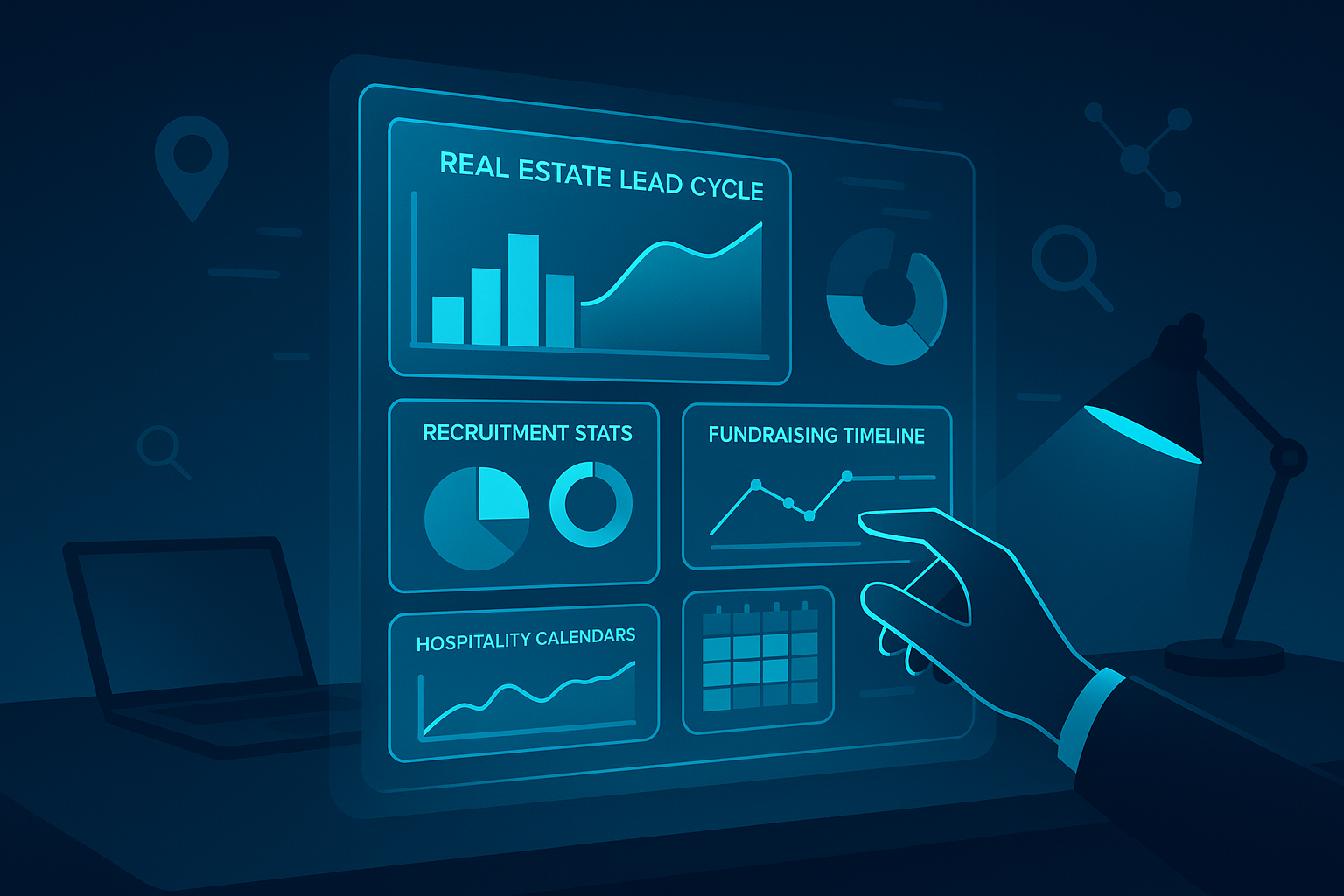
Start with industry-specific research, providers who understand real estate lead cycles, recruitment placement metrics, fundraising timelines, or hospitality seasonality deliver faster ROI than generalists. Use Google Business listings, industry association directories, and peer referrals to build your initial list.
Verify credentials through state licensing databases and insurance verification portals. Request client references within your vertical, a hospitality AI service should provide hotel or restaurant case studies, not generic “customer service” examples. During initial consultations, evaluate their questions: Do they ask about your current conversion rates, average time-to-hire, or guest satisfaction scores?
Assess integration capabilities with your existing systems. Whether it’s your property management software, ATS platform, donor database, or reservation system, seamless data flow prevents operational disruption and ensures accurate ROI measurement.
Key Questions to Ask Before Booking
- ROI Measurement: “How do you track and report outcomes for businesses similar to mine? Can you share specific metrics like lead conversion improvements or time-to-hire reductions?”
- Implementation Timeline: “What’s the realistic timeline from contract signing to measurable results? How much training will my team need?”
- Industry Expertise: “Can you provide case studies from [real estate agencies/recruitment firms/fundraising organizations/hotels] showing before-and-after performance data?”
- Quality Assurance: “How do you maintain service quality, and what’s your escalation process when issues arise?”
Real-World Example: Vetting AI-Powered Hospitality Services
Maria, who manages a boutique hotel and upscale restaurant, recently evaluated AI-powered guest experience services. Her process: she requested demos showing actual guest conversation flows, analyzed cost-per-booking improvements from similar properties, and verified the provider’s ability to integrate with her reservation and CRM systems. By focusing on real-world results and seamless integration, Maria ensured her investment would deliver measurable improvements in guest satisfaction and revenue.
Comparing Service Providers: Local Experts, National Chains & Specialized Partners
When searching for business services near me, you’ll encounter three distinct provider types, each with different strengths for mid-market SMEs. The key is matching your operational needs with the right expertise level and service model.
Local Specialist vs. National Chain vs. Industry-focused Agency
Local specialists offer personalized attention but may lack vertical expertise. National chains provide standardized processes but often miss industry nuances. Industry-focused agencies like Vynta AI combine deep vertical knowledge with scalable automation, delivering measurable outcomes across real estate, recruitment, fundraising, and hospitality sectors.
| Criteria | Local Specialist | National Chain | Industry-Focused Agency |
|---|---|---|---|
| Personalization | High but generic | Moderate, templated | Very high, vertical-specific workflows |
| Speed to Deploy | Variable, 4-12 weeks | Fast, 2-4 weeks | Fast, 2-4 weeks with pre-built agents |
| Industry Compliance | May vary by expertise | Standardized, basic | Always compliant, industry certified |
| Human-AI Integration | Low, manual processes | Low-medium automation | High, human-in-the-loop controls |
| Ongoing Support | Localized, relationship-based | Tiered, scripted responses | Dedicated, outcome-tied partnerships |
What to Measure: ROI, Response Time, & Integration
Focus on conversion metrics that directly impact revenue. Track lead-to-appointment rates, booking conversion percentages, time-to-hire improvements, and guest satisfaction score increases. Vynta AI clients typically see 70% faster lead qualification in real estate, 50% reduction in recruitment screening time, and triple engagement rates in fundraising campaigns.
Integration capability determines long-term success. Evaluate how seamlessly providers connect with your existing CRM, property management system, applicant tracking system, or hospitality platform. The best business services near me should enhance current workflows, not replace functional systems.
When to Switch (and How to Do It Smoothly)
Switch when current providers fail to deliver measurable improvements after 90 days, lack industry-specific expertise, or cannot integrate with your core systems. Plan transitions during slower business periods, maintain parallel systems for two weeks, and document all workflow changes for staff training.
Successful transitions require clear success metrics, stakeholder communication, and phased rollouts. Start with one business function, measure results for 30 days, then expand to additional areas once ROI is proven.
Industry Spotlight: Business Services for Real Estate, Recruitment, Fundraising & Hospitality
Industry-specific business services near me deliver exponentially better results than generic solutions. Each vertical has unique workflows, compliance requirements, and success metrics that specialized providers understand intimately.
AI-Powered Solutions for Each Vertical, How ROI is Delivered
Real Estate: AI agents provide 24/7 lead capture, instant qualification based on budget and timeline, and automatic CRM updates. Agencies report 70% faster lead processing, increased viewing bookings, and better agent productivity through automated follow-up sequences.
Recruitment: Automated candidate screening, interview scheduling, and skills assessment reduce manual effort by 50%. AI agents prevent qualified candidates from falling through cracks while maintaining personalized communication throughout the hiring process.
Fundraising: Intelligent investor targeting, personalized outreach campaigns, and automated follow-up sequences triple engagement rates. Organizations shorten capital raising cycles through systematic relationship management and data-driven prospect prioritization. For more details on how AI can transform fundraising, see fundraising investor outreach automation.
Hospitality: AI-powered guest communication, reservation management, and upselling automation increase satisfaction scores while boosting revenue. Hotels achieve 20% higher upsell conversion rates and significantly reduce no-show rates through proactive guest engagement.
Implementation Guide: What to Expect & How to Prepare
Successful implementation follows a structured timeline: initial workflow audit (3-5 days), custom agent configuration and system integration (2-4 weeks), and team onboarding with human-AI alignment training (2-3 sessions). This phased approach ensures zero disruption to live business operations.
Preparation involves documenting current processes, identifying integration points with existing systems, and establishing baseline metrics for comparison. The best providers offer transparent project management with regular progress updates and clear milestone deliverables.
Addressing Common Concerns and Objections
Common Concerns Resolved:
- Impersonal Service: AI agents augment staff capabilities with built-in human-in-the-loop controls, ensuring authentic and personalized guest or client interactions.
- Data Security: Providers use industry-certified encryption, regular compliance audits, and adhere to GDPR/CCPA standards to protect sensitive information.
- Staff Resistance: Gradual implementation and comprehensive training help teams see AI as an augmentation tool, not a replacement.
- Integration: API-first architecture and pre-built connectors ensure smooth integration with major CRM, PMS, and ATS platforms.
| Common Concern | Strategic Solution |
|---|---|
| Will AI agents feel impersonal? | Human-in-the-loop controls ensure authentic interactions with automatic escalation |
| Data security and compliance | Industry-certified encryption, regular compliance audits, GDPR/CCPA adherence |
| Staff resistance to change | Gradual implementation, comprehensive training, focus on augmentation not replacement |
| Integration with existing systems | API-first architecture, pre-built connectors for major CRM/PMS/ATS platforms |
Security concerns are addressed through enterprise-grade encryption, regular penetration testing, and comprehensive audit trails. All data remains within your control, with transparent processing logs and immediate escalation protocols for sensitive situations. For a deeper understanding of ROI in business services, see Return on investment.
Maximizing Results: Practical Tips, Troubleshooting & Advanced Strategies

Successful business services near me implementation requires ongoing optimization and proactive issue resolution. The most effective approach combines regular performance monitoring with strategic workflow adjustments based on real usage data.
Practical Optimization Techniques
Review analytics monthly to identify where AI agents excel or struggle, then adjust workflows accordingly. Schedule quarterly outcome audits with your service provider, focusing on conversion improvements and efficiency gains. Pilot new features like advanced upselling or investor segmentation with controlled cohorts before full deployment.
Key Insight: Track conversion rates, response times, and customer satisfaction scores weekly. The best business services adapt based on performance data, not assumptions.
Use integrated dashboards to monitor KPIs across all touchpoints. Successful clients establish baseline metrics before implementation, then track improvements in lead quality, booking rates, hiring efficiency, and guest satisfaction scores over time. For more on measuring ROI, see The Development of Return on Investment (ROI) Analysis for Training.
Troubleshooting Common Issues and Solutions
Inconsistent results often indicate insufficient training data or unclear escalation protocols. Address this by reviewing recent interactions, refining agent responses, and strengthening human-in-the-loop checkpoints for complex scenarios.
Integration problems typically stem from API conflicts or data formatting mismatches. Work with technical support to review connection logs, verify data mappings, and test system synchronization during off-peak hours to minimize disruption.
Cultural resistance from staff requires transparent communication about role enhancement rather than replacement. Demonstrate how automation handles routine tasks, freeing employees for strategic relationship building and complex problem-solving that drives revenue growth.
Advanced Strategies for Business Leaders
Verify provider certifications through state licensing boards and industry associations. Cost structures should be transparent with clear ROI projections based on your business size and vertical. Most effective providers offer bundled services across multiple functions with volume discounts.
Implementation timelines vary by complexity: simple lead qualification systems deploy within two weeks, while comprehensive hospitality automation requires 4-6 weeks including staff training. Measurable results typically appear within 30-60 days of full deployment.
Compliance requirements differ by industry, real estate needs MLS integration, recruitment requires EEOC adherence, fundraising demands SEC compliance, and hospitality must meet PCI standards. Choose providers with demonstrated expertise in your specific regulatory environment. For more strategies and industry insights, read our about page.
Why Vynta AI Is the Strategic Partner for Local Business Success
Unlike generic automation tools or enterprise platforms designed for Fortune 500 companies, Vynta AI delivers industry-specific solutions that understand the unique challenges facing real estate agencies, recruitment firms, fundraising organizations, and hospitality businesses seeking business services near me.
Why Human-AI Collaboration Wins
AI agents handle high-volume, routine interactions while human staff focus on relationship building and complex decision-making. This strategic division of labor increases both efficiency and service quality, with automatic escalation ensuring personal attention when situations require human judgment.
Controlled automation maintains your brand voice and local market knowledge while scaling operations beyond traditional staffing constraints. Staff become more productive and engaged when freed from repetitive tasks to focus on revenue-generating activities. For further reading on optimizing business services, see our latest services overview.
Measurable Outcomes Across All Verticals
Real estate agencies reduce lead response time by 70% while increasing qualified appointment bookings. Recruitment firms cut screening effort in half while improving candidate experience and placement rates. Fundraising organizations achieve triple engagement rates with systematic investor relationship management.
Hospitality businesses see double-digit increases in guest satisfaction scores alongside 20% higher upsell conversion rates. These improvements compound over time, creating sustainable competitive advantages in local markets.
| Vertical | Key Metric Before | Results After Vynta AI |
|---|---|---|
| Real Estate | 4-hour average lead response | 15-minute response, 70% faster qualification |
| Recruitment | Manual screening, slow placement | 50% less screening time, improved placement rates |
| Fundraising | Low investor engagement | 3x engagement, shorter capital raising cycles |
| Hospitality | Average guest satisfaction, low upsell | 20% higher upsell, double-digit satisfaction gains |
Frequently Asked Questions
What are the key differences between business services and product-based businesses?
Business services deliver ongoing expertise tailored to your operations, focusing on measurable outcomes and scalability, whereas product-based businesses offer one-time purchases of physical goods. Services adapt to your workflows and grow with your business, providing continuous value beyond the initial transaction.
How can I identify business service providers near me that deliver measurable ROI?
Look for providers with proven track records in your industry who prioritize outcome-based solutions aligned with your KPIs. Prioritize local partners offering scalable, personalized services that augment your team’s capabilities and provide transparent metrics demonstrating improvements in efficiency, revenue, or customer satisfaction.
Which types of business services are most beneficial for industries like real estate, recruitment, fundraising, and hospitality?
Industry-specific services such as lead qualification and property matching for real estate, candidate sourcing and screening for recruitment, investor outreach and relationship management for fundraising, and guest experience optimization and reservation management for hospitality deliver the greatest ROI by addressing unique operational challenges.
Why is choosing a service provider with industry-specific expertise important for mid-market business growth?
Providers with deep industry knowledge understand your sector’s unique pain points and can tailor solutions that drive measurable business outcomes. This expertise ensures faster implementation, higher adoption, and scalable growth by aligning services directly with your operational goals and customer expectations.
About The Author
Anas Moujahid is the chief contributing writer & Operations Director for the Vynta AI Blog, where he turns cutting-edge AI automation into measurable business outcomes for mid-market companies.
Vynta AI designs enterprise-grade AI agents that augment rather than replace people, freeing teams to focus on higher-value work while the bots handle the busywork.
We specialise in four service-heavy verticals where AI can move the revenue needle fast: real estate, recruitment, fundraising and hospitality.
Anas started his career architecting AI and automation systems; today he leads operations at Vynta AI, making sure every deployment lands real-world ROI, whether that’s more booked viewings for estate agents, faster placements for recruiters, warmer investor pipelines for fundraisers or happier guests for hotels and restaurants.
Vynta AI delivers results by:
- Building industry-specific agents pre-trained on real-world workflows, no generic chatbots here.
- Integrating seamlessly with existing CRMs, ATSs, PMSs and fundraising platforms, zero rip-and-replace.
- Measuring success in business KPIs (lead-to-close rates, time-to-hire, donor retention, RevPAR) not vanity metrics.
- Providing transparent implementation plans so clients know exactly what to expect, when and why.
- Pairing every AI agent with human-in-the-loop controls to keep quality, compliance and brand voice on point.
Since launch, Vynta AI has helped agencies slash lead qualification time by up to 70 %, recruitment firms cut screening hours in half, fundraising teams triple investor touchpoints and hospitality brands lift guest satisfaction scores by double digits, all while keeping human expertise firmly in the loop.
Anas writes with the same ethos that drives Vynta AI: outcome-focused, jargon-free and grounded in real business value. Expect data-backed insights, practical implementation guides and a clear-eyed view of what AI can, and can’t, do for your organisation.