
At Vynta AI, we’ve observed that properties treating messaging as a strategic revenue driver, rather than just customer service, consistently outperform competitors in both guest experience metrics and profitability. The difference lies in implementation approach: successful hotels integrate messaging across the entire guest journey, from pre-arrival engagement through post-stay relationship building.
Hotel Messaging 101: Definitions, Channels & Strategic Value
What Is Hotel Messaging?
Hotel guest messaging represents the evolution from traditional phone-and-email communication to real-time, multichannel digital conversations between properties and guests. Unlike legacy methods that required guests to wait on hold or check email, modern messaging delivers instant, contextual communication through guests’ preferred channels.
Today’s messaging ecosystem encompasses SMS, WhatsApp Business, email automation, OTA platform integration, web chat, in-room tablets, and QR-triggered communication. AI transforms these channels from simple notification systems into intelligent conversation platforms that understand context, guest preferences, and optimal timing for different types of interactions.
Why Hotel Messaging Now?
Guest expectations have fundamentally shifted toward mobile-first, on-demand communication. Modern travelers expect the same instant responsiveness they receive from ride-sharing apps and food delivery services. Properties that still rely primarily on phone calls and email find themselves at a competitive disadvantage in guest experience and operational efficiency.
Consider a boutique hotel guest arriving after hours who needs restaurant recommendations. Traditional communication requires calling the front desk, potentially waiting on hold, and receiving generic suggestions. With intelligent messaging, the guest texts a simple question and receives personalized recommendations based on their dining preferences, reservation history, and real-time availability, all within seconds, without staff intervention.
Core Business Outcomes
The measurable impact of strategic hotel messaging implementation extends far beyond convenience. Properties report average reductions of 40-50% in front desk call volume, freeing staff for high-value guest interactions. Response time improvements from minutes or hours to under 3 seconds create immediate guest satisfaction gains.
Revenue optimization occurs through timely, targeted upselling opportunities. AI-powered messaging can identify the optimal moment to offer room upgrades, spa services, or dining reservations based on guest behavior patterns and preferences. This precision timing typically doubles upsell conversion rates compared to generic promotional emails or front desk suggestions.
Operational efficiency gains compound over time as messaging systems learn from guest interactions and automate increasingly sophisticated workflows. Properties using advanced platforms handle 60-80% of routine inquiries without human intervention while maintaining personalization and brand voice consistency.
High-Impact Features of Modern Hotel Messaging Platforms
Multichannel Communication Architecture
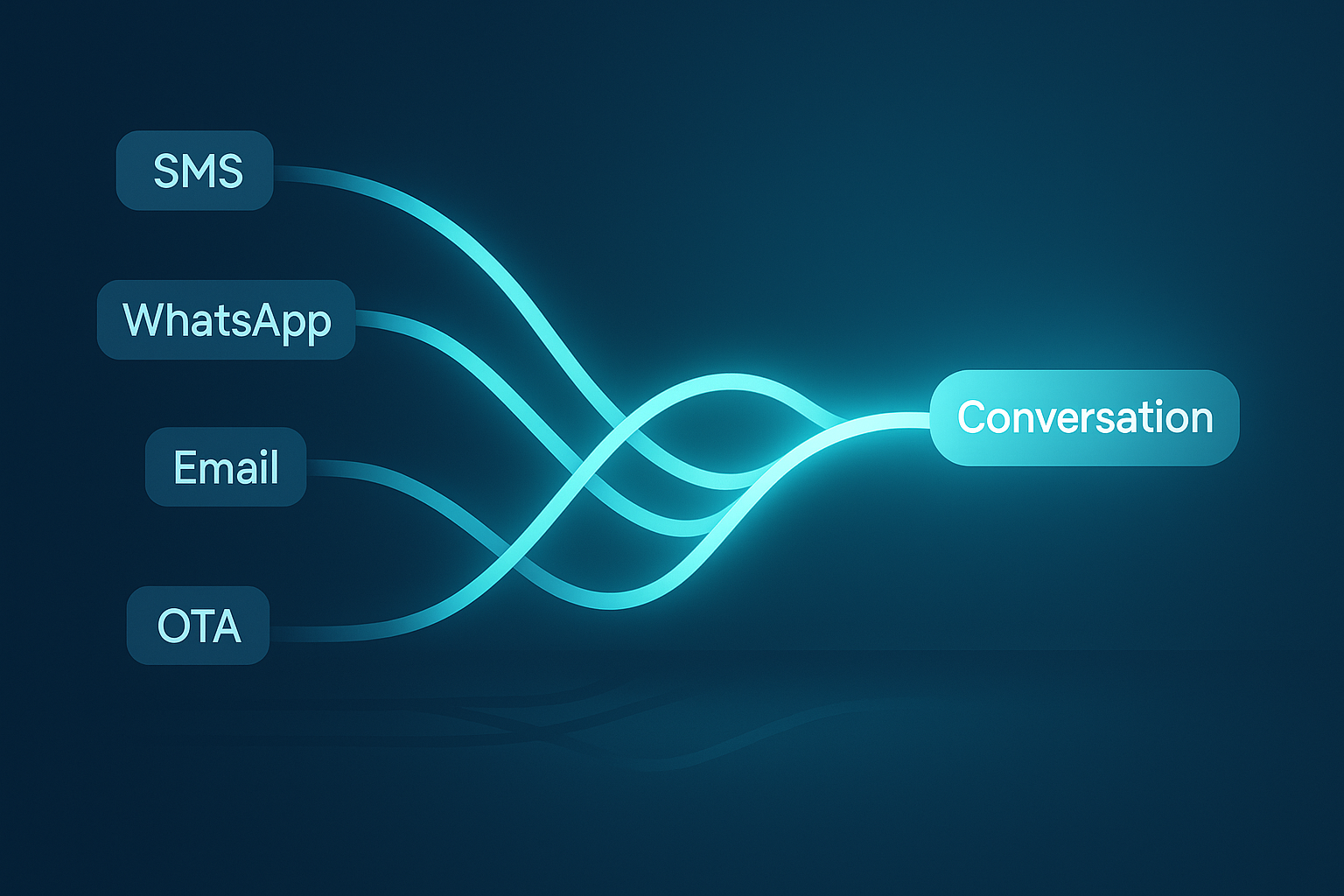
Effective hotel messaging platforms unify SMS, WhatsApp, email, and OTA communications into single conversation threads, eliminating the fragmentation that frustrates both guests and staff. This unified approach ensures context preservation regardless of which channel guests use to initiate or continue conversations.
Deep PMS integration synchronizes real-time room status, guest preferences, and booking details across all communication channels. When a guest texts about early check-in availability, the system instantly accesses current housekeeping status and provides accurate responses without staff lookup time.
Advanced AI and Automation
Modern AI messaging goes beyond scripted chatbots to deliver contextually aware responses that feel genuinely helpful. Natural language processing enables systems to understand intent behind guest questions, whether they’re asking about amenities, requesting services, or expressing concerns that require immediate escalation.
Workflow automation orchestrates communication across the entire guest journey. Pre-arrival sequences handle confirmation, special requests, and arrival instructions. On-property automation manages room service orders, housekeeping requests, and concierge services. Post-stay workflows facilitate feedback collection and future booking nurturing.
Sentiment analysis algorithms monitor conversation tone and automatically escalate potentially negative situations to human staff before they become complaints. This proactive approach enables service recovery while guests are still on-property, dramatically improving resolution outcomes.
Personalization & Revenue Optimization
AI-powered personalization analyzes guest history, preferences, and real-time behavior to deliver relevant offers at optimal moments. Rather than generic promotional blasts, smart messaging presents spa services to wellness-focused travelers or restaurant recommendations aligned with dietary preferences noted during booking.
Dynamic campaign scheduling maximizes engagement by sending messages when guests are most likely to respond positively. Analytics reveal that upsell offers sent 2-3 hours after check-in achieve 40-60% higher conversion rates than pre-arrival or late-evening communications.
Guest & Staff Experience Enhancement
App-free messaging through SMS and WhatsApp eliminates adoption barriers, with 85% of guests preferring text-based communication over downloading proprietary apps. Staff benefit from unified conversation histories that provide complete context for every guest interaction, eliminating the frustration of repeated explanations.
Two-way messaging capabilities enable real-time service recovery without front desk escalation. When guests report issues via messaging, staff can acknowledge, resolve, and follow up seamlessly, often converting potential complaints into positive experiences that drive loyalty.
Measurable Benefits: ROI, Efficiency, and Guest Satisfaction
Guest Experience & Loyalty Impact
Hotels implementing AI-powered hotel messaging systems report average NPS increases of 12-18 points within six months. Response time improvements from hours to seconds directly correlate with guest satisfaction, properties achieving sub-30-second response times see 23% higher review ratings compared to those relying solely on phone and email.
The speed advantage is transformative: AI messaging delivers responses in under 3 seconds, while manual processes average 15-45 minutes during peak periods. This responsiveness translates to measurable loyalty gains, with guests 40% more likely to book directly again when their previous stay included seamless messaging experiences.
Operational Streamlining & Cost Savings
Automation typically handles 60-80% of routine guest inquiries without human intervention, freeing staff for complex, high-value interactions. A 150-room boutique hotel averages 15-20 hours per week in time savings, equivalent to $12,000-18,000 annually in labor cost avoidance.
Efficiency Breakthrough: Properties using AI messaging report 40-50% reduction in phone call volume, with front desk staff redirecting energy toward personalized guest experiences that drive revenue and satisfaction.
The human-AI partnership model proves most effective, automation handles routine requests while staff focus on upselling, complaint resolution, and creating memorable moments that distinguish premium hospitality experiences.
Revenue Impact: Beyond Traditional Upselling
Targeted messaging campaigns generate 15-25% higher conversion rates than generic email marketing, with personalized offers sent at optimal moments (2-3 hours post-check-in) achieving 8-12% upsell acceptance rates. Properties report $25-40 additional revenue per room through messaging-driven ancillary sales.
Secure payment integration reduces booking friction, while automated confirmation and reminder sequences decrease no-shows by 20-35%. These operational improvements compound into significant revenue protection and growth opportunities that traditional communication methods cannot match.
Leading Hotel Messaging Platforms: 2025 Feature Analysis
Vynta AI – Comprehensive Hospitality Automation
Best for: Mid-market hotels seeking end-to-end guest experience automation with measurable ROI
Vynta AI delivers industry-specific AI agents that understand hospitality workflows, guest journey nuances, and revenue optimization opportunities. The platform combines advanced natural language processing with deep hospitality expertise, enabling personalized guest interactions that drive satisfaction and profitability.
Integration capabilities span major PMS systems, with implementation typically completed in 2-3 weeks. The platform’s strength lies in its outcome-focused approach, clients report average guest satisfaction improvements of 18% and operational efficiency gains of 25-30% within 90 days.
Canary Technologies – Guest Experience Platform
Best for: Hotels prioritizing contactless experiences with integrated payment processing
Canary’s strength centers on seamless check-in/check-out automation combined with secure payment integration. The platform excels at reducing front desk friction while maintaining personalization through AI-driven upsell recommendations.
Advantages:
- Strong contactless check-in capabilities
- Integrated secure payment processing
- Comprehensive PMS integration
Limitations:
- Higher implementation complexity
- Limited customization for unique property needs
Revinate Ivy – 24/7 AI Guest Agent
Best for: Properties requiring multilingual support with high automation rates
Revinate Ivy focuses on conversational AI with real-time translation capabilities, handling up to 60% of guest inquiries automatically. The platform integrates well with existing Revinate CRM systems, providing continuity for properties already using their marketing tools.
Advantages:
- Excellent multilingual support
- High automation success rates
- Strong brand voice customization
Limitations:
- Requires existing Revinate ecosystem for full value
- Limited revenue optimization features
| Platform | AI Automation Level | Channel Coverage | PMS Integration | Implementation Time | Best Fit |
|---|---|---|---|---|---|
| Vynta AI | Advanced contextual AI with hospitality-specific training | SMS, WhatsApp, Email, Web Chat | Universal compatibility | 2-3 weeks | ROI-focused mid-market properties |
| Canary Technologies | Moderate automation with payment focus | SMS, Email, In-app | Broad PMS support | 4-6 weeks | Contactless experience priority |
| Revinate Ivy | 60% query automation with translation | SMS, WhatsApp, Email | Revinate ecosystem preferred | 3-4 weeks | Multilingual properties |
| Cloudbeds | Workflow-based automation | Email, SMS, OTA messaging | Native Cloudbeds integration | 2-4 weeks | All-in-one PMS users |
Cloudbeds – All-in-One Property Management
Best for: Properties using Cloudbeds PMS seeking unified guest communication
Cloudbeds messaging integrates seamlessly with their property management ecosystem, providing workflow automation across reservations, housekeeping, and guest services. The platform excels at operational coordination but offers less sophisticated AI compared to specialized solutions.
Advantages:
- Native PMS integration eliminates data silos
- Unified operational dashboard
- Cost-effective for existing Cloudbeds users
Limitations:
- Limited AI sophistication for complex queries
- Restricted to Cloudbeds ecosystem
For a broader perspective on the evolution of digital communication in hospitality, see this recent study on AI-driven guest engagement.
Choosing Your Hotel Messaging Platform: Strategic Decision Framework
Property-Specific Needs Assessment
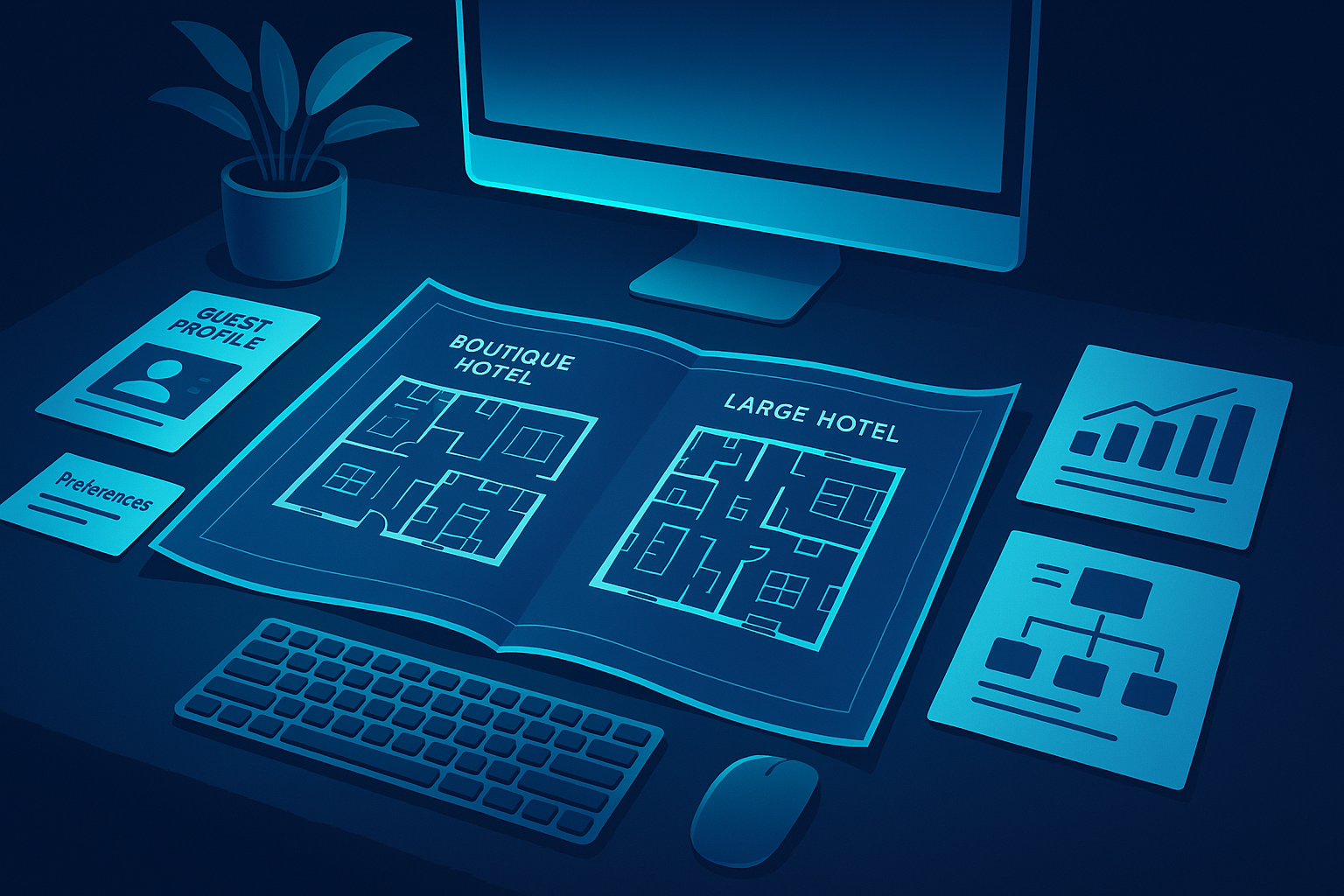
Property size and guest volume drive platform requirements. Boutique hotels (20-80 rooms) benefit most from personalization-focused solutions like Vynta AI, where individual guest recognition creates competitive advantage. Larger properties (100+ rooms) require scalable automation that maintains service quality across high message volumes.
Guest demographics significantly influence channel preferences. Business travelers favor SMS and WhatsApp for immediate responses, while leisure guests engage more with email sequences for pre-arrival planning and post-stay follow-up. International properties must prioritize multilingual capabilities and global messaging compliance.
Implementation Reality Check: Most hotel messaging platforms require 2-6 weeks for full deployment. Factor staff training, workflow adjustment, and guest communication about new channels into your timeline.
ROI Forecasting and Budget Planning
Calculate potential returns using three key metrics: labor cost reduction, revenue enhancement, and guest retention improvement. A 100-room property typically saves $15,000-25,000 annually in operational costs while generating $30,000-50,000 additional revenue through improved upselling and reduced no-shows.
Platform pricing varies significantly, from $200-500 monthly for basic automation to $2,000-5,000 for comprehensive AI solutions. Vynta AI’s outcome-based pricing model aligns costs with measurable results, reducing implementation risk while ensuring sustainable ROI.
Integration and Technical Considerations
PMS compatibility determines implementation complexity. Properties using major systems (Opera, Maestro, RoomKeyPMS) typically achieve faster integration, while custom or legacy systems may require additional development time.
Data security and compliance requirements vary by location and guest base. GDPR compliance is mandatory for European guests, while TCPA regulations govern SMS marketing in North America. Choose platforms with built-in compliance management to avoid regulatory complications.
For more on the broader context of the hospitality industry, including technology trends, see this overview.
Hotel Messaging Success Strategies: Proven Implementation Approaches
Strategic Message Sequencing Across Guest Touchpoints
Pre-arrival messaging begins 48-72 hours before check-in with personalized welcome messages including local recommendations and upgrade opportunities. Optimal timing for upselling occurs 2-4 hours post-check-in when guests have settled but remain open to enhancing their experience.
Post-stay sequences should launch within 24 hours of checkout, combining gratitude with review requests and future booking incentives. Properties achieving 40%+ email open rates time these messages for mid-morning when guests have returned to routine but retain positive stay memories.
Human-AI Partnership Excellence
Successful hotel messaging implementation requires staff buy-in and clear escalation protocols. AI handles routine inquiries, room service orders, housekeeping requests, basic information, while complex complaints, special requests, and VIP guest interactions route immediately to human agents.
Training programs should emphasize the importance of human-AI collaboration, ensuring staff understand when to intervene and how to leverage messaging data for personalized service. Ongoing feedback loops between staff and AI systems help refine automation rules and maintain a consistent brand voice across all guest interactions.
Regularly review messaging analytics to identify opportunities for further automation, service recovery, and upselling. Properties that continuously optimize their messaging workflows see sustained improvements in guest satisfaction, operational efficiency, and revenue per guest.
Frequently Asked Questions
Is it normal for a hotel to text you?
Yes, it is increasingly common for hotels to text guests as part of their communication strategy. Text messaging allows hotels to provide timely updates, personalized offers, and quick responses to guest inquiries, enhancing the overall guest experience.
How do you send a message to a hotel?
You can send a message to a hotel through various channels such as SMS, WhatsApp, email, or via the hotel’s app or website messaging system. Many hotels now offer AI-powered messaging platforms that ensure your message is received and responded to promptly, often within seconds.
What is a hotel messenger?
A hotel messenger is a digital communication platform or tool that enables real-time, multichannel messaging between guests and hotel staff. These systems often use AI to automate responses, manage guest requests, and support personalized upselling, improving both operational efficiency and guest satisfaction.
About The Author
Anas Moujahid is the chief contributing writer & Operations Director for the Vynta AI Blog, where he turns cutting-edge AI automation into measurable business outcomes for mid-market companies.
Vynta AI designs enterprise-grade AI agents that augment rather than replace people, freeing teams to focus on higher-value work while the bots handle the busywork.
We specialise in four service-heavy verticals where AI can move the revenue needle fast: real estate, recruitment, fundraising and hospitality.
Anas started his career architecting AI and automation systems; today he leads operations at Vynta AI, making sure every deployment lands real-world ROI, whether that’s more booked viewings for estate agents, faster placements for recruiters, warmer investor pipelines for fundraisers or happier guests for hotels and restaurants.
Vynta AI delivers results by:
- Building industry-specific agents pre-trained on real-world workflows, no generic chatbots here.
- Integrating seamlessly with existing CRMs, ATSs, PMSs and fundraising platforms, zero rip-and-replace.
- Measuring success in business KPIs (lead-to-close rates, time-to-hire, donor retention, RevPAR) not vanity metrics.
- Providing transparent implementation plans so clients know exactly what to expect, when and why.
- Pairing every AI agent with human-in-the-loop controls to keep quality, compliance and brand voice on point.
Since launch, Vynta AI has helped agencies slash lead qualification time by up to 70 %, recruitment firms cut screening hours in half, fundraising teams triple investor touchpoints and hospitality brands lift guest satisfaction scores by double digits, all while keeping human expertise firmly in the loop.
Anas writes with the same ethos that drives Vynta AI: outcome-focused, jargon-free and grounded in real business value. Expect data-backed insights, practical implementation guides and a clear-eyed view of what AI can, and can’t, do for your organisation.